


1. Background
Today, developing countries, including Iran, are facing the challenge of retaining healthcare professionals to continue the provision of health care services and improving the quality of services. Young physicians are expected to replace doctors who are retiring, but due to the insufficiency of conditions in the health sector, they prefer to migrate. Regarding the future population growth of the country, maintaining skilled physicians is essential to meet the increasing health needs of the community as well as providing adequate health services at all levels nationwide (1, 2). A hidden side effect of physicians’ migration is the freelance transfer of elite genes from developing countries to developed countries. In Iran, the most talented students are chosen to attend medical schools. Asadi et al. (3) reported that the frequency of immigration among Iranian health professionals is 54.77%, even though students are bond to upon graduation serve in medical professions at least equal to the length of their medical course. Few developed countries, such as Australia, Japan, Canada, and Germany (4), have implemented such regulations for medical education.
National structural constraints, along with problems in developing countries, are the main reason for the “departure of the physicians and elites’ non-return”. To reduce the migration of physicians, the administrative bodies of medical systems of developed countries pay special attention to the issues of physicians, such as continuous education, creating employment opportunities, job security, and welfare. While, in developing countries, a host of scientific, economical, technological, and political problems as well as lack of advanced research facilities, welfare, and the inability of the community to use physicians’ expertise, stimulates the physicians to leave their homeland (3, 5). For example, in Pakistan, low salaries and benefits, poor quality of education, job dissatisfaction, lifestyle, lack of job opportunities, working environment problems, terrorism, social harassment, management weakness, colleagues’ pressure, long hours of work, and religious and political variables are the main barriers for retention of physicians (6, 7). Chang (cited in Nokarazi) reported that “the critical conditions and UN sanctions in Iraq have led to the extensive migration of several skilled human resources, including physicians and highly specialized engineers” (5).
Kizito et al. (8) investigated the problems of Ugandan doctors that stimulate them to migrate and reported the lack of equipment and resources in hospitals, high working load, highly dangerous work environment, low salaries and benefits, and political reasons as the main reasons. While the country needs its trained physicians, they are abandoning the country.
Developing societies need skilled health professionals to maintain and improve their health, and motivating them to stay through providing the tools they need to work, the educational opportunities, the support for their colleagues’ network, and the recognition of their difficult work facilitate achieving this goal. The presence of an intellectual leader and the activation of a scientific-national community with the help of citizens abroad will make the coherent development of scientific and technological capacities in developing countries more, which will be mutually beneficial (for both educated people and the country) (3, 9).
Two types of financial incentives and supervisory measures are needed to stimulate doctors (4). Talent management strategies at the individual level, include the availability of job opportunities, the nature of the work environment, training chances, compensation of damage, and providing benefits (10), Flexible working hours, and reduced working hours (11-13). Interventions such as financial rewards, professional development, continuous education, improving hospital infrastructure, availability of resources, hospital management, and appreciation are among the most important components of maintaining health professionals (5-8). Undoubtedly, Motivational factors vary according to culture and circumstances in each country, financial incentives, professional development, and management issues are the most important influential factors. However, sole financial incentives are not enough to motivate health workers. Clearly, recognizing the motivation methods of health professionals and improving infrastructure can dramatically improve their morale.
Simoens et al. (cited in Schultz and Rijks) reported that motivating physicians who work outside of their careers to return to work in health care is a cheaper approach compared to training new health professionals. Implementing new policies such as reducing work stress, redesigning jobs, flexible working hours, managing relationships, and reducing the workload of doctors can make working more attractive and optimize human resources (14).
Willis-Shattuck et al. (15) mentioned financial rewards, professional development, continuous education, hospital infrastructure, availability of resources, hospital management, and recognition/appreciation as factors that stimulate health professionals to stay. Health tourism and tourist therapy can also increase doctors’ salaries.
Nentwich et al. (16) mentioned to good working conditions, commitment to providing service, more education, family relationships and general satisfaction, professional progress, and better income, and good infrastructure, equipment, and consumables. Varhagen and Cornuel (17) reported seven elements of university culture, reputation and position of the university, the process of recruitment, professional development, the educational environment, the research atmosphere, and the work environment. Phillips and Rapper (18) mentioned the opportunity to learn and grow, test new cases, brand index and university reputation, being a model in the academic network (19), payment system, welfare facilities, performance appraisal, and job promotion (20), supportive behaviors of managers and empowerment of doctors (21) as the most important factors that influence doctors to stay in the country and affect the survival of human resources in the health sector.
To achieve sustainable development in the health sector, Iran needs to train and maintain doctors. But young doctors have different expectations from managers due to their different mental frameworks and mental contexts. Doctors immigrate in the hope of gaining experience, which can be met with scientific progress, high wages, dignity, and social welfare, freedom of thought and access to newer scientific resources, better career opportunities, and professional development (5). The elites and medical graduates in Iran have many ideas that can guarantee the progress and scientific development of the country’s health, but because of the lack of government support, their creative ideas never happen. Another issue that has wandered Iranian doctors is “job hope”. It’s a pity that we train elite human resources of the country with a great expense, but easily put them to Western countries to continue their studies in specialized fields or employment without any hope for their return, and this has a great impact on the health sector, non-optimal use of doctors, and health indicators. In the meantime, the developed countries welcome the elites of other countries because of their needs, and they welcome them merely by relying on their attractive social systems, which is a kind of meritocracy to them, without any expense for their training. The expectations of physicians can be met by developing precise policies and consequently providing the basis for sustainable development in the health sector.
2. Objectives
Based on what is mentioned above, the current study aimed to provide an optimal model for maintaining elites and medical graduates in Iran.
3. Methods
This is a mixed-method study that was conducted based on the sequential exploratory strategy. First, a qualitative phase was done using thematic analysis based on the inductive approach in 2018. To collect data, 17 faculty members of Shiraz University of Medical Sciences (SUMS) and 19 former graduates who returned back to Iran were interviewed using a semi-structured framework. Interviews were conducted after obtaining official permissions and the interviewees’ willingness to participate. Inclusion criteria were having at least 10 years of job experience, full-time collaboration as a faculty member of the SUMS, experience of study and employment outside of Iran, cooperation with the International Department of SUMS, and voluntary return to Iran (for former graduates who returned back to Iran). In total, 36 interviews were conducted.
Each interview lasted 60 to 120 minutes. All interviews were recorded and transcribed. Thematic analysis is an appropriate way to achieve reliable and valid results from textual data. For this reason, qualitative data were analyzed using this method. The transcripts were first carefully read, and the keywords were extracted. Then, themes were extracted, and a meaningful relationship was established between the themes and the categories, and the final agreement was reached among the research team.
Seven hundred and thirty nine initial themes were extracted, which then were extracted several times by reviewing and categorizing similar themes and revising 60 themes around the base theme.
In this study, purposive sampling method with maximum diversity has been used and with 36 interviews, we reached theoretical saturation. To confirm the validity of the extracted themes, the four criteria presented by Guba and Lincoln (22) were used (i.e., credibility, transferability, dependability, and confirm ability); and using different strategies such as purposeful sampling technique, interviewing various participants, spending long-time on data and frequent reviewing of data, reviewing the codes by two independent researchers, using special coding, and reviewing procedures by two external referees. The reliability was estimated at 0.89 via the Holistic coefficient. In the quantitative section, a researcher-made questionnaire (60 questions) with a four-point Likert scale was developed, and its validity was authenticated by 15 experts in the management fields. By using the content validity ratio (CVR) table, questions with a CVR < 0.49 were omitted, and reliability (with Cronbach’s alpha = 0.93) was tested and verified.
The statistical population of this study was all junior medical assistants of SUMS (283 students), which were sampled according to Morgan table (163). In addition to the Morgan table, Mundfrom (23) proposed that the minimum recommended sample size is 3 to 20 times the number of variables (an absolute range from 100 to more than 1000). 200 questionnaires were distributed; that 158 questionnaires were returned.
According to the advice of statistical experts, 158 completed questionnaires were sufficient for this study. Therefore, sampling was stopped. Confirmatory factor analysis was used to analyze the data by using Mplus version 7.4 and SPSS software.
4. Results
In total 36 interviews were performed (14 females and 22 males with a PhD and specialist degrees). Thirty two of interviewees were married. In the qualitative section, thematic data were extracted from the transcripts of the interviews. The obtained data were analyzed using the thematic analysis, then were clustered in three categories: basic, organizing, and global themes, and a thematic network was organized (code: ATTRIDE-STIRLING MODEL).
Regarding the theme of “inclusive physician retention”‘, 60 basic themes and 9 organizing themes were extracted, including: “improving international interactions”, “dynamic administrative rules”, “supportive managers”, “dynamic work environment”, “enriching occupational experiences”, “dynamic learning”, “dynamic research”, “improving socio-cultural infrastructure”, “work and life balance”, and one global theme (Figure 1).
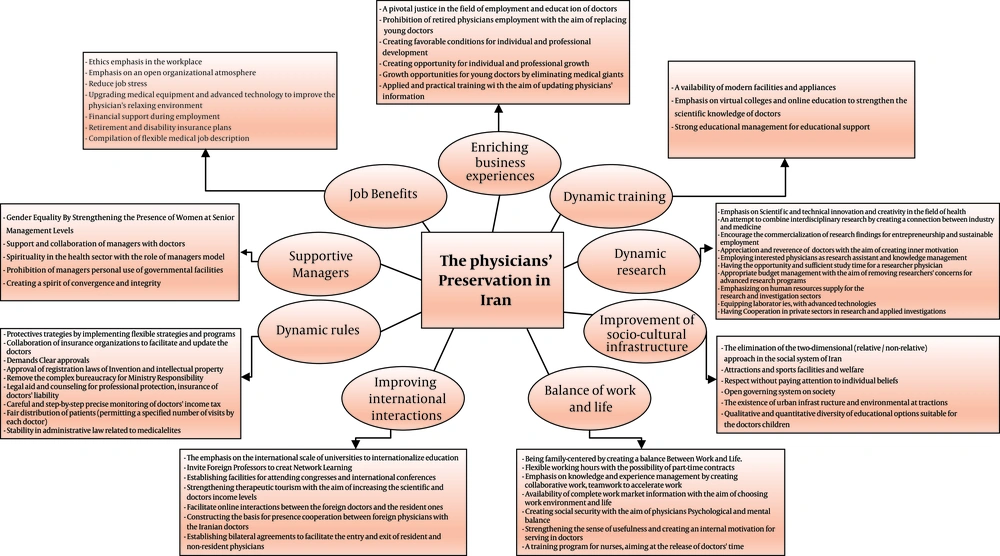
Figure 1.
Native physicians retention components in the Iranian Health System
In the quantitative section, 158 questionnaires (43 women, 55 men, and 60 unspecified) were filled. The estimated values in Table 1 (factor load, critical values) indicate that the factor loads referring to the basic theme are good representatives of the status.
Table 1.Estimated Factor load, SE Critical amount, with P < 0.001 of Basic Themes of Inclusive to Keep Physicians in Iran
| Organizing Themes | Basic Themes | Estimate Factor Load | S.E Critical Amount |
|---|---|---|---|
| Improving international interactions | The emphasis on the international scale of universities to internationalize education | 0.57 | 0.06 |
| Invite foreign professors to create network learning | 0.70 | 0.05 | |
| Providing necessary facilities for attending international congresses and conferences | 0.72 | 0.04 | |
| Strengthening medical tourism with the aim of increasing the scientific and physicians’ income levels | 0.80 | 0.03 | |
| Facilitating online interactions with foreign physicians and residents | 0.81 | 0.04 | |
| Constructing the basis for cooperation between foreign physicians and their Iranian counterparts | 0.66 | 0.05 | |
| Singing bilateral agreements to facilitate international travels of resident and non-resident physicians | 0.73 | 0.05 | |
| Dynamic rules | Protective strategies by implementing flexible strategies and programs | 0.66 | 0.06 |
| Collaboration with insurance organizations to facilitate and update the doctors’ demands | 0.62 | 0.06 | |
| Clear approvals | 0.66 | 0.05 | |
| Approval of registration laws on invention and intellectual property | 0.69 | 0.05 | |
| Eliminate complex bureaucracy with the aim of holding the ministry accountable (organization) | 0.64 | 0.05 | |
| Legal aid and counseling for professional protection, liability insurance for physicians’ | 0.67 | 0.05 | |
| Careful and step-by-step precise monitoring of doctors’ income tax | 0.42 | 0.08 | |
| Fair distribution of patients (limiting the number of visits by each physician) | 0.44 | 0.07 | |
| Stability in administrative law related to the medical elites | 0.58 | 0.05 | |
| Supportive Managers | Improving gender equality by strengthening the presence of women at senior management levels | 0.60 | 0.07 |
| Support and collaboration of managers and physicians | 0.66 | 0.06 | |
| Strengthening spirituality in the health sector by using the role of managers’ model | 0.60 | 0.06 | |
| Prohibiting managers from personal use of governmental facilities | 0.48 | 0.07 | |
| creating a spirit of convergence and integrity | 0.76 | 0.05 | |
| Job Benefits | Emphasis on respect, ethical commitment and honesty in the workplace | 0.59 | 0.07 |
| Emphasis on an open organizational atmosphere | 0.70 | 0.05 | |
| reducing job stress | 0.76 | 0.04 | |
| Upgrading medical equipment and advanced technology to improve the physician’s relaxing environment | 0.66 | 0.06 | |
| Financial support during employment | 0.62 | 0.06 | |
| retirement and disability insurance plans | 0.55 | 0.07 | |
| Compilation of flexible medical job description | 0.69 | 0.06 | |
| Enriching business experiences | A pivotal justice in the field of employment and education of doctors | 0.56 | 0.07 |
| Prohibiting employment of retired physicians to replace them with young physicians | 0.41 | 0.08 | |
| Creating favorable conditions for individual and professional development | 0.79 | 0.04 | |
| Creating opportunities for individual and professional growth | 0.77 | 0.04 | |
| Growth opportunities for young physicians by eliminating doctors who have a false reputation | 0.73 | 0.04 | |
| applied and practical training to update physicians’ information | 0.79 | 0.03 | |
| Dynamic training | Availability of modern facilities and appliances | 0.76 | 0.07 |
| Emphasis on virtual colleges and online education to strengthen the scientific knowledge of physicians | 0.73 | 0.06 | |
| Strong educational management for educational support | 0.91 | 0.05 | |
| Dynamic research | Emphasis on scientific and technical innovation and creativity in the field of health | 0.83 | 0.04 |
| Trying to combine interdisciplinary research by creating a connection between industry and medicine | 0.76 | 0.04 | |
| Encouraging commercialization of research findings for entrepreneurship and sustainable employment | 0.80 | 0.04 | |
| Appreciation and reverence of physicians to create inner motivation | 0.77 | 0.05 | |
| Employing interested physicians as research assistants and knowledge management | 0.80 | 0.04 | |
| Having the opportunity and sufficient study time for those physicians who do research | 0.79 | 0.04 | |
| appropriate budget management to remove researchers’ concerns for advanced research programs | 0.76 | 0.05 | |
| Emphasizing on human resources supply for the research and investigation sectors | 0.77 | 0.04 | |
| Equipping laboratories with advanced technologies | 0.82 | 0.04 | |
| Cooperation with the private sector in research and applied investigations | 0.72 | 0.05 | |
| Improvement of socio-cultural infrastructure | Elimination of the two-dimensional (relative/non-relative) approach of the social system of the country | 0.50 | 0.07 |
| Providing entertainment and sport facilities | 0.77 | 0.06 | |
| Respect regardless of individuals’ beliefs | 0.62 | 0.07 | |
| Using an open governing system | 0.58 | 0.08 | |
| Creating urban infrastructure and environmental attractions | 0.67 | 0.06 | |
| Qualitative and quantitative diversity of educational options based on the needs of physicians’ children | 0.62 | 0.06 | |
| Balance of work and life | Being family-centered by creating a balance between work and life. | 0.76 | 0.05 |
| Flexible working hours with the possibility of part-time contracts | 0.86 | 0.03 | |
| Emphasis on knowledge and experience management by creating a collaborative work environment, teamwork, and accelerating activities | 0.76 | 0.03 | |
| Availability of a database on the work market to facilitate choosing a work environment and life | 0.86 | 0.03 | |
| Creating social security to help physicians to achieve psychological and mental balance | 0.60 | 0.05 | |
| Strengthening the sense of usefulness and creating an internal motivation for serving in physicians | 0.77 | 0.04 | |
| A training program for nurses aimed to release physicians’ time | 0.73 | 0.05 |
In other words, the correlation of sub-concepts with the references related to these themes has been estimated at a high level. Hence, the instrument of validation has a necessary confirmatory factor.
The results of the quantitative section showed that the theme of a strong educational management base for educational support had the highest explanatory power to the physicians’ preservation model (Table 1).
Strong educational management for educational support with a factor load of 0.91, flexible working hours with the possibility of part-time contracts with a Factor load of 0.86, Availability of complete work market information to choose a work environment, life with a factor load of 0.86, emphasis on scientific and technical innovation and creativity in the field of health with a factor load of 0.83, equipping laboratories with advanced technologies with a factor load of 0.82, facilitate online interactions between the foreign physicians and the resident ones with a factor load of 0.81 had the highest explanatory power among all extracted themes.
5. Discussion
The current study, which used a mixed-method approach, aimed to identify methods of preserving physicians in Iran in 2018. Iranian health system is faced with a shortage of human resources, meanwhile annually, its experts migrate from the country. Thus, this research was conducted using a new approach and a thematic analysis method, by preparing a researcher-made questionnaire. The qualitative results are presented in I. I. The quantitative analyses revealed that an effective and strong educational management for educational support with a factor load of 0.91 is the most important component of the retention of physicians. The most important reason for the immigration of physicians is better learning opportunities. Low quality of education has a negative effect on maintaining young physicians. Due to the characteristics of the medical profession, they should be up-to-date and receive timely training, which requires online and virtual training so that new medical advances can quickly be shared among practicing physicians. A young physician who is interested in new knowledge is faced with educational limitations due to US economic sanctions, national religious and cultural beliefs, such as (the lack of corpse for anatomical description), and medical observation. These findings are consistent with previous research (6, 7, 10, 16, 17). Thus, the dynamic training of physicians requires updating educational facilities and emphasizing on virtual learning and the use of relevant films and updated medical books with 3D images. And above all, qualified and experienced medical professors who can manage teaching (for example, filming of the corpse in the first presentation by expert professors) or culture-building to incentivize the society to donate corpses for the teaching and training of young physicians.
The two main themes (i.e., “flexible working hours with the possibility of part-time contracts” and “availability of complete work market information to choose work environment and life (0.86)” were identified as the theme of balance of work and life in the second phase. Consequently, by adopting a series of measures such as being family-centered, flexible working hours, sharing of knowledge and experience and teamwork, the availability of complete work market information, social security, enhancing the sense of usefulness and providing internal motivation, a training program for nurses which aims to release physicians’ time all will result in the balance of work and psychological and mental relaxation of physicians. It is consistent with the results of Hartmannbund (2012) in Germany, Saarma et al. (2012) in Canada, and Buddeberg-Fischer et al. (2008) (Cited in Ono et al.) in Switzerland. They emphasized that teamwork practices in hospitals and treatment centers can reduce the workload, improve sharing resources, and better collaboration with colleagues (2). Therefore, the culture of sharing experiences and knowledge and teamwork should be institutionalized. Today, young doctors are interested in working less than older doctors, and by providing flexible work and working market availability, they can be motivated to stay in the country, which is consistent with the research results (11-13).
The emphasis on scientific and technical innovation and creativity in the field of health (0.83) and equipping laboratories with advanced technologies (0.82) reflect the theme of Dynamic research as the next solution to preserve doctors. It is in line with previous studies (5, 17, 18). Due to some problems, such as the high accident rate in Iran, transplantation and surgical operations are higher than developed countries, this threat and other bitter events have become an opportunity, and the experiences of Iranian physicians in some surgical procedures and intrinsic links are remarkable, which requires more collaboration and investment of both private and public sectors and more interaction of the industry and engineering sectors with researcher-physicians. Hence, with grateful acknowledgment from researcher-physicians, attracting physicians who are interested in research activities as an assistant in research and knowledge management projects, cross-disciplinary integration of research and commercialization of research findings, time management, proper management of the budget to remove researcher’s concerns, emphasizing on providing human resources, equipping laboratories, researchers can be motivated to stay in the country and make further efforts. The most important need of doctors is appreciation and reverence of valuable services and boarding efforts in the field of research and investigation. A researcher who devotes his/her time to research in the health sector does not expect anything unless being appreciated for his/her boarding efforts. Maslow’s pyramid refers to this component in the hierarchy of needs. Iran’s scientific relationship with advanced countries in the field of science and research is a two-way relationship, so that developed countries with constructive interactions can benefit from the experience of the Iranian experts.
Facilitating online international interactions with other physicians and residents (0.81) reflects the theme of improving international interactions at the next level. Today, the internet is a huge contributor to the growth of knowledge. Diaspora network and close relationships with non-resident physicians can be sources of growth in the health sector, which is in line with previous research (24, 25). Doctors also ask to invite more prominent medical scholars for short and long-term periods. They stated that more effort is needed to hold scientific medial conferences. Granting facilities to hold congresses and international conferences can be a source of scientific growth. Allocating governmental budgets and facilities, such as training vacations and educational missions, can be helpful and encouraging for the maintenance of elite physicians. Making efforts to increase the international credibility of universities, providing chances for international cooperation with foreign doctors, strengthening medical tourism to increase doctors’ scientific and income levels, signing bilateral agreements to facilitate international travel of resident and non-resident physicians are among suggestions for preserving doctors.
The four themes equipping laboratories with advanced technologies (0.82), encourage the commercialization of research findings for entrepreneurship and sustainable employment (0.80), employing interested physicians as a research assistant and knowledge management (0.80), and strengthening medical tourism to increase the scientific and income levels of physicians (0.80) were the results of the quantitative section of the research that should be addressed by policymakers and health planners. The important thing to keep in mind about the preservation of doctors in the country, particularly young ones, is the support and collaboration of managers with young doctors. The existence of a spirit of convergence and integration in the organization and being a model as a manager are of crucial importance. When a young doctor sees hospital parking as a lacquer car showroom in the capital city (Tehran), when the specialization culture prevails in the community, and the office of the old doctors is busy, and they visit a lot of patients, while young doctors are not able to pay their offices’ costs, they are no longer motivated to stay in the country. When it comes to the personal use of managers from state facilities, and he sees gender inequality at senior management levels, he will lose his motivation to stay in the country.
Hence, it is recommended that the health sector managers being a role model and emphasize on respect, ethical commitment, integrity, and open organizational atmosphere, creating job security, providing up-to-date medical equipment and advanced technology in the workplace, retirement, and disability insurance plans, compilation of flexible medical job description, the pivotal justice, the prohibition of the use of retired physicians to replacing them with young doctors, eliminating doctors who have a false reputation and fair distribution of patients, and culture-building to increase referrals to family physicians and participating and continuous education to update the information of physicians, motivates young doctors to stay in the country and the health sector, and to improve the health level of the country. It is also consistent with previous research (5-8).
5.1. Conclusions
According to the results, a variety of variables affect physicians’ retention in Iran. The effective and strong medical education administration as educational support, flexible working hours, Availability of a database on the work market, and emphasis and attention to creativity and scientific and research innovations in the medical field had the most distinctive strength on physicians’ retention among physicians affiliated to the SUMS. It is suggested that the findings of the current study be taken into consideration by educational planners and policymakers. Responsiveness to the personal and organizational needs of physicians can be effective in preserving and protecting these valuable human capital by improving and implementing timely and correct domestic and foreign policies.
5.2. Strength and Limitation
One of the strengths of qualitative studies is that such studies open new avenues for the researcher, and the researcher is aware of the opinions of the participants.
One of the problems of qualitative studies is the difficulty of coordinating interviews, and the interviewees do not share their opinions because of some personal and professional reasons. Gaining their trust is a difficult task. Some interviewees did not permit to record the interview.


