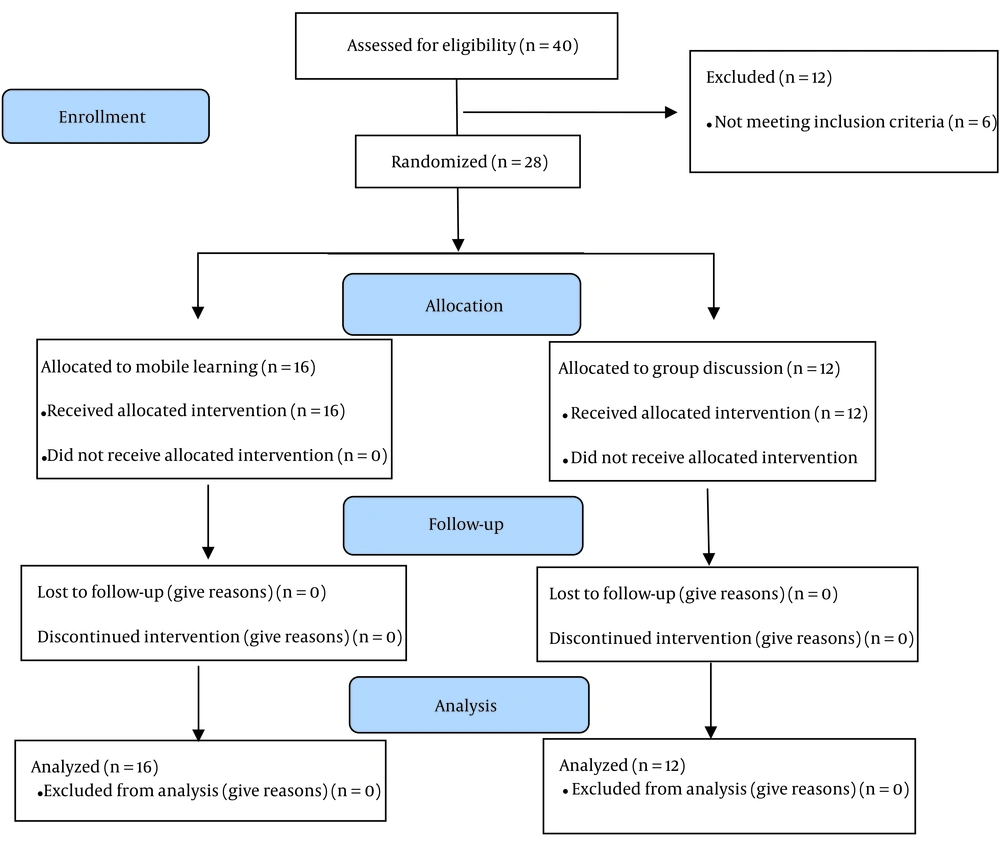
This study aimed to compare the effects of psychotropic drug education using group discussion and mobile learning on nursing students’ learning, satisfaction, and attitude at Shiraz University of Medical Sciences. The results demonstrated an increase in the 2 groups' scores of learning and satisfaction with the instruction method after the intervention compared to baseline. Although the mobile learning group's satisfaction score was higher than that of the discussion group, the difference was not statistically significant after ANCOVA. The results also revealed a significant difference in the mobile learning group’s score of attitudes after the intervention compared to before that. These results were consistent with those of numerous investigations, for instance, a study on using mobile phones for triage indicators among emergency nurses in 2018; the results demonstrated a significant increase in knowledge scores after the intervention compared to baseline (
25). Another study investigated the impacts of using educational booklets and interactive multimedia using CDs on the prevention of osteoporosis among female students. The results revealed a significant increase in both groups' learning scores after the intervention compared to baseline (
26). Similarly, 1 study compared the lecture method, electronic learning, and conceptual map on pediatric nursing education and came to the conclusion that all 3 methods were effective in the promotion of the students' knowledge and learning (
13). Another compared the effects of anatomy instruction via mobile phone and lecture methods. The findings indicated an increase in both groups’ learning scores after the training compared to baseline (
27). In the present study, no significant differences were found between the 2 instruction methods with regard to changes in learning scores. These results are consistent with those of some other studies. Zarshenas et al reported no significant differences in learning scores between the interactive multimedia method and educational booklet (
26). Another disclosed that cardiac patients’ self-care training via computer and brochure caused an increase in knowledge scores in both study groups, but the difference between the 2 groups was not statistically significant (
28). However, contradictory results were obtained in some other studies. For instance, comparing the effects of health education using mobile phone- and web-based discussion, it was reported that group discussion based on mobile phones provided more valuable opportunities for self-education, educational motivation, and interaction between the learners and the learning process (
29). Similarly, 1 study compared the effects of lecturing, problem-solving, and self-education through a computer on BSc nursing students’ drug calculation skills in the intensive care course. The results indicated that all 3 methods were significantly correlated to the students’ learning levels, but self-education through computer was less effective compared to the other 2 methods (
30). Some studies showed that if the instructional design is standard, appropriate, and meticulous, there will be no significant differences in students’ learning (
31), but at the same time, lack of differences between the 2 groups’ learning scores in the present study could be attributed to the advantages and disadvantage of the 2 instruction methods. The main strong points of education using mobile phones include lightness, small size, and portability of the educational device, accessibility to education at any time and place, flexible learning, application of multimedia techniques regardless of time and place, and provision of valuable learning opportunities at both dynamic and static times. On the other hand, the main disadvantages of this method include lack of face-to-face relationships, lack of concentration at the time of learning due to the attractiveness of mobile phones, lack of network coverage in some regions, learners' inability to organize the learning process, lack of technical and support infrastructures, lack of educational standards for changing traditional materials into the electronic format, and mobile phones' small LCDs and keyboards (
32-
35). Moreover, the main strong points of learning through group discussion include information exchange, ability to learn complicated materials, empowerment of reasoning, ability to evaluate viewpoints and make the best decisions, improvement of communication skills, and increasing learners' self-confidence. On the other hand, one of the limitations of this method is that a longer period of time is required for education because of the need for logical discussions among students, while a specific time is dedicated to educational plans in universities' curricula. Thus, students may not gain great benefits from this method. Additionally, group discussion requires the instructor to manage the groups quite effectively. In case of instructor's inefficiency, this method may not be accompanied by high success rates. Moreover, this method is not appropriate for large groups and meetings (
10). In the current study, the results of the paired
t-test showed an increase in the 2 groups' scores of satisfaction with the instruction methods after the intervention compared to baseline. The results of the independent
t-test also revealed that the satisfaction score with the instruction method was significantly higher in the mobile learning group compared to the discussion group. These results are consistent with some other studies (
36-
39). The software used in the current study benefitted from repeatability, visual and audio attractions, videos, animations, possibility to use the written format, and summary of the materials, which were effective in the students’ high satisfaction levels. However, the results are in contrast to those of some other studies, including the one that evaluated the impact of education using mobile phones on nursing students' knowledge, skills, and self-confidence at the time of caregiving (
40) or one which reported no significant differences between the intervention and control groups regarding the rate of satisfaction, which was attributed to the small sample size, as well as the students’ inability to respond to E-mails due to large loads of homework (
41), Similarly, 1 study compared the effects of traditional and novel instruction methods on dental students’ knowledge and attitude and found no significant differences between the 2 groups with respect to satisfaction with the instruction method. Based on their perspective, this finding resulted from the novelty of the multimedia educational method (
42). One research developed electronic learning for nurses. The results indicated no significant differences between the intervention and control groups, which was ascribed to the small sample size, as well as the loss of some participants due to limitations in the location of using computer facilities (
43). All the above-mentioned studies showed no significant differences between the intervention and control groups. Students' interest in traditional lecture methods, internet and mobile phone limitations, and bandwidth limitations could also play a pivotal role in learners’ dissatisfaction.
The results of the paired
t-test revealed a significant increase in the mobile learning group's attitude scores after the intervention compared to the baseline. These results are consistent with those obtained in some other studies (
22,
35,
44-
47). However, contradictory results were obtained by other studies (
41,
48). The controversy among the results could result from the advantages and disadvantages attributed to each of the educational methods. The main advantages included interaction, accessibility, high motivation, cooperative learning, and flexibility. On the other hand, low transfer speed, bandwidth limitations, limited memory space, low internet speed for downloading images, videos, and animations, small LCD and keyboard, and relatively high cost were mentioned as the main disadvantages of mobile phones (
35).