
1. Background
The year 2020 was spent with the deadly coronavirus, which has threatened our existence and disrupted our daily lives. The virus may change our whole life, but it forced us to find other sources to cope with our lives. Virtual classes will be a new norm for our educational institutions. Online courses are gradually accelerating. There comes a time when a full degree is awarded to students without attending university or college (1).
Distance education is believed to be as effective in higher education as traditional education (2). The use of technology in distance education can help cross the borders of space and time for lifelong learning (3, 4). Many academic institutions invest heavily in technology-based classes to adapt to the new generation of students whose technology is an important part of their lives (5). Active learning is defined as any instructional method that engages students in the learning process (6). Tools such as mobile devices and applications or “apps” can help engage students and improve learning (7). Therefore, one of the most effective tools for active learning is using a mobile device (8).
Diabetes is a progressive and chronic disorder that has become a major health problem worldwide, especially in developing countries (9, 10). Medical students should be well educated to prevent possible misdiagnosis that may lead to the patient's death in the future (11).
Medical students use mobile devices in their daily activities (12). There are about 3.8 billion mobile users worldwide (13). Mobile learning (m-learning) is becoming a new method in the field of medical education (12). It is defined as the use of wireless small and portable devices, such as cell phones, smartphones, personal digital assistants, tablets, and personal computers, for communication and educational purposes (14).
With the advent of mobile technologies, educators can adapt their traditional teaching methods to the 21st century digital learning environment (7). Mobile technologies, without time and space constraints, can increase students' enthusiasm for learning and provide the opportunity to learn in dead and dynamic times. Other benefits include accuracy and ease of teaching, 24-hour teaching, the reduced workload of the face-to-face education system, and reduced face-to-face education costs (15-17). Most users of m-learning are higher education students (18). Many medical students and educators use mobile technologies in education and have a good attitude toward using m-learning (19, 20), and have the potential to develop medical education (21).
2. Objectives
Here, we need to prove the effectiveness of using mobile educational applications in the education process so that in the future, this method can be used to promote not only medical education but also other fields. The purpose of our study was to investigate the effectiveness of learning diabetes educational content through a mobile-based app in medical students of the Abadan University of Medical Sciences during the coronavirus disease 2019 (COVID-19) pandemic.
3. Methods
In the present descriptive study, an educational mobile app for diabetes, including the information modules, as well as educational videos made by the researchers of this study, was designed for 32 medical students of Abadan University of Medical Sciences who had endocrine physiology courses in the first semester of the academic year 2019-2021 during the COVID-19 pandemic. This educational application, along with other virtual teaching methods, was provided to students through links as well as the Navid Learning Management System (LMS). The structure of the pancreas, a history of diabetes, familiarity with diabetes, types of diabetes, risk factors, complications, diagnosis and treatment, calorie intake, diabetes and lifestyle, and diabetes and exercise were some of these modules.
3.1. App Preparation
The research team designed and produced the content of the diabetes application by purchasing the 'JoApp' App Builder produced by Sepahan Data Tools Company. The application was purchased by researchers and designed and developed by the application developer. This application is powered by the Java language:
- App Name: Diabetes
- Package Name: ir.abadan.diabetes
- Version: V1.0
- Size: 78 MG
- Category: Educational
- The execution environment: Android
- Language: Persian
To prepare the content for the application, the categories were first defined, and after reading many articles and simplifying the content, we drew a mind map, based on which we included the educational content in the sub-categories defined in a language understandable to the students and general population.
We tried to use pictures and infographics as much as possible to understand more in less time. To increase the attractiveness of the application, educational videos made with different animation software were produced by the researchers, and some of them were included inside the app. The rest of the educational videos were included in Aparat, the video-sharing service, to prevent the increase in the size of app and were constantly updated. This application was developed by the research team, and all property rights belong to the research team.
A researcher-made questionnaire consisting of three parts was prepared. The first part was about the purpose of the project and how to complete the questionnaire, the second part included students’ demographic information, and the third part contained 10 questions about learning the educational content of diabetes through a mobile app containing educational videos in the virtual classroom of endocrine physiology, and the questionnaire was scored based on a five-point Likert scale (strongly agree, agree, neutral, disagree, and strongly disagree).
The questionnaire was reviewed by 10 faculty members of the university and students in terms of face validity and content validity, and its reliability was assessed on 24 students by Cronbach's alpha method. To measure the reliability of the questionnaire, in two intervals of 2 weeks, the designed questionnaire assessing the prepared app for diabetes distance learning was given to students, and its Cronbach's alpha was 0.881.
This study was performed on a group of medical students (32 students) selected by census method.
The questionnaires were designed online, and the link was provided to 53 medical students who had endocrine physiology courses in the first semester of 2019 - 2021, of whom 32 students answered the questionnaires. Filling in the questionnaire was optional for the students, and this issue did not affect the students' evaluation results. After collecting data and organizing them, they were analyzed by Statistical Package for the Social Sciences (SPSS) software version 21 using descriptive statistics.
4. Results
In the present study, 32 medical students of the Abadan University of Medical Sciences participated. Students were in the age range of 19 to 35 years (mean: 21.65 ± 3.86), and 43.75% of them were male, and 56.25% were female.
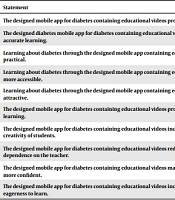
Table 1 presents the statements of the designed mobile app, and the frequency of students rated the statements. The statement "learning the educational content of diabetes through the mobile application containing educational videos increases the creativity of students" was found with the highest level of satisfaction from the perspective of medical students.
Table 1.
| Statement | A | B | C | D | E |
|---|---|---|---|---|---|
| The designed mobile app for diabetes containing educational videos provides fast learning. | 10 (31.250) | 18 (56.250) | 4 (12.5) | 0 (0) | 0 (0) |
| The designed diabetes mobile app for diabetes containing educational videos provides accurate learning. | 9 (28.125) | 16 (50) | 6 (18.750) | 1 (3.125) | 0 (0) |
| Learning about diabetes through the designed mobile app containing educational videos is practical. | 9 (28.125) | 17 (53.125) | 6 (18.750) | 0 (0) | 0 (0) |
| Learning about diabetes through the designed mobile app containing educational videos is more accessible. | 11 (34.375) | 16 (50) | 3 (9.375) | 2 (6.250) | 0 (0) |
| Learning about diabetes through the designed mobile app containing educational videos is attractive. | 6 (18.750) | 19 (59.375) | 4 (12.5) | 2 (6.250) | 1 (3.125) |
| The designed mobile app for diabetes containing educational videos provides sustainable learning. | 7 (21.875) | 19 (59.375) | 5 (15.625) | 1 (3.125) | 0 (0) |
| The designed mobile app for diabetes containing educational videos increases the creativity of students. | 9 (28.125) | 20 (62.5) | 3 (9.375) | 0 (0) | 0 (0) |
| The designed mobile app for diabetes containing educational videos reduces the student's dependence on the teacher. | 6 (18.750) | 18 (56.250) | 4 (12.5) | 4 (12.5) | 0 (0) |
| The designed mobile app for diabetes containing educational videos makes the student feel more confident. | 10 (31.250) | 14 (43.750) | 7 (21.875) | 1 (3.125) | 0 (0) |
| The designed mobile app for diabetes containing educational videos increases the eagerness to learn. | 10 (30.303) | 16 (48.485) | 6 (18.182) | 0 (0) | 0 (0) |
a A = strongly agree; B = Agree; C = Neutral; D = Disagree; E = strongly disagree.
b Values are expressed as No. (%).
Overall, the following results were obtained based on the highest satisfaction levels: (1) creativity in learning (90.625%); (2) fast learning (87.5%); (3) accessible learning (84.375%); (4) practical learning (81.25%); (5) sustainable learning (81.25%); (6) eagerness to learn (78.78%); (7) attractive learning (78.125%); (8) accurate learning (78.125%); (9) reducing the student's dependence on the teacher (75%); and (10) feeling more confident (75%).
5. Discussion
The findings of the present study showed that the educational mobile app facilitated learning and was accessible. Gangaiamaran and Pasupathi stated that mobile assisted language learning (MALL) is easily accessible for students with no space or time limits (22). In a study by Hashim et al., the off-line feature helped users to access learning content via the application, which had been installed on their mobile devices (23). The students found that their interaction with the educational apps enhanced their qualifications (24). On the other hand, some students did not understand the use and the easiness of usage of educational apps on mobile devices (24).
In our study, most students believed that educational mobile apps speed up learning. In a study by Chang et al., the speed of learning and near transfer are interrelated and identify the neural mechanisms by which faster learners transmit their information better (25). On the other hand, Doghonadze stated that fast learning seldom stimulates students’ creativity, and unless they are very intellectual, they may try to memorize the content, instead of trying to understand it (26). Keney et al. assessed the effects of using apps in clinical practice and showed that such apps speed up access to healthcare information. They believed that access to mobile apps during medical procedures was not a barrier to provide services, and they offer effective and continuous services (27).
We made educational videos to make the learning more interesting. In this study, the majority of medical students believed that using the educational videos of the diabetes app would make them more interested in learning. Hussain et al., in a systematic review, showed that teaching and learning by mobile educational apps have become mobile and attractive by playing videos in the classroom and using interesting content (28). This finding is in line with our results. Animations, which were developed by Demir and Akpınar, had a positive effect on students' learning and motivated them to learn (29). Calderon et al. showed that diabetes education through animation had a positive effect on improving health literacy about diabetes in the Latino population with limited knowledge about health (30). Sporrong reported that animations can help to improve user interaction in terms of speed to perform specific tasks (31). In our review, we did not find a study that undermines the attractiveness of education with mobile learning apps.
According to our study, the use of such an app containing educational videos reduces the student's dependence on the teacher in learning diabetes. This finding is consistent with the findings of Klímová and Kacetl and Klímová studies (32, 33). According to a meta-analysis using a standard statistical mean difference (SMD), due to the different measurement tools, students who learned through mobile apps were more confident than those who used traditional learning methods (34). Osman and Abdel Haliem declared that using mobile apps empowers students by creating a sense of autonomy and helping them to develop self-directed learning skills (35). Hidayati and Diana reported that students’ positive response to the use of an educational app was a sign of enhanced independent English learning outside the classroom. They revealed that the teacher is no longer the only learning source for the students. The students can learn English while spending time on social media or involving in various other pop-culture categories; thus, teachers should encourage them to make use of the available resources to help them improve their English (36). Motivation is the most important advantage of independent learning (37). Jou et al. (38), Baby (39), and Khan et al. (40) showed that the use of mobile apps strengthens students' motivation, which was in line with our study. Demeir and Akpınar reported that mobile learning may significantly increase students’ motivation by creating a positive impact on academic achievement and performance (29). Students' intrinsic motivation was enhanced by mobile apps through continuous assessment of individual progress, increased curiosity in learning, and enhanced control over the study (41).
In our study, the majority of students agreed that the use of mobile educational apps boosts creativity in learning. Creativity is essential to innovation, novelty, and sustenance (42). Creativity can cause teachers to develop the skills of their students without their curriculum lag behind (43). Studies seldom describe how higher education educators use mobile devices to boost the student’s creativity (22). Jahnke and Liebscher reported that in-depth analysis using the creative approach reveals three types of creativity that enhance meaningful learning with the mobile app (24).
Accuracy and practicality were other advantages of the designed mobile app in our study mentioned by students. The main factor determining the value of an application may be its ability to provide meaningful, accurate, and timely information to the user (44). Tucker et al. assessed the effectiveness of health mobile apps for new mothers during the postpartum period and showed that the current general apps do not provide enough information about maternal health, but those providing more evidence-based information with functional design meet most of these standards, however, they are unlikely to be downloaded by users (45). Therefore, it seems that although most of the apps reviewed were not specialized for students, most studies have emphasized the need to include evidence-based information to foster the accuracy of the information contained (46). Practicality is another parameter that influences teaching (47). According to Payne et al., medical students, the medical apps were used from 1 to 30 min by mostly on disease diagnosis/management and medication reference. They suggested the development of more apps to support their training and clinical practice (48). In a study by Rowe and Sauls, most clinicians used apps in their practice (60%) and reported their benefits (49). In a study by Chase et al., students were more likely to use devices in ‘down-time’ rather than as part of their clinical learning (50).
In addition to the benefits mentioned, there are problems in using such apps, including the use of e-learning by organizations and individuals, the technological limitations of mobile devices, and cultural issues (51). Although the majority of college students own a smartphone, there may be students who do not own one (52). Individual limitations include the lack of initiation, no willingness to try new events, relatively inadequate training of the personnel of new technologies and their applications, and low stakeholder participation in the transition to e-learning (53-55). Providing examples of successful implementation of mobile apps as well as online apps in the curriculum of the universities is urgently needed, which will enhance the creativity of all those involved in learning through technology (56).
5.1. Conclusions
Using mobile educational apps along with other teaching methods can lead to fast, creative, practical, accurate, and lasting learning, and due to their attractiveness, it creates a desire to learn in people. As educational apps are mostly interesting and motivate students to learn, instructors should use them alongside their teaching to have better assessment results, provided that these apps are intelligently designed.