


1. Background
Inflammatory bowel disease (IBD), comprising ulcerative colitis (UC) and Crohn’s disease (CD), is a chronic immune-mediated condition characterized by periods of relapse and remission. Over the past several decades, research has increasingly highlighted that IBD is not solely a gastrointestinal disorder but a systemic disease with broad extrasintestinal manifestations affecting the joints, skin, liver, and skeletal system. One of the most clinically significant systemic complications is the accelerated loss of bone mineral density (BMD), which predisposes patients to osteopenia, osteoporosis, and fractures (1). The prevalence of osteopenia in IBD has been reported to range from 22% to 77%, while osteoporosis affects approximately 15% to 42% of patients, substantially higher than age-matched controls (2).
The mechanisms underlying bone loss in IBD are multifactorial. Chronic inflammation plays a central role: pro-inflammatory cytokines such as tumor necrosis factor-alpha (TNF-α), interleukin-1 (IL-1), and interleukin-6 (IL-6) stimulate osteoclastogenesis through RANKL-mediated pathways, leading to increased bone resorption (3). Elevated levels of TNF-α, in particular, directly impair osteoblast differentiation while enhancing osteoclast activity, contributing to cortical and trabecular bone loss (4). In this context, systemic inflammation becomes a powerful determinant of bone health.
Glucocorticoids, commonly used to manage IBD flares, represent another major driver of bone demineralization. Even low-dose or short-duration steroid use can reduce bone formation, disrupt calcium metabolism, and increase fracture risk (5). Repeated corticosteroid bursts or chronic steroid dependency dramatically accelerate bone loss, making osteoporosis a predictable complication of long-term therapy.
Nutritional deficiencies further amplify bone deterioration in IBD. Malabsorption of vitamin D and calcium, coupled with decreased dietary intake during disease flares, significantly reduces BMD. Vitamin D deficiency is highly prevalent in IBD patients and contributes to secondary hyperparathyroidism, promoting increased osteoclastic bone turnover (6). Alterations in body composition, particularly reduced BMI and loss of lean muscle mass, correlate strongly with lower BMD because adipose and muscle tissues exert endocrine effects that support bone remodeling (7).
In recent years, attention has shifted toward understanding the role of biologic therapies, particularly anti-TNF-α agents, in modulating bone health. Anti-TNF-α medications - including infliximab, adalimumab, and certolizumab - are central to the management of moderate-to-severe IBD. Theoretically, by suppressing TNF-α-driven inflammation, these agents should improve BMD. Indeed, some studies have demonstrated increases in bone formation markers and stabilization of BMD following anti-TNF-α therapy (8). Additional reports from rheumatoid arthritis populations have similarly shown that TNF inhibitors reduce bone turnover and protect against erosive bone loss (9).
However, findings across IBD studies are inconsistent. While some investigations report improvements in lumbar spine and hip BMD during anti-TNF-α treatment (10 - 12), others observed persistent bone loss or elevated bone resorption markers despite biologic therapy (13, 14). Notably, a retrospective analysis demonstrated that IBD patients exposed to TNF inhibitors were diagnosed with osteoporosis at a younger age compared with anti-TNF-naïve patients (15). These divergent outcomes raise important questions regarding the true impact of anti-TNF-α therapy on bone health and whether the observed effects reflect biological mechanisms, confounding by disease severity, or treatment selection bias.
2. Objectives
Given these uncertainties, there is a clear need for additional research exploring the relationship between anti-TNF-α therapy and BMD in real-world IBD populations. This pilot study aims to evaluate the association between anti-TNF-α therapy and bone mineral density in patients with IBD while accounting for steroid exposure, disease activity, nutritional supplementation, BMI, and other clinical variables. By analyzing these multidimensional factors together, we hope to provide a more nuanced understanding of bone health risks in patients undergoing biologic therapy. Furthermore, this study contributes to ongoing discussion about whether anti-TNF-α treatments directly influence bone metabolism or whether observed bone loss reflects underlying disease severity, chronic inflammation, cumulative steroid use, or nutritional deficits. Understanding these relationships is essential to improving the long-term skeletal health of individuals living with IBD.
3. Methods
3.1. Study Design and Setting
This investigation was conducted as a cross-sectional pilot study at the IBD Treatment Center of Firoozgar Hospital in Tehran, Iran, between January 2021 and December 2022. The center functions as a tertiary referral institution, drawing patients from across the region and providing comprehensive care, including advanced biologic therapy and nutritional counseling. The present study was designed to characterize bone health among patients receiving different therapeutic regimens for IBD while assessing the specific association between anti-TNF-α therapy and bone mineral density. Therefore, we collected detailed clinical, laboratory, and radiologic patient data within a defined time frame.
3.2. Participant Enrollment
Patients were recruited consecutively during routine outpatient visits. Eligibility required a confirmed diagnosis of ulcerative colitis or Crohn’s disease based on clinical presentation, endoscopic findings, radiologic imaging, and histopathologic evidence. The diagnostic criteria were consistent with international guidelines. Participants were included if they were between 15 and 50 years of age and receiving stable maintenance therapy for a minimum of three months prior to enrollment. Patients were excluded if they had conditions known to independently affect bone metabolism, such as hyperthyroidism, chronic renal insufficiency, chronic liver disease, systemic lupus erythematosus, diabetes mellitus, or chronic obstructive pulmonary disease. Individuals with vitamin D deficiency identified during screening, pregnant women, postmenopausal women, patients with a history of metabolic bone disease, and those receiving estrogen replacement were also excluded to avoid confounding biases. Postmenopausal women were excluded from the study to reduce confounding related to estrogen deficiency, which is a well-established independent risk factor for bone loss. Restricting the cohort to premenopausal women and men allowed for a more homogeneous assessment of disease- and treatment-related effects on bone mineral density and justified the use of Z-scores for BMD interpretation.
3.3. Treatment Group Classification
Participants were categorized based on the primary immunosuppressive therapy they were receiving at the time of enrollment. The anti-TNF-α group included patients treated with infliximab or adalimumab for at least 12 weeks. Duration was verified to ensure adequate exposure to the biologic agent. The comparison group consisted of patients receiving azathioprine (with or without mesalazine). These two treatment pathways reflect common IBD management strategies in Iran and globally. Importantly, no patient in either group was receiving medications directly affecting bone turnover, such as bisphosphonates, selective estrogen receptor modulators, systemic hormones, or anticonvulsants.
3.4. Clinical Data Collection
Demographic characteristics - including age, sex, body mass index (BMI), and smoking or alcohol consumption - were recorded at baseline. BMI was calculated as weight in kilograms divided by height in meters squared. Patients reported their dietary intake of calcium and their use of vitamin D supplements. Detailed medical histories were obtained to determine disease duration in months, number of prior flares, and any intestinal resections. Hospitalization within the previous year due to active disease was also documented.
Disease activity was assessed using validated scoring systems. For ulcerative colitis, the Mayo Scoring System was employed, incorporating stool frequency, rectal bleeding, endoscopic findings, and physician global assessment. For Crohn’s disease, the Crohn’s Disease Activity Index (CDAI) was used, integrating symptoms, laboratory findings, and weight changes. Both tools have been widely validated and allow for classification of patients into remission, mild, moderate, or severe disease states.
3.5. Steroid Exposure Assessment
Cumulative corticosteroid use was quantified by reviewing medical records for all steroid prescriptions within the previous two years. The total cumulative dose was calculated in prednisone-equivalent milligrams to standardize comparisons. Steroid exposure was categorized both as a continuous variable and dichotomously (recent vs. remote use) to allow for regression modeling.
3.6. Bone Mineral Density Measurement
Bone mineral density was measured using a dual-energy X-ray absorptiometry (DEXA) scanner (Hologic Discovery Wi, Hologic Inc., USA). Daily quality-control calibration was performed using a manufacturer-supplied phantom in accordance with standard operating procedures. Lumbar spine (L1-L4) and femoral neck BMD values were recorded and expressed as Z-scores based on age- and sex-matched reference data. Although T-scores are typically used for diagnosing osteoporosis in adults over 50 years, Z-scores were applied in this study due to the relatively young age of the cohort and the desire to compare patients against age-matched norms. For analytic purposes, osteoporosis was defined as a Z-score ≤ -2.0, osteopenia as a Z-score between -1.0 and -2.0, and normal BMD was considered when the Z-score was above -1.0.
3.7. Statistical Analysis
Data were analyzed using SPSS version 18. Continuous variables were evaluated for normality using the Kolmogorov-Smirnov test. Means and standard deviations were calculated for normally distributed variables, while medians and interquartile ranges were used when distribution was skewed. Comparisons between groups were performed using independent-samples t-tests for continuous variables and chi-square or Fisher’s exact tests for categorical variables.
Correlations between continuous clinical variables (e.g., BMI, vitamin D levels, disease duration, cumulative steroid exposure) and BMD were assessed using Pearson’s correlation coefficients. Variables demonstrating significant univariate associations were subsequently entered into multivariable logistic regression models to evaluate independent predictors of osteoporosis. Variables with P < 0.10 in univariate analysis - along with age and sex, included as standard demographic controls - were entered into a multivariate logistic regression model to determine independent predictors of osteoporosis. Adjusted odds ratios (ORs) with 95% confidence intervals (CIs) were calculated to quantify effect sizes. A P-value less than 0.05 was considered statistically significant throughout all analyses.
4. Results
4.1. Participant Characteristics
A total of 58 patients were enrolled, including 42 individuals (72.4%) with ulcerative colitis and 16 (27.6%) with Crohn’s disease. The mean age of participants was 35.4 ± 8.51 years, with a range of 15 to 50 years. Females constituted 51.7% of the cohort. The mean body mass index was 24.58 ± 2.87 kg/m², consistent with a normal weight range for the majority of participants.
Between the anti-TNF-α group (n = 29) and azathioprine group (n = 29), there were no statistically significant differences in age or sex distribution. However, individuals in the anti-TNF-α cohort tended to have slightly lower BMI (P = 0.06), although this difference did not reach statistical significance. Disease duration was shorter in the anti-TNF-α group (48.82 ± 47.92 months) compared with the azathioprine group (80.92 ± 52.29 months, P = 0.03), reflecting the clinical practice of initiating biologic therapy earlier in more aggressive disease (Table 1).
Table 1.Clinical Characteristics by Treatment Group a
| Variables | Anti-TNF-α (n = 29) | Azathioprine (n = 29) | P-Value |
|---|---|---|---|
| Qualitative Clinical Data (n or %) | |||
| Male/Female | 12 / 17 | 16 / 13 | 0.87 |
| Disease Type (CD/UC) | 11 / 18 | 5 / 24 | 0.12 |
| Smoking (Yes) | 34.5% | 37.9% | 0.79 |
| Alcohol Use (Yes) | 3.4% | 13.8% | 0.20 |
| Calcium Supplement | 10.3% | 13.8% | 0.98 |
| Vitamin D Supplement | 20.7% | 27.6% | 0.8 |
| Remission Status | 65.5% | 96.5% | 0.005 |
| Quantitative Clinical Data (Mean ± SD) | |||
| Age (years) | 31.81 ± 7.29 | 38.79 ± 8.27 | 0.10 |
| BMI (kg/m²) | 23.67 ± 2.54 | 25.49 ± 2.92 | 0.06 |
| Disease duration (months) | 48.82 ± 47.92 | 80.92 ± 52.29 | 0.03 |
| Vitamin D level (ng/mL) | 24.75 ± 6.35 | 19.46 ± 7.05 | 0.01 |
Abbreviations: BMI, body mass index; CD, Crohn disease; SD, standard deviation; TNF-α, tumor necrosis factor-alpha; UC, ulcerative colitis.
a Values are presented as mean ± standard deviation unless otherwise indicated.
4.2. Disease Activity
Remission rates differed significantly between treatment groups. Among patients on azathioprine therapy, 96.5% were in clinical remission based on Mayo score or CDAI criteria, whereas only 65.5% of patients receiving anti-TNF-α therapy were in remission (P = 0.005). This imbalance underscores potential confounding related to disease severity, as patients requiring anti-TNF-α treatment likely represent a more refractory population.
4.3. Lifestyle and Nutritional Factors
Smoking rates were comparable between groups (34.5% anti-TNF-α vs. 37.9% azathioprine, P = 0.79). Alcohol consumption remained low across both cohorts, reflecting regional patterns. Vitamin D supplementation occurred in 20.7% of anti-TNF-α patients versus 27.6% of azathioprine patients. The mean serum vitamin D level was significantly higher in the anti-TNF-α group (24.75 ± 6.35 ng/mL) compared with the azathioprine group (19.46 ± 7.05 ng/mL, P = 0.01), although both means indicate insufficiency (Table 1).
4.4. Bone Mineral Density Findings
The mean overall Z-score was -1.72 ± 0.84. Based on Z-score criteria, 43.1% of all participants were classified as osteoporotic (Z ≤ -2.0), 36.2% as osteopenic, and only 20.7% as having normal BMD. Osteoporosis prevalence differed markedly by treatment group and the difference was statistically significant (χ² = 8.1, P = 0.01) (Figure 1).
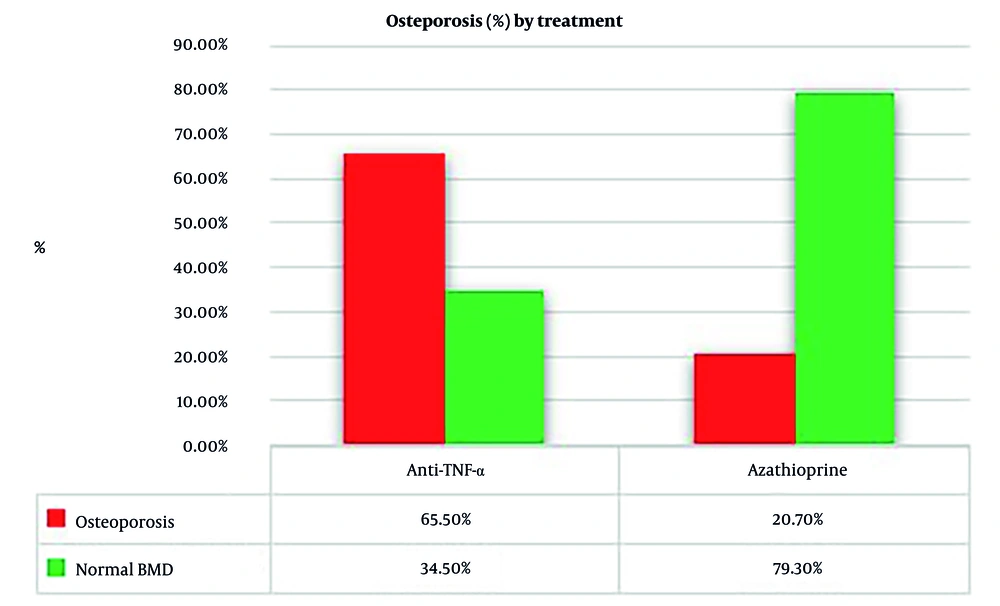
Figure 1.
Osteoporosis prevalence by treatment group analysis. The difference was statistically significant (P = 0.01)
4.5. Logistic Regression Analysis
To further evaluate the relationship between clinical variables and the presence of osteoporosis, a univariate logistic regression analysis was performed. Anti-TNF-α therapy demonstrated a strong association with osteoporosis (unadjusted OR 7.06, 95% CI 2.15 - 23.19, P = 0.001), indicating that patients receiving biologic therapy were significantly more likely to exhibit low bone density compared with those treated with azathioprine-based regimens. Each 1-unit decrease in BMD Z-score substantially increased the odds of osteoporosis (OR 2.35, 95% CI 1.40 - 3.95, P = 0.002), reflecting the direct contribution of lower bone mass to the outcome. Because of the cross-sectional nature of the study, these findings should be interpreted as associations rather than causal effects.
In univariate analysis, anti-TNF-α therapy was associated with higher odds of osteoporosis; however, the wide confidence interval reflected limited sample size and potential instability of unadjusted estimates.
Cumulative corticosteroid exposure was also significantly associated with osteoporosis (OR 1.31 per 1000 mg prednisone-equivalent increase, 95% CI 1.08 - 1.58, P = 0.004), emphasizing the detrimental skeletal effects of repeated steroid use. Lower BMI emerged as a significant predictor (OR 1.18 per 1-unit decrease, 95% CI 1.04 - 1.32, P = 0.008), consistent with the established relationship between nutritional status and bone strength.
Analysis by anatomical site indicated that lumbar spine Z-scores were significantly lower in the anti-TNF-α group (-2.02 ± 0.76) compared with the azathioprine group (-1.43 ± 0.81, P = 0.004). Femoral neck Z-scores showed a similar pattern (-1.85 ± 0.93 vs. -1.21 ± 0.79, P = 0.01).
Disease activity and vitamin D levels showed trends toward significance (P = 0.088 and P = 0.090, respectively), suggesting potential contributions, although these did not meet statistical thresholds in univariate analysis. Age, sex, and disease type were not significant predictors. The full univariate logistic regression findings are presented in Table 2.
Table 2.Univariate Logistic Regression Analysis for Predictors of Osteoporosis in Inflammatory Bowel Disease Patients
| Predictor Variable | Unadjusted OR | 95% CI | P-value |
|---|---|---|---|
| Anti-TNF-α therapy (Yes vs. No) | 7.06 | 2.15 - 23.19 | 0.001 |
| BMD (per 1-unit decrease in Z-score) | 2.35 | 1.40 - 3.95 | 0.002 |
| Cumulative corticosteroid exposure (per 1000 mg prednisone-equivalent) | 1.31 | 1.08 - 1.58 | 0.004 |
| Body mass index (per 1-unit decrease) | 1.18 | 1.04 - 1.32 | 0.008 |
| Vitamin D level (per 1 ng/mL increase) | 0.94 | 0.87 - 1.01 | 0.090 |
| Disease activity (Active vs. Remission) | 2.42 | 0.87 - 6.67 | 0.088 |
| Disease type (CD vs. UC) | 0.74 | 0.26 - 2.09 | 0.570 |
| Age (per 1-year increase) | 1.03 | 0.96 - 1.10 | 0.410 |
| Sex (Male vs. Female) | 1.61 | 0.64 - 4.02 | 0.300 |
Abbreviations: BMD, bone mineral density; CI, confidence interval; IBD, inflammatory bowel disease; OR, odds ratio; TNF-α, tumor necrosis factor-alpha.
4.6. Correlation Analyses
Pearson correlation revealed significant relationships between BMD and several clinical variables. BMI was positively correlated with Z-score (r = 0.41, P = 0.002). Cumulative corticosteroid exposure correlated negatively with Z-score (r = -0.45, P = 0.001). Disease duration did not show significant correlation with BMD, while vitamin D levels exhibited a moderate positive association (r = 0.32, P = 0.02).
The median cumulative corticosteroid exposure was higher among patients with osteoporosis compared with those without osteoporosis. Cumulative steroid dose, expressed as prednisone-equivalent milligrams, demonstrated a significant negative correlation with BMD Z-score (r = -0.45, P = 0.001).
In both univariate and multivariable logistic regression analyses, cumulative corticosteroid exposure was independently associated with increased odds of osteoporosis (adjusted OR 1.50 per 1000 mg increase, 95% CI 1.10 - 2.00, P = 0.010).
4.7. Multivariable Logistic Regression
After adjustment, anti-TNF-α therapy remained significantly associated with increased risk of osteoporosis (adjusted OR 3.50, 95% CI 1.20 - 10.20, P = 0.022), indicating a persistent association even after controlling for BMI, steroid exposure, vitamin D levels, disease activity, and demographic factors.
In the multivariable logistic regression model - adjusted for BMI, cumulative corticosteroid exposure, vitamin D levels, disease activity, age, and sex - the association between anti-TNF-α therapy and osteoporosis was attenuated but remained statistically significant (adjusted OR 3.50, 95% CI 1.20 - 10.20, P = 0.022). No evidence of multicollinearity was observed. Given the modest sample size, these findings should be interpreted as exploratory.
Lower BMD was a strong independent predictor (adjusted OR 2.00, 95% CI 1.10 - 3.60, P = 0.015), reinforcing the direct mechanistic relationship between bone mass and osteoporosis. Cumulative corticosteroid exposure independently increased osteoporosis risk (adjusted OR 1.50, 95% CI 1.10 - 2.00, P = 0.010), highlighting the long-term impact of steroid therapy on bone metabolism. Likewise, lower BMI remained significant (adjusted OR 1.20, 95% CI 1.05 - 1.40, P = 0.005).
Disease activity and vitamin D levels did not retain statistical significance in the adjusted model but remained clinically relevant trends. Full multivariate regression outcomes are shown in Table 3.
Table 3.Multivariate Logistic Regression Analysis for Independent Predictors of Osteoporosis
| Predictor Variable | Adjusted OR | 95% CI | P-value |
|---|---|---|---|
| Anti-TNF-α therapy (Yes vs. No) | 3.50 | 1.20 - 10.20 | 0.022 |
| BMD (per 1-unit decrease in Z-score) | 2.00 | 1.10 - 3.60 | 0.015 |
| Cumulative corticosteroid exposure (per 1000 mg prednisone-equivalent) | 1.50 | 1.10 - 2.00 | 0.010 |
| Body mass index (per 1-unit decrease) | 1.20 | 1.05 - 1.40 | 0.005 |
| Disease activity (Active vs. Remission) | 1.96 | 0.71 - 5.44 | 0.190 |
| Vitamin D (per 1 ng/mL increase) | 0.97 | 0.90 - 1.05 | 0.480 |
| Age (per 1-year increase) | 1.04 | 0.97 - 1.11 | 0.260 |
| Sex (Male vs. Female) | 1.72 | 0.66 - 4.45 | 0.260 |
Abbreviations: BMD, bone mineral density; CI, confidence interval; OR, odds ratio; TNF-α, tumor necrosis factor-alpha.
5. Discussion
The present pilot study demonstrates a significant association between anti-TNF-α therapy and lower bone mineral density among patients with inflammatory bowel disease. While the cross-sectional design does not permit causal inference, the pattern of findings contributes to the ongoing debate regarding the skeletal effects of TNF-α inhibition in IBD. In this cohort, individuals receiving anti-TNF-α therapy demonstrated a markedly higher prevalence of osteoporosis compared with those receiving azathioprine-based therapy, even after adjusting for potential confounders.
Our findings contrast with several previous studies showing improved bone health following anti-TNF-α therapy. For example, Veerappan and colleagues reported significant improvements in bone formation markers among Crohn’s disease patients treated with adalimumab (16). Similarly, a prospective study on infliximab demonstrated stabilization of lumbar spine and femoral neck BMD over a one-year treatment period (12). Studies in rheumatoid arthritis populations also support a protective role for TNF-α inhibition on bone turnover (14).
However, other investigations have raised concerns similar to our findings. Sugimoto et al. observed that infliximab therapy in Crohn’s disease was associated with elevated N-terminal telopeptide of type I collagen, indicating increased bone resorption (13). Hakimian et al. found that Crohn’s disease patients exposed to TNF inhibitors were diagnosed with osteoporosis at a significantly younger age compared with anti-TNF-naïve patients (15).
Several mechanisms may explain these discrepancies. One possibility is confounding by disease severity. In our study, remission rates were notably lower in the anti-TNF-α group, suggesting more severe baseline inflammation. Chronic systemic inflammation is a powerful driver of bone resorption through cytokine-induced activation of the RANKL pathway (17, 18). Thus, lower BMD in anti-TNF-α patients may reflect the severity of disease prompting biologic therapy rather than a detrimental medication effect.
Another important consideration is the timing of bone assessments. Some beneficial effects of anti-TNF-α therapy on bone metabolism require prolonged suppression of inflammation to manifest. In our study, DEXA scans were not uniformly timed relative to biologic initiation. Patients may have undergone scanning early in therapy, before any potential bone recovery. In contrast, many positive studies evaluated BMD over longer treatment durations.
Cumulative steroid exposure emerged as an independent predictor of osteoporosis in this cohort. This aligns with robust mechanistic literature describing how glucocorticoids suppress osteoblastogenesis, enhance osteoclast activation, and impair calcium metabolism (5). Patients with severe IBD often experience repeated steroid courses, which may compound bone loss even when transitioned to anti-TNF-α agents.
Body composition also played a significant role. Lower BMI strongly predicted reduced BMD, consistent with literature demonstrating that adipose-derived estrogen and mechanical loading support bone strength (7, 19). Because chronic inflammation and malabsorption frequently lead to weight loss in IBD, BMI may serve as a proxy for nutritional status and metabolic reserve.
Importantly, the use of Z-scores rather than T-scores may influence interpretation. Z-scores are appropriate in premenopausal adults and younger individuals but are not the conventional method for diagnosing osteoporosis. However, given our cohort’s relatively young age distribution, Z-scores were chosen to compare bone density against age-matched norms. Nevertheless, caution is warranted when comparing these findings with studies using T-scores.
The magnitude of the observed odds ratio for anti-TNF-α therapy should be interpreted with caution. Although the association remained statistically significant after multivariable adjustment, the wide confidence interval suggests potential overestimation of the true effect size. This finding likely reflects residual confounding, particularly confounding by indication, as patients receiving anti-TNF-α therapy had lower remission rates and more severe disease. Moreover, the modest sample size limits the stability of regression estimates. Consequently, the observed odds ratio should be viewed as exploratory rather than definitive.
This study has several limitations. The cross-sectional design prevents determination of temporal relationships between anti-TNF-α therapy and bone health. The sample size, although adequate for pilot analysis, limits statistical power, particularly for subgroup comparisons. Disease activity was significantly different between treatment groups, raising the likelihood of confounding by severity. Data regarding cumulative steroid use relied on medical record documentation and patient self-report, which may introduce recall bias. The use of Z-scores, while appropriate for younger populations, limits comparability with osteoporosis studies using T-scores. Finally, therapy duration was not standardized, and timing of DEXA scans varied, preventing assessment of longitudinal changes in BMD.
5.1. Conclusions
This expanded cross-sectional pilot study identified a significant association between anti-TNF-α therapy and reduced bone mineral density in patients with inflammatory bowel disease. While anti-TNF-α therapy remained independently associated with osteoporosis after multivariable adjustment, this relationship likely reflects the complex interplay between disease severity, chronic inflammation, cumulative corticosteroid exposure, and nutritional status rather than a direct harmful effect of biologic therapy.
Given the high prevalence of osteoporosis observed - particularly among patients receiving anti-TNF-α - these findings reinforce the importance of routine bone health monitoring, timely DEXA assessment, and proactive management of modifiable risk factors such as vitamin D deficiency, nutritional deficits, and prolonged steroid use. Further prospective studies are required to delineate causality, examine long-term changes in bone density following biologic initiation, and differentiate the direct effects of anti-TNF-α agents from residual confounding related to underlying disease severity.


