1. Background
The evolution from hunting and gathering to agriculture, followed by industrialization, has had a profound effect on human physical activity patterns [1]. On the other hand, the use of mobile phones is similar in the same way to behaviors such as watching television and using computers, to reduce physical activity and fitness. According to various studies, cardiorespiratory fitness and body composition are two suitable indices which are the best variables of body composition based on the estimated tests including maximal oxygen uptake (VO2max), cardiorespiratory fitness, body fat percentage, body mass index (BMI) and waist-to-hip ratio (WHR) [2, 3]. Expanded studies have been conducted based on the indices of cardiorespiratory fitness and body composition, both inside and abroad. Some studies have examined these features specifically in a student community [2, 4, 5]. Wang et al. (2011) found a close relationship between visceral fat and body weight and waist circumference in Japanese students at first term, and recommended anthropometric indices such as weight and waist circumference for the diagnosis of visceral fat [6]. Rajabi (2006) in study examined some of the most important factors of body composition and cardiorespiratory fitness in students throughout the country. From the study results, a relatively good situation in body composition variables was found between Iranian boy and girl students, but boys were in a better situation. Unlike girls, most boys were in relatively good situation in terms of cardiorespiratory fitness situation [7]. Body fat in the subjects of Hamadan University of Medical Sciences during 2010 and 2011, with good, medium and weak levels of physical activity, was reported as 8.25, 11.98, and 22.65%, respectively and a suggestion of supervised physical exercise was recommended to improve body composition and lipid profile [8]. It seems that the limited rate of motion is more in girls than boys, and some solutions are required to reduce it. Given the importance of cardiorespiratory fitness and physical composition in the student class, continuous assessment and knowledge of university officials concerning physical activity is one of the requirements in macro planning in order to improve and change the lifestyle from inactive to active status. Despite the importance of cardiorespiratory fitness and body composition, unfortunately these indices have not been examined in students at postgraduate level. Given the lack of comprehensive and systematic researches to describe the features of cardiorespiratory fitness and body composition in students at postgraduate level and knowledge about the present status of these features, some studies are required to be conducted periodically every few years (for example, every 5 years) to provide the norms related to students [7, 9-11]. Accordingly, the present study aims to examine body composition and cardiorespiratory fitness and the relationship between them in students at postgraduate level.
2. Methods
2.1. Participants
This cross-sectional study. In the 2014 - 2015 academic year, all first-year university students from a postgraduate (PhD and MS students) Tarbiat Modares level university were invited to take part in the present study. Three hundred volunteer students aged 22 - 36 years old (including one hundred male students and two hundred female students) were selected using random targeted sampling. After explaining the purposes and procedures of the study, the subjects filled the health form and gave their consent. Then, some recommendations and advices were given to the subjects to avoid vigorous exercise 24 hours before testing and heavy meals 2 - 3 hours before testing. The study was in accordance with the declaration of Helsinki.
2.2. Body Composition
Body fat were measured using body composition analysis device (BoCAx1, Medigate, South Korea) [12]. BMI was calculated as weight (kg)/height (m2). To measure the height, the subjects stood with their back to a stadiometer (Seca, Hamburg, Germany) without shoes and their stature and height was measured in cm. Waist-to-hip ratio (WHR) is the dimensionless ratio of the circumference of the waist to that of the hips. This is calculated as waist measurement divided by hip measurement. To measure the WHR, a tape meter was used. The waist circumference is the midpoint between the lowest rib and iliac crest, in other words around level of the umbilicus was measured (cm). Hip circumference be measured around the widest portion of the buttocks, with the tape parallel to the floor. For both measurements, the individual stood with feet close together, arms at the side and body weight evenly distributed, and wore little clothing [13].
2.3. Cardiorespiratory Fitness Test
All subjects participated in the test after measuring the body composition indices. Cardiorespiratory fitness was measured by 20-m Shuttle Test Run in order to determine the maximal oxygen uptake (VO2max) [14]. This test involves continuous running between two lines 20 m apart in time to recorded beeps. The speed at the start is quite slow and gradually increase and the beeps will be closer together. The test is stopped if the subject fails to reach the line (within 2 meters) for two consecutive ends after a warning. VO2max calculated by following formula [15]:
VO2max = 14.4 + 3.48 (minutes completed)
2.4. Data Analysis
The normality of population was approved using Shapiro-Wilk test. The data obtained was categorized and explained based on the mean and standard deviation. T-independent test was used to examine the difference between groups. Also, the correlation between variables was examined using Pearson correlation coefficient. The findings were examined at confidence level of 95% (P ≥ 0.05). Also, all data were analyzed by the SPSS software package (SPSS for Windows; SPSS Inc., Chicago, IL, USA; Version 19.00).
3. Results
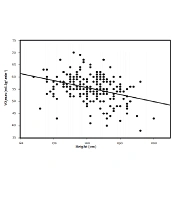
The results showed the obtained data in male and female students at postgraduate level including VO2max (37.4 and 25.3 ml/kg/min), body mass (74 and 58.4 kg), body fat percent (18.9 and 21.7 %), BMI (23.7 and 22.4 kg/m2) and WHR (0.83 and 0.73). An inverse relationship was observed between VO2max with BMI, WHR and body fat percent (P ≤ 0.05). Also, a significant difference was observed between men and women in BMI, WHR, VO2max, body mass and body fat percent (P ≤ 0.05) (Tables 1 and 2) (Figures 1, 2, 3 and 4).
Table 1.
Comparison of Gender Differences in Using T Testa
| Variable | Men | Women | P Value |
|---|---|---|---|
| Age, y | 26.22 ± 3.51 | 26.34 ± 3.33 | - |
| Height, cm | 176.9 ± 5.5 | 161.4 ± 4.95 | < 0.001 |
| Weight, kg | 74.04 ± 11.4 | 58.43 ± 9.5 | < 0.001 |
| Percentage of body fat, % | 18.88 ± 4.7 | 21.64 ± 5.1 | < 0.001 |
| Body mass index, kg.m-2 | 23.7 ± 3.31 | 22.4 ± 3.26 | < 0.01 |
| Waist-to-hip ratio | 0.83 ± 0.06 | 0.73 ± 0.05 | < 0.001 |
| VO2max, mL.kg-1.min-1 | 37.4 ± 5.54 | 25.3 ± 3.06 | < 0.001 |
aAll values are expressed as mean ± SD.
Table 2.
Correlation of VO2max and Cardiovascular Risk Factors Based on Gender
| Variable | Group | BMI | PBF | WHR |
|---|---|---|---|---|
| Men | ||||
| VO2max, ml.kg-1.min-1 | r | -0.37 | -0.36 | -0.3 |
| P value | 0.0001 | 0.0001 | 0.004 | |
| Women | ||||
| r | -0.28 | -0.22 | -0.27 | |
| P value | 0.0001 | 0.005 | 0.001 |
Abbreviations: BMI, Body Mass Index, PBF, Percentage of Body Fat, WHR, Waist-to-Hip Ratio.
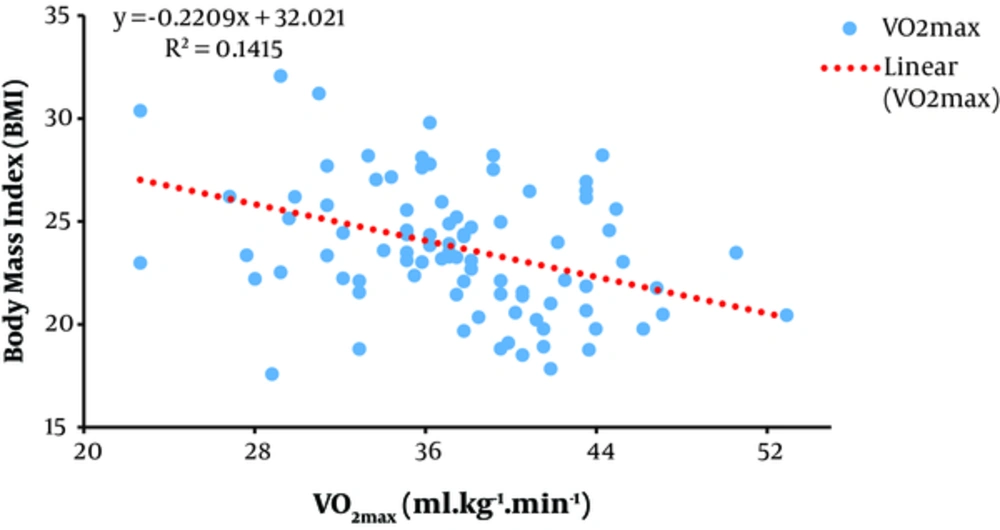
Figure 1.
The Correlation Between VO2max and BMI in Men
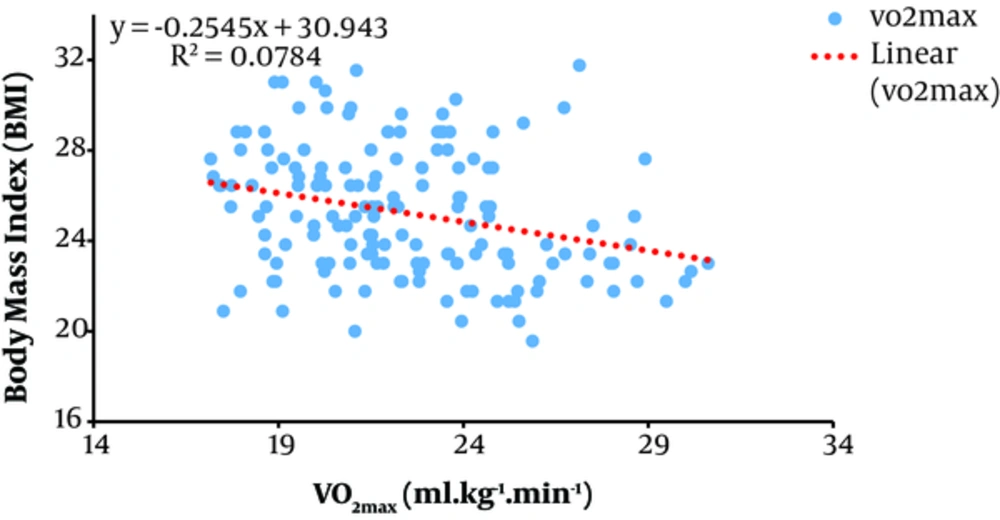
Figure 2.
The Correlation Between VO2max and BMI in Women
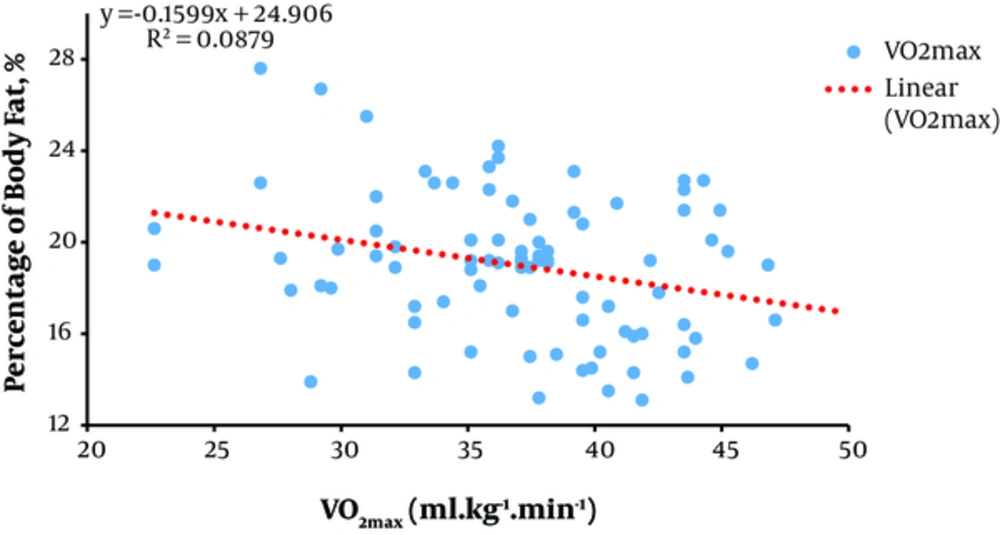
Figure 3.
The Correlation Between VO2max and Percentage of Body Fat in Men
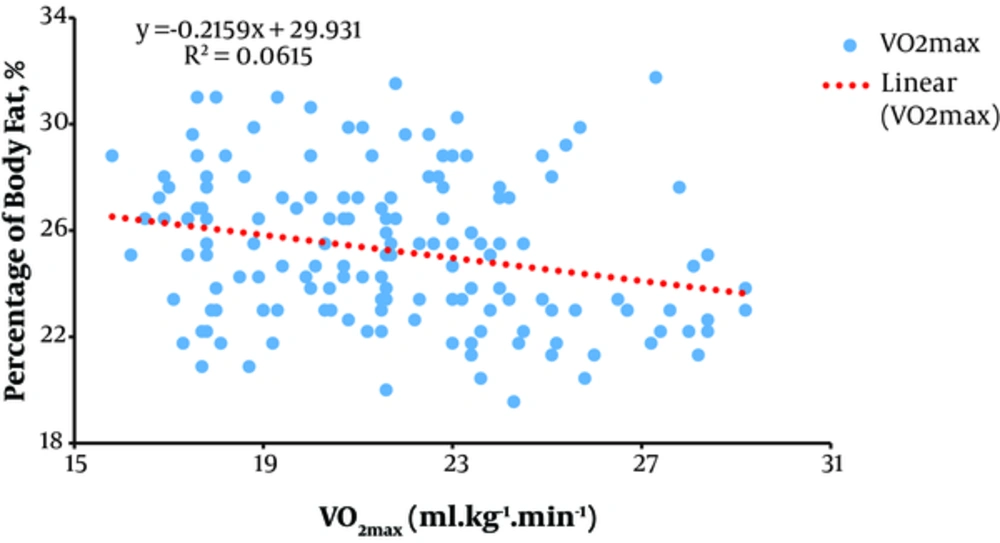
Figure 4.
The Correlation Between VO2max and Percentage of Body Fat in Women
4. Discussion
The participants in this study were three hundred students of postgraduate level in 2014 - 2015 including two hundred female and one hundred male. According to the results of the study, BMI, WHR, body fat percent and VO2max in male students at postgraduate level were, respectively 23.7 kg/m2, 0.83, 18.9% and 37.4 mL/kg/min.
Rajabi (2006) reported the mean of BMI, WHR, fat and VO2max in 2240 male students aged 19 - 25 aged, respectively as 22.4 kg/m2, 0.83, 15.22%, 48.47 mL/kg/min [7], which indicates fat percentage aside more cardiorespiratory fitness in students at postgraduate level compared to students at graduate level. Older age in students at postgraduate level might be one of reasons for these differences, but the main reason is inactivity and lower percent of physical activity in students at postgraduate level [7]. The average of body fat percent, BMI and WHR in male students of Tehran Medical science University obtained respectively as 23.3%, 18.6 kg/m2 and 0.8 [16]. Also, mean of body fat percent, BMI and WHR in male students aged 18 to 27 years at Shiraz University of Medical Sciences reported respectively as 15.6%, 22.7 kg/m2 and 0.85 [17].
BMI, WHR, body fat percent and VO2max in female students at postgraduate level were, respectively 22.4 kg/m2, 0.73, 21.7% and 25.3 mL/kg/min. A comparison of female students was made and it was discovered that increasing body fat is related to low cardiorespiratory fitness and these changes are more evident in women than men. Mean of BMI, WHR, fat and VO2max were, respectively 22.21 kg/m2, 0.75, 18.13% and 34.95 mL/kg/min in female students at graduate level [7]. The average of body fat percent, BMI and WHR in female students of Tehran Medical science University obtained respectively as 21.8 kg/m2, 32% and 0.7 [16]. Also, mean of body fat percent, BMI and WHR in female students aged 18 to 27 years at Shiraz University of Medical Sciences reported respectively as 30.3%, 22.1 kg/m2 and 0.77 [17]. Kordi et al. (2010) reported that in Iran 54.7% Tehrani women had excess body weight (BMI > 25) and the prevalence of obesity (BMI > 30) was 21.5% [2].
Sengupta et al. (2013) reported VO2max, body fat percentage, BMI and WHR, respectively as 31 mL/kg/min, 26.4% and 0.87 in 100 female students aged 18 to 22 years old at University of Calcutta, and stated that increasing fat mass and weight is related to aging and may result in poor hygienic conditions in adult [9]. Anthropometric indices are influenced by different factors such as age, gender, race, climate, culture and nutrition. Given the indirect and significant relationship between fat percentage and maximal oxygen uptake, proper volume and intensity of physical activity, especially in this age group can reduce fat mass, increase maximal oxygen uptake, and ultimately prevent cardiovascular disease. And these individuals can continue their scientific activities in an ideal physical and mental situation and enjoy better quality of life [4, 18]. Pribis et al. (2010) examined the cardiorespiratory fitness, fat mass and BMI in American female and male students from 1996 to 2008 and found a significant reduction in cardiorespiratory fitness, while no significant difference was observed between BMI and fat percent, but an increase in fat parentage to 0.5 and 0.6 was observed in male and female students within 13 years. Also, an indirect and significant relationship was reported between fat percentage and maximal oxygen uptake. It was stated that physical activity and proper nutrition have positive effect on the general performance of students. Physical activities can reduce the stress level and some strategies are required to improve the physical readiness of students [10].
Racette et al. (2014) in a study enrolled cardiometabolic risk of 134 graduate students between 2005 - 2010 and compare them with age-matched national samples. Most students had desirable weight, blood glucose, lipids, and fitness at both time points. However, 26.9% had elevated blood pressure, 29.9% performed aerobic exercise < 3 days/week, and 80.6% consumed < 5 fruits/vegetables daily. Relative to young adults nationwide, these students exhibited more favorable exercise patterns, dietary patterns, and cardiometabolic indices. Over time, increases in adiposity and decreases in exercise frequency correlated with adverse changes in lipid concentrations and fitness [19].
The results of the study showed an inverse significant relationship between maximal oxygen uptake with BMI, WHR and body fat. All studies showed an inverse relationship between physical fitness with BMI and body fat. Lower cardiorespiratory fitness students were more likely to be overweight or obese than those with high cardiorespiratory fitness [1, 5]. Studies used shuttle run, maximal treadmill test, maximal cycle test, cooper test to assess cardiorespiratory fitness [5]. Lohman et al. (2008) found an indirect relationship between BMI and physical activity [20]. However, Gonzales-Suarez et al. (2011) did not find differences between BMI and physical activity in overweight and normal youth [21]. Aires et al. (2010) showed that while physical activity influenced cardiorespiratory fitness and cardiorespiratory fitness influenced BMI, BMI was not related to physical activity [11]. Therefore, cardiorespiratory fitness acts as a mediator in the relationship between physical activity and BMI [5]. Leyk et al. (2006) demonstrated an increase in body weight and decrease in fitness in students aged 17 - 26 years [22]. The researchers reported inverse relationship between inflammatory indices and cardiovascular fitness [18, 23].
Researchers reported that about 40% to 50% of college students are physically inactive. More important, health and physically activity professionals in higher education have not been able to effectively increase students’ physically activity behaviors [24]. Small changes in lifestyle behaviors and adiposity within a healthy cohort of young adults significantly influenced cardiometabolic indices during their graduate career [19]. World health organization (WHO), BMI normal, overweight and obesity are classified as 18.5 - 24.9, 25 - 29.9 and > 30 kg/m2, respectively. A WHR ≥ 0.95 in men and ≥ 0.85 in women is considered abdominal obesity [25]. American College of Sports Medicine, moderate cardiorespiratory fitness of men and women aged 20 - 29 years were reported as 38 - 41 and 32 - 34 mL/kg/min, respectively. For men and women aged 30 - 39 years the values were obtained as 36 - 39 and 30 - 32 mL/kg/min, respectively [17]. Our findings in Table 1 shows that male and female students are in relatively ideal conditions of body composition, but they are in relatively weak cardiorespiratory fitness. Although, these conditions are more in female.
Reduction in the energy used for work and career and everyday activities is one of the reasons for the increasing prevalence of overweight and obesity. Consumption of high-fat diet along with a sedentary lifestyle, the prevalence of eating disorders and nutritional behaviors in the past three decades are factors that disturb the imbalance between energy expenditure and food intake [9, 26]. Based on more than five decades of epidemiological studies, it is now widely accepted that higher physical activity patterns and levels of cardiorespiratory fitness are associated with better health outcomes [19]. Physical activity is an important part of treatment and rehabilitation of diseases. Improving physical health results in mental health and it is generally accepted that physical activity may have positive effects on anxiety and mood. The advice on the importance of physical activity has changed in the past decade. In the 1990s, the focus of public health recommendations related to activities was 3 to 5 sessions per week. Since 1995, it has been found that 30 minutes of moderate-intensity physical activity affects health beside daily physical activity such as walking, gardening, washing windows as physical activity, even if they are not done every day of the week [3, 4, 25]. Physical activity resources are typically abundant, yet underutilized, on college campuses, therefore intervention programs should be designed to emphasize the use of these facilities. If the cardiovascular fitness of college students can be improved through increased physical activity participation, which may also foster an appreciation and increase in enjoyment of physical activity, obesity and chronic disease risks may be reduced in this population [27]. However researchers observed some short-term effects of such interventions, the long-term effects on maintaining physical activity were disappointing. More studies on various physical activity interventions in this population are needed in the future [19, 24].
4.1. Conclusion
According to the results of this study, it can be concluded that postgraduate students are in relatively ideal conditions of body composition, but they are in relatively weak cardiorespiratory fitness. These conditions are more in women who require notification and afterthought.
4.2. Suggestions
Consumption of high-fat diet along with a sedentary lifestyle, the prevalence of eating disorders and nutritional behaviors in the past three decades are factors that result in the imbalance between energy expenditure and food intake. It is recommended that relevant authorities should provide proper planning in the field of nutrition and physical activities to increase cardiorespiratory fitness in students at postgraduate level and reduce cardiovascular risk factors; therefore, sports programs and physical education courses can be offered at this level.