
1. Background
One of the most fundamental and important challenges in organizations is the growing need for capable managers in the future. In the future, organizational succession management becomes increasingly important. The future belongs to the organizations that use all their potential and actual opportunities to face new challenges (1). The principle that has been emphasized in the studies regarding succession management, this culture has been deployed using various scientific models that are not negligible. However, recent studies have mainly overlooked sucssesion management especially in medical universities (2).
Succession management refers to the process through which the human capacities of organizations are identified for key occupations and positions in the future and are prepared through specialized planning for these occupations (3). The goal of succession management is to identify talented individuals who are capable of leadership and management responsibilities in organizations, as well as developing leadership and succession management capabilities (4). One of these organizations is the educational system. Educational organizations are formal organizations where specific goals are achieved, and similar to other organizations, the management of these systems is intertwined with managerial processes such as planning, organization, supervision, control, and evaluation. On the other hand, the philosophies of management and leadership, motivation, communication, and human relations that govern the management activities of these systems could influence their existence and nature (4, 5). This requirement may stem from the concept of globalization, which has entered the 21st century in the social, political, and economic science fields, remarkably influencing governance frameworks, the geographical boundaries of countries, and cultural norms (6). The most significant issue in university management compared to other organizations is the presence of a complex and non-standalone campus environment. Furthermore, a foremost problem in the management of universities is the effort to maintain the simplicity of these educational systems as in other organizations (7).
Several models have been proposed for succession in organizations, which could be mainly categorized as the discipline model, leadership channel model, and seven-point star model. However, there is an urgent need for other models in academic centers; this particularly applies to the academic maturity of university faculty members (8). From the perspective of faculty, an important component of succession management is talent management and coaching paradigms for succession management (9). Notably, the alternative models of rearing various industries and non-educational organizations are not applicable to higher education systems (4, 10). The proposed models of succession management in universities have components such as culture, supporters, communication, competency, and continuity (11), as well as individual, organizational, and external factors, such as job satisfaction (12), action plan, and upgrading with preparation (13).
The results of numerous studies regarding the reasons behind the failure of succession management are indicative of a clear gap between the existing and desirable succession management, which could be attributed to issues such as inappropriate organizational culture, lack of systematic approaches, (14) and lack of Support from the organization’s senior manager (15). Furthermore, the unacceptance of the deployment of succession management by the chief organizational management is considered to be a major cause of failure in this regard (16). The lengthy turnaround of alternate director selection, lack of knowledge, skills, and public acceptance of other faculty members, and lack of standardized search and replacement approaches have also been identified as the challenges against the establishment of successor systems (2).
According to the literature, specific constraints faced by governmental agencies in the implementation of succession management programs include the political pressure on governmental agencies, bureaucracy and redundant administrative formalities, instability of directors, ineffectiveness of human resource management (HRM), attention to public values, and specific conditions and restrictions against governmental agencies (17). Among the other important challenges against the deployment of succession management in universities are role ambiguity, inappropriate training of employees, lack of attention to meritocracy, inappropriate performance evaluation and indifference culture, lack of job placement and lack of equal opportunity for promotion are among the most (18).
Some solutions have also been proposed for the successful deployment of succession management in universities, including the formation of successor reserves, transformational leadership, participatory motivation, design of multidimensional job paths, need assessment, and identification and employment of talented individuals with the highest influence on the deployment and stability of succession management in higher education systems (19). The consideration of these components makes succession management and talent management an important strategic aspect of higher education programs (20). The implementation of a strategic plan based on the establishment of succession management in higher education requires using the scientific models of succession management and communication between the model variables. An important variable in this regard is the belief that the senior executives of the organization implement the model and the executive guarantee of the model for its operation (7). A notable issue to consider in higher education succession management is the impact of extracurricular factors, such as policymaking, extracurricular decision-making in higher education executive affairs, and community culture.
With the introduction of succession management to the strategic plans of universities, the optimal predictive aspects of the deployment of succession management were considered to be organizational commitment and learning, organizational culture, teamwork and team learning, systemic thinking, participatory leadership, systemic thinking, and meritocracy development (21). For the successful deployment of succession management in universities, other strategies have also been suggested by researchers, including empowerment and talent management (22), human resource management, and financial management (23). The strategies resulting from the deployment of succession management may be influenced by various underlying conditions, which have been addressed in the previous studies in this regard. For instance, internal and external resources and familiarity with the culture, laws, and framework of higher education have been introduced by Oppong and Oduro-Asabere as the potential criteria for the identification of senior managers (24). Furthermore, factors such as accreditation requirements, curriculum development, educational strategies, and educational needs have been addressed by Tucker (25), while a succession management model has been reported based on the mentoring model (26, 27). The leader channel model has also been presented in some studies for the succession management of universities (28).
With the acceptance of this perspective, universities as a complex environment (29) have come to use four key indicators of human resource output, including staff ethics, organizational climate, job abandonment rate, commitment, and job satisfaction, which have been incorporated into the succession management model in universities. However, the acceptance of these underlying factors in the strategies for the deployment of succession management in public universities should only result in the employment of university principals from efficient human resources through succession management (11). Among the other consequences of succession management are the minimization of the outcomes of leadership crisis in universities (30), reduction of the costs of academic organizations through preventing faulty trial-and-errors (31), avoiding the challenges of leadership weaknesses (32), higher organizational efficiency (33), protection of the key expertise and knowledge of the organization (34), and strengthening the positive organizational culture, and contributing to the survival of the organization (8).
Succession management should be evaluated based on the goals of each organization without the use of specific programs due to the lack of standard metrics. In the current research, succession management was modeled among the faculty members of the medical universities of Iran using a qualitative method based on the grounded theory.
2. Objectives
The present study aimed to propose and validate a model for the succession management of medical universities based on the identification of the organizational components affecting the deployment of succession management.
3. Methods
This study was conducted with a mixed-methods, sequential, explanatory design based on the grounded theory. The qualitative phase involved the use of the conceptual framework in the systematic approach proposed by Strauss and Corbin (35), and the quantitative validation phase was performed at Kermanshah University of Medical Sciences in Kermanshah (Iran) based on the comments of 205 faculty members.
To design an indigenous model for succession management, qualitative data were collected in two stages through the comprehensive review of 103 credible documents in the databases of Scopus Citation, PubMed, ISI, and ISC, and 29 articles were selected, which were close to the concept of succession management in higher education based on keywords such as ‘succession management’, ‘substitutes for higher education’, and ‘universities’. The articles had been published during 2008-2019. The articles were selected based on the opinions of the three authors.
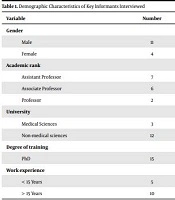
In the second stage, the required data were collected via 12 semi-structured, face-to-face interviews with the faculty members (eight men and four women) who held managerial positions. The interviewees were selected via porpusive method and data collection continued in both steps until data saturation. The duration of each interview was 25 minutes, and the semi-structured interviews consisted of seven questions. Notably, the senior executives of the medical universities and academic departments and four chief managers refused to participate in the interviews. Seven academic schools and central executive departments of Kermanshah University in 2019 were selected for the study.
In each qualitative phase, the open coding of the documents and interviews were performed by the researchers in order to discover the dimensions and components. The reliability of the analyzed documents was assessed based on intercoder reliability using the Lawshe formula (83.87%). Moreover, the reliability of the interviews was analyzed through peer debriefing, and the inter-rater reliability was estimated at 85.35%. Afterwards, axial and selective coding was performed for the analysis and control of the data by four co-researchers to increase validity. In total, 456 primary open-source codes were identified, which were reduced to 277 non-repetitive open-source codes. Following that, the non-repetitive open codes were reduced to 26 axial and eight selective codes.
In the analysis of the semi-structured interviews in three stages, open, pivotal and selective coding was conducted. After the transcription of the interviews line by line, the collected data were converted into textual data, which were open-coded with full precision. At this stage and the residueal stages, the textual data and data coding were controlled by four co-researchers.
At the initial stage of open coding, 484 primary open-source codes (concepts) were identified, which were reduced to 381 non-repetitive open codes. Afterwards, the non-repetitive open codes were reduced to 33 subcategories and 10 selected codes (main categories). Notably, we considered the categories in which the saturated conceptual space of the concepts was most possible. In the axial coding stage, the identified codes were classified into six categories using the systematic approach of the grounded theory. The causal conditions, underlying conditions, interventional conditions, central categories, deployment strategies, and consequences corresponded to the systematic approach of the grounded theory. Finally, the coding components of documents and interviews were compared, and the final 30 components were selected in six dimensions. Correspondingly, the succession management questionnaire was developed for the faculty members of the medical universities.
The validity of the questionnaire was assessed based on the comments of 12 informants in management sciences, and the reliability was assessed by conducting a pilot study on a sample size of 40 individuals (α = 0.701). After the pilot study, sampling was performed from seven schools of Kermanshah University of Medical Sciences in 2019, and the sample size was determined to be 205. Data analysis was performed using descriptive and inferential statistics, and the reliability of the questionnaire in the original study was α = 0.785.
In order to observe ethical considerations, the permit to conduct the research was obtained from Kermanshah University of Medical Sciences, and participation in the study was voluntary for the faculty members, the information of whom remained confidential. The study outcomes were communicated to the participants. Data analysis of the questionnaire was performed in SPSS version 23 and Amos software. In addition, the Smart PLS software was used to examine the correlations between the hidden variables and model fit in partial least squares.
4. Results
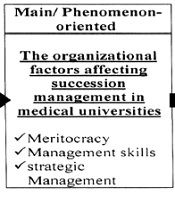
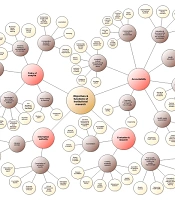
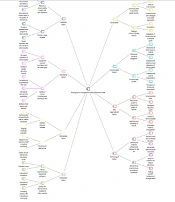
The results of the qualitative phase revealed 30 general categories, which were developed as a paradigmatic model. The axial phenomena include merit-based managerial skills and strategic management. Causal conditions consist of human resource management and chief management beliefs.
Contextual conditions include complexity of the academic environment, intra-departmental interactions, political space, extracurricular pressures, organizational misconduct, the crisis of capable executives, provincial indigenous management, intra-university administrators, policy councils, non-competitive rewards and recognition of the key positions.
Interventionist conditions of organizational culture, organizational environment, managerial experience, productivity and physical/mental fitness. In this paradigmatic model strategies in clouds organizational stability of the managers, academic independence, knowledge-based management and scientific-research empowerment. In this suggestion model outcomes consist of increasing satisfaction, ethical management, use of scientific models, creating a dynamic university, improvement of organizational motivation and promotion of the counseling culture in the university managers. These dimensions were related to the central issue of ‘organizational factors affecting succession management’.
Regarding the age distribution of the respondents, the age range of the participants was 28 - 62 years, and the mean age was 42.30 years (6.69%). The work experience of the respondents was within the range of 1 - 34 years, while the mean work experience was 13.50 years (7.72%), and work experience as a faculty member was within the range of 1 - 32 years.
The factor analysis of the six dimensions of the surrogacy management questionnaire was performed in a single case and each dimension of factor analysis. Prior to factor analysis, the Kaiser-Meyer-Olkin (KMO) and Bartlett tests were performed to ensure the adequacy of the sampling and significance of the data (Table 1). After the elimination of the common items between the factors in factor analysis, the weak items of the factors (> 1) were identified, all of which had a higher share of 0.3 and could explain the acceptable percentage of the common variance.
Table 1.
Factor Analysis of Six Dimensions of Succession Management Questionnaire
| Dimensions | KMO | P Value | Factors with Value of > 1 Based on Scoring Chart | Percentage of Common Variance | Cronbach’s Alpha after Factor Analysis |
|---|---|---|---|---|---|
| Central category | 0.663 | 00.0 | 1 | 58 | 0.63 |
| Causal conditions | 0.715 | 00.0 | 3 | 52 | 0.64 |
| Underlying conditions | 0.708 | 00.0 | 10 | 63.5 | 0.65 |
| Interventional conditions | 0.774 | 00.0 | 4 | 53.6 | 0.65 |
| Strategies | 0.807 | 00.0 | 5 | 65 | 0.65 |
| Outcomes | 0.709 | 00.0 | 6 | 57 | 0.53 |
The validation of the research model was performed using the regression analysis and path analysis. The regression analysis between the surrogate variable and axial phenomena subscales, causal conditions, contextual conditions, confounding factors, strategies, and outcomes of Levene’s test alternate management deployment was used to examine the normality of the data. Since the data were not normal, the regression analysis was applied with log (10 data) instead of the mean scores.
The correlations between the succession management components and variables of the main dimensions (axial phenomenon, causal conditions, contextual conditions, confounding factors, strategies, and outcomes) were estimated at r = 0.995, and the Pearson’s correlation-coefficient between the predicted values and actual values of the dependent variable was estimated at 0.99. The variance values of the criterion variable were also explained by combining the dependent variables based on the R2 coefficient (0.99), and the combined variables accounted for 0.98 of the variance of succession management.
According to the information in Table 1, the observed F value at the degree of six was 3,113.158, and the P value of 0.000 indicated that the F values were significant at the significance level of 0.01. In other words, significant correlations (0.99%) were observed between the linear combination of the succession management subscales and the concept of surrogacy, and the surrogate management criterion variance could be explained by the predictive subscales.
The path analysis using the Amos software version 4.4 was used for the model fit indices. The fit indices of the modified succession model in the medical universities showed that the proposed model was fitted (Table 2). Figure 1 depicts the final model of surrogacy management.
Table 2.
Fit Indices of Modified Alternative Breeding Model in Medical Universities
| Fit Indices | Fit Index | Adjusted Fit Rate of Modified Model | Valid Values for Model Acceptance |
|---|---|---|---|
| X2 | Absolute | 11.79 | |
| NPAR | Number of Components | 29 | |
| Df | Degrees of Freedom | 6 | |
| P value | Confidence Level | 0.067 | Significance < 0.5 |
| CMIN/Df | Parsimonious | 1.965 | Values 1 - 5 were good, values close to 2 - 3 were very good. |
| NFI | Comparative | 0.989 | Values above 0.90 indicative of model fit |
| CFI | Comparative | 0.994 | Values above 0.90 indicative of model fit |
| RMSEA | Parsimonious | 0.069 | Values less than 0.08 showed good model fit |
| P Ratio | Parsimonious | 0.286 | Values of this index between 0 - 1, smaller values indicated higher costs |
Abbreviations: CMIN/DF, normed chi-square, NFI, normed fit index; CFI, comparative fit index; RMSEA, root mean squared error of approximation
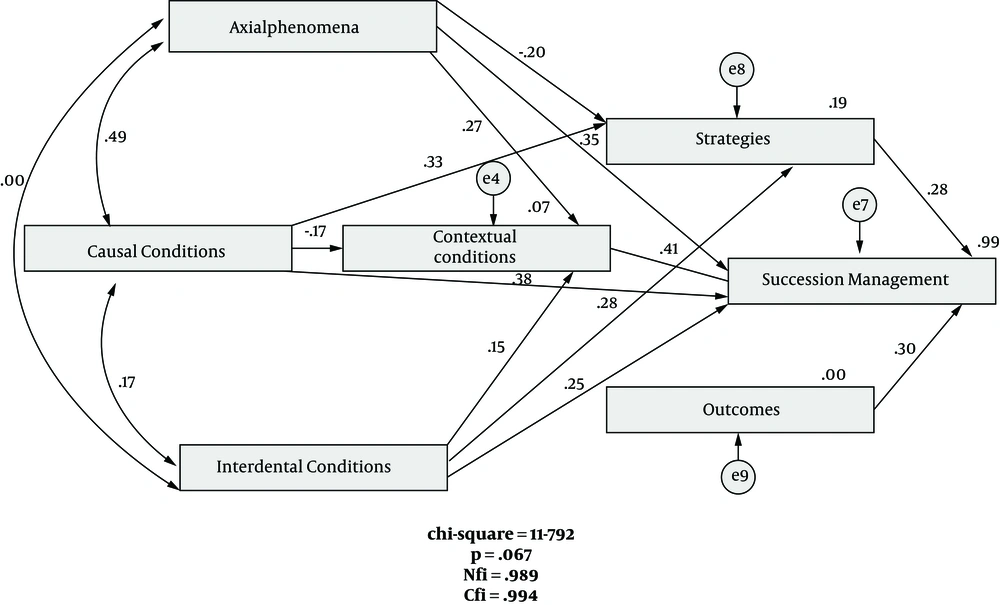
Figure 1.
Final model of succession management
5. Discussion
According to the results of the present study, organizational factors affected the establishment of sucssession management in the medical universities as a central phenomenon, including the three components of meritocracy, management skills, and strategic management. As for the main phenomenon of the organizational factors affecting succession management in the medical universities, meritocracy was the only component that was emphasized with the most citation (92 mentions). Notably, the fundamentals of succession management are merit-oriented, which is a managerial concept that is inseparable from talent management as a system for the identification, promotion, and maintenance of competent individuals with the aim of optimizing organizational balance towards the realization of business outcomes (36). Our findings in this regard are in line with the studies conducted by Bano (2017), Mandi (2008), and Shiri (2011). Furthermore, many researchers believe that the concepts of talent management and succession management overlap (37), which could be considered equivalent and interchangeable.
Therefore, it could be inferred that despite the differences in this dual association, these concepts could be used interchangeably.
The component of managerial skills (87 citations) is a requirement for training directors, and the focus should be placed on the skills and capabilities that are needed in the future business of the organization (38, 39). The findings of the current research regarding this component are in line with the study by Zeinaldini-Bidmeshki (2011).
The strategic management element is the basis for every succession system. Succession systems are linked to the field of HRM, as well as the strategic orientations of the organization, thereby linking these two domains (1). The importance of this component has been clearly demonstrated in the succession model of higher education institutions proposed by McMaster (10). The component of the ‘beliefs of senior university executives’ (39 citations) as the support at the highest level of organization and organizational units is a pillar of deploying succession management in all organizations (7). Moreover, the lack of support from senior executives is considered to be the most important factor in the failure of executive management in the implementation of succession management programs in medical universities (16).
In the qualitative projects based on the grounded theory, the underlying conditions have been reported to be the specific factors that influence both strategies and the general environmental factors that affect strategies and are known as intermediary conditions (40). In the present study, underlying conditions were divided into three major factors of specialized characteristics, management factors, behavioral factors, and political issues. Specialized characteristics included the complexity of academic environments, research orientation, and interactions within the educational groups. Some factors such as the interactions within the educational departments (nine citations) have been among the main components in this regard. Interaction refers to the behaviors of the individuals affecting communication through each other are referred to as social interaction (41). The findings of Tucker (2017) are consistent with the results of the present study regarding the complexities of medical universities.
Although these components have not been specifically stressed in higher education in other studies, the design of the succession management model based on indigenous organizational indices has been recommended in one study (42). In the current research, the components of the ‘organizational misconduct of the director for survival’ (five citations) in managerial positions and ‘false dependence of the educational organization on the current director’ (four citations) were described by the interviewees in remarks such as “The lack of succession management causes damage to the system through taking away the accumulation of the managerial experiences of the current director and failure to transfer them to the new director.”, “Succession may be misunderstood as taking the place of the current director.” or “It may be interpreted as the current manager’s efforts to maintain the current position.” Organizational misconduct refers to the deliberate actions of the members of an organization, which violate the organizational and social core norms. The two components of ‘political atmosphere’ (eight citations) and ‘pressures from outside the university’ (11 citations) were highlighted in the citations and interviews, which was not clearly conceivable in the previous studies in the industrial sector.
In the present study, the intermediate conditions of the model were divided into organizational factors and the potential of the effectiveness of succession management. In previous studies, organizational culture had nine citations, and organizational environment had 11 citations, while the component of management experience under expressions in remarks such as “Effective work experience in universities is helpful.” and “The review of the managerial work record is essential to succession.” were stressed in the interviews of the current research. The component of ‘physical and mental fitness’ (two citations) was described by the interviewees as ‘the ability to work in the field of management’, ‘physical ability to work’, and ‘interest in the management position’. Moreover, the interpretations turning around pivots in remarks such as “The selection of directors and their positions should be consistent with their education.” and “Having academic expertise for the managerial position.” led to the discovery of the ‘academic capability’ component with 16 citations in the model as one of the mediating conditions for the deployment of succession management in universities.
The consequences of deploying succession management in universities based on the proposed model in the present study to lead intermediate/interventional conditions in two levels indicated the potential effectiveness of succession management and organizational factors. Conditions such as increased satisfaction, ethics management, participatory leadership, application of academic models, establishment of dynamic universities, increased organizational motivation, and counseling culture in the academic management were resulted as such. Although these components have been repeatedly addressed and stressed in previous studies, the components of a dynamic university (24 citations) in such examples as ‘avoiding the neglect of previous management programs, avoiding favoritism, creating a logical routine system, and avoiding trial-and-error’ were extracted from the interviews.
There are many similarities between the results of the present study and other studies regarding the establishment of succession management, indicating the existence of succession management principles in organizations depending on the organizational mission and vision. This also applies to higher education and universities and plays an even more crucial role in non-academic organizations as there is the lack of clear beliefs in the university faculty members. Although the research was exploratory, there could be dimensions of a secondary study due to the nature of the data provided by the grounded theory in indigenous and local communities. The practical suggestions of the current research to incorporate decentralized criteria into the key positions of academic ability based academic organizations are based on the complexity of the academic environment in terms of the culture, audience, and clients, as well as the significant differences with other non-academic organizations from the conventional approaches of non-academic organizations. Another practical suggestion is to select university administrators from native faculty members and eliminate non-competitive rewards to medical university administrators. The main recommendation of our study is to maintain academic independence in medical universities by selecting managers based on the succession management process.
The main limitation of the present study was the lack of familiarity with many samples of succession management, to the extent that it made it difficult for the memos to make a link between the codes. Due to the fact that it is a new issue in Iran, another limitation was the inadequate citation in local articles.
5.1. Conclusion
This study aimed to present a model and validation for the deployment of succession management in medical universities. The sample population consisted of the senior managers of the medical universities Kermanshah, who were experts in the field of human resources. According to the results, the succession management model consisted of six dimensions and 30 components. The data were analyzed based on the qualitative grounded theory, and the proposed model was based on three merit-oriented categories in the fields of science, ethics, physiology, psychology, updated management skills, and the requirements to implement succession management in the strategic plans of universities. The findings of the qualitative phase were based on the grounded theory and introduced a native model of succession management in Kermanshah University of Medical Sciences. In the qualitative phase, the validity of the model fit and fit indices indicated the suitability of the model for the faculty members of medical universities.