
1. Background
Tyler and Hlebowitsh define evaluation as a process for determining the degree to which educational objectives and program performance are consistent (1). Fitzpatrick et al. also define evaluation as the identification and clarification of practical and defensible criteria, collecting information, and determining the value of the subject under evaluation in relation to these criteria (2). Evaluation is an inherent element of the teaching-learning process, which remarkably affects teaching and learning (3). Evaluation is used to measure the process and attain educational goals. Rather than emphasizing on failures, evaluation should be accompanied by the engagement and motivation of learners. In addition, evaluation highlights strengths, weaknesses, threats, and opportunities in order to improve the teaching method (4).
Educators are rewarded when the result of their work is appropriate and desirable and cannot be achieved unless the findings are judged with confidence about their disciples. In the planning of teaching and decision-making in educational activities, educators need substantial and reliable information about the preparedness and academic achievement of learners, as well as the efficiency of classroom activities; evaluation could provide such information (5). Evaluation helps educators become aware of the progress of learners and identify their strengths and weaknesses (6). According to the findings of Aslramz, evaluation helps educators in achieving educational objectives, and by showing the strengths and weaknesses of teaching and learning processes, facilitates timely correction and improvement (7). Furthermore, evaluation helps educators to become adapted to various teaching strategies and pay attention to the needs of learners in order for the opportunity of successful learning (3). When evaluation and education are effectively intertwined, they enable educators to find the individual needs of learners at the right time.
Through evaluation, learners will be able to discover their positive and negative aspects, which urge them to strive to develop the positive aspects and eliminate their educational inadequacies with the guidance of educators. Evaluation causes the educational content to be constantly reviewed and not be forgotten (8). The results of evaluation also aid students to self-identify, which is an important educational objective and influential factor in conscious decision-making. Evaluation is a key element in the provision of feedback to learners from the beginning of training until the final exam (5, 9). Previous findings have indicated that attention to evaluation improves the performance of learners (10).
Despite the benefits and importance of evaluation in the teaching-learning process, a comprehensive and native model for the evaluation of the learners in the Iranian higher education system has not been developed, and data is scarce in this regard. Therefore, the identification of the influential factors in the high-quality and effective implementation of evaluation in the teaching-learning process is essential to taking effective steps toward eliminating the current issues associated with evaluation in the teaching-learning process. In fact, the influential factors in the effective implementation of evaluation encompass all the factors that contribute to the evaluation process, making educators and learners aware of the teaching and learning status.
2. Objectives
The present study aimed to identify the influential factors in the effective implementation of evaluation in the teaching-learning process in the Iranian higher education system. To this end, the national studies regarding the influential factors in evaluation of the teaching-learning process were reviewed.
3. Methods
This study was conducted using the synthesis method to identify the influential factors in the effective implementation of the teaching-learning process evaluation in the Iranian higher education system. The research was based on a qualitative approach. The sample population encompassed all the studies focused on the influential factors in the evaluation of the teaching-learning process during 2000 - 2018. In total, 36 studies were selected, and after several screening stages, 10 studies that were more relevant to the subject matter were selected as the research sample based on the review of the titles, abstracts, and research content. Database search was performed using keywords such as the ‘factors/indicators affecting the evaluation of students’ and ‘teachers/implementation of evaluation’. The databases included CIVILICA, Magiran, Elmnet, Noormags, and SID.
For the research synthesis of the documents in the field of the research, content analysis was used in a categorical manner. Initially, open coding was carried out, and after the extraction of the open codes, axial coding was performed. Finally, the identified axial codes were incorporated into the selected codes. For the validity and reliability of the extracted codes, the verification methods of the research team members and the self-review method of the researcher were applied.
4. Results
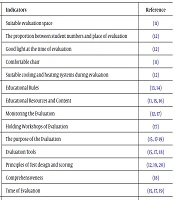
According to the information in Table 1, the analysis of the content of the documents regarding the research yielded five factors and 29 indicators in the form of structural and behavioral dimensions, which were identified for the influential factors in the effective implementation of the teaching-learning process evaluation in the Iranian higher education system.
Table 1.
Findings from Open, Axial, and Selective Coding
| Dimensions | Factors | Indicators | Reference |
|---|---|---|---|
| Structural | Factors related to the Conditions and Environment of Evaluation | Suitable evaluation space | (11) |
| The proportion between student numbers and place of evaluation | (12) | ||
| Good light at the time of evaluation | (12) | ||
| Comfortable chair | (11) | ||
| Suitable cooling and heating systems during evaluation | (12) | ||
| Factors related to the Educational System | Educational Rules | (13, 14) | |
| Educational Resources and Content | (11, 15, 16) | ||
| Monitoring the Evaluation | (12, 17) | ||
| Holding Workshops of Evaluation | (17) | ||
| Factors related to the Evaluation System | The purpose of the Evaluation | (15, 17-19) | |
| Evaluation Tools | (15, 17, 18) | ||
| Principles of Test design and scoring | (12, 19, 20) | ||
| Comprehensiveness | (18) | ||
| Time of Evaluation | (15, 17, 19) | ||
| Behavioral | Factors related to Teachers | Feedback | (18) |
| Lack of bias in evaluation | (19) | ||
| Interacting with students | (11, 19) | ||
| Teaching method | (13, 15-17) | ||
| Expression of Teachers | (17) | ||
| Academic Degree | (11) | ||
| Observance of Ethical Values | (14, 16) | ||
| Teacher's psychological readiness | (11, 17) | ||
| Motivation of Teachers to perform Evaluation | (17) | ||
| Attention to individual differences of Students | (17) | ||
| The Personality Characteristics of the Teachers | (11) | ||
| Factors related to Students | Learner's Readiness | (11, 17) | |
| Students' attitude towards Evaluation | (11, 12, 16, 17) | ||
| Test Anxiety | (12) | ||
| Students' Awareness about Evaluation | (17) |
5. Discussion
In the present study, all the influential factors and indicators of the effective implementation of the teaching-learning process evaluation (human and non-human) were identified in the Iranian higher education system, and no phenomenon or event was outside the interaction of the structural and behavioral dimensions (21). These factors were divided into the main dimensions of structural and behavioral.
5.1. Structural Dimension
The structural dimension described all the elements, factors, and physical/non-human conditions that constitute the order, rules, form, and physical/material body of the organization (22), which encompassed a set of regular associations between the components of the organization (e.g., rules and regulations) (23). The influential factors in the effective implementation of the teaching-learning process evaluation in the Iranian higher education system in the structural dimension included the factors related to the conditions and environment of evaluation, educational system, and evaluation system.
5.2. Factors Related to the Conditions and Environment of Evaluation
The findings of the current research indicated that five main factors related to the conditions and environment of evaluation could influence the effective implementation of the teaching-learning process evaluation. These factors included the proper evaluation space, proportion of the number of student place of evaluation, proper lighting at the time of evaluation, comfortable seats, and proper cooling/heating systems during evaluation.
Since the space and environment where education, learning, and evaluation take place are of great importance, the meticulous design and construction of these spaces should be considered by architects and educational planners, and the design of these spaces should be performed optimally. Such spaces should not have a psychological effect on students, and the evaluation space should prevent fraud on behalf of the students.
There must be a proportion between the number of the student and place of evaluation. In other words, a certain number of students should be placed in each class. The higher proportion is associated with the lower probability of loss of focus in the student. Lighting is another important influential factor in the design of educational environments as it affects the implementation of evaluation. The position, size, and type of the windows also determine the amount of space lighting in the design of an educational environment. High-low lighting during education and evaluation causes vision problems in the students. The evaluation process may last from minutes to several hours, and the individuals need comfortable seats to focus on the exam; this is an important aspect of evaluation, which is often neglected since inappropriate deployment may disrupt the calm and quiet of the environment.
The status of the temperature of the evaluation space is another factor related to the conditions and environment of evaluation. If the evaluation space is overly cold/hot, the students are sure to face problems and cannot properly transfer their competencies. In addition, some students may not be able to tolerate cold/heat. Therefore, the status of the temperature of the evaluation space should be appropriate.
5.3. Factors Related to the Educational System
The findings of the current research demonstrated that four main factors that were related to the educational system (educational rules, educational resources and content, evaluation monitoring, and holding evaluation workshops) could influence the effective implementation of the evaluation of the teaching-learning process. Every educational system has a set of rules and regulations that are imperative to teachers and students to observe the frameworks. Evaluation is one of the sub-systems that should be subjected to these rules and regulations. With the changes in the structure and plans of educational systems, the role of educational evaluation has become more prominent. Therefore, educational rules and regulations directly affect the implementation of evaluation.
The setting of educational contents is considered to be a major determinant of learning. Occasionally, inefficient and inappropriate content and its disproportion with the understanding ability of the students make learning difficult or yields outcomes that fall short of expectations, which in turn affects the evaluation process. Evaluation should be consistent with the contents of formal educational programs and materials and encompass important learning in relation to the general goals of education.
The monitoring of evaluation is an important task that is essential to efficient educational systems, and its main purpose is to improve education and learning. The presence of educational monitoring programs and their continuity in the achieving of educational goals are of utmost importance. Today, evaluation monitoring aims to improve the quality of the implementation of evaluation by providing various methods of monitoring for teachers, and with their help and through professional cooperation, the performance quality of the teachers could improve, along with problem-solving regarding the implementation of evaluation (24). Furthermore, holding evaluation workshops could influence the implementation of evaluation as it allows teachers to be informed of what, why, and how to evaluate. Therefore, evaluation strategies should be disseminated to all teachers (1). Holding evaluation workshops is considered to be an optimal method to inform teachers and students about the evaluation process.
5.4. Factors Related to the Evaluation System
The findings of the current research indicated that there are five factors related to the evaluation system, including the purpose of evaluation, evaluation tools, principles of test design and scoring, comprehensiveness, and time of evaluation. It should be determined whether the purpose of evaluation is the improvement of learning (formative evaluation) or measuring the amount of learning (summative evaluation) (25). Each of these purposes has specific features, tools, and methods. Therefore, the purpose of the evaluation should be initially determined.
Evaluation tools are another influential factor in evaluation systems. Based on the information received from evaluation tools, the teacher obtains a clear picture of the learning process and the results of the students’ efforts. In addition, the diversity of the information obtained from various evaluation tools increases the credibility of the teachers’ decisions (26). For the usefulness of the information, it is essential that the information be directly related to the content of the educational goals, program, methods, and means, as well as the characteristics of the learners; without the consideration of these factors, test contents cannot be properly determined (27). Therefore, it is crucial for teachers to observe the design principles of tests while designing their content.
Attention to various dimensions of learning is considered to be another key influential factor in the effective implementation of evaluation. The principle of comprehensiveness propels that the evaluation process must cover all the aspects and levels of learning. Moreover, the time of evaluation should be appropriate, and the end of the course is not a proper time for evaluation. Notably, summative evaluation is to be deducted, while summative evaluation is not sufficient due to the inappropriate position, and other types of evaluation (especially formative evaluation) are required. In this regard, Maroufi et al. stated that the evaluation space, appropriate lighting, and evaluation time are important influential factors in evaluation, which is in line with the present study (28).
5.5. Behavioral Dimension
The behavioral dimension refers to the performance of behavior of individuals. Therefore, the main content of every organization revolves around human behavior (21). In the current research, the behavioral dimension encompassed the factors related to teachers and students.
5.6. Factors Related to Teachers
The findings of the current research revealed 11 main factors in this regard, including feedback, lack of bias in evaluation, interaction with students, teaching methods, the expression of teachers, academic degree, observance of ethical values, psychological preparedness of teachers, motivation of teachers to perform evaluation, attention to the individual differences of students, and characteristics of teachers. The mentioned factors could largely affect the effective implementation of evaluation in the teaching-learning process. In evaluation, feedback plays a pivotal role in achieving educational goals and improving the quality of learning and teaching-learning, as well as attracting the attention of learners and their parents. In the new evaluation approaches that seek to guide the learning paths of students, effective educational feedback based on the actual performance of students in the learning process is considered to be a fundamental, underlying concept. In this regard, Murray concluded that providing post-evaluation feedback to students could improve their education and performance in evaluation (29). Furthermore, Aliasgharpour et al. reported the quality of feedback to be a key influential factor in evaluation, which is in line with the results of the present study (11).
Evaluation should be without bias; in other words, the conditions for the implementation of evaluation should be equal for all students. In conducting an evaluation, the teacher should not discriminate between students. According to Ranjbar et al. personal goals should not be involved in the evaluation process (30).
As a result of interactions, teachers find more cognition than students, which makes it possible for teachers to consider the methods of evaluation and scoring (19). Teachers should not discriminate in these interactions since they may discriminate in the evaluation process of learners as well. Johnson considers the learner-learner interactions to be important influential factors in evaluation, which is consistent with the results of the present study (31).
In modern teaching methods, learning occurs through the interactions among the students and use of learning assist tools, which could be effective in the improvement of student learning and performance, as well as the evaluation outcomes. In addition, the education and evaluation of students’ learning should not be allocated to a specific place and time (32). The teaching methods applied by teachers may vary in different situations, making it possible to use diverse evaluation methods in accordance with teaching methods.
According to Shakournia et al. (33), the expression of teachers and their ability to deliver lessons largely influence evaluation and content learning, thereby resulting in successful evaluation. Academic degree is another influential factor in evaluation as it involves two main components of knowledge and experience. Teachers with a higher academic degree have more knowledge and experience, which help them use various evaluations in different situations. In this regard, Aghamirzayi et al. claimed that academic degree is an important influential factor in evaluation, which is in line with the results of the present study (34).
The observance of ethical values is another important component to be considered in evaluation. For instance, the teacher’s questions should not be imperative or the teacher should not evaluate specific students because it may signal discrimination, which is in sharp contrast to ethics (35, 36). Furthermore, it is essential to refrain from humiliating students in the classroom since evaluation is only performed to understand the progress of learners, and any comparison or reprimand must be avoided (32).
Teachers experience different behaviors in different situations, which reflect the psychological impact of the situation. In the evaluation process, the psychological preparedness of teachers is paramount since the teachers who do not have the necessary psychological preparedness may have rigorous evaluations or vice versa. In addition, the lack of psychological preparedness in teachers hinders proper evaluation.
Every teacher has a different motivation to carry out evaluation and seeks specific goals through. For instance, the motivation of some teachers to carry out an evaluation could be to identify the strengths and weaknesses of students or some teachers may seek to identify the learning level of students and takes measures for their improvement. In this regard, Aliasgharpour et al. considers the motivation of teachers to conduct evaluation as an influential factor in evaluation (11).
Different students have different conditions, and teachers should pay attention to this issue. For this reason, the average ability of students should be considered, and in addition to the activities, assignments, and educational regulations that should fit the students’ talents and physical, mental, and intellectual preparedness, the average ability of students should be evaluated as well. Undoubtedly, there are elites in every class, and evaluation should disregard their special abilities. Since each student has a dominant personality brigade (visual, auditory, tactile), it is justified that a variety of visual questions (tables, diagrams, figures) and common writing be incorporated in tests.
The personality of the teacher plays a pivotal role in the implementation of effective evaluation. As such, it could be stated that the personality and behavior of the teacher in the classroom also affects the evaluation process, as well as the enthusiasm and motivation of students for education and learning, which in turn enhances the quality of teaching-learning (19). For instance, a rigorous teacher may act in a rigorous manner and give hard tests, causing the grades of the students to plunge. Factors such as realism, fair behavior, and accountability are among the other important characteristics of teachers that affect the evaluation process. In this regard, Vakili et al. considers personality traits to be significant influential factors in evaluation, which is consistent with the results of the present study (37).
5.7. Factors Related to Students
The findings of the current research indicated that there were four factors related to students in the evaluation process, including preparedness, attitude toward evaluation, test anxiety, and awareness of evaluation. Previous knowledge and readiness of learners are prerequisites for learning and could even be effective in the evaluation process. In this regard, Potts (38) claimed that the lack of psychological preparedness in students at the time of tests increases their anxiety. Evaluation should be performed when students are psychologically and informationally able to participate in evaluation. In addition, some students consider evaluation as a positive factor in receiving feedback and improving learning, while others tend to have an electronic evaluation instead of a written evaluation. This shows the attitudes of students toward evaluation and is a significant influential factor in the implementation of evaluation in the teaching-learning process.
Test anxiety is a common mental state that occurs in almost every individual throughout life with varying degrees. Test anxiety is also common when examination times approach, so that everyone might experience this state at least once in their lifetime. For this reason, when a student is in a testing position, anxiety may arise (39). Factors such as the difficulty of the exam questions, fear of the test, and perception of students regarding failure in exams could increase test anxiety. According to the findings of Jacobs and Koehn, the awareness of students regarding evaluation and its method is the most important factor to be considered in the evaluation process (40). If students are aware of the evaluation from the beginning, they have higher motivation for learning and gaining new skills, which in turn makes them better acquainted with the evaluation approach and encourages harder work to obtain better results, thereby contributing to the effectiveness of the evaluation process.
5.8. Conclusion
This study aimed to determine the influential factors in the effective implementation of evaluation in the teaching-learning process in the Iranian higher education system. The identified factors included the structural dimension (factors related to the conditions and environment of evaluation, educational system, and evaluation system) and behavioral dimension (factors related to teachers and students). The implementation of evaluation in the Iranian higher education system is influenced by several factors that have been reported in the previous studies as well, and the research synthesis method combines and integrates these factors. Therefore, special attention must be paid to these factors as an appropriate practice guide for the officials of the Iranian higher education system. Our findings could be incorporated into a model as the basis for the further investigations in this regard.