
1. Background
The human development and human knowledge, as well as the volume of various curricula and few opportunities of students for the in-depth understanding and development of long-term skills (e.g., critical thinking, problem-solving, and communication) have attracted the attention of scholars to the overwhelming challenge of facilitated learning and its improvement, as well as the role of teachers and educators (1).
Numerous studies have indicated that despite over-training, learning does not occur properly, and the current educational approaches have changed in favor of applying appropriate teaching strategies to shift from traditional teaching methods to interactive and cooperative approaches (2). Since teaching patterns and methods are key structural issues in higher education, cooperative learning methods have been widely used for a number of reasons (3).
The reasons Jeddah has cited in his review study and comprehensive research demonstrated that cooperative learning is based on theory, its efficacy has been proven, and the method encompasses various techniques that could be used by educators. The main theories on which cooperative learning are based include anthropology (Mead, 1936), sociology (Coleman, 1961), economics (Fon Meuse, 1949), political sciences (Smith, 1759), psychology, and other social sciences. In the field of psychology, studies have shown that cooperative learning is rooted in social dependency (Deutsche, 1949, 1962; Johnson & Johnson, 1989), cognitive development (Johnson & Johnson, 1979; Piaget, 1950; Vigotsky, 1978), and behavioral learning theories (3).
Several studies have been focused on the principles and applications of cooperative methods, which have been assessed in various investigations for comparison with other methods. For instance, Slavin introduced some of the most successful methods in 1991 in this regard, including student group learning, team development, team competition, individual learning with team assistance, cooperative-integrated reading and writing, subdivision of the subject into different sections, learning together, group research, and jigsaw (4).
The jigsaw method was designed by Aronson et al. in 1978 and modified by Slavin in 1937. In this method, learners are grouped into teams of 2 - 4 to work on a subject that has been divided into different sections. The jigsaw method has a prominent feature over other special collaborative learning methods. In this technique, individuals, teams, and experts are part of the discussion or topic that they have selected and are provided with a special opportunity for the training of students to take responsibility and develop critical thinking skills, strengthen self-esteem, reinforce positive attitudes, strengthen self-leadership skills, adopt problem-solving, foster creative and intelligent behaviors, and teach sophisticated social behaviors and other social skills to students (5).
The development of learning and, application of knowledge, and acquisition of capabilities and meta-abilities in medical science education and the related disciplines have been influenced by the learning practices in the environment. Approximately 80% of Iranian teaching methods are lecture-based, which may be forgotten within weeks. Cooperative learning is of particular importance as one of the most effective approaches to learning. In addition to learning, this method helps learners acquire useful social skills such as self-management and problem-solving. Several studies have been conducted in this regard, especially in the field of nursing. Medical and nursing jobs are considered highly important considering their specific professional roles.
2. Objectives
This review study aimed to assess the effects of the cooperative jigsaw method on various learning outcomes in medical education.
3. Methods
This systematic review and meta-analysis was conducted via searching in databases such as PubMed, Google Scholar, SID, and MagIran using keywords such as the jigsaw method, cooperative learning, and Iranian medical students. The references of the related articles were assessed, and the authors were contacted in many cases.
No limitations were considered regarding the year of the study, and all the studies published until the period of the current research were selected. The search results were assessed by three reviewers, and several steps were followed to identify the relevant studies for the meta-analysis. Initially, the results were selected based on the study title, and the irrelevant titles were eliminated. Afterwards, the abstracts of the articles with extractive titles were examined, and the irrelevant and duplicate titles were eliminated. Finally, the articles containing both relevant titles and abstracts were selected for analysis (6).
In order to extract the data, a checklist of the required information was prepared. The inclusion criteria were the experimental and quasi-experimental studies conducted on various sample populations or the interventional studies with a pretest-posttest design and intervention measurements. The interventions encompassed the jigsaw or puzzle methods, as well as conventional comparative methods. The measurable outcomes were the changes in knowledge, performance or perception, satisfaction, and social skills.
The meta-analysis was performed to determine the summary estimate in the intervention and control groups using the CMA3 software (comprehensive meta-analysis software) and the fixed model method. Data were extracted through qualitative evaluation by two of the project partners, and the heterogeneity of the studies was measured using the I2 index with the following formula (7):
The forest plot was drawn to provide the quantitative results. In order to perform the meta-analysis and calculate the summary estimate, these values were computed based on the formulas of mean differences, standard deviation for mean differences, pretest and posttest scores in the intervention (jigsaw method) and control groups (8). The r value shows the correlation between the pretest and posttest scores, and the correlation-coefficient value was considered to be r = 0.5.
4. Results
The Google search results yielded 71 articles, Google Persian search yielded 512 articles, SID search yielded 18 articles, MagIran search yielded 25 articles, and PubMed search yielded 56 articles. In total, 682 articles were screened through the flowchart screening process (Figure 1) after the elimination of the irrelevant titles, duplicates, and abstract reviews. Finally, 10 relevant articles remained for analysis (Table 1).
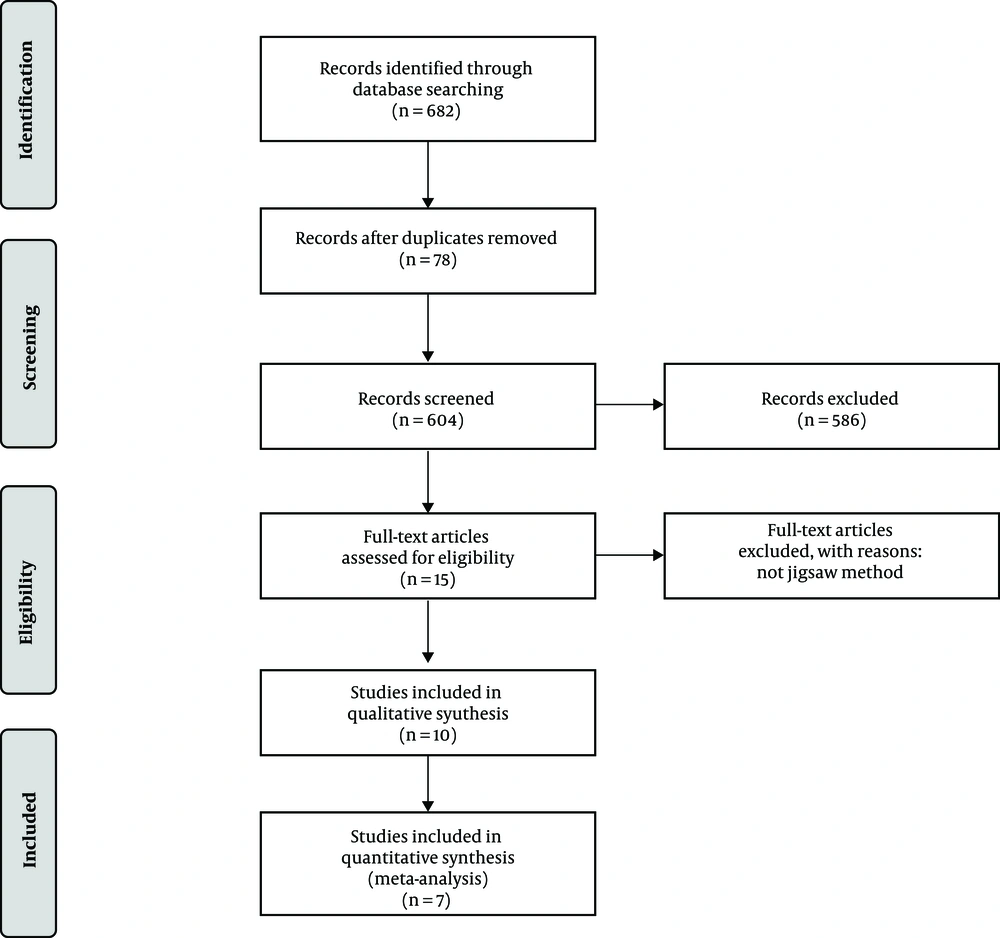
Figure 1.
PRISMA flowchart of selected studies
Table 1.
General Characteristics of Selected Articles
| First Author | Year of Study | Location of Study | Sample Population | Type of Study | Tools | Expected Measured Outcome | Ref. |
|---|---|---|---|---|---|---|---|
| Gholamhosseini L. | 2012 | Tehran | Army Medical Students | Quasi- experimental; Pretest with control group | Questioner | Learning, Attitude | (9) |
| Torabizadeh K. | 2010 | Tabriz | Nursing Students | Quasi- experimental; Pretest with control group | Questioner | Perception | (10) |
| Baghcheghi N. | 2011 | Arak | Nursing Students | Quasi- experimental; Pretest with control group | Questioner | Communication Skills | (11) |
| Haghighat M. | 2014 | Ahvaz | Nursing Students | Quasi- experimental; Pretest with control group | Questioner | Learning, Satisfaction | (12) |
| Javaheri Arasteh A. | 2019 | Tehran | Nursing Students | Quasi- experimental; Pretest with control group | Questioner Performance Checklist | Learning, Performance | (13) |
| Bagheri SJ. | 2017 | Urmia | Nursing Students | Quasi- experimental; Pretest with control group | Questioner Performance Checklist | Learning, Performance | (14) |
| Sanaie N. | 2019 | Tehran | Nursing Students | Quasi- experimental; Pretest with control group | Questioner | Learning, Motivation | (15) |
| Noruzi HM. | 2016 | Mashhad | Nursing and Anesthesiology Students | Quasi- experimental; Pretest with control group | Questioner | Learning, Satisfaction | (16) |
| Sadeghnezhad Forotagheh M. | 2013 | Mashhad | Anesthesiology Students | Quasi- experimental; Pretest with control group | Questioner | Learning, Satisfaction | (17) |
| Jafariyan M. | 2017 | Gonabad | Clinical Laboratory Sciences and Public Health Students | Quasi- experimental; Pretest with control group | Questioner | Learning, Satisfaction | (18) |
Out of 10 studies (Table 1) that were performed using experimental and quasi-experimental methods, the study by Gholamhosseini was quasi-experimental and conducted on two groups, while the quantitative results were not presented in the full-text article, and only the qualitative results were reported (9). In addition, two articles by Torabizadeh et al. (10) and Baghcheghi et al. (11) were interpreted individually due to the measurement of different outcomes and small sample population and were not included in the meta-analysis. Finally, seven articles with a pretest-posttest design, intervention and control group measurements, and random allocation were selected for the final analysis to calculate the summary estimate. The heterogeneity index (I2) was calculated to be 85, which indicated high heterogeneity.
The specifications of the reviewed studies are presented in Table 2 (12-18). Only in the study by Gholamhosseini (9), the sample population included army medical students, and in the other cases, the studies were performed on nursing, anesthesiology and laboratory science, and public health students.
Table 2.
Characteristics of Studies Included in Meta-Analysis
| First Author (Ref.) | Place | Year of Study | Jigsaw Group | Control Group | ||||||||
|---|---|---|---|---|---|---|---|---|---|---|---|---|
| Pretest | Posttest | N | Pre | Post | N | |||||||
| Mean G1 | SD G1 | Mean G1 | SD G1 | Sample Size | Mean G2 | SD G2 | Mean G2 | SD G2 | Sample Size | |||
| Haghighat M. (12) | Ahvaz | 2014 | 15.60 | 3.70 | 32.50 | 3.60 | 17 | 15.50 | 2.30 | 33.05 | 2.70 | 20 |
| Javaheri Arasteh A. (13) | Tehran | 2019 | 8.66 | 1.98 | 11.54 | 2.20 | 36 | 7.91 | 1.91 | 7.88 | 2.23 | 36 |
| Bagheri SJ. (14) | Urmia | 2017 | 13.54 | 1.25 | 17.30 | 1.45 | 36 | 12.81 | 1.83 | 17.30 | 1.45 | 34 |
| Sanaie N. (15) | Thehran | 2019 | 12.74 | 3.21 | 19.34 | 2.43 | 41 | 13.04 | 2.97 | 13.65 | 2.73 | 41 |
| Noruzi HM. (16) | Mashhad | 2016 | 22.40 | 3.50 | 35.80 | 3.80 | 33 | 24.00 | 3.70 | 44.00 | 3.30 | 32 |
| Salehnezhad Forotagheh M. (17) | Mashhad | 2013 | 4.10 | 1.35 | 8.50 | 1.10 | 30 | 4.40 | 1.25 | 4.4 | 1.25 | 30 |
| Jafariyan M. (18) | Gonabad | 2017 | 15.97 | 1.52 | 18.80 | 1.27 | 18 | 15.68 | 1.74 | 14.78 | 2.31 | 16 |
In the study conducted by Gholamhosseini on army medical students, the jigsaw method was used to measure the changes in knowledge, skills, and attitude development, and the results were qualitatively presented. The positive changes in the intervention group were reported as well (9). In the mentioned study, the students who had selected a course in the health information technology of disease classification systems were considered as the research samples. The basic research tools were the knowledge, skills, and attitude of the students, as well as their academic achievement test during the course.
The studies performed by Baghcheghi et al. and Torabizadeh et al. were excluded from the analysis because the measured outcomes were different and not replicated in the other studies. The measured outcome in the study by Torabizadeh et al. was the perceptions of nursing students toward the psychosocial atmosphere of classrooms in terms of the relationship with the teachers, intimacy, clarity of the tasks, interaction and cooperation, attention to individual abilities, justice, innovation, and creativity. These outcomes were measured using parametric analysis, and no significant difference was reported between these two active methods of teaching in terms of their effects on the perception of the nursing students regarding the psychosocial environment of the classrooms. On the other hand, the results obtained by Baghcheghi et al. demonstrated the significant impact of the jigsaw method compared to the comparative method on enhancing communication skills in clinical settings.
Due to the small number of the articles, only two studies by Javahari Arasteh et al. (13) and Bagheri et al. (14) measured the outcome of clinical performance and skills, while no analysis was performed to determine the summary estimate of the performance outcome. Javaheri Arasteh et al. (13) examined the performance of nursing students in basic cardiopulmonary resuscitation, reporting that in the jigsaw training group, performance significantly increased compared to the control group immediately after and three months after the training.
The findings of Bagheri et al. (14) indicated the significant increase in the clinical skill assessment of nurses before and after the intervention. In the mentioned study, the tools used to measure the outcomes were questionnaires, and the outcomes included learning, communication skills, perception, and satisfaction. However, only the learning outcome was included in the analysis of the current research since satisfaction with learning was only measured in four papers (12, 16-18). One of the limitations of this review was the difference in the applied questionnaires for outcome measurement.
The research conducted by Sanaie et al. addressed the impact of the jigsaw method on motivation (15), and satisfaction and motivation were reported to improve in the jigsaw technique group. Table 3 shows the summary estimate calculated for the total mean difference index. Figures 2 and 3 depict the forest plot of the results of the intervention and control groups and in total, as well as the relative weight of each study.
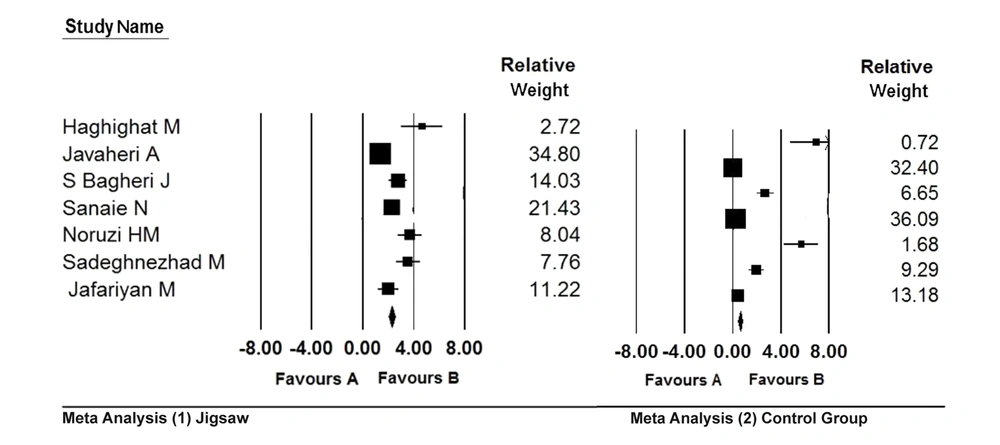
Figure 2.
Forest plot of 1) jigsaw group and 2) control group (pretest and posttest)
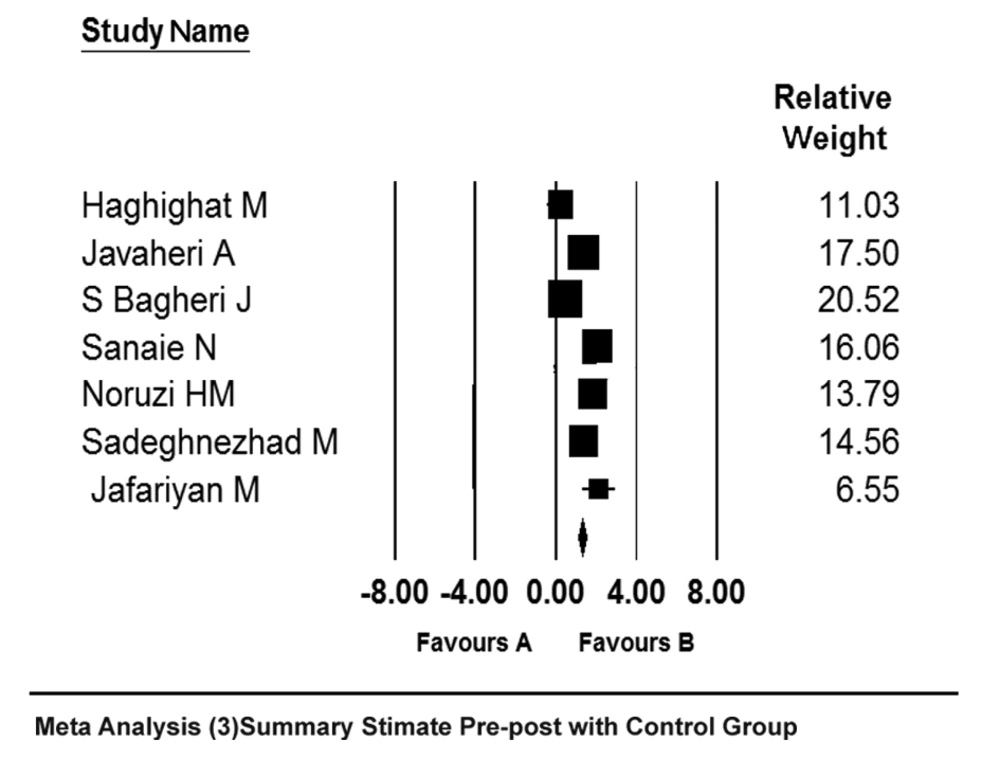
Figure 3.
Forest plot and total summary estimate
Table 3.
Meta-Analysis Results of Summary Estimate and Groups by Split (Jigsaw and Control)
| Model | Study Name | Statistics for Each Study | ||||||
|---|---|---|---|---|---|---|---|---|
| Std Diff in | Standard | Variance | Lower Limit | Upper Limit | Z Value | P Value | ||
| Fixed | Summary | 1.295 | 0.110 | 0.012 | 1.079 | 1.510 | 11.785 | 0.000 |
| Jigsaw | 2.273 | 0.137 | 0.019 | 2.004 | 2.541 | 16.590 | 0.000 | |
| Control | 0.644 | 0.095 | 0.009 | 0.458 | 0.830 | 6.384 | 0.000 | |
5. Discussion
The results of the present study were analyzed in the two stages of pretest and posttest in the intervention and control groups in medical education regarding various outcomes of learning, skills, motivation, perception, and satisfaction. As in the most of the studies in this regard, the jigsaw group showed improvement in the comparison of the pretest and posttest outcomes with the control group.
Several studies have been focused on medical education in terms of the tremendous impact of various methods of cooperative learning, demonstrating effective learning outcomes. For instance, Karimi Moonaghi and Bagheri (19) reported the impact and enhancement of the jigsaw cooperative approach on various outcomes of learning, satisfaction, motivation, management, and perception in different countries.
The review study conducted by Jadhav et al. aimed to compare different teaching methods with the jigsaw method by presenting several studies, and the researchers also examined various educational outcomes, such as learning, self-motivation, and self-esteem and were influenced by this teaching method (3). In the field of nursing, Kritpracha et al. demonstrated the impact of the jigsaw method on enhancing self-directed learning outcomes and success of nursing academic achievements in the students of Prince of Songkla University (Thailand) (20).
In another study, Leyva-Moral and Riu Camps reported the increased satisfaction of nursing students (21). In addition, the study by Buhr et al. was conducted on the medical students at Duke University to assess the impact of the jigsaw method on sub-acute and prolonged clinical care in patients. In the mentioned study, the jigsaw training method was reported to be effective in enhancing clinical skills (22). The study by Cho regarding simulated training indicated increased learning, perception, motivation, and satisfaction. As suggested by the author, jigsaw is an effective training strategy in simulated training (23). In a study of pharmacy, Phillips and Fusco demonstrated the effects of this method on pharmacy students at the Chicago School of Pharmacy (24), while Oludipe and Awokoy observed the reduction of anxiety in the students using cooperative learning strategies (25).
The literature review showed that many studies have been focused on medical sciences, especially nursing, and the effective results of the cooperative learning approach have been highlighted and emphasized, only a few of which have been mentioned in this section. Some of the highlights of the method include the enhancement of social skills, high degree of face-to-face interaction, and promotion of individual accountability, positive interactions, and critical thinking (26-28).
In the educational classes based on the jigsaw learning model where the cooperative learning paradigm is practiced, the pattern resembles a puzzle. In the jigsaw method, the participation of each student is as essential as any piece of a puzzle to complete and fully understand the final outcomes. When the role of each student is fundamental, the presence of each student also becomes essential, which is precisely the strength of this strategy (5). The results obtained by Gholamhosseini (9) in army medical students highlighted the challenges in this process, as follows:
1. The unfamiliarity of the faculty members with new teaching methods;
2. Scattered and limited information of the professors regarding active and effective teaching methods;
3. Lack of knowledge of the teachers regarding the organization of classrooms and time management;
4. Lack of workshops on new approaches for the teachers interested in changing educational practices
One of the limitations of the present study was the small number of the studies in the field of medical education, which were also highly heterogeneous. This indicates that in the medical education in Iran, cooperative learning methods are not yet well-established. Due to the small number of the studies in this regard, the results should be interpreted cautiously.
In conclusion, the review of the literature in Iran indicated that the jigsaw method is not adequately used in medical education. Considering the different approaches and outstanding features of various cooperative learning methods as shown in the literature review in most areas and the fact that lecturing remains a dominant method of teaching, changing educational approaches in universities to a wide array of cooperative approaches (e.g., active learning strategies) is recommended in order to enhance the cognitive and non-cognitive aspects of education, especially in the field of medical sciences, which has the major task of promoting the health of the community members. Furthermore, it is recommended that professors be provided with the necessary information and training in order to improve health services.