


1. Background
Today’s conceptual approach could be viewed as a return to rationality and morality. Therefore, ethics are regarded as the cornerstone of developments in from a futuristic perspective (1). Ethics occasionally refer to respecting spiritual values or legal restrictions in terms of the behavior of individuals based on community standards (1, 2). According to Britannic encyclopedia, the three branches of ethics are normative ethics, applied ethics, and meta-ethics (3). Professional ethics is defined as a set of predetermined values that revolve around the ethical codes that should be observed by professionals in the workplace (4).
Although morality is essential to every occupation, it is more prominent in healthcare professions as the proper behavior and responsibility of healthcare staff toward patients play a key role in the improvement of health and wellbeing (5). Therefore, the observance of professional ethics in the performance of various medical groups is more critical than the other branches of care (6). However, the quality of ethics is influenced by multiple organizational factors, such as the quality of social capital.
Social capital encompasses the information, trust, and norms of the interactions within social networks (7). In this regard, Estrin et al. (8) have stated that social capital mainly refers to the communication and participation of the members of an organization as a means to achieving economic capital. In addition, Hasanah (9) considers social capital to be an instrument for achieving social development in various systems with an emphasis on the concept of trust. Social capital is influenced by health through several mechanisms; for instance, increased social capital leads to the release of information and subsequently improves health (10, 11). Furthermore, Shoja et al. (12) claimed that social capital is positively correlated with mental health, and individuals with a better mental health are qualified for social responsibility and playing important social roles. Therefore, special attention should be paid to professional ethics and its association with social capital given the impact of this concept on the physical and mental health of individuals in the field of health care.
Given the importance of this issue, extensive research has been conducted in this regard. In a study by Emamgholi (13), professional ethics played a positive, significant mediating role in the effect of organizational culture on social capital. Furthermore, the findings of Ali Zadeh et al. (14) indicated the correlations between the components of professional ethics and various dimensions of social capital. In the mentioned study, all the components of professional ethics (healthy relationships, attachment to work, seriousness in work, and participation in work) were observed to be positively correlated with the dimensions of social capital (structural, cognitive, and relational capital).
According to the study by Torkzadeh et al. (15), contrary to the concept of social capital in Western foundations and theories and from the perspective of the Holy Qur’an, social capital is a social phenomenon based on principles such as faith, virtue, vision, conviction, and belief in Imamate, as well as spiritual orientation toward divine revelation or salvation, providing the context for achieving positive social outcomes and worldly and afterworld rewards by individuals and social groups.
In a review by Ahmadi et al. (16), the improvement of social capital and communication networks was reported to be effective in enhancing the level of professional ethics, and technology communication and information also mediated the correlations between social capital variables and the promotion of professional ethics. On the other hand, the results obtained by Ghasemizadeh et al. (17) indicated that the cognitive dimension of social capital could predict professional ethics. In another review by Samari and Mesibi (18), the climate of legal and regulatory work ethics was observed to have a more significant impact on the other aspects of the ethics of the work atmosphere, creating an appropriate working climate and improving the job performance of teachers, which ultimately enhanced the development of social capital.
2. Objectives
In general, the present study aimed to predict the professional ethics of physicians and medical specialists based on social capital in Shiraz University of Medical Sciences, Iran. The following research questions were also addressed:
1) What is the status of social capital in the field of research?
2) What is the status of professional ethics in the field of research?
3) Is the professional ethics of medical professionals predictable based on their perception of the social capital in their workplace?
3. Methods
This descriptive-correlational study was conducted on all the hospitals in Shiraz (n = 33) in 2019. Via cluster sampling, 10% of the hospitals were selected as the research sample, and the questionnaires were completed by all the general practitioners and specialists of these centers (n = 200).
Field data on social capital were collected using the social capital questionnaire by Torkzadeh et al. (15). In addition, field data on professional ethics were collected by using a researcher-made scale. In order to calculate the validity of social capital by item analysis, the correlations between the items and total score of each dimension were determined, and the total score of each dimension of social capital and its validity were observed to be high. The Cronbach’s alpha was also used to measure the reliability of each dimension of this questionnaire, indicating high reliability (Table 1).
Table 1.Correlation Coefficients and Internal Consistency of Social Capital Scalea
| Social Capital | Social Trust | Social Norm | Social Network | |
|---|---|---|---|---|
| Correlation-coefficient Range | 0.63 - 0.73 | 0.74 - 0.94 | 0.62 - 0.90 | 0.42 - 0.52 |
| Cronbach’s Alpha | 0.63 | 0.97 | 0.96 | 0.84 |
a** Sig.: 0.0001.
The scale of professional ethics consisted of seven dimensions, including after patient care, protection of information and interaction with the family of patients, conduction of clinical research, provision of clinical education, respect for colleagues, and adherence to professional standards. The items of the scale were constructed based on a range of five options. In order to calculate the validity, the correlations between the items and total score of each dimension were evaluated, and the total score of each dimensions and its validity were observed to be high. In order to measure the reliability of each dimension of the scale, Cronbach’s alpha was used, which had all the dimensions of high reliability. (Table 2).
Table 2.Correlation Coefficients and Internal Consistency of Professional Ethics Scalea
| Professional Ethics | Professional Standards | Respect for Colleagues | Provision of Clinical Training | Conducting Clinical Research | Protection of Patient Information | Protection of Patient Information | Patient Care | |
|---|---|---|---|---|---|---|---|---|
| Correlation-coefficient Range | 0.60 - 0.79 | 0.74 - 0.78 | 0.53 - 0.66 | 0.72 - 0.77 | 0.65-0.76 | 0.80 - 0.85 | 0.50 - 0.70 | 0.50 - 0.76 |
| Cronbach’s Alpha | 0.82 | 0.63 | 0.63 | 0.68 | 0.66 | 0.64 | 0.65 | 0.68 |
a** Sig.: 0.0001.
3.1. Statistical Analysis
Data analysis of the first and second research questions was performed using one-sample t-test, and the third question was analyzed by multivariate regression. It should be noted that in the first and second questions, the cut-off point is 3 (19).
3.2. Ethical Considerations
By providing the necessary explanations regarding the importance and objectives of the research, non-compulsion in the response, non-receipt of the respondents’ details, confidentiality, and non-disclosure of the opinions, the obtained results were only used to improve the effectiveness of organizational behavior and inform the respondents.
4. Results
4.1. What Is the Status of Social Capital in the Field of Research?
The results of one-sample t-test (Table 3) indicated that the mean social capital was higher than cut-off points (Table 3). Therefore, the status of the social capital of the hospitals was considered favorable.
Table 3.Assessment of Social Capital Utility
| Mean ± SD | t | df | Sig. |
|---|---|---|---|
| 4.15 ± 0.29 | 7.5 | 199 | 0.0001 |
4.2. What Is the Status of Professional Ethics in the Field of Research?
The results of one-sample t-test showed that the mean professional ethics of the physicians and medical experts was higher than cut-off points, which was calculated based on the t-value, and the difference was considered significant. In other words, the professional ethics of the physicians and medical specialists of Shiraz University of Medical Sciences had a desirable status (Table 4).
Table 4.Current Status of Professional Ethics
| Mean ± SD | t | df | Sig. |
|---|---|---|---|
| 4.39 ± 0.39 | 14.09 | 199 | 0.0001 |
aQ3 is selected based on a 75% point.
4.3. Is the Professional Ethics of Medical Professionals Predictable Based on Their Perception of the Social Capital in the Workplace?
According to the final model depicted in Figure 1, the professional ethics of the physicians and medical specialists were predictable and identifiable based on their perceptions of social capital. Therefore, it could be concluded that in 69% of the cases, the professional ethics of the physicians and medical specialists can be predicted based on social capital and their perceptions in this regard. (Table 5).
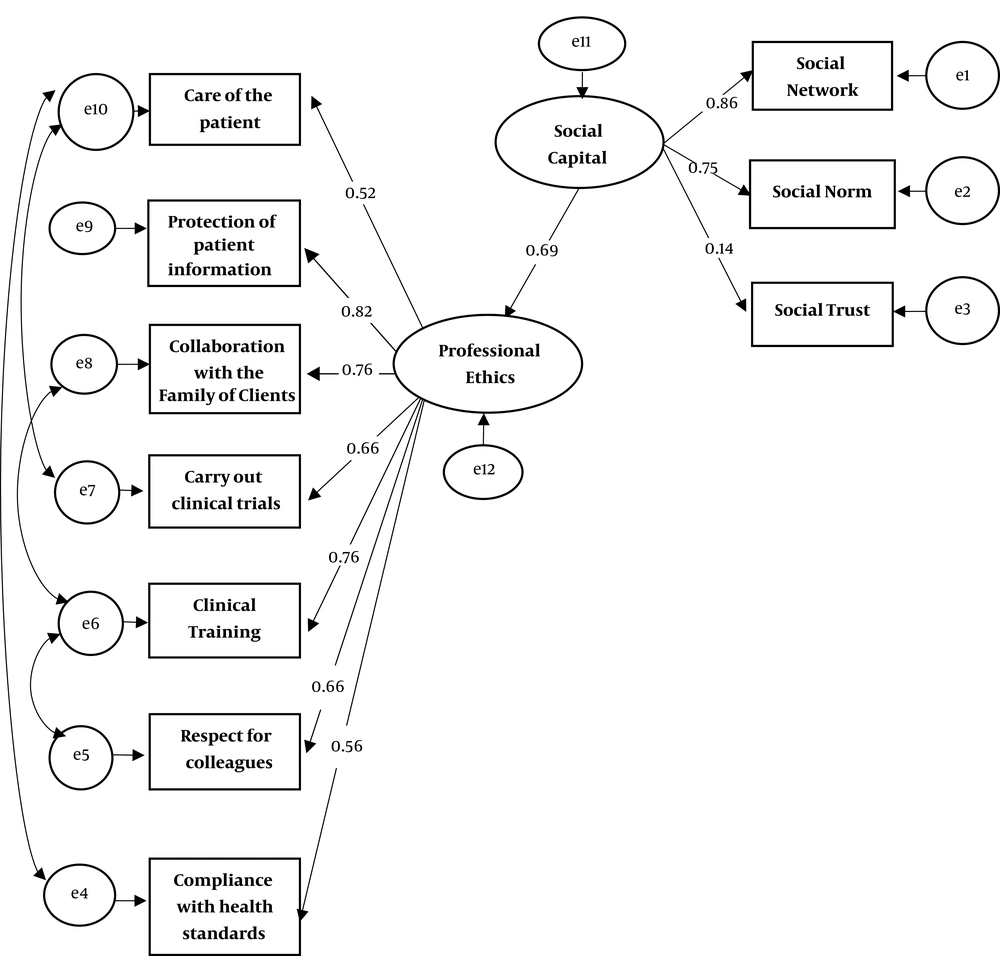
Figure 1.
Final model of research with significant coefficients and confirmatory factor loading
Table 5.Factor Loading in Dimensions of Social Capital and Professional Ethicsa
| Path | Sig. P-Value | Factor Load |
|---|---|---|
| Social capital ← social network | 0.001* | 0.86 |
| Social capital ← social norm | 0.001** | 0.75 |
| Social capital ← social trust | 0.185 NS | 0.14 |
| Professional ethics of physicians ← patient care | 0.001** | 0.52 |
| Professional ethics of physicians ← protection of patient information | 0.001** | 0.82 |
| Professional ethics of physicians ← collaboration with family of patients | 0.001** | 0.76 |
| Professional ethics of physicians ← conduction of clinical trials | 0.001** | 0.66 |
| Professional ethics of physicians ← clinical training | 0.001** | 0.76 |
| Professional ethics ← respect for colleagues | 0.001** | 0.66 |
| Professional ethics of physicians ← compliance with health standards | 0.001** | 0.56 |
a*, P < 0.05; **, P < 0.01; NS, P > 0.05.
In order to evaluate the goodness-of-fit of the model, different values of model fitting were calculated in the AMOS software. Table 6 shows the obtained data on the general fit of the model. Regarding the number of the samples, it could be stated that the fitting of the model was entirely within the acceptable range and was relatively acceptable, while the root mean square error of approximation (RMSEA) index was considered the most important indicator in this context and obtained at 0.079 to confirm the mentioned finding.
Table 6.Index of Final Research Model
| Fitting Indices | Observed Values | Acceptable Range |
|---|---|---|
| Chi-square (χ2) | 82.03 | + |
| Degrees of freedom (df) | 30 | + |
| Significance level (P-value) | 0.001 | ≥ 0.05 |
| χ2 to df | 1.3 | 1-3 |
| Adjusted goodness-of-fit index | 0.94 | ≤ 0.90 |
| Comparative fit index | 0.71 | ≤ 0.90 |
| Stock mean-square residual (RMR) | 0.026 | ≤ 0.90 |
| RMSEA | 0.07 | > 0.1 |
5. Discussion
According to the results of the present study, the physicians and medical specialists believed that the mean social capital of Shiraz University of Medical Sciences was higher than the optimal level (Q3), which indicated that the social capital in this university was excellent. Notably, the form and plan of organizational communication are influenced by the organizational structure (20). This finding is rather justified since the dominant organizational structure in hospitals is mainly empowering to encourage group sympathy and empathy. This finding is rather justified since the dominant organizational structure in hospitals is mainly empowering to encourage group sympathy and empathy. In line with our findings, Gholipour et al. (21) analyzed social capital in terms of structure and content separately, reporting significant correlations between the structural dimension of social capital and management processes, such as the accountability of the managers, transparency in decision-making, and teamwork (21, 22). In the current research, the physicians and medical specialists viewed professional ethics to be at an adequate level (Q3); in other words, the physicians and medical experts highly observed professional ethics. In this regard, Tatoglu et al. (23) stated that although ethical observance is important in every occupation, the degree of adherence to ethical standards varies in the professions of the health sector. This is mainly because proper behaviors along with the responsibility of healthcare staff toward patients play a pivotal role in the health improvement of the patients. Therefore, it could be inferred that the professions of the healthcare sector are innately based on ethics.
Social capital is another important predictor of professional health ethics. Our findings in this regard showed that the membership of professors as a homogeneous group in various social networks inside and outside the field of medicine and their strong support for each other was associated with positive results and outcomes, which in turn led to the development of ethics. Professionalism is positive in their personal and interpersonal performance through social capital. Our findings in this regard are consistent with the views of Pope (24) who stated that the development of social capital in a social system is based on ethical activities and ethical climate in the organization. In addition, Breakey (25) stated that by decreasing social capital, anti-moral behaviors (e.g., theft, and violence) may develop in organizations, while increased social capital would lead to the higher respect of the rights of citizens (1). Due to the numerous challenges faced by physicians in contact with patients, attention to ethics in decision-making and performance are considered paramount, and social capital could be a significant influential factor in professional ethics.
5.1. Conclusions
Social capital is an important criterion of the survival of every organization, including the medical and healthcare sectors. Given the importance of social capital in the growth, success, and sustainability of social systems, administrators and health officials must develop an atmosphere of trust, safety, and loyalty through the development of basic infrastructure and promotion of ethics among medical staff, especially in physicians and medical specialists.
5.2. Limitations of the Study
Relatively difficult access to professors and their cooperation;
Lack of cooperation in completing the questionnaires on behalf of some professors;
Lengthy administrative process to obtain the permit to distribute the questionnaires.
5.3. Research Implications
The need to examine the correlations between the variables of the current research with other organizational factors in further studies;
Conducting similar research in a wider area of medical universities;
Considering that social capital had a positive function in our study, university administrators and officials should attempt to enhance and integrate social networks, improve the existing space in different sectors, and increase social trust.
