
1. Background
Self-concept is the cornerstone of psychiatric disorders (1). Cognitive-behavioral models consider self-concept and low self-esteem as the main causes of eating disorders in adolescents (2). Adolescence and young adulthood are critical periods for developing and improving the concept of oneself (3). Promoting self-concept is one of the most important academic goals (4). Academic self-concept is a psychological structure that directly and indirectly affects many educational outcomes (5). Academic self-concept can have a profound effect on academic achievements and self-esteem (6). Results of studies have shown that self-concept is a significant predictor of students’ academic achievements (7). High levels of self-concept are associated with good academic achievements and vice versa (8). Several methods are applied to improve students’ academic self-concept among which the collaborative teaching-learning method (jigsaw approach) can be mentioned as an effective one. The jigsaw approach is a well-structured method employed to increase collaboration among students (9). Nowadays, students do not desire to memorize or they have not been expected to store information, but rather to know how to have critical thinking and reach the information. Different approaches such as cooperative learning have been developed to make learning more efficient (10). Participatory learning has positive effects on schools and improve students’ self-concept (11). Several studies have demonstrated its positive impacts on university students’ attitudes toward learning and promoting their learning depth (12). Furthermore, university students have reported that this approach has increased levels of collaboration among them (13). Designed by Aronson, the jigsaw approach was introduced as a collaborative approach with a new application. Using this approach aids students to acquire full proficiency in a part of the required course topics. Afterward, they share the acquired knowledge with the whole group and teach what they have learned to other members of the group. To this end, students are initially divided into non-homogeneous groups and assigned a topic to be explored. This topic is divided into important sections by the groups and different sections are distributed among the students. After collecting the data on the topic, students return to their groups and share their findings with other students. Therefore, since each student’s mark binges on other students who are in the same group, they should try their best to accomplish their tasks in the best possible way (14). Not only does this collaborative learning program respect the individuality of students in performing the tasks, but also it eliminates conflicts among students who have different learning abilities (15). In Iran, the effect of teaching based on participatory learning of jigsaw type on Kermanshah students’ social competitiveness (2018) has shown that after modifying the pre-test scores, the effect of the factor between the subjects (membership in the experimental group and using the jigsaw method, membership in the control group and not using the jigsaw method) on the dependent variables of social adequacy was significant and caused a difference between the level of social adequacy between the two groups (11). Given the significant relationship between academic self-concept and students’ future achievements (7) and considering that the jigsaw teaching approach can provide a better understanding of different complicated topics for students (16), self-concept is known as outcome of sociocognitive and emotional development, and an important factor of social and mental health outcomes (17). Only little attention has been devoted to academic self-concept of students and the relationship between academic self-concept and their quality of life (18).
2. Objectives
The current study sought to examine the effect of the jigsaw approach on improving academic self-concept among university students of educational sciences.
3. Methods
The present study was a quasi-experimental study which was followed by a pretest-posttest design with a control group. Its statistical population consisted of all undergraduate students of educational sciences at Farhangian University in Sistan-Baluchestan province. The study was carried out with a total of 60 students (30 in the control group and 30 in the experimental group) studying at Farhangian University located in the Zahedan, Sistan-Baluchestan province, Iran.
First of all, these university students were asked to complete Liu and Wang academic self-concept scale. After that, those students who had the required inclusion criteria, like obtaining the least score on the academic self-concept scale, were selected. After eliminating the confounding variables, the students were divided into two groups. The experimental group received twelve 90-minute sessions of the jigsaw approach in 6 weeks (two sessions per week). Meanwhile, the control group did not receive such training. Inclusion criteria of the students were age ≥ 25 years, individual voluntary agreement, and no physical or mental disabilities. Exclusion criteria were the use of psychiatric drugs and not participating in the training program more than three sessions. Informed consent was taken from all the participating students.
3.1. The Jigsaw Teaching Approach
The jigsaw approach, introduced by Aranson et al. to enhance peer cooperation among students by dividing tasks, involves each student in a group to learn responsibility. Students work in two different groups: main groups and jigsaw groups. First, students come together in their main groups. The main groups are divided into pieces like a jigsaw puzzle, and students join the jigsaw groups thus formed. These jigsaw groups consist of the group members from different main groups that come together to study the same subject. After learning the subject in a jigsaw group, students return to their main groups and share the information they learned with the members of their own main group (10). In the jigsaw teaching approach, students attempt to explore a part of the course topics they have to learn. After doing so, they share what they have learned with other members of the group. In this approach, students are typically grouped to study a chapter of a textbook. Afterward, each member of the group reads a part of the chapter and holds the responsibility for teaching it to other members of the group according to the following arrangement:
In group 1A: student (A1), student (A2), student (A3), and student (A4). In group 2B: student (B1), student (B2), student (B3), and student (B4). In group 3C: student (C1), student (C2), student (C3), student (C4). In group 4D: student (D1), student (D2), student (D3), student (D4).
Students marked by number 1 were in expert group 1 and an important issue was assigned to them in which they had to become proficient. Students marked by number 2 were in expert group 2 and another important issue was assigned to them in which they had to become proficient. The same happened to students marked by numbers 3 and 4. These people were in temporary expert groups and they became fully acquainted with parts assigned to them. Then, these students found a way to share their knowledge with the members of their groups. When the task was accomplished by the expert groups, groups A (1 to 4) to D (1 to 4) were formed again. Accordingly, the students taught the parts they worked on to other students in their groups. At the end of the educational intervention, the two groups were asked to take a posttest and fill out the academic self-concept scale. To investigate the effect of the approach, the results of the two groups were evaluated based on learning by considering the subjects’ performance on a test.
3.2. The Academic Self-Concept Scale
The academic self-concept scale was designed by Liu et al. (19). This scale consists of two subscales, i.e. academic confidence, assessed by 10 items, and academic effort, evaluated by 10 items. The academic confidence assesses students’ feelings and perceptions about their own academic qualities and the other subscale, i.e. academic effort, examines students’ commitment to, involvement in, and interest in school assignments. The items are scored on a 4-degree scale (ranging from yes = 4 to no = 1). In this scale, scores range from 20 to 80 and the following items, 2, 4, 7, 9, 11, 13, 14, 16, 17, and 20, are negatively worded. Cronbach’s alpha coefficients of academic confidence, academic effort, and the whole scale were 0.77, 0.83, and 0.91, respectively. In Iran, inner consistency of Liu and Wang academic self-concept scale was analyzed by Porparizi et al. who reported an acceptable reliability and validity (20).
4. Results
In the final step, the data were analyzed using descriptive and inferential statistics and the repeated measures multivariate analysis of covariance (MANCOVA) and ANCOVA via SPSS 23 software.
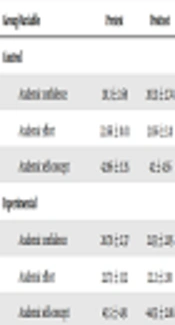
In this section, students’ scores in the experimental and control groups are reported as mean ± standard deviation, and the highest and the lowest scores of academic self-concept and the subscales of academic confidence and academic effort. The experimental group witnessed an increase in the mean scores of all variables in the posttest (Table 1).
Table 1.
The Means and Standard Deviation of Academic Self-Concept of the University Students in the Pretest and Posttesta
| Group/Variable | Pretest | Posttest |
|---|---|---|
| Control | ||
| Academic confidence | 20.3 ± 2.69 | 20.33 ± 2.74 |
| Academic effort | 22.66 ± 0.01 | 21.66 ± 3.11 |
| Academic self-concept | 42.96 ± 3.35 | 42 ± 4.56 |
| Experimental | ||
| Academic confidence | 20.76 ± 2.37 | 21.33 ± 2.05 |
| Academic effort | 22.73 ± 3.32 | 22.2 ± 2.01 |
| Academic self-concept | 43.5 ± 4.91 | 44.53 ± 2.86 |
aValues are expressed as mean ± SD.
Results of MANCOVA demonstrated a significant difference between the experimental and control groups in terms of at least one of the subscales of academic self-concept (academic confidence and academic effort) (Table 2). It means that jigsaw approach has a direct effect on academic confidence or academic effort.
Table 2.
The Results of the Multivariate Analysis of Covariance Examining the Subscales of Academic Self-Concept
| Test Name | Value | F | df Hypothesis | df Error | Level of Significance | Eta-Squared |
|---|---|---|---|---|---|---|
| Pillai’s trace | 0.13 | 4.12 | 2 | 55 | 0.02 | 0.13 |
| Wilks’ Lambda | 0.87 | 4.12 | 2 | 55 | 0.02 | 0.13 |
| Hoteling’s trace | 0.15 | 4.12 | 2 | 55 | 0.02 | 0.13 |
| Roy’s largest root | 0.15 | 4.12 | 2 | 5 | 0.02 | 0.13 |
Results of the one-way analysis of covariance show that academic self-concept and the subscales of academic confidence and academic effort were significantly different between the control and experimental groups (error level < 5%). Given the Eta coefficient, academic self-concept (F = 6.41, α = 0.01) caused a difference by 10% and the subscale of academic effort (F = 6.69, α = 0.01) caused a difference by 11%. Accordingly, training the teaching-learning approach has the highest impacts on academic effort and academic self-concept, respectively (Table 3).
Table 3.
The Results of the One-Way Analysis of Covariance Examining Academic Self-Concept
| Variable/Change Source | Sum of Squares | df | Mean of Squares | F | P Value | Eta-Squared | Statistical Power |
|---|---|---|---|---|---|---|---|
| Academic confidence | |||||||
| Posttest | 16.15 | 1 | 16.15 | 4.3 | 0.04 | 0.07 | 0.53 |
| Group | 11.21 | 1 | 11.21 | 2.98 | 0.08 | 0.05 | 0.39 |
| Academic effort | |||||||
| Posttest | 19.52 | 1 | 19.52 | 3.12 | 0.08 | 0.05 | 0.41 |
| Group | 41.78 | 1 | 41.78 | 6.69 | 0.01 | 0.11 | 0.72 |
| Academic self-concept | |||||||
| Posttest | 94.22 | 1 | 94.22 | 7.18 | 0.01 | 0.11 | 0.75 |
| Group | 48.02 | 1 | 48.02 | 6.41 | 0.01 | 0.10 | 0.7 |
5. Discussion
The current study aimed to investigate the effect of the collaborative teaching-learning method (the jigsaw approach) on improving university students’ self-concept. The results of the present study showed that this approach directly affected academic effort and led to an improvement in academic self-concept in students. Previous research has indicated that self-concept is one of the important factors which plays key role in students’ success in various courses, including math (21) and many of the adolescents’ physical and motor behaviors can be altered via physical self-concept (22). Additionally, self-concept is among predictors of aggression among students (23). Therefore, educational institutions and organizations should pay more attention to increasing motivational factors, such as self-concept and motivation, among students (24). In Iran, research has shown that the jigsaw collaborative approach has positive impacts on and improves self-concept and motivation of elementary school students (25). Fortunately, the collaborative jigsaw approach makes the members of a group gain a deeper understanding of science and helps them perceive a better mastery over a concept and create new knowledge (26). By applying the jigsaw approach, students, especially freshman university students, can develop an effective technique to deal with integrated subjects (15). Hence, students gain a better level of self-concept and obtain high levels of self-confidence and interest in learning more by contributing to a variety of lessons. Therefore, jigsaw technique can be a valuable way to enhance thinking among Farhangian University students because being in different groups, listening to other people’s perspective, and discussing various subjects with them can give students the opportunity to think more.
5.1. Limitations
The limitations of the present study include:
1- No previous research was found on the topic in Iran and jigsaw approach is not known by the majority of teachers.
2- Students in Farhangian University have been educated through traditional methods, and changing their mind to use cooperative methods is difficult.