
1. Introduction
Schwartz-Jampel Syndrome (SJS) is a rare autosomal recessive disease characterized by muscle
weakness and stiffness, abnormal bone development, short stature, joint contractures, and facial dysmorphisms. Patients display microstomia, micrognathia, thermoregulatory disturbance, jaw muscle rigidity, myopathy, anatomical deformities, and malignant hyperthermia. The treatment of these patients is challenging for anesthesiologists. Facial muscle contraction leads to a “mask-like” appearance with pursed lips and blepharophimosis (1, 2). Due to the small number of cases of these patients and the lack of experience in administering general anesthesia to these patients, we decided to present this case.
2. Case Presentation
A four-year-old female with American Society of Anesthesiologists (ASA) status III, SJS, and epilepsy was scheduled for Blepharoplasty in Rasuol Akram Hospital. She had a family history of SJS, with an uncle also suffering from SJS. Her symptoms started with muscle weakness at 10 months old, leading to a myotonia diagnosis. She had a drug history of Tegretol syrup and baclofen tablets. She had normal intelligence and speech. She also had a history of knee fracture surgery one year ago with no anesthesia problems. In the preoperative examination, she had a small ASD in echocardiography with a normal EF of 60%. Lab tests were normal. The patient’s weight was 10 kg.
Evaluation of the airway and the Mallampati scoring were unsuccessful due to the patient’s inability in mouth opening and facial muscle rigidity (Figure 1). Due to limited mouth opening and micrognathia, difficult intubation was predictable despite a prior history of anesthesia. Difficult intubation equipment and considerations were arranged (LMA and pediatric fiberoptic bronchoscope, video laryngoscope, and special blades for difficult intubation were available at the bedside in the OR).
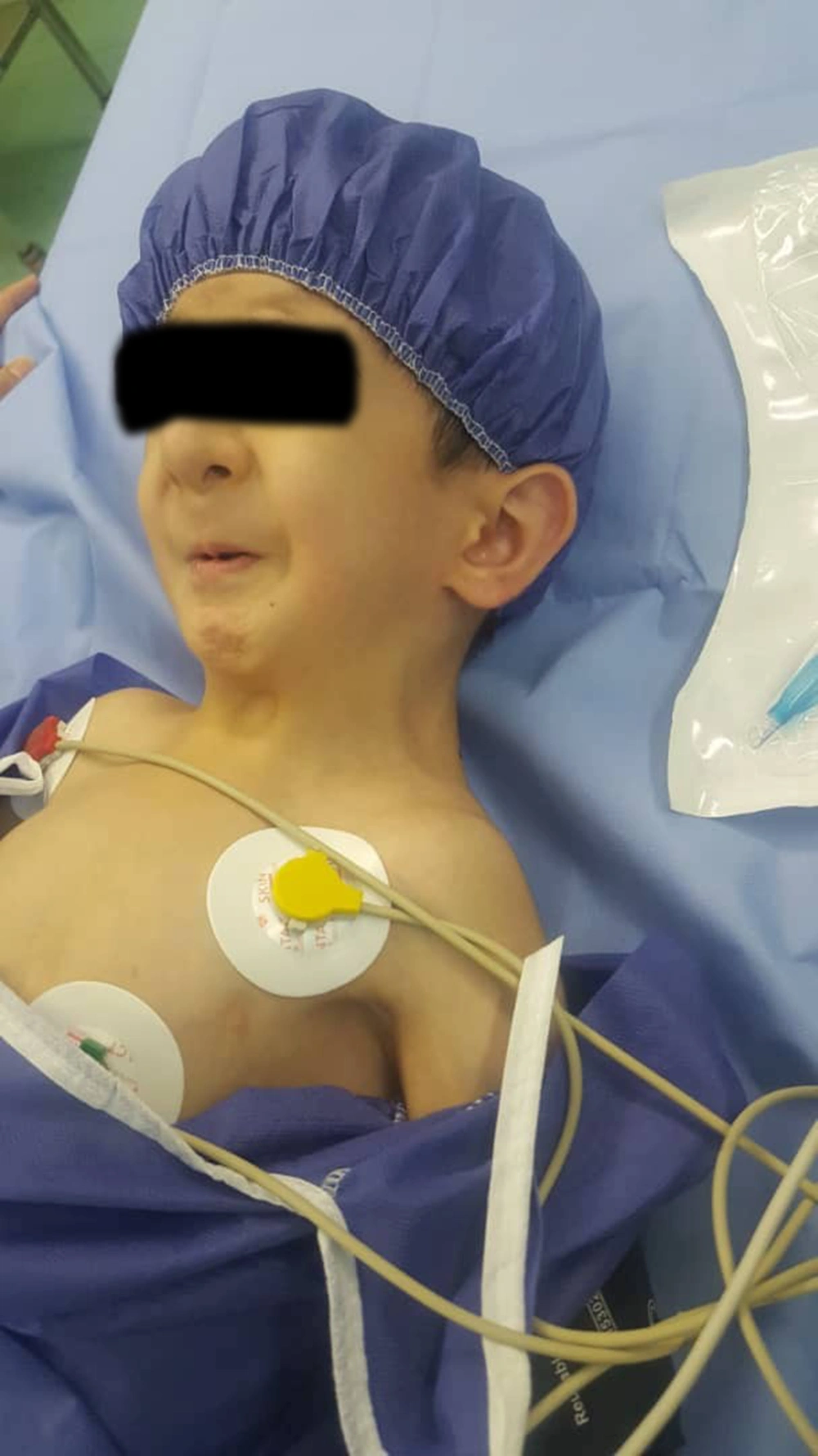
Figure 1.
A four-year-old female with Schwartz-Jampel syndrome and epilepsy
The anesthetic machine was cleaned of volatile agents by disconnecting and removing the vaporizer and renewing CO2 absorbent using a new disposable breathing circuit and O2 flushing for 50 minutes.
Dantrolene was sufficiently available. Because the patient did not cooperate, an awake intubation plan was impossible. As the possibility of malignant hyperthermia inhalation induction with sevoflurane with spontaneous breathing was unsafe, we decided to do rapid sequence induction of anesthesia.
First, we gave an intravenous line with 20 g chatter from the patient’s right hand. For anesthesia induction, we injected 30 μg of fentanyl, 20 mg of propofol, and 8 mg of rocuronium. Sugammadex was present in the OR before anesthesia induction. About 45 seconds after the rocuronium injection, a 3.5-cuffed endotracheal tube was inserted without difficulty by video laryngoscopy (blade 2 of C-MAC Video Laryngoscope) and fixed. Blood pressure, heart rate, and body temperature were monitored during anesthesia. General anesthesia was maintained with total intravenous anesthesia, consisting of 2% propofol (100 μg/kg/min) and remifentanil (0.15 μg/kg/min). She received rocuronium every half an hour during the operation. Ventilator settings were done with tidal volume 125 cc, respiratory rate of 16, peep 3 cm H2O, peak airway pressure was 28 cm H2O, and the mean pressure of 7 cm H2O. Capnography, pals oximetry, temperature, ECG, and noninvasive blood pressure monitoring were used during the operation.
3. Discussion
Schwartz-Jampel syndrome is rare, with about 100 cases defined in the medical manuscript. It is categorized by visible clinical heterogeneity and can be separated into three types: 1A, 1B, and type 2. As known, SJS type 1, the usual form of the disorder, may be apparent in infancy or childhood. Also, SJS type 2, a rarer form of the disorder, is characteristically acknowledged at birth or congenital form. Most investigators now consider that SJS type 2 is essentially similar to Stuve-Wiedemann. Moreover, SJS is supposed to be inherited as an autosomal recessive mannerism. However, some cases reported in the medical texts suggest an autosomal dominant inheritance form.
Schwartz-Jampel syndrome suffers from myopathy, muscle weakness, and muscle stiffness, including jaw muscle rigidity (3). Abnormal bone development causes short stature, and facial dysmorphisms such as micrognathia, microstomia, and thermoregulatory disturbance are common (4).
Patients may have difficulty in intubation due to short neck immobility of the neck and short mouth opening, and micrognathia. The Mallampati score has been used for many years to classify patients when difficulty tracheal intubation is plausible. The classification provides a score ranging from 1 to 4 based on the anatomic structures of the airway while the patient opens the mouth and sticks out the tongue. However, in this case, the airway evaluation and the Mallampati scoring were unsuccessful due to the patient’s inability to open the mouth and facial muscle rigidity. However, this muscle stiffness disappeared with non-depolarizing muscle relaxants in our patient, and the Mallampati examination may not be suitable for evaluating the airway in this group of patients. Before anesthesia, we anticipated the equipment needed for the difficult airway management, and Boogie, LMA, video laryngoscope, special blades for difficult intubation, and fiberoptic bronchoscope were ready. However, the patient was intubated by Macintosh blade without any problems after receiving a muscle relaxant, but the muscle stiffness resolved with non-depolarizing muscle relaxants in our patient, and maybe the Mallampati examination is not suitable for evaluating the airway in Schwartz-Jampel patients. It shows that some cases do not have stiff jaw muscle contracture, and laryngoscopic intubation is sometimes possible. In de Oliveira Camacho et al.’s study, the attempts at tracheal intubation by a Macintosh Blade No. 3 were difficult (1). A new try by a C MAC® video laryngoscope was done. That was seen in about 60% of the glottis, but putting in the endotracheal tube was impossible, and the patient was ventilated with LMA (1). Although we had no problems with intubation, we had prepared the LMA for emergencies.
These patients are also predisposed to malignant hyperthermia, a situation in which contact with inhaled anesthetics or depolarizing muscle relaxants may cause a rapid rise in body temperature (hyperthermia), muscle twitching, stiffness, and further symptoms. Consequently, we must not use any possible triggers, like volatile anesthetics and succinylcholine. The anesthetic machine must be cleaned of volatile agents by disconnecting and removing the vaporizer and renewing the carbon dioxide absorbent using a new disposable breathing circuit and flushing for 50 min, as we did in this case (5). Dantrolene was sufficiently available. Core body temperature and end-tidal carbon dioxide (ETCO2) monitoring are vital for assessing any signs of increased metabolism (6). We monitored ETCO2 during anesthesia in our case.
Patients may have ventilation problems due to kyphoscoliosis or pectus carinatum and reduced vital capacity. We encountered no issues while handling the patient’s ventilation. In Mukaihara et al.’s case, reporting direct laryngoscopy was impossible because the patient’s mouth could not be thoroughly opened; nevertheless, the patient’s trachea was easily intubated using a MultiViewScope handle with a stylet scope (7). The MultiViewScope handle is beneficial for managing difficult airways related to SJS (7).
This study found that sometimes the hypnotic with a non-depolarizing muscle relaxant like Rocuronium may relax the facial and mouth muscle and facilitate direct laryngoscopy and intubation.