


1. Background
Parent-child interaction is one of the most important factors underlying the psycho-social development of the children (1), while the limited and unfavorable interaction can cause psychological and behavioral problems for the children and hinder, interrupt or limit their optimal psycho-social development (2). Studies show that the quality of parent-child interaction, as parenting styles, takes various froms and is manifested in the form of responsive-protective, domineering-restrictive or permissive-indifferent interactions. On the other hand, Desikroll and Pianta (3), stated that the quality of parent-child interaction have different emotional consequences which lead to the safe or unsafe emotional relationships. Also, they may cause a variety of mental disorders, including anxiety, depression, eating disorders and risky behaviors. In addition, results of a reseach by Findler et al. (4) show that the quality of parent-child interaction is related to the child's cognitive functions in such a way that the desirable interactions improves the academic performance and executive functions of the children. However, some studies (1) show that inappropriate interactions between parents and children lead to the formation of impulsive behaviors, aggression, anger and negative emotions in children.
In addition to the quality of parent-child interaction, children's negative experiences in the family are among the other stress sources that can derail the healthy psychological development and have negative consequences in communication and academic fields. These experiences are clearly reflected as child abuse (5, 6) physical, emotional, sexual abuse, neglect and exploitation. They endanger the child's health and growth processes (7). In this regard, Barnett et al. (8) referred to physical child abuse as kicking, hitting and punching or whipping, and emotional abuse is referred to as threatening and withholding from loving the child (9). Any of them can cause death, injury, incompatibility and behavioral problems among the children. In addition, the United States Department of Health and Human Services (10) identified neglect as insufficient supervision and failure to meet the child's basic needs such as safety, is considered as the most important form of child abuse.
Some theorists (11) emphasized the role of parental burnout among the underlying causes of undesirable parent-child interactions and child abuse. Parental burnout (12) refers to the exhaustion and desperation of parents in doing the parental role in favor of the child and other family members. It will happen if the parents' resources are not enough to respond the demands of the family members. That is, there will not be a balance between demand (risk factors) and resources (protective factors).
In the meantime, Mikolajczak and Roskam (13) defines risk factors as sources of parental stress, which include parental perfectionism, low emotional intelligence, ineffective parenting style, lack of partner support, and spouse unemployment. They also define protective factors as some affaires which can reduce the experienced stress, including high emotional intelligence, high social support, desirable leisure time, and appropriate strategies for emotion regulation and problem solving.
According to aforementioned points (12), stated that parental burnout declines the parents' ability to respond the child's continuous demands and needs. As a result, due to lack of parental attention and support, the children turn to destructive behaviors such as anger, destruction of equipment, aggression and disobedience or negative passive behaviors like isolation, crying and self-harming. Meanwhile, Öngören (1) show that parental burnout has a direct relationship with children's self-harming behaviors. In addition, Szabo et al. (2) indicates that there is a positive relationship between parental burnout and children's depression and anxiety.
2. Objectives
Although parental burnout lead to the unfavorable parent-child interactions and child abuse, as a result of unfavorable parent-child interactions, the symbols of behavioral-emotional problems in children increase. Therefore, the parent-child interactions become much more ineffective and deepens the parental burnout. Due to the intensification of parental burnout, the child abuse in various forms occurs (11). In this regard, studies conducted by the American Health Ministry show that there is a direct relationship between parental burnout and the parent's physical, emotional and behavioral child abuse. Since the experience of child abuse and the parent-child interaction quality play an essential role in the psycho-social development of children, they prepare the basis for a variety of behavioral-emotional disorders in children. Therefore, identifying the factors affecting this phenomenon can help children's health workers to offer effective solutions to change the parent-child relationships. In the meantime, although the role of parental burnout in the formation of undesirable parent-child interactions and child abuse were studied, the interpretation of these relationships needs more research. Therefore, the aim of the present study is to determine the relationship between parental burnout and the quality of parent-child interaction and child-abuse experience.
3. Methods
It was a descriptive and correlational research and it is a practical research in terms of purpose. The statistical population of this study includes 7 - 12 year old female school students in Tabriz city in the academic year of 2021 - 2022. A total of 297 students were selected as the sample of study using the purposeful sampling method and the Krejcie and Morgan table (1970). Simultaneous regression analysis test was used to analysis the data.
3.1. Parental Burnout Assessment
The parental burnout scale was firstly developed by Rozkam et al. (14) in 23 items, which is used to assess the level of parental fatigue and burnout caused by parenting tasks. It is measured based on a seven-point Likert scale ranging from never (0 score) to every day (6 scores) with four subscales including: Fatigue in the role of being parent, confrontation with the past self parenting, hating the role of parents and emotional distancing from children. The reliability of the test was from 0.69 to 0.88 in the considered time period. the validity of the parental burnout test through correlation coefficients with the level of parental fatigue, neuroticism, parental disagreement and family disorder is reported as 0.7, 0.47, 0.22 and 0.53 (14). In Iran, the parental burnout scale was implemented on 448 Iranian parents (226 mothers and 2 fathers); Cronbach's alpha coefficient for the subscale of burnout from the parental role was 0.91, confrontation with the past self parenting was 0.90, and hating the parental role was 0.90, keeping the emotional distance from parental role is 0.69. Validity of parental burnout test with parental satisfaction and mental health was reported as -0.38 and -0.28, respectively.
3.2. Parent-Child Relationship
Parent-Child Relationship Scale by Pianta (15) contains 33 items that measure the parents' perception of their relationship with their children. This scale was translated by Tahmasian and Khorramabadi and its validity was evaluated by experts (16). It includes the areas of conflict (17 items), intimacy (10 items), dependence (6 items) and overall positive relationship (all areas) (17). This scale has been used to measure the parent-child relationship at all ages (17). Each of the fields of conflict, intimacy, dependence and overall positive relationship were identified with Cronbach's alpha of 0.84, 0.69, 0.46 and 0.80, respectively (16).
3.3. Child Abuse
Child Abuse Self-Report Scale by Mohammad Khani (18) was used to measure child abuse and children's perception of abuse by the family and the other people. It consists of 38 questions including the physical, sexual, emotional abuse and neglect. The scoring in this scale is based on a 5-point Likert scale from very low (1 point) to very high (5 points) (18). Using Cronbach's alpha and the test-retest method, the reliability of the child abuse self-report questionnaire was calculated (0.92). It shows that the scale has a high internal consistency; Cronbach's alpha coefficient for physical, sexual, emotional and neglect subscales were 0.80, 0.73, 0.85, 0.78, respectively.
4. Results
Before conducting the main analysis, several preliminary analysis were conducted to get the preliminary insights on the data. The descriptive findings include mean, standard deviation and correlation coefficient of research variables (Table 1).
Table 1.Descriptive Findings of Research Variables
| Variables | Mean ± SD | 1 | 2 | 3 |
|---|---|---|---|---|
| Parent burnout | 49.60 ± 24.97 | - | - | - |
| Child-paren interaction | 98.70 ± 20.63 | -0.49 | - | - |
| Child abuse | 39.62 ± 15.25 | 0.43 | -0.41 | - |
As Table 1 shows, the correlation coefficient between parental burnout with parent-child interaction is -0.49, parental burnout with parent-child interaction is 0.43, and parent-child interaction with child abuse is -0.41. They are significant. In order to test the proposed model of the relationship between parental burnout and child abuse with the mediating role of parent-child interaction, the structural equation modeling method was used. The proposed model fit with the data based on the fitness indices, including the chi-square, is reported as the absolute goodness of fit index in Table 2.
Table 2.Fitting the Proposed Model with the Data Based on Goodness of Fit Indices
| Goodness of Fit Indices | χ2 | df | χ2/df | GFI | AGFI | NFI | CFI | IFI | TLI | RMSEA |
|---|---|---|---|---|---|---|---|---|---|---|
| Values | 87.221 | 41 | 2.124 | 0.950 | 0.919 | 0.926 | 0.959 | 0.959 | 0.945 | 0.062 |
Abbreviation: RMSEA, root mean square error of estimation; NFI, Normed Fit Index; GFI, Goodness of Fit Index; CFI, Comparative Fit Index; IFI, Incremental Fit Index; TLI, Tucker-Lewis Index; AGFI, Adjusted Goodness of Fit Index.
The higher the value of chi square (0 < chi-square), the lower the fitness of the model. A significant chi-square shows a significant difference between the assumed and observed covariances. However, since the chi-square includes the sample size, its size is inflated in the large samples and usually becomes statistically significant. That is why many researchers assess chi-square in relation to its degree of freedom (relative chi-square) (19). In relative (normed) Chi-Square Index, the values close to 2 or less than two are considered as a conventional criterion for the model fit. Also, other important indices, including Goodness of Fit Index (GFI), Adjusted Goodness of Fit Index (AGFI), Bentler-Bonnet Index or Normed Fit Index (NFI), Comparative Fit Index (CFI), Incremental Fit Index (IFI), Tucker-Lewis Index (TLI) are also reported in Table 2 in which, a fit of 0.9 or higher is accepted. Another suitable index is the root mean square error of estimation (RMSEA) index in which a value of > 0.8 is acceptable, and 0.5 or less accepted in good models.
According to Table 2, the fit indices include χ2/df = 2.12; GFI = 0.95; AGFI = 0.92; NFI = 0.93; CFI = 0.96; IFI = 0.96; TLI = 0.94 and RMSEA = 0.06. They show that the proposed research model is fit. Table 3 indicates the parameters related to the direct effects of variables in the proposed research model.
Table 3.Parameters of Direct Effects Between Research Variables in the Proposed Research Model
| Paths | Standard Value | Nonstandard Value | Standard Deviation | Critical Ratio | P-Value |
|---|---|---|---|---|---|
| Parental burnout → child parent interaction | -0.685 | -0.737 | 0.101 | -7.304 | 0.001 |
| Parental burnout → child abuse | 0.322 | 0.144 | 0.047 | 3.041 | 0.002 |
| Child parent interaction → child abuse | -0.321 | -0.133 | 0.048 | -2.786 | 0.005 |
As the results in Table 3 show, all the direct paths are significant. Figure 1 shows the proposed model of the research along with the standard coefficients of the paths.
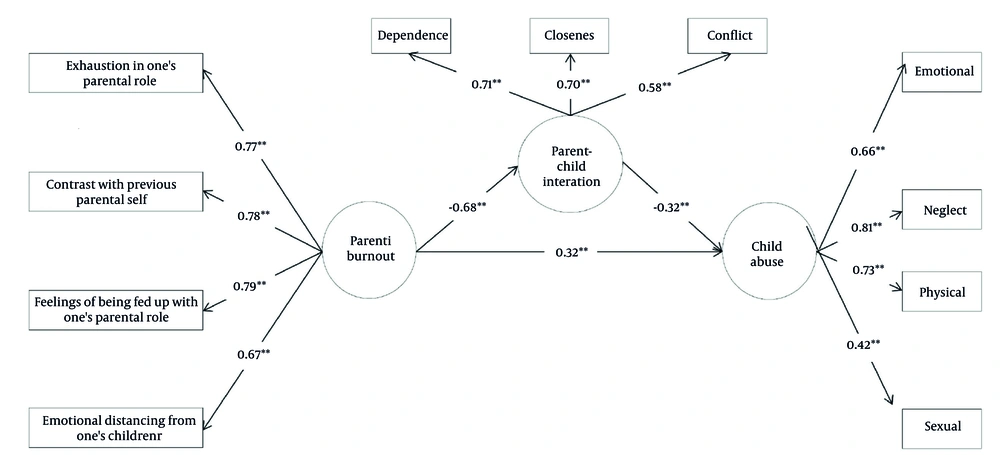
Figure 1.
The proposed model of the research along with the standard coefficients of the paths. ** There is a significant relationship between the variables.
One hypothesis of the proposed model in this research is the existence of an indirect or mediator path. To determine the significance of a mediating relationship and the indirect effect of the independent variable on the dependent variable through the mediating variable, bootstrap method was used in Macro test program by Preacher and Hayes (20). The bootstrap results for the mediator path of the proposed model is shown in Table 4.
Table 4.Bootstrap Results for the Intermediate Path
| Paths | Data | Boot | Standard. Error | Lower-Upper Limit | P-Value |
|---|---|---|---|---|---|
| Parental burnout → child parent interaction → child abuse | 0.209 | 0.2068 | 0.0467 | 0.1263 - 0.3168 | 0.001 |
As the results in Table 4 show, the lower limit of the confidence interval for parent-child interaction, as a mediating variable between parental burnout and child abuse, is 0.1263 and its upper limit is 0.3168. Its confidence level is 95 and the number of bootstrap resampling is 5000. Considering that zero is outside this confidence interval, we see that the indirect relationship between the variables is significant. In addition, the results of the bootstrap test showed that this indirect relationship is significant at the P ≤ 0.001 level. Therefore, parent-child interaction plays a mediating role in the relationship between parental burnout and child abuse.
5. Discussion
The aim of the present study was to investigate the structural relationships of parental burnout caused during the corona virus lockdown with parent-child interaction and physical and emotional child abuse. The results indicated an increased level of child abuse, undesirable parent-child interaction and its statistical significant relationship. The first finding of the current research shows that parental burnout caused by the corona virus lockdown has a positive relationship with parent-child interaction. It shows that the greater the parental burnout of the child's caregivers, the more problems the child parent interaction will have. Burnout causes major problems, including fatigue, boredom and neglecting the child which affect the parent-child interaction. Most of the researches that investigated this hypothesis focused on interventions that improved the parent-child interaction and its effect on burnout. It is concluded that parent-child interaction is related to parental burnout and this relationship can be investigated due to the relationship between parental burnout and parent-child interaction.
In a research consistent with the findings of the present study, Chung et al. (21) showed that the way of understanding the COVID-19 pandemic and anger affects the parent-child relationship. Also, Russell et al. (22) showed that there is a significant relationship between parents' resilience and stress by which the quality of the parent-child relationship and caring are being affected.
The second finding of the current research shows that parental burnout caused by the corona virus lockdown has a positive relationship with physical-emotional child abuse. It shows that the greater the parental burnout, the greater the possibility of misbehaving and harming the child. In explaining this finding, it can be concluded that the risk of misbehaving the children during the corona virus lockdown is due to the many stress factors related including physical and mental health concerns, economic stress, home schooling challenges, marital conflicts. They all increase the level of parental burnout so that the risk of child abuse increases, too.
The study of Wu and Xu (23) showed that the child maltreatment increased during the pandemic due to multiple strsssful factors. The results of Griffith (12) on parental burnout shows that parents who experience burnout are more exposed to child abuse and child neglect. This finding is also verified in the research of Taubman-Ben-Ari et al. (24).
In another study, Shpiegel et al. (25) realistically examined the harmful effects of the COVID-19 pandemic on parental burnout, child abuse, and child neglect with the mediating role of compassion fatigue (i.e., a combination of burnout and secondary traumatic stress). Consistent with the findings of this study, they showed that COVID-19 caused greater compassion fatigue, which in turn led to parental burnout and child abuse.
The third finding of the current research shows that parent-child interaction has a positive relationship with physical-emotional abuse of children. It shows that weak parent-child interaction and aggressive interaction was associated with a higher level of physical or emotional child abuse, in such a way that the lower the level of interaction between parents and their children or the more aggressive parents interacted with children, the higher the level of physical or emotional child abuse was.
It can be concluded that child abuse decreases the parent-child interaction rate or increases the negative interactions between them which creates a vicious cycle. In other words, child abuse and parent-child interaction mutually affect each other. In a study by Henneman et al. (26), 7 to 12 year old students were placed in three groups with high, medium and low performance level based on teachers' ratings. The results showed that the child's behavioral performance is strongly affected by the socio-cultural and family status. Also, Roskam et al. (14) investigated the prevalence of the child mistreatments and show that 1.2% of mothers reported that their children were abused and this had a direct relationship with decreased parent-child interaction; whenever the child- parent interaction was desirable, the child abuse rate was 3.5 times less.


