


1. Background
A significant proportion of the global population considers spirituality/religion to be important in their lives (1). Many individuals turn to religion and spirituality as sources of comfort, hope, and guidance during challenging times (2). Substantial evidence suggests that religion and spirituality have a positive impact on both physical and mental health (3). However, religion and spirituality can also be a source of conflict and distress in people’s lives, as evidenced by research on topics such as religious crisis (4), negative religious coping (5), religious pressure (6), spiritual distress (7), and spiritual dryness (8).
In recent years, researchers have turned their attention to a potentially problematic area of religious and spiritual life known as religious and spiritual struggle. Religious and spiritual struggle has been described as “tensions, conflicts, and negative emotions surrounding sacred matters” (9). Religious and spiritual struggle is a phenomenon that extends beyond religious individuals and also encompasses those who identify as non-religious (10). In fact, these struggles are present in nearly every religious and spiritual tradition, even among those who self-identify as non-religious (11). Religious and spiritual struggles (RSS) are typically multifactorial; they can arise from both internal and external events and challenge personal beliefs (12). These struggles occur when aspects of one’s religious or spiritual beliefs become the focus of negative thoughts, worries, or conflicts (13). Individuals experiencing such struggles may feel uncomfortable acknowledging them, as they are often accompanied by feelings of guilt, shame, and even fear of judgment from others (14).
Most mental health professionals agree that religious and spiritual struggle impedes mental health (15). A growing body of research supports the association between religious struggles and various forms of psychological distress, including depression, anxiety, and post-traumatic stress disorder (PTSD) (15). A meta-analysis indicates that religious struggles predict the exacerbation of psychological symptoms (depressive symptoms, anxiety symptoms, PTSD symptoms) and other indicators of poor adjustment (16). Furthermore, individuals experiencing religious struggles have been shown to be at a higher risk of suicidal ideation (17). Currently, it is known that religious struggles predict increased psychological distress and negative psychological functioning (18). An examination of religious struggles in a cancer population receiving palliative care revealed an association with decreased quality of life (19).
Religious and spiritual struggles are commonly reported globally (15) and often motivate individuals to seek mental health treatment (9, 13). It is important to note, however, that RSS are not always detrimental and can, in some cases, enhance psychological well-being through their impact on meaning-making, spiritual growth, and sacred experiences (20-22). Although individuals may experience RSS in various ways, recent work has focused on six primary types (9, 23): (1) Divine (anger by God; feeling punished or neglected by God); (2) demonic (feeling attacked by the devil; perceiving the devil as the cause of negative events, temptations, or torment); (3) interpersonal (conflict or mistreatment involving religious individuals or institutions, anger toward the original religion); (4) ethical (struggling to adhere to moral principles, feeling guilty about moral failures); (5) doubt (worrying about the correctness of one’s beliefs; confusion about beliefs); and (6) ultimate meaning (questions and concerns about the deeper meaning of life; worrying about a perceived lack of meaning).
The 26-item RSS Scale was developed by Exline et al. (13) as an expansion of Pargament’s Religious Coping Scale (5) and Exline’s Religious Comfort and Pressure Scale (6). Both of these earlier scales measured only specific aspects of religious struggles, and the original RSS authors aimed to create a more comprehensive tool that would encompass all six identified domains. While this scale is a beneficial tool, its length (26 items) makes it impractical in some settings (e.g., clinical settings or large-scale surveys that assess many topics and where religion and spirituality are not the primary focus). In recent years, the need for a shorter form of the RSS has been felt (13). In response, a shorter version of this questionnaire, known as the 14-item Religious and Spiritual Struggle Scale (RSS-14), was developed, containing approximately half the items of the original RSS, with 14 items (2 - 3 items per subscale) compared to the original 26 items (4 - 5 items per subscale) (24). The RSS-14 was created in order to maintain internal consistency and preserve a broad range of content and a structure similar to the original version. It has also been translated and adapted into other languages, including Polish (25) and Brazilian (26).
Given that religion and spirituality-related issues, including RSS, are influenced by cultural and educational teachings, it is imperative to examine the structure of this scale within the Iranian cultural context. Previously, the long form of this questionnaire, comprising 26 items, was examined by Ebrahimi Jamarani et al. in 2022 in an Iranian population, and the results of confirmatory factor analysis (CFA) indicated a good fit for the six-factor model (27). This study evaluates the factor structure and psychometric properties of the Persian version of the RSS-14 in an Iranian sample.
2. Objectives
The current research aimed to evaluate the psychometric properties of the short form of Exline’s RSS when applied to the Iranian population.
3. Methods
3.1. Participants
The current study employed a descriptive-correlational design. The study population consisted of adults aged 18 - 65 who received the questionnaire link via online platforms. The inclusion criteria were as follows: (1) Age between 18 and 65 years, (2) at least a basic level of literacy, and (3) willingness to participate in the research. Participants were excluded from the study if they (1) expressed dissatisfaction with continuing their participation; or (2) failed to complete the questionnaires. To estimate the sample size, previous studies were consulted, which provided various guidelines for determining the sample size required for questionnaire normalizing, ranging from 2 to 20 participants per item (28). All ethical principles were strictly adhered to in this study, including voluntary participation, informed consent, data confidentiality, a comprehensive explanation of research objectives, provision of research results to participants, and the participants’ freedom to withdraw from the study at any time. Given that the current questionnaire had 14 items, 20 participants were allocated to each item, resulting in an estimated sample size of 280. To account for potential attrition, the final sample size was set at 300.
In order to conduct the research, three doctoral students in psychology initially translated the scale into Persian independently. Subsequently, a psychology professor proficient in English compared these translated versions with the original text and made necessary revisions. A back-translation was then conducted by a professional English translator, and the resulting version was compared to the original Persian version by the first author to verify consistency. Finally, the scale was reviewed by another professor in the field. Once the final Persian version was finalized, it was distributed along with a demographic questionnaire, a Spiritual Well-Being Scale (SWBS), and a Perceived Stress Scale (PSS) through a link generated on social media platforms. The link was shared in various online groups, and participants were encouraged to distribute it further. This convenience sampling method was used to collect the necessary data. At the beginning of the questionnaire, the study purpose was briefly explained. Participants were asked to provide informed consent to participate in the research and were assured that they could withdraw from the study at any time. They were also assured that their data would be kept confidential and used solely for research purposes. After obtaining informed consent, participants were presented with the RSS Scale, followed by the SWBS, and finally the PSS.
3.2. Measurements
3.2.1. The 14-Item Religious and Spiritual Struggles Scale
This self-report measure assesses the extent of an individual’s struggles and tensions related to religious and spiritual matters (24). Introduced by Exline et al., the RSS-14 consists of 14 items and evaluates six domains: (1) Divine (negative feelings centered on beliefs about God or one’s perceived relationship with God); (2) demonic (concerns about being attacked by the devil or evil spirits, or experiencing negative events caused by such forces); (3) interpersonal (concerns about negative experiences with religious individuals or institutions, interpersonal conflict related to religious issues); (4) ethical (struggling to adhere to ethical principles, feeling guilt or worry about perceived transgressions); (5) doubt (feeling distress related to doubt or questioning of religious or spiritual beliefs); and (6) ultimate meaning (questions about the deeper meaning of one’s life). Items are rated on a 5-point Likert scale ranging from “not at all” to “very much” (0 - 4, with a total range of 0 - 56). Higher scores indicate higher levels of religious struggles. Cronbach's alpha for this scale in the present study was calculated to be 0.82 (24).
3.2.2. The Spiritual Well-Being Scale
The SWBS, developed by Ellison (29), is a 20-item self-report questionnaire to assess an individual’s spiritual well-being. Responses are rated on a 6-point Likert scale (“strongly agree” to “strongly disagree”). The scale is divided into two subscales, including religious well-being and existential well-being, each consisting of 10 items and yielding a score between 10 and 60. Odd items denote religious well-being, while even items denote existential well-being. The SWBS total score is the sum of the scores for both subscales, ranging from 20 to 120. For positively worded items, “strongly agree” responses are scored 6 and “strongly disagree” responses are scored 1, while for negatively worded items, the scoring is reversed (“strongly agree” responses are scored 1 and “strongly disagree” responses are scored 6). The total score can be categorized as follows: Low spiritual well-being (20 - 40), moderate spiritual well-being (41 - 99), and high spiritual well-being (100 - 120). Dehshiri et al. conducted a study with 521 students to normalize the Persian version of the SWBS. The results demonstrated the test-retest reliability and internal consistency coefficients of 0.85 and 0.90, respectively, and CFA supported the construct validity of the scale (30).
3.2.3. The Perceived Stress Scale
Developed by Cohen et al., the PSS-14 is designed to assess the degree to which individuals perceive their life situations as stressful (31). This 14-item scale uses a 5-point Likert scale (“never” to “very often) to measure perceived stress. Each item is scored from 0 to 4, with higher scores indicating higher levels of perceived stress. The scale is unidimensional, and higher total scores reflect greater perceived stress. Maroufizadeh et al. conducted a study to examine the validity and reliability of this scale, reporting a Cronbach's alpha of 0.90 (32).
3.3. Data Analysis
To assess and measure the psychometric properties of the short form of the RSS Scale, its reliability and validity were examined. Exploratory factor analysis (EFA) using principal component analysis (PCA), CFA, divergent validity (calculating the correlation coefficients between the intended scale and the SWBS), and divergent validity (calculating the correlation coefficients between the intended scale and the PSS) were employed to evaluate the validity. Reliability was assessed using Cronbach's alpha, composite reliability (CR), and mean variance extracted. Data analysis was conducted using SPSS-26 and AMOS-24.
4. Results
A total of 300 participants were included in this study, of which 202 (67.3%) were female and 98 (23.7%) were male. In terms of education level, 26 participants (8.7%) were under diploma, 69 (23.0%) had a diploma, 36 (12.0%) had an associate’s degree, 139 (46.3%) had a bachelor’s degree, 23 (7.7%) had a master’s degree, and 7 (2.3%) had a doctoral degree. Regarding marital status, 97 participants (32.3%) were single, 200 (66.7%) were married, and 3 (1.0%) were divorced. The age range of the participants was 18 - 65 years, with a mean (standard deviation) 36.16 ± 12.03.
To identify the underlying factors related to the RSS Scale, eigenvalues greater than one and the scree plot were used. A factor loading of 0.40 or higher was considered significant to confirm factor loading of an item. To assess the sampling adequacy, the Kaiser-Meyer-Olkin (KMO) measure of sampling adequacy was employed (33). In assessing the EFA results, the KMO value was found to be 0.80, indicating an adequate sampling (> 0.70). Bartlett's test of sphericity was also significant (χ2 = 1331.8, df = 91, P < 0.01). Examination of the scree plot suggested that factor loadings had a greater weight, and there was a sharp drop in eigenvalues after the fourth factor (Figure 1).
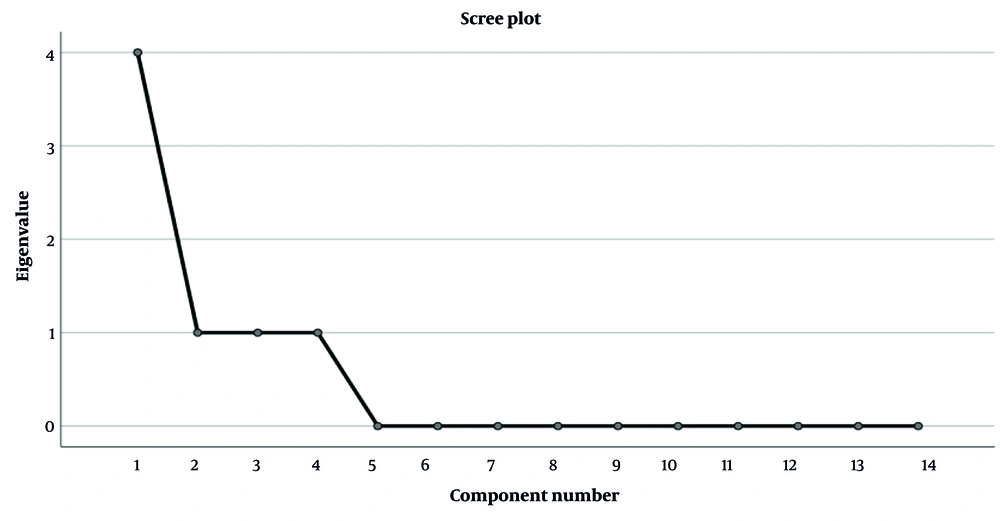
Figure 1.
Scree plot for factor analysis
Based on Table 1, the items of the RSS Scale loaded onto four factors, overall accounting for 61.65% of the total variance.
Table 1.Eigenvalues, Explained Variance, and Cumulative Variance of Factors for the Religious and Spiritual Struggles Scale
| Factor | Eigenvalues | Explained Variance | Cumulative Variance | Mean ± SD | Skewness | Kurtosis |
|---|---|---|---|---|---|---|
| 1 | 4.4 | 31.47 | 31.47 | 2.43 ± 1.41 | 1.86 | 1.79 |
| 2 | 1.79 | 12.83 | 44.3 | 4.36 ± 1.52 | 1.55 | 1.67 |
| 3 | 1.35 | 9.67 | 53.97 | 1.01 ± 1.55 | 1.15 | 1.7 |
| 4 | 1.07 | 7.67 | 61.65 | 2.01 ± 1.97 | 0.73 | -0.29 |
Based on Table 2, a varimax rotation of the items on the RSS Scale revealed a four-factor solution. The first factor consisted of items 1, 2, 3, 6, and 8, and was labeled “feeling religiously rejected”. The second factor, comprised of items 7, 9, 10, 11, and 12, was labeled “ambiguous religious/spiritual identity”. The third factor consisted of items 4 and 5, and was labeled “feeling threatened by the devil”. Finally, the fourth factor, consisted of items 13 and 14, was labeled “challenging the meaning of life”.
Table 2.Factor Loadings of Scale Items in Exploratory Factor Analysis, Mean, and Standard Deviation
| Items | Factor Loading | Mean ± SD | |||
|---|---|---|---|---|---|
| First | Second | Third | Fourth | ||
| 1. I have felt that God has abandoned me. | 0.78 | -0.007 | 0.05 | 0.26 | 0.32 ± 0.76 |
| 2. I have felt that God is punishing me. | 0.73 | 0.04 | 0.20 | 0.27 | 0.62 ± 0.93 |
| 3. I have felt anger toward God. | 0.76 | 0.13 | 0.001 | 0.12 | 0.35 ± 0.74 |
| 4. I have felt harmed, mistreated, or insulted by religious/spiritual people. | 0.57 | 0.53 | -0.02 | -0.10 | 0.66 ± 1.09 |
| 5. I have felt anger toward organized religion. | 0.58 | 0.56 | -0.14 | -0.04 | 0.48 ± 1.02 |
| 6. I have had conflicts with others regarding religious issues. | 0.30 | 0.71 | -0.02 | -0.02 | 1.21 ± 1.07 |
| 7. I have struggled with myself regarding moral principles. | 0.06 | 0.70 | 0.12 | 0.17 | 0.94 ± 1.1 |
| 8. I have felt guilty for not adhering to my moral standards. | 0.02 | 0.53 | 0.22 | 0.23 | 1.05 ± 1.1 |
| 9. I have been distressed by doubting or questioning my faith or spirituality. | -0.15 | 0.46 | 0.17 | 0.28 | 0.63 ± 1.1 |
| 10. I have felt confused about my religious/spiritual beliefs. | 0.13 | 0.62 | 0.09 | 0.38 | 0.53 ± 0.88 |
| 11. I have worried that the devil or evil spirits caused my problems. | 0.01 | 0.09 | 0.89 | 0.04 | 0.59 ± 0.94 |
| 12. I have felt under attack by the devil or evil spirits. | 0.10 | 0.15 | 0.88 | 0.01 | 0.42 ± 0.74 |
| 13. I have questioned whether life really matters. | 0.31 | 0.15 | -0.03 | 0.74 | 1.29 ± 1.3 |
| 14. I have felt a lack of deeper meaning in my life. | 0.16 | 0.23 | 0.02 | 0.72 | 0.73 ± 1.004 |
The CFA was conducted to validate the findings of the EFA. The CFA deals with assessing the factor loading of each item, mutual correlations between factors, and fit indices to evaluate the overall model fit (33). Maximum likelihood estimation (MLE) was employed to assess the model fit indices (Figure 2).
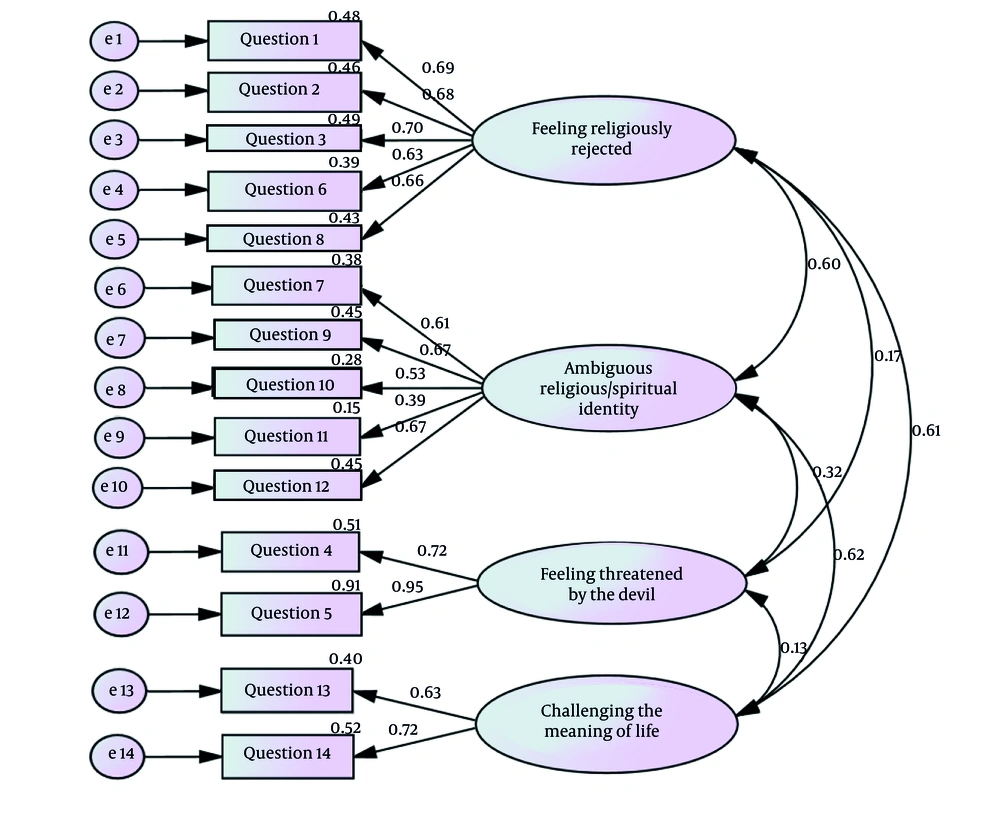
Figure 2.
Confirmatory factor analysis (CFA) of the four-factor model of the Religious/Spiritual Struggles Scale (initial model)
Based on the results, factor loadings of each item in its respective factor were significant at the 0.01 level (P < 0.001). Additionally, the mutual correlations or relationships between factors were significant at the 0.01 level (P < 0.001). Subsequently, the fit indices of the initial model were examined. The most prominent classification for organizing fit indices was proposed by Hair et al. (34), who categorized fit indices into three groups: Absolute, relative, and parsimonious fit indices.
Based on Table 3, the fit indices of the initial model, specifically the Goodness-of-Fit Index (GFI), root mean square error of approximation (RMSEA), Comparative Fit Index (CFI), Normed Fit Index (NFI), Incremental Fit Index (IFI), and Relative Fit Index (RFI), were unsatisfactory compared to the cut-off points and were below the acceptable range. To modify model fit, according to AMOS-24 suggestion, correlation coefficients (mutual pathway) were established between the errors of 1 and 2, 1 and 3, 2 and 3, and 9 and 10 covariances. The modified model results indicate that the NFI was marginally acceptable, with a difference of 0.02, and the RFI was also marginally acceptable, with a difference of 0.04. Other fit indices indicated improvement compared to the initial model and were within the acceptable range. The inflation of PCFI and PNFI is expected due to the complexity of the model (Figure 3).
Table 3.Fit Indices of the Four-Factor Model of the Religious/Spiritual Struggles Scale in Both the Initial and Modified Models
| Fit Indices | Initial Model | Modified Model | Cut-off Point (Norm) |
|---|---|---|---|
| Absolute | |||
| χ2/df | 2.81 | 2.22 | 5 - 1 |
| GFI | 0.88 | 0.93 | > 90 |
| RMSEA | 0.09 | 0.06 | < 0.08 |
| CFI | 0.85 | 0.93 | > 0.90 |
| Relative | |||
| NFI | 0.81 | 0.88 | > 0.90 |
| IFI | 0.85 | 0.93 | > 0.90 |
| RFI | 0.75 | 0.86 | > 0.90 |
| Parsimonious | |||
| PCFI | 0.63 | 0.64 | < 0.50 |
| PNFI | 0.65 | 0.68 | < 0.50 |
Abbreviations: GFI, Goodness Fit Index; RMSEA, root mean square error of approximation; CFI, Comparative Fit Index; NFI, Normed Fit Index; IFI, Incremental Fit Index; RFI, Relative Fit Index; PCFI, Parsimonious Comparative Fit Index; PNFI, Parsimonious Normed Fit Index.
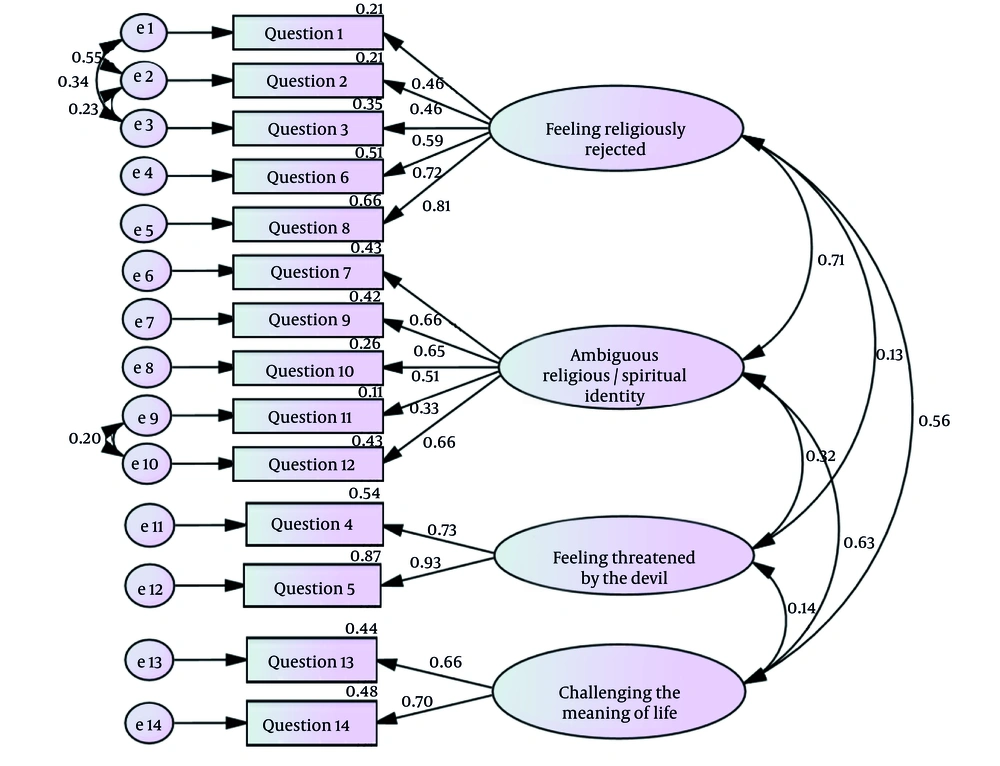
Figure 3.
Confirmatory factor analysis (CFA) of the four-factor model of the Religious/Spiritual Struggles Scale (modified model)
Based on Table 4, the correlation coefficients of the factors of feeling religiously rejected, ambiguous religious/spiritual identity, challenging the meaning of life, and the total score with spiritual well-being were -0.64, -0.27, -0.48, and -0.55, respectively, which were significant at the P < 0.01 level. The correlation coefficients of the factors of ambiguous religious/spiritual identity, challenging the meaning of life, and the total score with perceived stress were 0.14, 0.14, and 0.20, respectively, which were significant at the P < 0.05 level (P < 0.1). The Cronbach's alpha value, exceeding 0.70, indicated satisfactory internal consistency among the scale items. As shown in Table 4, the Cronbach's alpha values for the factors and items ranged from 0.70 to 0.82. The CR values, exceeding 0.70, indicated satisfactory convergent validity (35). In Table 4, these values ranged from 0.80 to 0.91. Furthermore, the mean variance extracted values, exceeding 0.50, indicated high convergent validity of the scale, meaning that the factor in question is highly correlated with the total scale (36). According to the results in the Table 4, these values ranged from 0.51 to 0.83.
Table 4.Examination of Convergent and Divergent Validity, Cronbach's Alpha, Composite Reliability, and Mean Variance Extracted
| Factors | Divergent Validity (Spiritual Well-being) | Convergent Validity (Perceived Stress) | Cronbach's Alpha | CR | AVE |
|---|---|---|---|---|---|
| Feeling religiously rejected | -0.64 a | 0.09 | 0.79 | 0.86 | 0.55 |
| Ambiguous religious/spiritual identity | -0.27 a | 0.14 b | 0.70 | 0.80 | 0.51 |
| Feeling threatened by the devil | -0.03 | 0.09 | 0.79 | 0.91 | 0.83 |
| Challenging the meaning of life | -0.48 a | 0.14 b | 0.70 | 0.84 | 0.73 |
| Total score | -0.55 a | 0.20 b | 0.82 | - | - |
Abbreviation: AVE, average variance extracted; CR, composite reliability.
a P < 0.05.
b P < 0.01.
5. Discussion
The present study investigates the psychometric properties of the Persian version of the RSS-14, a brief self-report measure designed to assess RSS. Religious and spiritual struggles refer to a state of turmoil or tension within an individual’s religious or spiritual system (37). The current scale examines RSS through 6 domains and 14 items. Exline et al. utilized a longitudinal, internet-based sample of American adults who had reported some religious or spiritual struggles in a preliminary screening to collect initial data on the factor structure, reliability, and validity of the RSS-14. A six-item screening in a population of 2889 individuals (N = 2889), followed by two-stage structural analyses with 2-week intervals (Wave 1: N = 1911, Wave 2: N = 1003), provided a good fit for the six-factor model, although this structure only emerged in CFA, not EFA. Overall, these findings offer initial support for the RSS-14 as a relatively brief measure of RSS (24). Factor analysis of the Persian version of this scale was conducted on a sample of 300 individuals (mean age = 36 years). The sample consisted of 67% female and 23% male, with 67% being married. The EFA revealed four factors, including feeling religiously rejected, ambiguous religious/spiritual identity, feeling threatened by the devil, and challenging the meaning of life, which collectively explained 61.65% of the total variance. Confirmatory factor analysis confirmed the resulting factor structure. Results demonstrated that the internal consistency of the total scale was acceptable (0.82). To assess reliability, Cronbach's alpha and CR coefficients were used. The detailed results presented in the findings section indicate that the RSS Scale has high internal consistency. Cohen et al.’s PSS was used to assess convergent validity, and Ellison’s SWBS was used to assess divergent validity, confirming the convergent and divergent validity of the scale (31).
The present study findings regarding the reliability of the RSS Scale align with previous research, indicating satisfactory reliability for this measure. In a study examining the psychometric properties of the Brazilian version of the RSS-14, the reliability (Cronbach's alpha) for each of the six factors ranged from 0.73 to 0.83. The Brazilian version also presented six factors (similar to the original version) and explained 68.48% of the variance. The psychometric quality of the questionnaire was maintained across two different samples (26). In a study exploring the psychometric properties of the Polish version of the RSS-14, reliability (Cronbach's alpha) for each of the six factors ranged from 0.62 to 0.90. The confirmation of the structure, internal consistency, reliability, and validity of the Polish version of the RSS-14 was assessed through three separate studies. All three studies confirmed a good fit for the six-factor model, which is very similar to the model obtained in the original version of the instrument (25).
The research findings indicate that the RSS Scale possesses satisfactory validity. The correlation between the scores of the RSS and the PSS Scales was significant. These results demonstrate the convergent validity of the RSS Scale. Similarly, in the normalization of the Polish version of this scale, all subscales of the RSS Scale exhibited a positive correlation with stress (25). Furthermore, in the normalization of the long form of the scale in the Iranian population, a direct and significant relationship was found between all six factors of the RSS Scale and the total score of the PSS (27). Individuals experiencing religious struggles tend to have increased anxiety, depression (38), obsessive-compulsive disorder (OCD) symptoms (39), and a higher risk of suicidal ideation (17). Research suggests that individuals who feel abandoned by God or experience religious guilt tend to experience stress (21).
Divergent validity was also confirmed by measuring the correlation between the RSS Scale and the SWBS. Religious struggles represent tensions and conflicts in religion and spirituality-related affairs, and are in contrast with spiritual well-being, which is a positive concept linked to spiritual health. Consequently, the negative and significant correlation between the scores of the RSS Scale and the SWBs appears to be logical.
To assess the construct validity of this scale, factor analysis was employed. The EFA results revealed that in the Iranian population, the factor loadings of the scale were distributed across four factors instead of the original six factors: Factor 1, feeling religiously rejected, consisted of items 1, 2, 3, 6, and 8, suggesting that individuals may feel neglected or mistreated by God or religious people and experience anger toward them. Factor 2, ambiguous religious/spiritual identity, consisted of items 7, 9, 10, 11, and 12, referring to the struggles and confusion individuals experience regarding their moral beliefs and values, as well as the guilt and discomfort they feel when not adhering to them. Factor 3, feeling threatened by the devil, consisted of items 4 and 5, addressing the notion that individuals perceive their life problems as stemming from the threats and temptations of the devil or evil spirits. Factor 4, challenging the meaning of life, consisted of items 13 and 14, referring to the concerns and confusion individuals face regarding the deeper meaning of life or the lack thereof. Collectively, these four factors explained 61.65% of the total scale variance, while both the Brazilian (26) and Polish (25) versions of the RSS-14 confirmed the original six-factor model. Although the RSS-14 demonstrated a common structure across different samples, some adaptations in the number of items within subscales might be necessary.
5.1. Limitations
The sampling method employed in this study was convenience sampling. Given the obtained data, all participants in the research were Muslim, and individuals of other religions were not considered. Consequently, caution should be exercised when generalizing the results to other samples. Based on the preliminary assessment of the reliability and validity of the RSS Scale in this research, conducting further studies on the reliability and validity of this measure in other samples, as well as exploring construct validity through CFA in a larger sample, are recommended as complementary actions for future research.
5.2. Conclusions
Overall, the results reveal that the Persian version of the RSS-14 is a reliable and valid tool for assessing RSS in the Iranian population. This instrument can be considered a useful and concise self-report measure for research, particularly when a brief tool is needed. In conclusion, based on the present research findings regarding reliability, validity, time required for completion, ease of scoring, and interpretation, the RSS-14 is a suitable tool for measuring RSS.


