
1. Background
A review of the developments in universities and higher education centers as cultural and social units since their primary formation in the 13th century has revealed that higher education centers are dynamic institutions, which play multiple roles simultaneously with the evolution of social, cultural, and epistemological structures (1). However, the dynamism and rising trend of environmental changes have complicated policymaking and decision-making by managers. Recently, the importance of policymaking has been emphasized by the senior managers of the national health system, which should be carried out based on the most reliable evidence and outcomes of scientific studies, as well as the current status of every country and viewpoints of experts (2). The office of institutional research (OIR) is one of the primary and efficient departments of universities and is responsible for guiding academic research from design to conversion into executive policies in line with internal improvement and external responsiveness. Also, the OIR plays a key role in improving the quality of universities and higher education through targeted research (3).
Currently, the OIR is a pillar that leads universities through various responsibilities, such as counseling in the policymaking process, research-based decision-making and planning, and preparing reports on the analysis of students, faculty members, and university employees (4, 5). If a university is considered a center for 'idea manufacturing and wisdom' in the community, the OIR may be regarded as the center for decision-making and organizational intelligence in the university. The role of institutional research (IR) in the decision-making process is to transform data into management intelligence and executive policies (6). According to Peterson (1999), IR is designed to provide the information required for planning, policy development, resource allocation, and management in all the functional areas of the university (7). IR initially emphasizes data collection and using the outcomes of data analysis to support planning, organizational management, and organizational subsystems to meet legal requirements. Nevertheless, IR has taken on a wider role in universities and educational institutions given the complications of educational institutions and the profitable role of higher education (8).
In recent decades, IR has been formed and developed in reputable universities across the world, aiming at conducting extensive and targeted research to provide the information required by university managers for effective decision-making, offering solutions, and ensuring the optimal performance of different sections of universities, along with improving the quality of the functions, processes, and outputs of this influential institution in the community (6). In this regard, Volkwein (1999) exploited a matrix model to describe the role and goals of IR; the model encompassed two axes of evaluation (from internal improvement to external responsiveness) and management (from administrative and bureaucratic levels to academic and professional levels). Based on this model, the four specific roles of IR in a university include information authority, spin doctor, policy analyst, and scholar and researcher (9). With the emergence of a knowledge-based economy, Serban declared the fifth role of universities to be ‘knowledge management’ in the 21st century (10). According to this scholar, the four main roles of IR could be implemented when knowledge management is realized in the university. In addition to these five roles, Bagshaw has emphasized the mediating role of learning in the university, claiming that the main assessment of the OIR is knowledge, and the university is a learning institution (11).
The ultimate goal of the health system of every country is the improvement of public health quality and promotion of health justice among the community members. The main goal of medical education is the training of skilled workforces who can provide efficient services in the healthcare and treatment system. On the other hand, the level of medical education is measured based on community needs, and quality improvement is possible through internal enhancement and external responsiveness. In addition to knowledge transfer and management, the OIRs in medical universities play a fundamental role in designing and implementing healthcare programs and policies. Volkwein (9) considers the other roles of OIRs to be problem-solving, informing, and proposing solutions, which could result in achieving the goals of the 12 policies presented in the health system reform package.
Despite the long history of IR in developed countries and its impact on policymaking, planning, and decision-making, no OIRs have been established in any of the medical universities of Iran in a coherent and principled manner so far. Decision-making and policymaking in medical universities are based on the views and opinions of the members of the official councils of the university.
2. Objectives
The present study aimed to identify and use the themes formed in the area of IR in medical universities by proposing a coherent conceptual model.
3. Methods
This qualitative and interpretive case study was conducted using the historical research approach to develop the IR model in the field of medical sciences based on Morse’s viewpoint at Kermanshah University of Medical Sciences (KUMS) (2017) (12). In this approach, the researcher incorporates a novel knowledge into a framework that has been previously developed, which was the typology of IR in the present study. In this context, the components (theoretical constructs) and sub-components (specialized constructs) are supposed to be situated based on the criteria (typology) or main IR functions (information authority, spin doctor, policy analyst, and scholar and researcher). Therefore, the new knowledge in our study was the components and sub-components of IR in the field of medical sciences, and the analysis subject (evaluated sample) was KUMS. To increase the validity of the research, we collected data using multiple methods, including collaborative observation, in-depth semi-structured interviews, credible evidence, and document analysis.
The research population included experts and managers in the field of medical science education at KUMS. The participants were selected from the faculty members of the university via purposive sampling, and we prioritized those with medical education experience, more years of employment, and a higher organizational rank. The process continued until reaching data saturation, which was established through the repetition of the responses (10th interview). In the qualitative section, 10 experts and managers in the field of medical education were selected from various disciplines. The duration of each interview was 20 - 60 minutes, and open questions regarding the evaluated phenomenon were answered by the participants. In this process, several questions were asked depending on the opinions of the interviewees; in fact, questions were raised based on the statements of the participants. Notably, the interviews were recorded and transcribed with the permission of the participants. Considering the nature of the research objectives, data were also collected through the assessment of written documents, including the comprehensive scientific map of Iran, innovation packages for medical education based on higher health education plans, macro-policies of the Islamic Republic of Iran, healthcare higher education plans, and comprehensive healthcare plans. Another data collection method in the current research was participatory observation since the researcher was an employee of KUMS.
According to the purpose of the research, upstream documents were evaluated in detail based on the thematic analysis technique developed by Attride-Stirling (13). Notably, code extraction from the interviews and documents was based on the IR derived from theoretical foundations and Volkwein’s model (14).
The validity of the research was confirmed based on Lincoln and Guba's evaluative criteria (1994), including member checking, peer-reviews/debriefing, triangulation, prolonged engagement, and persistent observation (15). Besides, the reliability of the interviews was assessed by a retest and inter-coder reliability. To calculate the retest reliability, some of the interview texts and evaluated documents were selected as samples, and each was recorded at a specific interval by the researcher. Following that, specific codes were assigned to each interview and compared at the two intervals (Table 1). The minimum coding homogeneity must be 60% to confirm the proper reliability of qualitative studies (16). Accordingly, the codes that were similar at the intervals were regarded as the agreement codes, and the non-similar codes were specified as the disagreement codes for each selected interview. Also, the following equation was used to estimate the reliability between the coding processes of the two intervals:
Table 1.
Retest and Inter-coder Reliability in Interviews and Documents
| Variables and Interviewer Code | Total Code in Two Steps | Number of Codes Agreed | Number of Failed Codes | Retest Reliability (%) |
|---|---|---|---|---|
| Retest reliability | ||||
| Interviews | ||||
| Interviewee 2 | 114 | 47 | 11 | 82 |
| Interviewee 5 | 39 | 18 | 2 | 82 |
| Interviewee 8 | 76 | 32 | 9 | 84 |
| Interviewee 10 | 61 | 26 | 5 | 85 |
| Total | 290 | 123 | 27 | 85 |
| Documents | ||||
| Documents a | 125 | 53 | 12 | 85 |
| Inter-coder reliability | ||||
| Interviews | ||||
| Interviewee 2 | 106 | 50 | 14 | 94 |
| Interviewee 5 | 41 | 17 | 6 | 83 |
| Interviewee 8 | 73 | 22 | 21 | 60 |
| Interviewee 10 | 58 | 23 | 10 | 79 |
| Total | 278 | 112 | 51 | 81 |
| Documents | ||||
| Documents a | 124 | 49 | 15 | 79 |
a Comprehensive scientific map of Iran, healthcare higher education plans, innovation packages for medical education based on higher health education plans, comprehensive healthcare plans.
To calculate the reliability of the interviews based on the intersubjective agreement of the two coders, a student of health service management was requested to participate in the research as a co-researcher (coder). The partaking student was instructed on the necessary techniques before coding and coded four interviews and extracted 13 texts from the documents as the samples in cooperation with the other researchers. Following that, the percentage of intersubjective agreement (consensus between two coders) was also calculated using an equation (Table 1). Moreover, conventional content analysis was applied to analyze the data to match the research objectives. To this end, the qualitative data were analyzed based on open and axial coding along with the documented evidence. Afterward, the network of the themes was drawn based on the obtained data from the theme analysis using the NVivo software, followed by presenting an applicable conceptual model for KUMS.
3.1. Ethical Considerations
Since a qualitative study requires a close and friendly relationship between the researcher and the participants, the research objectives were explained to the subjects before the process implementation. The general goals of the research were elucidated before the interviews, and the participants were informed of the research process. Since the research process should not cause any material or spiritual harm to the participants, they were assured of the confidentiality terms regarding their personal information, and the interviews were performed anonymously, and each participant was assigned a code. All the investigated documents were available online, and the researcher made no changes in the contents.
4. Results
The mean age and work experience of the interviewees were 45.5 and 16.6 years, respectively. Regarding the academic rank, three subjects (30%) were associate professors, while three (30%), three (30%), and one (10%) were assistant professors, non-faculty physicians, and professors, respectively. One of the important characteristics observed in the demographics of the interviewees was the diversity of the field of study, and their common feature was work experience in the field of medical education.
Ultimately, 543 initial codes were extracted from the in-depth description and interpretation of the interviews with the potential participants and studied documents, including 279 codes from the interviews and 264 significant codes from the documents. Finally, the codes were classified into 71 basic themes based on the similarity and proportionality principle of the themes after reviewing the source code repeatedly and their summarization and synchronization (Table 2).
Table 2.
Basic Topics Taken from Interviewing Participants and Reviewing Documents
| Series | Basic Theme | Series | Basic Theme |
|---|---|---|---|
| 1 | Health tourism | 37 | Decision-making system |
| 2 | International relations in the field of health | 38 | Comparative studies in the field of education and health |
| 3 | Communication with the community in the field of health | 39 | Modeling |
| 4 | Active interaction with economic institutions in the field of health | 40 | Localization |
| 5 | Intra-university communication | 41 | Review of successful experiences |
| 6 | University culture | 42 | The process of turning an idea into a product |
| 7 | Islamic culture in the health system | 43 | Application of information technology |
| 8 | Institutionalizing Islamic and spiritual values in the health system | 44 | Creating a city of health knowledge |
| 9 | Professional ethics in the health system | 45 | Application of knowledge technology |
| 10 | Justice in the field of health | 46 | Preparation of science and technology planning document |
| 11 | Exploring campus and student life | 47 | Knowledge-based community |
| 12 | Diagnosing | 48 | Scientific authority |
| 13 | Problem-solving | 49 | Applied research |
| 14 | Indigenous health needs in the community | 50 | Health system research |
| 15 | Health education needs basing on community needs | 51 | Application of research results |
| 16 | Economic and social health needs of the country | 52 | Educational research |
| 17 | Moving towards financial independence | 53 | Research Policy |
| 18 | Optimal resource allocation | 54 | Student dissertations |
| 19 | Decentralization | 55 | Quality evaluation system |
| 20 | Review of university structures | 56 | Accreditation templates |
| 21 | Human capital | 57 | Internal evaluation |
| 22 | Empowering faculty members | 58 | External evaluation |
| 23 | Empowering employees | 59 | Develop performance evaluation and accountability metrics |
| 24 | Continuing education to the medical community | 60 | Evaluation and monitoring at different levels of decision making |
| 25 | Empowerment of medical students | 61 | Assessment of educational needs based on the needs of the community |
| 26 | Community-oriented medical education | 62 | Improving health quality |
| 27 | Promoting community health literacy | 63 | Quality assurance |
| 28 | Emerging trends in medical education | 64 | Cost-effectiveness |
| 29 | Predicting future uncertainty | 65 | Providing counseling services within the university |
| 30 | Predicting effective variables in the future of the country's health system | 66 | Providing out-of-university counseling services |
| 31 | Predicting the effective variables in the future of the medical education system | 67 | In-university reports |
| 32 | Strategic plans | 68 | Annual performance of the university |
| 33 | Operational plans | 69 | Admissions registration Analysis |
| 34 | Evidence-based decision making | 70 | Graduate relationship analysis |
| 35 | Management dashboard | 71 | Preparation of financing report |
| 36 | Thinking room |
4.1. Construction of Inclusive and Organizing Themes
At this stage, the organizing themes of the research (theoretical constructs) were formed based on the semantic and conceptual correlations between the basic themes (specialized constructs) and by the in-depth evaluation of these correlations. In this respect, the extracted basic themes (specialized constructs) were analyzed within a framework of the main themes and IR function, which included information authority, spin doctor, policy analyst, and scholar and researcher, based on the recontextualization approach. Furthermore, we were able to classify the specialized constructs based on the organizing themes completely and accurately by recognizing the meaning and concept of each IR function based on Volkwein’s model (9). The summarization and integration of the basic themes under each organizing theme were simply achieved by considering the definition of each theme (Table 3).
Table 3.
Organizing and Comprehensive Themes Derived from the Basic Themes of IR Functions
| Inclusive Theme and Organizing Themes (Theoretical Structures) | Basic Themes (Specialized Structures) |
|---|---|
| Accountability | |
| Community and industry involvement in the field of health | Health Tourism; International Relations in the field of health; Communication with the community in the field of health; Active interaction with economic institutions in the field of health; Intra university communication |
| Academic cultural development & professional ethics | University culture; Islamic culture in the health system; Institutionalizing Islamic and spiritual values in the health system; Professional ethics in the health system; Justice in the field of health; Exploring campus and student life |
| Diagnosis and problem-solving to improve quality | Diagnosing; Problem-solving |
| Health needs assessment | Indigenous health needs in the community; Health education needs basing on community needs; Economic and social health needs of the country |
| Resource management at the university | Moving towards financial independence; Optimal resource allocation; Decentralization; Review of university structures; Human Capital |
| Educating & developing the members of the academic community | Empowering faculty members; Empowering employees; Continuing education to the medical community; Empowerment of medical students |
| Health education | community-oriented medical education; Promoting community health literacy |
| Policy of analysis | |
| Future studies & forecasting process | Emerging trends in medical education; Predicting future uncertainty; Predicting effective variables in the future of the country's health system; Predicting the effective variables in the future of the medical education system |
| Policy-making & planning | Strategic plans; Operational plans |
| Decision making & conceptualization process | Evidence-based decision making; Management dashboard; Thinking room; Decision-making system |
| Comparative studies & modeling | Comparative studies in the field of education and health; Modeling; Localization; Review of successful experiences |
| Knowledge & technology management analysis | The process of turning an idea into a product; Application of information technology; Creating a city of health knowledge; Application of knowledge technology; Preparation of science and technology planning document; Knowledge-based community; Scientific authority |
| Evaluation & research | |
| Leading academic research | Applied research; HSR (health system research); Application of research results; Educational research; Research Policy; Student dissertations |
| Accreditation | Quality evaluation system; Accreditation templates; Internal evaluation; External evaluation; Develop performance evaluation and accountability metrics |
| Total quality management & continuous quality improvement | Evaluation and monitoring at different levels of decision making; Assessment of educational needs based on the needs of the community; Improving health quality; Quality Assurance; Cost-effectiveness |
| Information authority | |
| Advisory services | Providing counseling services within the university; Providing out-of-university counseling services |
| Compilation of academic reports | In-university reports; Annual performance of the university; Admissions Registration Analysis; Graduate relationship analysisPreparation of financing report |
4.2. Discovering the Network of Themes
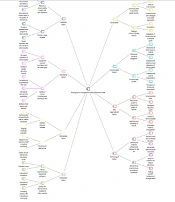
The network of the themes of the IR goals and uses was obtained by the NVivo software, and the data provided from the thematic analysis network and formation of the thematic network revealed that the primary framework of the IR functions consisted of four inclusive themes, 17 organizing themes, and 71 basic themes (Figure 1).
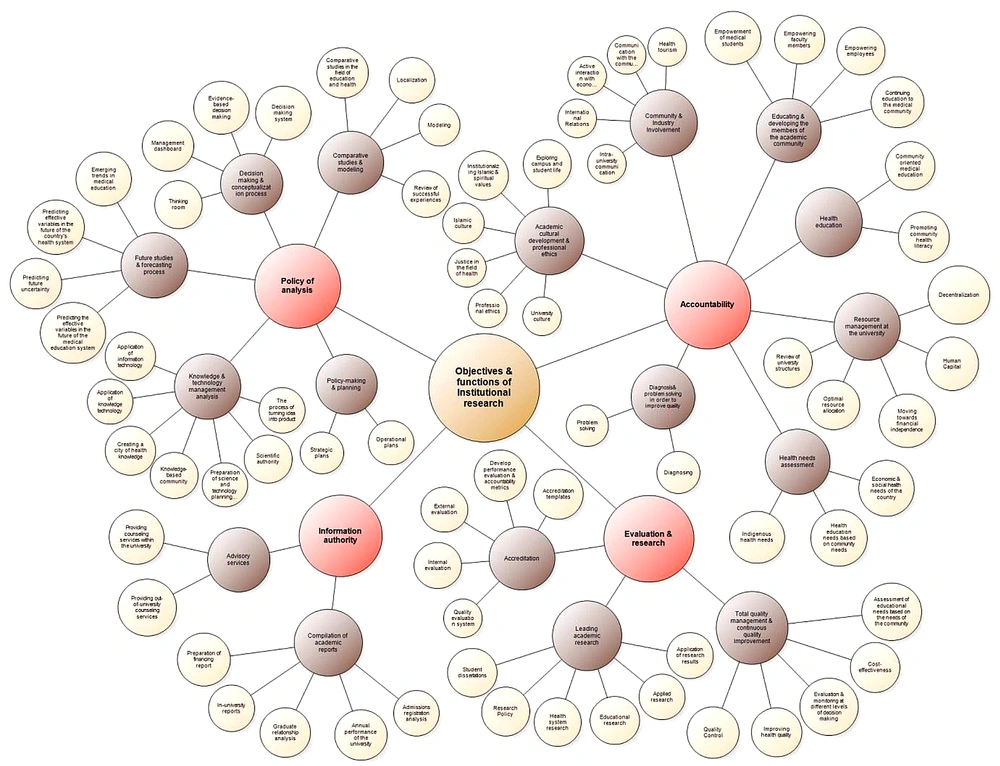
Figure 1.
Network of IR function themes extracted from NVivo Software
After determining the 17 dimensions of the IR function in medical universities, the dimensions were classified into four levels of IR organizational roles and organized into four main functions. Also, the conceptual model of the organizational roles and activities of IR in medical universities was drawn within a paradigm combination (Figure 2). The model encompassed four organizational roles and 17 dimensions of IR function. This type of IR function organization applied to a type of knowledge-based organization where IR has the four main functions of information authority, spin doctor, policy analyst, and scholar and researcher in the assessment continuum from internal improvement to external development, as well as in the managerial continuum from academic and professional management to administrative management and bureaucracy. Therefore, the proposed model could provide a general framework for measures regarding the initiation of IR activities in medical universities.
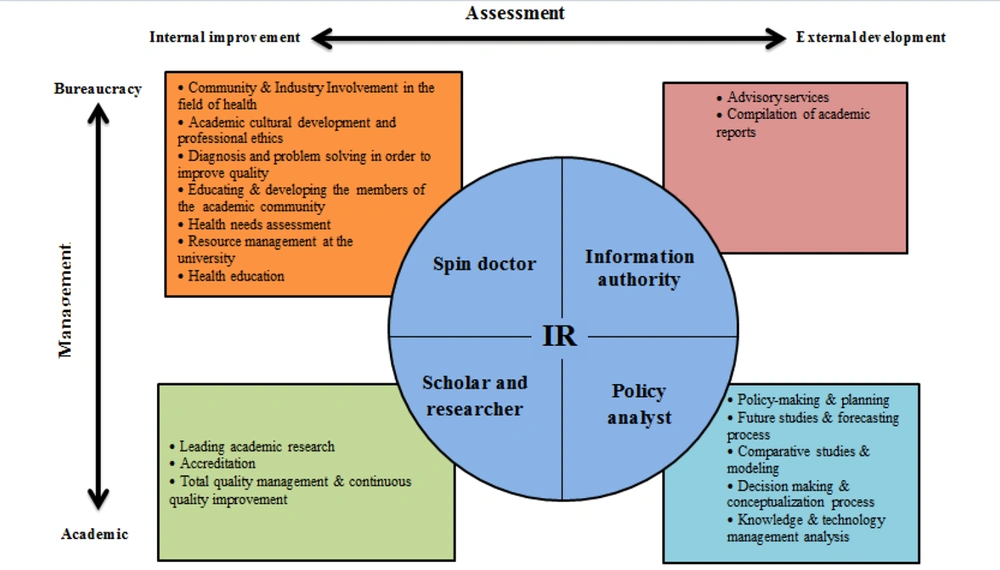
Figure 2.
Proposed model for IR
5. Discussion
Considering the objectives of our research (functions of IR in medical universities), we initially assessed the current status of KUMS using a case study design. Afterward, valuable information was obtained regarding the associated themes, as well as the theoretical and specialized constructs of IR, by conducting interviews and assessing upstream documents. As mentioned earlier, 71 basic themes were identified as the specialized constructs, and 17 organizing themes were considered as the theoretical constructs, which were analyzed within a framework encompassing the four inclusive themes of information authority, spin doctor, policy analyst, and scholar and researcher. At the next stage, the identified themes were presented in the form of a conceptual model.
Spin doctor (responsiveness of the university) is defined as the recognition, collective accountability, and commitment of academics to the scientific-professional demands, expectations, and needs of the main external stakeholders of the university (scientific society, civil society, and labor market), as well as the maximum use of efforts, motivations and abilities, continuous improvement of performance in line with these issues, and transparent, accurate, timely, and continuous reporting of university performance to the stakeholders to gain their trust, satisfaction, support, and cooperation for the management of the university (17). One of the philosophical approaches of postgraduate education is the perspectives on accountability and social commitment. In the 2025 vision plan of the medical education system in Iran, meeting the health needs of the community is emphasized as a pillar of the health system in line with the operationalization of the responsive medical package from the 12 packages of transformation in medical education. In this approach, medical universities are considered as an inherent element of the existing philosophy of postgraduate education as a social unit that has accountability perspectives to the community's needs and expectations. Social accountability is a commitment to the guidance, education, research, and provision of healthcare services based on the priorities of the community. This issue is regarded as the key mission of medical universities (18), and universities adopt numerous mechanisms to realize this mission and meet their responsibilities to address the needs of the community.
One of the most important mechanisms of universities for community relations and understanding their social responsibilities is communicating with the industry through establishing joint research centers, implementing the educational courses required by industries based on the situations and needs of the workplace and employees, and designing in-service courses in an actual environment. Scientific environments could be promoted through more emphasis on cooperation with the industries outside academic environments, which mutually benefits students, graduates, and recruiters (19). Today, industry-university communication is considered essential to development. In this organizational role, IR obligates the expansion of communication with the community and industry in the field of health. The proper interaction between university, which is in close contact with new scientific developments and strives to improve the quantity and quality of its scientific-research services, and production/service organizations, which are concerned with increased efficiency and productivity and the provision of optimal service delivery as a constant priority, are known to be critical in the survival of both. Undoubtedly, the improper correlations of scientific findings and practical experiences not only threaten universities with the risk of 'thinking in a vacuum', but they also complicate the improvement of welfare in the community by depriving organizations of scientific business management instruments. Notably, the mentioned cultural infrastructures should be provided for this purpose, and professional ethics should be institutionalized within the academic community.
Disease diagnosis should be carried out to develop and respond to community needs, and attempts should be made to identify and eliminate problems and damages to the internal processes and functions of the university and effectively respond to the needs and demands of the outside environment. Meanwhile, universities compete in various areas, including student and faculty management dimensions at national and international levels, research management, and investment. These institutions must maintain their credibility and popularity, produce high-quality research, keep students and faculty members satisfied, and respond to the growing demands of the community (20). As such, universities and higher education centers are affected by powerful and complicated forces and demand for higher education increases every day. Given the increased rate of unemployment and economic crises, attempts are made to gain expertise and receive academic degrees to find suitable jobs. Therefore, postgraduate education should provide better services and education to the community members, and the competencies and continuous improvement of faculty members and the community of academics play a fundamental role in the IR field in this regard. Considering this issue, empowering faculty members through their improvement and continuous staff training in the fields of medicine and health has been defined as another function of IR.
A more specialized aspect of IR is the role of researchers in leading academic research from applied and HSR research to policy research and education. From this perspective, unbiased institutional researchers assist university authorities in the decision-making process through research. Today’s competitive world needs managers who can make decisions rapidly and accurately. Proper management requires information for decision-making, and available data should be turned into information to be used for this purpose. To realize organizational goals, managers should analyze the environment, recognize variables, and take appropriate measures, which require access to updated information inside and outside the organization. Some of the main problems in organizational research projects that may prevent adequate returns include defining and implementing similar projects in various subsidiary units, incompliance of research projects with the goals and development strategies of the organization, irrelevance of research projects to the problems and issues threatening the entire organization, high probability of failure due to the unclear planning, creation, evaluation, implementation, and control of research projects, and development and transfer of inappropriate technology by the subsidiary units.
Recently, extensive research activities have been carried out in Iran, especially in the health and treatment system although they have mostly been in a scattered and uncoordinated manner regardless of the needs of the system and the development of its dimensions due to the absence of a unified and coherent system of applied research (21). One of the consequences in this regard is the improper decision-making of managers and lack of coordination between the actual needs and provision of health services (22). An important factor that has a further complicated investment in the research and development of these institutions is the lack of an efficient structure for the formation and defining research projects in the university headquarters, as well as the inability to determine goals and strategies, which in turn affects developing the related programs and performance of the affiliated units. The pivotal role of universities in community health has doubled the necessity of corrective measures in the field.
In general, a system is required in the central headquarter of universities for determining the process of the formation and defining of research projects, so that the research activities of the affiliated units could be guided to obtain comprehensive information on the current status and corrective measures and provided to managers (23). With any mission, goal/vision, executive institutions, and organizations will ultimately operate on a national or international scale and must be accountable to their clients and stakeholders. Such examples are a company aiming for customer satisfaction and profitability and an organization aiming for the complete and accurate implementation of legal duties to achieve the development and excellence goals of a country and must remain accountable in this regard (24). Comprehensive quality management is a commitment to having the optimal function in the organization through teamwork and establishing a continuous improvement process. Comprehensive quality management should also result in the better/optimal provision of high-quality services to meet customers’ needs and exceed their expectations (25). Medical universities are no exception, and their clients constitute a community of students, faculty members, academicians, and community members. An IR unit plays an accelerating role in the assessment, design, and continuous evaluation of the performance, resources, human resources, plans/processes, comprehensive quality management, accreditation/quality assurance, and development based on standards and metrics. In line with our findings, these activities have been confirmed by Peterson, Cyert and March, Olsen, Whitchurch, and Saketi (7, 26-29).
Playing the role of information authority, an institutional researcher provides reports tailored to government agencies to raise funds and attract student enrollment data and graduate enrollment information. An IR office is regarded as the databank of the university, which provides descriptive data for academic audiences by the preparation of data and the conversion and processing of information. The information supports the decision-making of the university management and acts as a council. Moreover, timely access to information is ensured by preparing academic reports, which in turn results in the identification of strengths and weaknesses, control of employees, reduction of staff costs, and fundraising (6, 30-32).
One of the activities of the OIR is to provide counseling services to students and community members (i.e., intra-university and extra-university counseling). This dimension of IR is administrative, presented in a bureaucratic manner, and improves internal university affairs. In this respect, our findings are congruent with the results obtained by Knight and Nemati (33, 34). Due to the particular nature of the health sector, policymaking in this area is more important and sensitive than in other sectors. The nature of decision-making in the health sector often involves the matters of life and death, and in most cases, health is affected by numerous decisions that might not be directly related to health care. Since health systems are technically complicated, any changes in this complex and interconnected system will have inevitable effects on other sectors, as well as the stakeholders (35), which places more emphasis on the importance of attention to this area. Our findings in this regard are in line with the results obtained by Calderon and Mathies, Toroghi et al., Saketi, Peterson and Corcoran, Saupe, and Bidokhti et al. (6, 17, 29, 36-38). Nevertheless, studies conducted in the field have mainly contributed to the general policy-making in higher education and are not specifically related to the field of health care.
By observing the influential variables in the future of the Iranian health system, the future of medical information, and attention to the newly emerged processes in medical education, institutional researchers contribute to the upcoming research and experimentation in our country, while also supporting the necessary changes through conducting comparative research and modeling, policy reviewing, and administrative and executive re-organization. Moreover, such measures could help analyze the policies of the university and positively influence decision-making and conceptualization processes. Policymakers and decision-makers need the most effective research to make the most successful policies, which justifies the use of research findings in policymaking (39).
The compilation of the 20-year vision plan of Iran is a valuable step toward directing the country's activities to achieve development, and one of the most important phrases of the document is focused on Iran's position in the 2025 vision in the field of science and technology. Achieving the goals set out in the vision requires comprehensive management and planning in all dimensions. Besides, the most important factors should be identified, and proper plans should be designed and implemented in the field of science and technology management. Since the vision looks to the future, using foresight approaches is crucial to measuring the correct orientation of the policies and quality of the programs designed for achieving the vision goals (40). The key roles of IR in this dimension are the analysis of knowledge and technology management, as well as converting an idea into a product, creating a health knowledge city, preparing a science and technology planning document, and creating a knowledge-based community. Our findings in this regard are consistent with the results obtained by Serban, Saketi, Volkwein, Entezari, and Nemati and Amiri (10, 29, 41-43).
5.1. Conclusions
With the instantaneous increase in the environmental complications and variables involved in the success of higher education and university, the existing opportunities cannot be fully exploited, and higher education should be developed with a greater emphasis on higher education policies in today’s competitive world. Therefore, moving in line with the formation of a construct known as IR is regarded as an effectual strategy to improve policy studies in the Iranian higher education system. The goals of IR are mainly related to the policy studies of institutes and centers, which could be used by the OIR and universities with some modifications. In this regard, recognizing the concept of academic independence and its requirements could be extremely beneficial as repeatedly emphasized by major higher education policymakers.