
1. Background
Emphasis on professionalism dates back to the late 1960s in the form of bioethics and professional ethics (1). In addition to the acquisition of clinical knowledge and skills in medicine, the development and improvement of values, attitudes, ethical norms, social skills, and other human characteristics of a physician are paramount. As such, special attention should be paid to professionalism as an essential competence in medicine (2). Since the principles of professionalism are not inherent in individuals, they must be learned properly. On the other hand, mere attention to teaching knowledge and skills to medical students without considering professionalism will lead to the training of physicians who lack the characteristics and professional responsibilities of an efficient physician, which is a serious threat to society (2, 3).
Although the dimensions of professional identity are clear today, we are faced with a significant lack of tools for promoting professionalism (4). Despite an emphasis on professionalism in numerous universities, professionalism training remains a challenging subject in medical education (2). Narrative medicine (NM) is a method of teaching and evaluating professionalism, which has recently gained popularity (5, 6).
It is mentioned that the NM approach was introduced by Dr. Charon, and its goals were expressed in the form of four skills, including empathy, reflection, professional commitment, and trust (7). Quoted to Charon, NM is the ability to identify, absorb, understand, interpret, and critically narrate a patient's illness story (8). As such, a narrative approach encompasses the knowledge and learnable skills that could help healthcare professionals understand patients' stories and conditions (9). Previous studies in this regard have provided various narrative approaches with different educational goals to groups of learners and evaluated the effectiveness of the training courses (10-16).
For the first time in Iran, an NM program was implemented in the present study in order to teach empathy and reflection to medical interns as part of the professional ethics course at Isfahan University of Medical Sciences in 2019. The participants practiced reflection and empathy by telling the patients' illness stories, and the clinical teachers received this feedback (17). Furthermore, reflection practices were accomplished using an educational tool (18).
2. Objectives
The present study aimed to elaborate on the challenges of implementing the first NM training course in Iran from the perspective of medical interns.
3. Methods
3.1. Study Design
This study was part of a research aimed to explain the experiences of the participants about the challenges of the first NM course in depth. The study was conducted using a qualitative approach. The participants of the study were medical interns who were enrolled in the NM course at Isfahan University of Medical Sciences. Active participation in the sessions was the inclusion criterion, and those who were not willing to be interviewed were excluded from the study. The participants were selected via purposive sampling.
The researcher was one of the course planners. After obtaining informed consent from the participants, the interview question was asked, as follows: "what were the challenges in implementing the NM training course?" Follow-up questions were also asked in the next stages (eg, “were there any problems in implementing this training course? Were these problems solvable?”).
The interviews continued until reaching data saturation, and the duration of each interview was 20 - 40 minutes depending on the time and patience of the participants, the obtained information, and the willingness of the participants. Notably, the interviews were recorded with their permission of the participants. In-depth semi-structured interviews were conducted individually to assess the participants' perspectives, and some of the participants were invited to be re-interviewed if necessary. In addition, the interview transcripts were returned to the participants so that they could provide their comments and make corrections.
3.2. Statistical Analysis
Data analysis was performed simultaneously with data collection in the MAXQDA10 software using qualitative content analysis and an inductive approach. In addition, the content analysis method proposed by Graneheim and Lundman was used for data analysis (19). The rigor and reliability of the data were evaluated based on the criteria of Lincoln, including transferability, reliability, and conformability (20).
4. Results
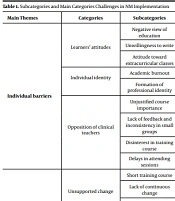
In total, 18 medical interns of both genders (10 males and 8 females) with the mean age of 25 ± 0.38 years were interviewed. After analyzing the interviews and eliminating duplicate codes, 523 codes were extracted in three main categories and eight subcategories. The main categories were individual barriers (subcategories: learners' attitudes, individual identity, and opposition of clinical teachers), educational barriers (subcategories: unsupported change, incoherence of sessions, educational atmosphere, and hidden curriculum) and environmental barriers (subcategory: physical factors) (Table 1).
Table 1.
Subcategories and Main Categories Challenges in NM Implementation
| Main Themes | Categories | Subcategories |
|---|---|---|
| Individual barriers | Learners' attitudes | Negative view of education |
| Unwillingness to write | ||
| Attitude toward extracurricular classes | ||
| Individual identity | Academic burnout | |
| Formation of professional identity | ||
| Opposition of clinical teachers | Unjustified course importance | |
| Lack of feedback and inconsistency in small groups | ||
| Disinterest in training course | ||
| Delays in attending sessions | ||
| Educational barriers | Unsupported change | Short training course |
| Lack of continuous change | ||
| Insufficient justification | ||
| Resistance to change | ||
| Incoherent sessions | Interference with internship | |
| Schedule of theory classes | ||
| Educational atmosphere | Few opportunities and negligence of learning | |
| Not taking education and evaluation seriously in internship | ||
| Principles of professional ethics between teachers and students | ||
| Emphasis on specialized education | ||
| Hidden curriculum | Degree of observing professionalism principles | |
| Prevailing atmosphere of moral values | ||
| Incompatibility of ethical principles with actual performance | ||
| Environmental barriers | Physical factors | Physical space |
| Problems with cooling systems |
4.1. Main Category One: Individual Barriers
4.1.1. Learners' Attitudes
The subcategories of learners’ attitudes included the negative view of education, unwillingness to write, and the attitude toward extracurricular classes. Some of the participants’ comments in this regard are as follows:
"In internship, scores are not important." (P2);
"Not everyone likes to write a story." (P10);
"I think there is an extra class. We have so many of these classes that waste our time." (P18)
4.1.2. Individual Identity
The subcategories of individual identity included academic burnout and formed professional identity. Some of the participants’ comments in this regard are as follows:
"I think because we are interns, we do not think about coming to class and learning anything anymore, and we are really bored." (P5);
"I think internship is too late for teaching NM." (P7);
"Our foliage has now formed, and we have become a tree. We could have been formed sooner than this when we were a seedling." (P17)
4.1.3. Opposition of Clinical Teachers
The subcategories in this theme included the lack of justification for the importance of the course, lack of feedback, inconsistency in small groups, disinterest in the training course, and delay in attending the sessions. Some of the participants’ comments in this regard are as follows:
"Using clinical teacher who are justified in this course and are interested in NM is helpful. It was really problematic when we were told to come to class at 7 in the morning, but some teachers came at 7:30!" (P4);
"We talked to our peers. Some teachers were more active, and the interns were interested. However, some of them did not even provide feedback." (P1)
4.2. Main Category Two: Educational Barriers
4.2.1. Unsupported Change
The subcategories of unsupported change included short training courses, lack of continuous change, insufficient justification, and resistance to change. Some of the participants’ comments in this regard are as follows:
"I think the class time was very short. Just as we got to become familiar with the course, it was over." (P9);
"We were just learning how to express our feelings and let ourselves go, and then it was over." (P13);
“This course has had a good impact, but many said that it should have been longer." (P8);
"The point is that new teaching styles are always resisted in the beginning." (P11)
4.2.2. Incoherent Sessions
The subcategories of coherent sessions were interference with internships and the schedule of theory classes. Some of the participants’ comments in this regard are as follows:
"For this class, even though it was early in the morning, those who were not on duty came to the class." (P14);
"Well, the problem is that we have little time to study in internship. That is why we are tired." (P12);
"The large number and initial resistance of interns and the time of the class made proper justification implausible." (P17)
4.2.3. Educational Atmosphere
The subcategories of educational atmosphere included few opportunities and the negligence of learning, not taking education and evaluation seriously in internship, principles of professional ethics between teachers and students, and emphasis on specialized education. Some of the participants’ comments in this regard are as follows:
"We are at the end of the course and are really tired of the atmosphere of education and hospitals." (P15);
"This class should be held for the teachers first. They behave very badly and should be a role model in terms of dealing with patients and students." (P5);
"The best time for holding NM is during clerkship." (P3);
"The number of students is very large, which causes problems in managing the class." (P1);
"In internship, we are stressed about being admitted in the residency exam. So, this course must be held in lower levels." (P3)
4.2.4. Hidden Curriculum
The subcategories of hidden curriculum included the degree of observing professionalism principles, prevailing atmosphere of moral values, and incompatibility of ethical principles with actual performance. Some of the participants’ comments in this regard are as follows:
"The health system is not healthy! That is why some students do not attend classes and clinical rounds and are on-call. In the Olympiad, for example, they have a 50% acceptance quota in the residency and do not participate in internship theory courses at all." (P9);
"There is a bad atmosphere. For example, last night I was on duty, and a patient fainted. I performed resuscitation with all my might, but when the patient returned to consciousness, the residents and nurses asked me why I came to resuscitate the patient so soon! I wondered what I should have done!" (P7);
"Unfortunately, the doctor sees the patient only as a product or a source of income. I really do not know if it is because of the work pressure that they forget these training or they really do not have a working conscience." (P15)
4.3. Main Category Three: Environmental Barriers
This category had only one subcategory of physical factors.
4.3.1. Physical Factors
The subcategories of physical space and problems in the cooling system were identified in the final main category. Some of the participants’ comments in this regard are as follows:
"Medical school classrooms are very large, and we are also a large population. Sometimes the professors’ voice cannot reach us at all. I think we should have sat closer to each other." (P11);
"Because of summer and due to energy saving, class started half an hour earlier, and this made the students resist more and sometimes come later." (P6)
5. Discussion
The analysis of the challenges associated with the implementation of NM resulted in the following main categories.
5.1. Individual Barriers
From the interns' viewpoint, implementing NM in internship was an important challenge. It seems that providing NM from pre-internship clinical courses and integrating this subject into the formal curriculum could effectively improve the challenges faced by individual learners. Furthermore, selecting trained and interested teachers to educate students was considered an issue in this regard.
5.2. Educational Barriers
According to the innovative NM approach, it is essential to consider the steps of presenting change to enhance the effectiveness of the training course by resolving educational challenges. Although the issues associated with hidden curriculum is less flexible to change, changing teaching methods, proper training, and informing teachers on the principles of professionalism could provide a more appropriate context.
5.3. Environmental Barriers
Undoubtedly, physical space and appropriate time are influential in motivating and improving the quality of education. It is possible to provide a favorable physical space to resolve this issue by considering the round arrangement of the chairs and using special halls in order for the audience to interact through eye contact.
To date, no studies have directly addressed the challenges of conducting NM. However, similar studies have examined the general results of providing NM to various groups of learners in terms of educational effectiveness (10-16). This was the first study in Iran to review the experiences of a training course evaluation in this regard (17).
A qualitative study was conducted by Vafadar and Parandeh to explain nursing students' experiences of clinical education through the narrative reflection method. The mentioned study introduced the general theme of ‘understanding self-worth in active clinical learning’, as well as four main categories, including self-awareness, promoting self-efficacy and motivation, participatory and active learning, and self-expression. The authors recommended the narrative approach and reflection training in clinical education for the professional development of students (21). Their findings are consistent with the results of the present study in terms of the general purpose of providing a narrative approach to cultivate the emotional domain of learners. However, they did not address the challenges of implementing this approach.
In another study by Boudreau et al., a narrative approach was developed to promote reflection in teachers. The feasibility and value of the implemented workshops were confirmed by the participants, and it was reported that reflective writing could effectively promote reflection and could be used by healthcare professionals (22). This is consistent with the current research in terms of the feasibility of implementation and acceptance by participants. However, the mentioned study is not in line with the general objective of our research.
The study by Arntfield et al. aimed to evaluate the effectiveness of NM. The students stated that the educational approach used in teaching narrative was necessary owing to its benefits, and NM was considered effective and important in this regard. However, the interpretation and meaning of the narrative was associated with cultural conflicts in terms of communication skills, participation, and professional development (23). The mentioned study is consistent with the results obtained by Huang et al. (24) regarding the presentation of a narrative approach; it is also in line with our study.
Studies regarding NM education, which had long been mandatory for medical students before internship, have proposed beneficial educational outcomes (16, 25-27). The prolonged training courses in these studies are considered significant in continuing the practice based on a narrative approach. According to the results of the present study, the general viewpoint of the interns toward extracurricular and optional classes was not quite positive, and they did not partake in these courses persistently. A solution in this regard would be to consider lower educational levels or start a medical course to offer NM. However, some studies have provided NM to residents, faculty members, and general practitioners, reporting favorable educational efficacy (23, 28-30).
5.4. Suggestions
Most of the studies regarding NM have been conducted in Western countries (especially the United States), and the effectiveness of NM may be associated with the cultural acceptance of medical students (24). Therefore, the impact of the acceptance of NM must be considered from a cultural perspective, and it is essential to conduct similar studies in other communities given the differences in the culture of Eastern societies. Furthermore, using an NM framework along with opinion of experts is recommended for NM implementation (31).
5.5. Limitations
Although our findings could be generalized to other educational groups to some extent, they may differ in other educational levels, and accurate and practical educational planning are required before offering NM. Our study was based on the analysis of one group of interns who participated in the first NM course in Iran. Other challenges should be addressed if these courses are to be repeated.
5.6. Conclusions
The analysis of the participants' experiences indicated that although positive results were attained in the NM course in terms of educational effectiveness, some challenges were faced in terms of educational innovation. Addressing these issues could make NM implementation more effective in subsequent courses in other universities.