
1. Background
Currently, environmental changes and challenges have created differences in the functions and roles of managers. All the profit, non-profit, public, and private sectors are exposed to rapidly and dynamically changing environments (1). The quality of management and competency is one of the main factors in the success of organizations (2).
Eligibility is an essential element for optimization of recruitment and hiring processes (3). Eligibility includes integrated practice of members or organizations in order to reach specific achievements (4) and also it can be defined as a prerequisite of effective performance and requirement for behavioral policies (5). Managers of the organization are an important source of gaining competitive advantage, and managerial competency reflects behaviors that are related to human values and are effective in shaping the dimensions of organizational culture (6). Therefore, the selection and appointment of managers and the identification of the most suitable individuals need an appropriate benchmark, criterion, and model through which the deserved and positive managers take over organizational positions. Therefore, the purpose of developing a competency model in each organization is to provide a model for the integration of performance of human resources that leads to effective performance and organizational success (7).
Positive organizational behavior can be affected by qualified managers. Recent decades have witnessed notable research about positive mental capacities (8). Positive organizational behavior insists on wisdom aspects of organizational behavior in addition to positive and nurturing states of human personality (9).
Organizational behavior has led to the use of opportunities for managers and proper approach to the problems. A manager can use this knowledge to increase effectiveness of their work and organization, and improve the quality and quantity of staff performance. They can delegate some of their responsibilities to the subordinates and start some programs to change and modify structure of the organization. This knowledge can be used to improve social communication among managers, notice differences in managers and help managers to get along with employees in different environments (10). Accordingly, modern organizations require managers who can benefit from positivism to handle states, potencies and human resources capacities in order to operate with positive organizational policies (11).
The importance of meritocracy, competency management, and emphasis on positive organizational behavior in organizations clarifies that organizations need efficient and effective managers and employees to achieve their goals for comprehensive development and to positively affect individual’s behavior (10). The importance of this issue in medical educational organizations in charge of maintaining, supplying, and promoting health, also controlling and preventing illness is confirmed because one of the most important parts of medical educational organizations is management, and managers are the keys to solve most of the problems. Managers of the healthcare services have a more important task in addition to having general management responsibilities such as planning, organizing, directing and controlling, innovating and motivating, coordinating, and budgeting. They should respond to the healthcare needs of the community through saving lives or improving health, which increases the sensitivity and importance of their work. Due to the dynamic, alive, and evolving nature of healthcare, managers of this sector must be able to synchronize themselves with changes and progresses (12). Scientific research shows that few studies have been conducted on the role of competency management in positive organizational behavior. Both variables are important in the effectiveness and efficiency of organizations, especially highly sensitive medical educational organizations. Therefore, a comprehensive study appears to be necessary to show the effect of these two variables and to design a model.
2. Objectives
The present research mainly aims to investigate the effect of competency management on positive organizational behavior (self-efficacy, hopefulness, resiliency, and optimism) in teaching hospitals of Kermanshah University of Medical Sciences (KUMS).
3. Methods
According to scientific researches, the present research is a quantitative paradigm using an applied method to notice research purposes. On the other hand, in a matter of time, it is a cross-sectional research. Data were collected with questionnaires. Based on the collected information, statistical population comprised 4800 individuals including nurses, doctors, and office staff in teaching hospitals of KUMS. Random sampling was used to select 355 individuals. Considering sample loss, 360 questionnaires were given to the samples and 352 questionnaires (97.8%) were finally returned. As some questionnaires were incomplete or defective, 342 questionnaires (95%) qualified for analysis. Competency management questionnaire is the result of the qualitative phase, and its content validity was measured as 8.3 out of 10 according to 12 professors using content validity ratio (CVR). It also has an acceptable goodness of fit (GOF) index. Construct validity of the questionnaire was confirmed by confirmatory factor analysis, which showed an acceptable fit in factor loading and statistical significance of the questionnaire. Convergent and divergent validities of the questionnaire also showed its high validity. Cronbach’s alpha coefficient was used to investigate its reliability, which resulted in Cronbach’s alpha coefficient of 0.923 for the whole questionnaire and 0.856 and 0.855 for its two main factors: promoter and balance indicators, respectively. Luthans’ positive organizational behavior questionnaire which includes four elements (self-efficacy, hope, tolerance and optimism) has been used for investigating positive organizational behavior. Professors confirmed its validity, and Cronbach’s alpha coefficient was 0.894, which shows its acceptable reliability. Ethical considerations of the research include informing participants about the subject and the method of the research, confidentiality of participants’ personal information, not conflicting with the religious and scientific standards, and it should be mentioned that the data were analysed in general. Pearson’s correlation test and structural equation modeling or least squares method are used for analyzing research hypotheses. Data were analyzed using SPSS version 23 and SMART PLS version 2.
4. Results
Demographic characteristics of selected employees (342 individuals) of the teaching hospitals of KUMS who participated in the study were determined (Table 1).
Table 1.
Demographic Characteristics of the Participants
| Variables | Frequency | Percent |
|---|---|---|
| Gender | ||
| Male | 128 | 37.42 |
| Female | 209 | 61.11 |
| Unanswered | 5 | 1.46 |
| Education | ||
| Associate | 14 | 4.09 |
| Bachelor | 279 | 81.57 |
| Master | 21 | 6.14 |
| Doctorate | 22 | 6.43 |
| Unanswered | 6 | 1.7 |
| Total | 342 | 100.0 |
The descriptive results including mean, standard deviation, skewness, and kurtosis of quantitative variables of the research were investigated (Table 2).
Table 2.
Descriptive Statistics of the Research Variables
| Variables/Components | Mean | Standard Deviation | Skewness | Kurtosis |
|---|---|---|---|---|
| Competency management | ||||
| Promoter competency | ||||
| Executive competency | 3.600 | 0.747 | -0.395 | -0.158 |
| Communicative competency | 3.762 | 0.725 | -0.553 | 0.406 |
| Developmental competency | 3.626 | 0.672 | -0.265 | -0.352 |
| Team competency | 3.706 | 0.716 | -0.114 | -0.745 |
| Knowledge competency | 2.531 | 0.743 | 0.285 | -0.336 |
| Total | 3.531 | 0.517 | -0.180 | -0.073 |
| Balance competency | ||||
| Attitude competency | 2.904 | 0.677 | 0.325 | 0.264 |
| Personal competency | 3.672 | 0.674 | -0.106 | -0.091 |
| Control competency | 3.912 | 0.595 | -0.654 | 0.683 |
| General | 3.832 | 0.642 | -0.537 | 0.678 |
| Total | 3.582 | 0.516 | -0.460 | 0.864 |
| Total competency management | 3.557 | 0.460 | -0.211 | 0.460 |
| Positive organizational behavior | ||||
| Self-efficacy | 3.721 | 0.667 | -0.495 | 0.941 |
| Hopefulness | 3.451 | 0.727 | -0.245 | 0.472 |
| Resiliency | 3.684 | 0.609 | -0.353 | -0.011 |
| Optimism | 3.600 | 0.732 | -0.308 | 0.097 |
| Total | 3.614 | 0.578 | -0.338 | 0.647 |
The mean score of promoter competencies was 3.531. Communicative competency had the highest mean and knowledge competency had the lowest mean. Moreover, the total mean score of balance competencies was 3.582. Control competency had the highest mean and attitude competency had the lowest mean. In addition, the total mean of positive organizational behavior was 3.614. Self-efficacy had the highest mean and hopefulness had the lowest mean. Also, the skewness distribution of research variables was normal at the error level of 0.132 and the kurtosis distribution was normal at the error level of 0.263 (Table 2).
Positive organizational behavior has a direct and positive correlation with competency management (r = 0.631), promoter competencies (r = 0.489) and balance competencies (r = 0.635) (Table 3).
Table 3.
Pearson Correlation of the Research Variables
| Order | Variable | 1 | 2 | 3 | 4 | 5 | 6 | 7 |
|---|---|---|---|---|---|---|---|---|
| 1 | Competency management | 1 | ||||||
| 2 | Promoter competencies | 0.891a | 1 | |||||
| 3 | Balance competencies | 0.890a | 0.585a | |||||
| 4 | Positive organizational behavior | 0.631a | 0.489a | 0.635a | 1 | |||
| 5 | Self-efficiency | 0.550a | 0.386a | 0.594a | 0.851a | 1 | ||
| 6 | Hopefulness | 0.460a | 0.381a | 0.438a | 0.846a | 0.658a | 1 | |
| 7 | Resiliency | 0.559a | 0.433a | 0.562a | 0.849a | 0.642a | 0.617a | 1 |
| 8 | Optimism | 0.573a | 0.455a | 0.565a | 0.839a | 0.593a | 0.570a | 0.655a |
aCorrelation at a level less than 0.001
In the modeling of the structural equations phase, Smart PLS software was used to analyze the conceptual model and research hypotheses in order to assess the research data and statistical deduction.
Regarding the modified model, factor loading in all questions was higher than 0.5 (Figure 1). All the T coefficients of the questions were higher than 1.96 (Figure 2).
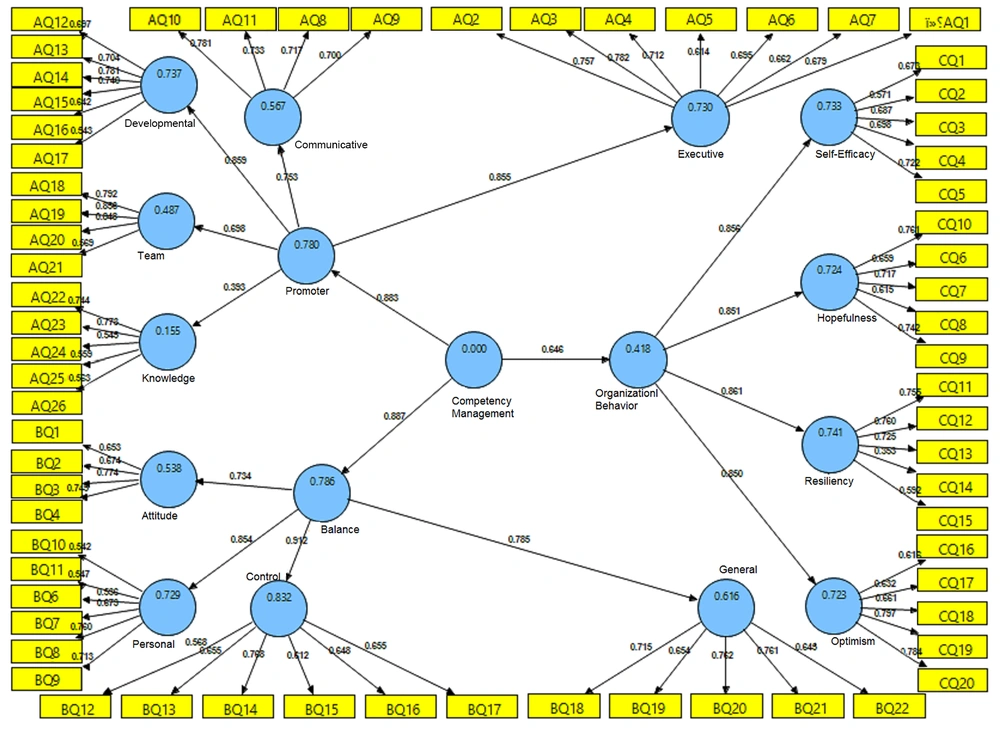
Figure 1.
Modified reflective measurement model in the standard coefficients estimation (factor loads) state
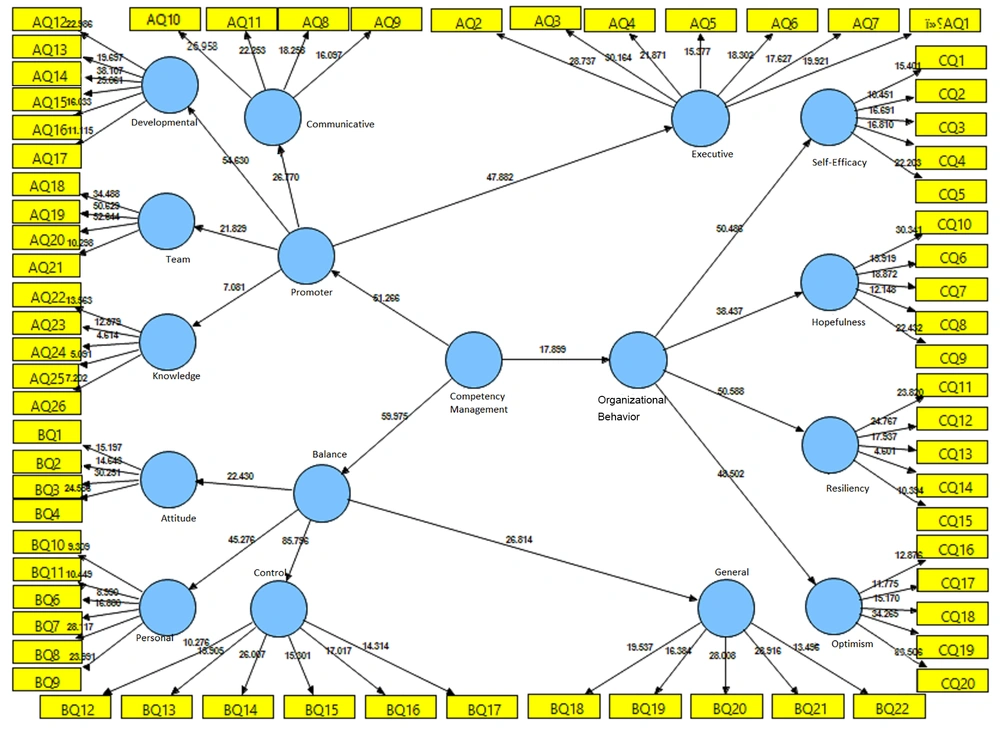
Figure 2.
Modified reflective measurement model in the significant level state
According to model quality, Cronbach’s alpha and composite reliability are higher than 0.6 for all variables. Therefore, it can be concluded that the competency management variable, its components and subcomponents and the positive organizational behavior and its components have an appropriate value. Thus, the appropriateness of the research reliability can be confirmed. The AVE value is higher than 0.4 for all variables. Therefore, the appropriateness of the research convergence validity can be confirmed. The cross-validated communality (CV-Com) value for the competency management variable, its components and subcomponents, and the positive organizational behavior and its components is strong. Therefore, the strong GOF of the measurement model (CV-Com) is verified. The R2 value of the endogenous variable of positive organizational behavior and its components, according to the three criterion values, confirms the strong GOF of the structural model. The Q2 value was evaluated for the competency management variable, its components and subcomponents and the positive organizational behavior and its components. Therefore, the GOF of the structural model (cross-validated redundancy (CV-Red) test) is verified. Fit results are descripted below (Table 4).
Table 4.
Results of GOF Index of the Hidden Variables in Research
| Components | Alpha | CR | AVE | R2 | Q2 | CV-Com | Communality |
|---|---|---|---|---|---|---|---|
| Competency management | |||||||
| Promoter competency | |||||||
| Executive competency | 0.826 | 0.871 | 0.492 | - | 0.358 | 0.492 | - |
| Communicative competency | 0.713 | 0.822 | 0.537 | - | 0.301 | 0.537 | - |
| Developmental competency | 0.773 | 0.842 | 0.474 | - | 0.343 | 0.472 | - |
| Team competency | 0.770 | 0.854 | 0.600 | - | 0.291 | 0.600 | - |
| Knowledge competency | 0.683 | 0.776 | 0.415 | - | 0.050 | 0.415 | - |
| Total | 0.886 | 0.901 | 0.479 | - | 0.215 | 0.279 | - |
| Balance competency | |||||||
| Attitude competency | 0.682 | 0.804 | 0.508 | - | 0.264 | 0.508 | - |
| Personal competency | 0.696 | 0.779 | 0.403 | - | 0.289 | 0.403 | - |
| Control competency | 0.729 | 0.816 | 0.427 | - | 0.346 | 0.427 | - |
| General | 0.750 | 0.834 | 0.502 | - | 0.308 | 0.502 | - |
| Total | 0.885 | 0.902 | 0.408 | - | 0.242 | 0.308 | - |
| Total competency management | 0.923 | 0.930 | 0.430 | - | 0.230 | 0.230 | - |
| Positive organizational behavior | |||||||
| Self-efficacy | 0.694 | 0.803 | 0.430 | 0.733 | 0.338 | 0.454 | 0.451 |
| Hopefulness | 0.740 | 0.827 | 0.451 | 0.723 | 0.350 | 0.502 | 0.490 |
| Resiliency | 0.641 | 0.780 | 0.490 | 0.740 | 0.319 | 0.431 | 0.429 |
| Optimism | 0.741 | 0.827 | 0.429 | 0.722 | 0.353 | 0.489 | 0.493 |
| Total | 0.894 | 0.909 | 0.493 | 0.417 | 0.140 | 0.377 | 0.438 |
GOF index of 0.559 confirms the appropriate and strong GOF of the whole model
The results determined the path coefficient of competency management on organizational behavior as 0.646, competency management on self-efficacy as 0.587, competency management on hopefulness as 0.486, competency management on resiliency as 0.592, and competency management on optimism as 0.611. The T-value of these hypotheses is more than 1.96, which means that the research hypotheses are confirmed. Therefore, results of the study of competency management components (promoter and balance competency) are confirmed (t > 1.96) except in path of competency management on self-efficacy and hopefulness (t < 1.96).
5. Discussion
The present study aimed to investigate the effect of competency management on the positive organizational behavior in teaching hospitals of KUMS. These results are consistent with the findings of Luthans et al. (13), Avey et al. (14), Avey et al. (15), Wang et al. (16), Woolly et al. (17), Peterson et al. (18), Ravand et al. (19), and Kaabomeir et al. (20).
Increasing the competency management and its components will increase positive organizational behavior. Since positive organizational behavior includes dimensions of self-efficacy, hopefulness, resiliency, and optimism, positive attitude toward human capital will enhance such positive abilities in employees. As the results show, employees with these capabilities can better deal with issues regarding their organization. These employees report their assessments of organizational conditions to those who they think are capable of making changes or compensating for losses, and express their views and ideas in order to improve their organization. Managers should create a space in the organization that implements all management principles in the organization. Competent managers should have leadership skills so that they can influence employees and help the organization to achieve its goals. Managers should have executive competencies such as change management, financial management, crisis management, and time management to make the best decision for the organization at critical times. Managers should help employees to build their self-confidence in order to be able to help by providing solutions for the organization problems. This means that managers should increase self-efficacy in the employees to prize them in expressing their opinions. When the management’s attitude toward employees is positive and their psychological capabilities are appreciated, employees will show more willingness to express their opinions and suggestions. As a result, managers will give more positive feedback to employees when they use their constructive suggestions. This, in turn, will lead to an increase in providing votes.
Competency management in organizations turns positive organizational behavior into effective human resources management, so that this positive organizational behavior can cause important indications to effective human resources management, education and development of employees, maintaining and creating competitive advantage and especially talent management in selection and promotion. Dignified employees develop more productivity, which means providing better and high quality services. Managers who have more abilities, internal and social awareness and care about competency, develop more tolerance of difficulties in employees. This kind of people have self-control, and as a result they have more self-efficacy, hope and optimism. Furthermore, managers with more occupational promoter competency encourage their employees to be more optimistic, do more positive additional activities, care about people’s satisfaction, solve more problems, and be more efficient. Balanced managers have characteristics like being familiar with technical field of organization, having intimate relationship with employees and clients, committing to ethical principles and being educated in healthcare related majors. The other features of balanced managers are familiarity with technology, software and hardware in medical centers, risk aversion and also observation and protection of patient rights. According to the results, balanced competency can enhance positive behaviors, which means balanced competency encourages employees to be more self-confident and reach occupational achievements by contributing to the empowerment and effectiveness of decisions in the organization. Hence, employees’ self-confidence leads them to carry out their tasks with enough confidence and achieve best results. Competency management in organization must show interest in learning opportunities, and continuous personal development. The other part of competency management role is to use employees’ experiences to assist in analysis of internal and external environment, have a realistic understanding of duties and expectations, care about organization development and improvement, take risks, choose challenging goals for organization and use other people experiences. Managers should also hold regular meetings with workgroups for their performance review to create positive work space in which employees can work with optimism, hope, efficacy and mental well-being. They should pay attention to manager-employee discussions and management strengths and weaknesses. Afterwards, this kind of management results in an increase in the psychological capital of individuals, more career success in employees, more commitments to perform duties and finally, occupational satisfaction.
5.1. Conclusions
The result of this research indicates that there is a significant relationship between competency management and balance and occupational promoter competencies. Also, the results of path analysis in structural equation modeling represent that competency management, promoter competencies, and balance competencies affect positive organizational behavior and its components such as self-efficacy, hopefulness, resiliency and optimism. Based on the results, it is recommended that managers improve psychological security in employees by protecting them, granting authority to them, promoting mutual respect, developing integrity and freedom in organization, involving employees in issues and paying attention to their morale, so that the employees can utilize other members of the organization with more confidence. Furthermore, given the importance of leadership and managers’ influence on employees, it is recommended that managers receive specialized management education and that experienced people be promoted to management positions.