
1. Background
Motivation is a general term for identifying the common ground between needs, cognition, and excitement (1). Motivation influences how people spend time and energy, and insist on achieving goals (2). One of the factors influencing learning is motivation, which can affect different aspects of learner’s behavior in educational settings (3). Among various factors affecting student performance, academic motivation is one of the most effective ones and studies show that students who do not have enough motivation will not make much effort for academic success (4). Low levels of motivation cause pessimism, anxiety and depression, and may lead to a decline in students' academic performance (5). Because of the impact of motivation on students’ academic achievement, psychologists have conducted several studies to identify the factors affecting motivation for progress and self-management learning. Pintrich indicated when learners actively participate in motivational and learning areas, self-regulated learning occurs. In this type of learning, learners make and manage learning activities. Self-regulation theory has two components of motivational strategies and learning strategies that are recognized as the most important determinants of academic achievement. Motivational strategies include three sub-components of (a) value component (intrinsic goal orientation, extrinsic goal orientation, and task value), (b) expectancy component (control beliefs, and self-efficacy for learning and performance), and (c) affective components (test anxiety); as well as, learning strategies include cognitive and meta-cognitive learning strategies (6). The success or failure of study is one of the main concerns of each educational system, which indicates its success (7). Studying the academic achievement of students and the factors affecting it and the need to review educational programs (8) are the most important reasons that make the current study necessary.
2. Objectives
The purpose of this study was to determine the role of motivational strategies in prediction of grade point average (GPA) among university students.
3. Methods
3.1. Participants
This analytical cross-sectional study recruited 300 students of Kermanshah University of Medical Sciences (KUMS) during 2018 - 2019. For sampling, all faculties were considered as a cluster, and finally the participants were selected using simple random sampling proportional to the size of each cluster. Participants filled out a self-administered questionnaire including the motivational strategies, GPA status, and background variable. Incomplete questionnaires were excluded. After removal of incomplete questionnaires, 264 questionnaires were analyzed (response rate was 88%).
3.2. Ethical Considerations
The Research Ethics Committees (REC) of KUMS approved the study protocol (IR.KUMS.REC.1397.076). Participants were briefed about the study method, confidentiality of data, and objectives of the study. All the selected students were willing to participate.
3.3. Inclusion and Exclusion Criteria
The inclusion criteria were being undergraduate and doctorate student, having passed at least one semester, and signing informed consent form. The exclusion criterion was incomplete questionnaires.
3.4. Measures
Questionnaire included three sections:
3.4.1. Background Variable Questionnaire
This questionnaire included age (year), sex (male, female), marital status (single, married), level of education (B.Sc., doctorate), school (medicine, dentistry, pharmacy, health and nutrition, nursing and midwifery, allied medical sciences), job (just student, student and employed), parents’ education level (under high school diploma, high school diploma, higher education), and living in dormitory (yes, no).
3.4.2. GPA Scale
The outcome variable in the current study was GPA (0 to 20) during data collection.
3.4.3. Motivation Strategies Scales
Motivational strategies were evaluated by the Motivated Strategies for Learning Questionnaire (MSLQ). It has 31 items in three components of value, expectancy, and affective. The value component has 14 items (score range 14 - 98) and measures three subscales of intrinsic goal orientation, extrinsic goal orientation, and task value. Four items measure intrinsic goal orientation, and four items measure extrinsic goal orientation. Task value includes six items. Expectancy component has 12 items (score range 12 - 84) and measures two subscales of control beliefs, and self-efficacy for learning and performance. Four items measure control and eight items measure self-efficacy for learning and performance. Furthermore, the affective component has 5 items (score range 5 - 35) and measures one subscale of test anxiety. More details of motivational strategies scale are shown (Table 1). A seven-point Likert scale from 1 (not applicable) to 5 (completely applicable) is used to measure motivation items (9, 10). The validity and reliability of this questionnaire have been confirmed in Iran (11, 12).
Table 1.
Examples of Scale Items of Motivational Strategies
| Components, Sub-Components | Items | Sample Item | Cronbach's Alpha | |
|---|---|---|---|---|
| Pintrich Study | The Present Study | |||
| Value | ||||
| Intrinsic goal orientation | 4 | In a class like this, I prefer course material that really challenges me so I can learn new things. | 0.74 | 0.70 |
| Extrinsic goal orientation | 4 | Getting a good grade in this class is the most satisfying thing for me right now. | 0.62 | 0.74 |
| Task value | 6 | I think I will be able to use what I learn in this course in other courses. | 0.90 | 0.77 |
| Expectancy | ||||
| Control beliefs | 4 | If I study in appropriate ways, then I will be able to learn the material in this course. | 0.68 | 0.64 |
| Self-efficacy for learning and performance | 8 | I believe I will receive an excellent grade in this class. | 0.93 | 0.86 |
| Affective | ||||
| Test anxiety | 5 | When I take a test I think about how poorly I am doing compared with other students. | 0.80 | 0.75 |
3.5. Statistical Analysis
Data were analyzed in SPSS-16. The linear regression model was performed to determine the role of motivational strategies on GPA. Pearson correlation was performed to assess the correlation between the subscale of motivational strategies and GPA. Pearson correlation was also performed to assess the correlation between the motivational strategies and age among the participants. In addition, linear regression analysis was performed to explain the variation in GPA on the basis of motivational strategies components. Cronbach's alpha was used to measure the reliability of the questionnaire.
4. Results
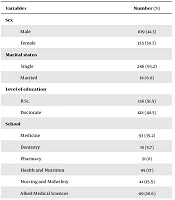
The age range of participants was 18 to 29 with a mean of 21.08 ± 1.26 years. Details of students’ background variables are shown (Table 2).
Table 2.
Distribution of the Background Variables Among the Students
| Variables | Number (%) |
|---|---|
| Sex | |
| Male | 109 (41.3) |
| Female | 155 (58.7) |
| Marital status | |
| Single | 246 (93.2) |
| Married | 18 (6.8) |
| Level of education | |
| B.Sc. | 136 (51.5) |
| Doctorate | 128 (48.5) |
| School | |
| Medicine | 93 (35.2) |
| Dentistry | 15 (5.7) |
| Pharmacy | 21 (8) |
| Health and Nutrition | 45 (17) |
| Nursing and Midwifery | 41 (15.5) |
| Allied Medical Sciences | 49 (18.6) |
| Job | |
| Just student | 248 (93.9) |
| Student and employed | 16 (6.1) |
| Mother education level | |
| Under high school diploma | 95 (36) |
| High school diploma | 86 (32.6) |
| Higher education | 83 (31.4) |
| Father education level | |
| Under high school diploma | 60 (22.7) |
| High school diploma | 89 (33.7) |
| Higher education | 115 (43.6) |
| Living in dormitory | |
| Yes | 146 (55.3) |
| No | 118 (44.7) |
The mean score of motivational strategies was 159.20 ± 27.21 (range: 31 - 217). Our results showed participants required 73.36% of the maximum achievable score for motivational strategies. The mean ± SD and percentage of maximum achievable score (PMAS) of motivational strategies sub-components are as follows: value 72.71 ± 14.51 and 74.19: including sub-components of intrinsic goal orientation 20.78 ± 5.02 and 74.21; extrinsic goal orientation 20.97 ± 5.30 and 74.89; and task value 30.95 ± 6.93 and 73.69, expectancy 63.87 ± 12.24 and 76.03: including sub-components of control beliefs 22.17 ± 4.48 and 79.17; and self-efficacy for learning and performance 41.70 ± 9.07 and 74.46, and affective 22.61 ± 5.87 and 64.603: including sub-component of test anxiety 22.61 ± 5.87 and 64.6.
Bivariate associations among subscales of motivational strategies and GPA are shown. Our findings indicated GPA was associated with the intrinsic goal orientation (r = 0.128), extrinsic goal orientation (r = 0.162), task value (r = 0.142), control beliefs (r = 0.125), and self-efficacy for learning and performance (r = 0.187), while inversely correlated with test anxiety (r = -0.173) (Table 3).
Table 3.
Motivational Strategies Subscale Correlation Matrix
| Mean (SD) | 1 | 2 | 3 | 4 | 5 | 6 | |
|---|---|---|---|---|---|---|---|
| Intrinsic goal orientation (1) | 20.78 (5.02) | 1 | |||||
| Extrinsic goal orientation (2) | 20.97 (5.30) | 0.392b | 1 | ||||
| Task value (3) | 30.95 (6.93) | 0.678b | 0.548b | 1 | |||
| Control beliefs (4) | 22.17 (4.48) | 0.458b | 0.395b | 0.533b | 1 | ||
| Self-efficacy for learning and performance (5) | 41.70 (9.07) | 0.693b | 0.548b | 0.681b | 0.581b | 1 | |
| Test anxiety (6) | 22.61 (5.87) | 0.124a | 0.407a | 0.185a | 0.157a | 0.144a | 1 |
| GPA | 15.82 (1.67) | 0.128a | 0.162b | 0.142a | 0.125a | 0.187a | -0.173b |
aP < 0.05.
bP < 0.01.
Furthermore, motivational strategies was significantly related to the GPA (r = 0.137 and P = 0.026).
Among sub-components of motivational strategies, extrinsic goal orientation (beta = 0.279 and P < 0.001) and test anxiety (beta = -0.287 and P < 0.001) were the best predictors of GPA. Moreover, the predictor variables accounted for 9% of the variation in GPA; F = 13.703, P < 0.001 (Table 4).
Table 4.
Predictors of the GPA by Motivational Strategies
| Un-Standardized Coefficients | Standardized Coefficients | t | P Value | ||
|---|---|---|---|---|---|
| B | Std. Error | Beta | |||
| Step 1 | |||||
| Intrinsic goal orientation | 0.002 | 0.030 | 0.005 | 0.055 | 0.956 |
| Extrinsic goal orientation | 0.068 | 0.025 | 0.215 | 2.675 | 0.008 |
| Task value | -0.002 | 0.023 | -0.007 | -0.078 | 0.938 |
| Control beliefs | 0.012 | 0.028 | 0.031 | 0.417 | 0.677 |
| Self-efficacy for learning and performance | 0.017 | 0.018 | 0.093 | 0.946 | 0.345 |
| Test anxiety | -0.079 | 0.019 | -0.278 | -4.269 | < 0.001 |
| Step 2 | |||||
| Extrinsic goal orientation | 0.068 | 0.025 | 0.214 | 2.691 | 0.008 |
| Task value | -0.001 | 0.021 | -0.005 | -0.061 | 0.952 |
| Control beliefs | 0.012 | 0.028 | 0.031 | 0.418 | 0.676 |
| Self-efficacy for learning and performance | 0.018 | 0.016 | 0.095 | 1.066 | 0.287 |
| Test anxiety | -0.079 | 0.019 | -0.278 | -4.278 | < 0.001 |
| Step 3 | |||||
| Extrinsic goal orientation | 0.067 | 0.024 | 0.213 | 2.768 | 0.006 |
| Control beliefs | 0.011 | 0.027 | 0.030 | 0.415 | 0.678 |
| Self-efficacy for learning and performance | 0.017 | 0.015 | 0.093 | 1.156 | 0.249 |
| Test anxiety | -0.079 | 0.019 | -0.278 | -4.286 | < 0.001 |
| Step 4 | |||||
| Extrinsic goal orientation | 0.068 | 0.024 | 0.215 | 2.817 | 0.005 |
| Self-efficacy for learning and performance | 0.020 | 0.013 | 0.109 | 1.542 | 0.124 |
| Test anxiety | -0.079 | 0.018 | -0.277 | -4.277 | < 0.001 |
| Step 5 | |||||
| Extrinsic goal orientation | 0.088 | 0.020 | 0.279 | 4.332 | < 0.001 |
| Test anxiety | -0.082 | 0.018 | -0.287 | -4.449 | < 0.001 |
5. Discussion
The result of the current study indicated that students gained 73.36% of the maximum achievable score for motivational strategies. Our findings indicated a “weak” positive correlation between the motivational strategies and GPA; that is, the higher the score of motivational strategies, the better the student’s GPA. This finding is consistent with that of other studies (11, 12). These studies show the need for designing educational programs to promote motivational strategies among students.
Our findings indicated GPA was associated with task value, extrinsic goal orientation, self-efficacy for learning and performance, and test anxiety. This finding is consistent with that of other studies (13, 14). Test anxiety is a psychological situation in which persons experience extreme distress and anxiety in exam conditions, and can actually impair learning and exam performance (15). Several studies have reported the negative effects of test anxiety on academic achievement, that is, greater test anxiety lowered academic achievement (13, 14). In order to prevent test anxiety, it has been suggested to promote self-esteem and reduce fear of failure as one of the most effective ways (16, 17). It appears that programs for promoting self-esteem and reducing fear of failure can help prevent test anxiety and consequently improve GPA.
Our results also indicated a significant correlation between task value and GPA. Task value refers to what a student learns from the content of a course or how to perform a task (18). Several studies have also been conducted on the relationship between task value and academic achievement; for example, Pintrich (6), Bong (19), and Martin-Krumm et al. (20) in their studies reported that various dimensions of task value have a positive and significant relationship with GPA among students. Our findings also confirm these studies.
Self-efficacy is another aspect of motivational strategy defined as judging individuals about their ability to organize and execute a series of tasks to achieve a goal. Numerous studies have shown that it is one of the predictors of academic achievement (21, 22). Self-efficacy perception of previous successes is a stronger and more effective predictor of success (23). Considering the importance of self-efficacy in improving GPA, it should be addressed in educational planning.
This study has limitations such as self-report data collection which can have the risk of recall bias, as well as gathering information only among a group of medical students, which can make generalizability of the results difficult.
5.1. Conclusions
Our results suggest that educational programs be planned to increase extrinsic goal orientation and reduce test anxiety in order to promote GPA among university students.