
1. Background
In recent decades, the growing popularity of online video games, as a common form of entertainment, has caused major concerns about the potential consequences of excessive gaming (1). Massively multiplayer online role-playing games (MMORPGs) are network-based, three-dimensional, interactive, and narrative environments, which are both permanent and consistent (2, 3), contributing to the mass appeal of gaming (4).
Previous studies on the internet gaming disorder (IGD) have widely investigated MMORPGs due to their higher addictive potential than other games (5, 6). IGD, as a phenomenon currently under investigation, is included in section III (emerging measures and models) of the fifth edition of the diagnostic and statistical manual of mental disorders (DSM-5). Generally, IGD is defined as “persistent and recurrent use of the internet to engage in games, often with other players, leading to clinically significant impairment or distress…” (7).
The addictive potential of MMORPGs can be partly explained by their fulfilment of particular gaming motives (8). Among MMORPG players, motives, including achievement, socializing, and escapism, seem to predict gaming addiction (9). Other researchers (10, 11) have suggested escape and fantasy as the most important motives, predicting IGD in MMORPG gamers. Also, some scholars have reported that young adults with IGD have risk profiles comparable to other addictive disorders. Evidence shows that IGD is associated with many dysfunctional personality traits, such as impulsivity (12), sensation seeking (13), low self-esteem (13), and neuroticism (14), similar to other addictive behaviors (5, 15).
Some personality traits may lead individuals to value specific features of games, feel motivated to play games, and become addicted to gaming (16). It is known that individuals with poorly regulated emotions often engage in maladaptive behaviors, such as addictive disorders, to escape from or downregulate their emotions (17, 18). Researchers have shown that MMORPG users express low life satisfaction (19), besides high levels of social anxiety (16). According to previous studies, young males with high levels of anxiety or depression symptoms and females with high levels of depression experienced IGD related to MMORPG (20) and had a lower quality of life (21).
Many studies have examined the relationship between five broad personality traits (Big Five) and IGD; however, the findings are somewhat conflicting. Griffiths and Salvarli (22), in the first review of IGD and its associated personality traits, suggested the need for further research in this area. Therefore, considering the similarities of personality traits between individuals with IGD and other behavioral addictions (23, 24), in the present study, the Substance Use Risk Profile Scale (SURPS) (25) was used to define the personality profiles of MMORPG players. Clustering gamers, based on personality traits, can shed light on the characteristics of IGD in MMORPG gamers and overcome a narrow-minded approach (11) that treats players as a uniform group.
2. Objectives
The present study aimed to investigate the motives predicting IGD in MMORPG players, according to their personality profiles.
3. Materials and Methods
3.1. Participants
The study sample consisted of 202 MMORPG gamers, including 124 (61.4%) men, aged between 18 and 48 years (M = 27.85, SD = 6.49). With respect to the educational level, 9.4% (n = 19) of the study sample had a junior high school certificate, 52.5% (n = 106) had a high school diploma, 22.3% (n = 45) had a bachelor’s degree, 11.9% (n = 24) had a master’s degree, and 4.0% (n = 8) had a specialist certificate or PhD.
3.2. Procedures
A sample of 202 MMORPG gamers was selected from a broader sample of 600 candidates. The selected sample included gamers, who declared their favorite game genre to be MMORPGs (e.g., Final Fantasy, World of Warcraft, Fallout, and Monster Hunter) in an online survey of video game habits and IGD. The research tool was developed, based on Google forms and drafted in Italian. The gamers were contacted through the university website or mailing lists, using the snowball sampling method. Informed consent was obtained from the participants at the beginning of the survey. No personally identifiable information was gathered. Data were collected in 2019.
3.3. Measures
First, demographic information (i.e., age, gender, and educational level) of the participants was collected, and gaming features (i.e., onset age of gaming, weekly time spent on gaming, and daily hours spent on digital devices) were determined. We used the SURPS, developed by Woicik et al. (25), to assess the personality risk profiles. SURPS contains 23 items, rated on a four-point Likert scale, ranging from “completely disagree” to “completely agree”. This scale consists of four underlying personality dimensions: Hopelessness with seven items, requiring an inversion of the respondent's score (e.g., “I feel that I’m a failure”; α = 0.88); anxiety sensitivity with five items (e.g., “It frightens me when I feel my heart beat”; α = 0.72); impulsivity with five items (e.g., “I often don't think things through before I speak”; α = 0.66); and sensation seeking with six items (e.g., “I would like to skydive”; α = 0.70). The internal consistency coefficient (Cronbach’s α) of the scale was measured to be 0.74.
The Motives for Online Gaming Questionnaire (MOGQ) (26) was also used in the present study. MOGQ is a 27-item scale, rated on a five-point Likert scale, ranging from “almost never/never” to “almost always/always”. It assesses seven motivational factors for playing, covering the full range of possible motives: Sociability (items 1, 8, 15, and 22; α = 0.78); escape (items 2, 9, 16, and 23; α = 0.92); competition (items 3, 10, 17, and 24; α = 0.85); coping (items 4, 11, 18, and 25; α = 0.82); skill development (items 5, 12, 19, and 26; α = 0.92); fantasy (items 6, 13, 20, and 27; α = 0.87); and recreation (items 7, 14, and 21; α = 0.97). The internal consistency coefficient (Cronbach’s α) of the questionnaire was measured to be 0.94.
Moreover, the Italian version of the Internet Gaming Disorder Scale-Short Form (IGDS9-SF) (27), validated by Monacis and colleagues (28), was used in this study to assess the severity of IGD, associated with online gaming activities over a 12-month period. This scale contains a single latent factor structure and comprises nine items, corresponding to the nine core criteria defined by the DSM-5. The responses are rated on a five-point Likert scale, ranging from one (never) to five (very often), with higher scores indicating a higher level of gaming problems. The internal consistency coefficient (Cronbach’s α) of this scale was measured to be 0.75.
Finally, the subjects’ life satisfaction was investigated in this study. Five single items were used to determine the gamers’ satisfaction with work or school performance, family relations, friendships, romantic relations, and leisure time (29). The items were rated on a five-point Likert scale, ranging from one (“completely dissatisfied”) to five (“completely satisfied”).
3.4. Statistical analysis
First, we performed K-means clustering of SURPS dimensions (i.e., hopelessness, anxiety sensitivity, impulsivity, and sensation seeking) to determine the main personality profiles among the participants. Generally, a cluster analysis enables us to identify subgroups that would not have been found with classic categorizations (30). Second, a series of Chi-square and ANOVA tests was conducted to detect possible differences between the identified clusters. Finally, stepwise linear regression models were used to determine gaming motives, predicting IGD by controlling for age and gender.
4. Results
A two-cluster solution, based on K-means clustering, was used for profiling the study sample, according to the risk personality traits determined by SURPS. The two clusters were labelled as “sensation seekers” (SS) and “prone to negative emotions” (PNE). The SS group (n = 113, 55.9%) exhibited a higher level of sensation seeking (M = 2.61, SD = 0.58 vs. M = 2.13, SD = 0.53; F = 37.28, P < 0.001) than the PNE group, whereas the PNE group (n = 89, 44.1%) showed higher levels of anxiety sensitivity (M = 2.70, SD = 0.50 vs. M = 1.96, SD = 0.51; F = 107.40, P < 0.001), hopelessness (M = 2.42, SD = 0.63 vs. M = 1.87, SD = 0.47; F = 50.56, P < 0.001), and impulsivity (M = 2.00, SD = 0.58 vs. M = 1.64, SD = 0.43; F = 25.81, P < 0.001) than the SS group. Also, in the SS group, 72.6% of the gamers were male (n = 82; mean age = 29.19 years, SD = 6.59), while in the PNE group, women accounted for 52.8% of the subjects (n = 47; mean age = 26.27 years, SD = 6.05). The differences in the time spent on online gaming between the SS and PNE groups are shown in Table 1.
Table 1.
Differences in the Time Spent on Gaming Between the SS and PNE Groups
| Variables | SS Group (N = 113), No. (%) | PNE Group (N = 89), No. (%) | χ2 |
|---|---|---|---|
| Number of days spent on gaming | 6.234 | ||
| Everyday | 31 (27.4) | 32 (36) | |
| 5 - 6 days | 22 (19.5) | 25 (28.1) | |
| 3 - 4 days | 30 (26.5) | 25 (16.9) | |
| 1 - 2 days | 23 (20.4) | 12 (13.5) | |
| Less than once a week | 7 (6.2) | 5 (5.6) | |
| Hours spent daily on gaming, h | 7.664 | ||
| < 1 | 15 (13.3) | 8 (9) | |
| 1 - 2 | 52 (46) | 32 (36) | |
| 3 - 4 | 32 (28.3) | 33 (37.1) | |
| 5 - 6 | 13 (11.5) | 11 (12.4) | |
| 7 - 8 | 0 (0) | 3 (3.4) | |
| > 8 | 1 (0.9) | 2 (2.2) |
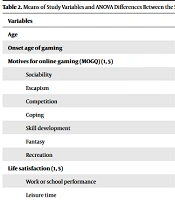
The results of Chi-square test showed no significant cluster differences in the time spent weekly (χ2 (4, n = 202) = 6.23, P = 0.18) or hours spent daily (χ2 (5, n = 202) = 7.66, P = 0.18) on gaming. As for gender comparisons, in the SS group, there were no significant gender differences in days spent on gaming weekly (χ2 (4, n = 113) = 8.44, P = 0.08) and hours spent daily on gaming (χ2 (4, n = 113) = 3.19, P = 0.53). On the other hand, in the PNE group, males spent significantly more days on gaming during a week, compared to females. The results showed that 35.7% of men and 21.3% of women played 5 - 6 days a week. Also, 40.5% of men played every day versus 31.9% of women (χ2 (4, n = 89) = 11.08, P = 0.03). However, females spent significantly more hours per day on gaming, compared to males. The results showed that 19.1% of women played 5 - 6 hours daily versus 4.8% of men (χ2 (5, n = 89) = 14.21, P = 0.02). The differences between the two groups regarding the onset age of gaming, motives for gaming, life satisfaction, and IGD, according to ANOVA test, are presented in Table 2.
Table 2.
Means of Study Variables and ANOVA Differences Between the SS and PNE Groups
| Variables | SS Group, Mean ± SD | PNE Group, Mean ± SD | F | P |
|---|---|---|---|---|
| Age | 29.10 ± 6.59 | 26.27 ± 6.05 | 9.85 | 0.002 |
| Onset age of gaming | 7.31 ± 3.36 | 7.05 ± 2.33 | 0.38 | 0.54 |
| Motives for online gaming (MOGQ) (1, 5) | ||||
| Sociability | 1.95 ± 0.93 | 2.17 ± 0.91 | 2.65 | 0.105 |
| Escapism | 1.65 ± 0.80 | 2.48 ± 1.32 | 30.30 | 0.000 |
| Competition | 2.05 ± 1.03 | 1.87 ± 1.01 | 1.64 | 0.202 |
| Coping | 2.59 ± 0.99 | 2.88 ± 1.06 | 3.97 | 0.048 |
| Skill development | 2.39 ± 1.22 | 2.46 ± 1.25 | 0.15 | 0.702 |
| Fantasy | 1.92 ± 1.04 | 2.48 ± 1.25 | 12.45 | 0.001 |
| Recreation | 4.16 ± 1.25 | 4.18 ± 1.29 | 0.01 | 0.922 |
| Life satisfaction (1, 5) | ||||
| Work or school performance | 3.76 ± 0.86 | 3.22 ± 1.04 | 16.09 | 0.000 |
| Leisure time | 3.67 ± 0.91 | 3.28 ± 0.97 | 8.64 | 0.004 |
| Family relations | 4.00 ± 0.98 | 3.46 ± 1.12 | 13.28 | 0.000 |
| Friendships | 3.96 ± 0.95 | 3.45 ± 1.15 | 11.77 | 0.001 |
| Romantic relations | 3.71 ± 1.49 | 3.26 ± 1.61 | 4.24 | 0.041 |
| IGD (9, 36) | 12.67 ± 3.97 | 14.76 ± 5.29 | 10.30 | 0.002 |
Regarding gender differences within clusters, in the SS group, males started gaming significantly earlier than females on average (M males = 6.84, SD = 2.95 vs. M females = 8.55, SD = 4.07; F = 6.07, P = 0.02), whereas no significant gender differences were found in the PNE group (M males = 6.76, SD = 2.48 vs. M females = 7.32, SD = 2.18; F = 1.24, P = .27).
Considering the online gaming motives, the PNE group was significantly more likely to play MMORPGs for escapism, coping, and fantasy motives, compared to the SS group. In the PNE group, the competition motive was significantly stronger in males than females (M = 2.11, SD = 1.09 vs. M = 1.65, SD = 0.88; F = 4.68, P = 0.03), whereas in females, escapism (M = 2.01, SD = 1.05 vs. M = 2.89, SD = 1.39; F = 11.42, P = 0.001) and fantasy (M = 2.16, SD = 1.12 vs. M = 2.78, SD = 1.30; F = 5.64, P = 0.020) motives were significantly stronger.
On the other hand, in the SS group, competition (M = 2.28, SD = 1.07 vs. M = 1.46, SD = 0.63; F = 16.04, P = 0.00), skill development (M = 2.60, SD = 1.25 vs. M = 1.84, SD = 0.94; F = 9.58, P = 0.002), coping (M = 2.71, SD = 1.01 vs. M = 2.26, SD = 0.86; F = 4.98, P = 0.028), and recreation (M = 4.32, SD = 1.15 vs. M = 3.74, SD = 1.43; F = 5.00, P = 0.027) motives were significantly stronger in male players than females.
Regarding the level of life satisfaction, the SS group was significantly more satisfied with life than the PNE group in all aspects. Significant differences were observed in the IGD scores between the two groups. In other words, the PNE group obtained higher scores on IGDS9-SF, compared to the SS group (MPNE = 14.76, SD = 5.29 vs. MSS = 12.67, SD = 3.97; F = 10.30, P = 0.002). Also, considering gender differences in IGD, males in the SS group obtained significantly higher scores on the gaming addiction scale than females (Mmales = 13.34, SD = 4.25 vs. Mfemales = 10.90, SD = 2.39; F = 9.08, P = 0.003). However, in the PNE group, no gender differences were found (Mmales = 15.29, SD = 5.92 vs. Mfemales = 14.30, SD = 4.67; F = 0.77, P = 0.382).
A stepwise linear regression analysis was performed on two clusters of SS (1) and PNE (2) separately to determine prominent motivational predictors of IGD in these MMORPG gamers. In the SS group (1), 31% of variance in IGD could be explained by escape, gender, and competition motives (F (16.06) = 2.59, P < 0.001). Other variables were excluded from the model (Table 3).
Table 3.
The Results of Linear Regression Analysis of IGD in the SS Group (n = 113) a
| Dependent Variable | Independent Variables | β | t-Value | P-Value |
|---|---|---|---|---|
| IGD | Escapism | 2.09 | 5.24 | 0.000 |
| Gender | 2.17 | 2.84 | 0.005 | |
| Competition | 0.80 | 2.41 | 0.018 | |
| Sociability | 0.03 | 0.34 | 0.735 | |
| Coping | 0.07 | 0.70 | 0.487 | |
| Skill development | 0.00 | 0.04 | 0.969 | |
| Fantasy | 0.15 | 1.45 | 0.151 | |
| Recreation | - 0.15 | - 1.67 | 0.097 | |
| Age | - 0.11 | - 1.39 | 0.168 |
a β = Standardized coefficient.
In the PNE group (2), 31% of variance in IGD could be explained by competition and sociability motives (F (19.68) = 6.05, P < 0.001). Other variables were excluded from the model (Table 4).
Table 4.
The Results of Linear Regression Analysis of IGD in the PNE Group (n = 89) a
| Dependent Variable | Independent Variables | β | t-Value | P-Value |
|---|---|---|---|---|
| IGD | Competition | 0.42 | 4.15 | 0.000 |
| Sociability | 0.23 | 2.27 | 0.026 | |
| Escapism | 0.14 | 0.13 | 0.190 | |
| Coping | - 0.04 | - 0.27 | 0.788 | |
| Skill development | - 0.15 | - 1.15 | 0.252 | |
| Fantasy | 0.01 | 0.09 | 0.925 | |
| Recreation | 0.04 | 0.34 | 0.738 | |
| Gender | 0.04 | 0.36 | 0.72 | |
| Age | 0.04 | 0.46 | 0.65 |
a β = Standardized coefficient.
5. Discussion
This study aimed to investigate the gaming motives predicting IGD in MMORPG players, considering their addiction risk-related personality profiles. The cluster analysis distinguished the samples into two personality profiles of SS and PNE with different gaming motives (e.g., escape, competition, and sociability), which could predict IGD among players of online multiplayer games. Although the competition motive was a predictor of IGD in both groups of gamers, the escapism motive and gender were the strongest risk factors for IGD in the SS group, whereas in the PNE group, the sociability motive predisposed the gamers to online gaming addiction. Also, the present findings showed that PNE gamers scored higher on the IGD scale, compared to the SS group.
In both groups, one-third of the gamers played almost every day. In the PNE group, males spent significantly more days of the week on gaming than females, whereas females spent significantly more hours per day on video games than males. The latter finding contradicts previous studies, which showed that the amount of time spent on gaming among men is longer than women (12, 31). Nonetheless, the gender discrepancies in the time spent on playing video games may diminish over time, as MMORPGs are becoming ubiquitous. The hours spent on playing video games by PNE women may be a coping strategy for dealing with negative affectivity (20). In our study, this hypothesis was confirmed, as PNE women showed a greater tendency to play for escapism motives than PNE males.
Moreover, male and female gamers in the PNE group tended to play MMORPGs for escapism, fantasy, and coping motives, compared to the SS group. It seems that players with anxious or depressive moods prefer to live in safer alternative environments for social interactions and tend to avoid potential hazards and risks of meetings and gatherings in the real world (32). The present results showed that male SS gamers played mostly for skill development, coping, and recreational motives, compared to female SS gamers. In this regard, some studies have shown that sensation seeking, that is, the tendency to enjoy and pursue new and exciting activities (33), can provide a coping mechanism for SS males to overcome their boredom and enjoy the psychological and physiological stimulation and rewards (34). A large body of evidence has attributed dysfunctional video game use to the poor self-control of sensation seekers (35), which is commonly observed in male gamers.
Moreover, the competition motive for playing games was significantly more common among males than females, both in the PNE and SS groups. Therefore, this gaming motive seems to indicate a gender-related need among players of virtual multiplayer games. Also, PNE players were significantly more dissatisfied with all assessed areas of life, with no gender differences. Consistent with the literature (36), online gaming could help gamers, who experienced negative emotions, to partially overcome their dissatisfaction with real life. Our findings confirmed the hypothesis that IGD can be predicted by sociability and competition motives in the PNE group. Generally, online multiplayer games are intended to meet the needs of PNE individuals, including socializing with peers, making friends, and enabling them to lead or teach their skills to other players, thereby promoting a sense of self-accomplishment and pride in winning (35).
Likewise, the competition motive, that is, a person’s desire to defeat other gamers (37), increases the risk of problematic behaviors in SS individuals. As noted by Kuss, Louws, and Wiers (6), gaming-related problems are associated with SS motives for competing and mastering the mechanics of online games and are quite different from addictive disorders (i.e., substance-related). For SS gamers, who did not have any problems in other areas of life, excessive gaming can be perceived as a gain in areas of mechanics and competition. However, for SS gamers, the motives predicting IGD included the escapism motive and gender. The literature suggests escapism as a predictor of problematic MMORPG use (38, 39). It is also considered as one of the nine criteria in DSM-5 for IGD diagnosis.
In conclusion, the present findings showed that MMORPG gamers, who exhibited negative affect and low satisfaction with life, were more prone to IGD, as they could redeem themselves through gaming, achieve their social relationship goals, and master the competencies they lack in everyday life. Based on the present results, the SS gamers were prone to gaming addiction and were motivated by seeking new stimuli, rewards, and excitement from competitions, which were not real.
The present study has several methodological limitations. Firstly, it was a self-report survey and included a somewhat modest number of gamers. Secondly, the majority of the participants were university students; therefore, the sample was not representative of all gamers. Thirdly, the cross-sectional design of the study limits the interpretation of our results, and causation can be only inferred with caution; therefore, replication and generalization of the present findings require further research. Fourthly, future research must investigate the relatively unexplored relationships between excessive online gaming and different features of games (e.g., Final Fantasy, World of Warcraft, Fallout, and Monster Hunter). It seems that the choice of a specific MMORPG, besides gaming abuse tendencies, is dependent on the person’s particular needs and personal motives for playing. Finally, gender differences in gaming preferences should be studied in more detail.
Despite the mentioned limitations, the present study has some merits for not only scholars, but also clinicians. The identification of some personality traits, classically associated with substance use disorders (e.g., sensation seeking), helped us identify some individual characteristics, which are risk factors for IGD when combined with specific gaming motives.