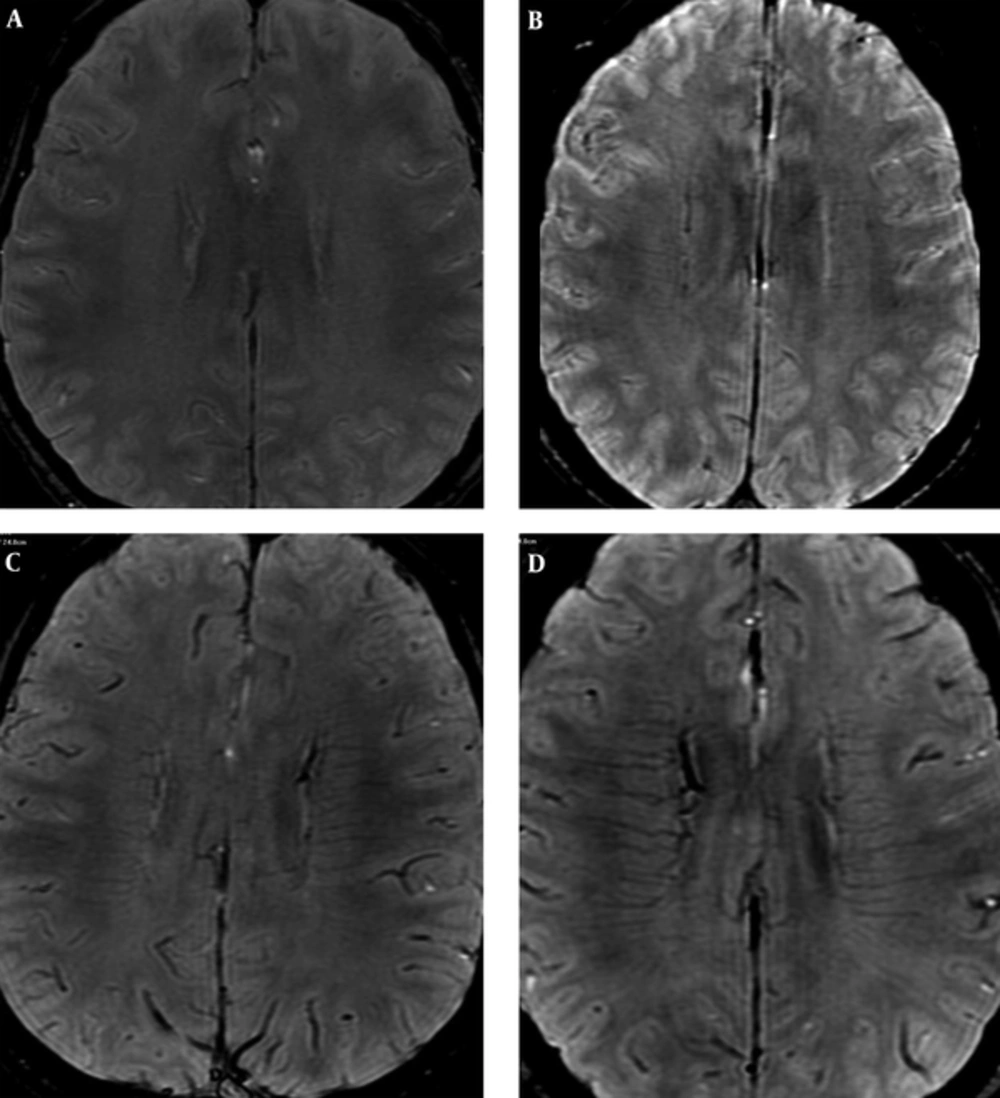
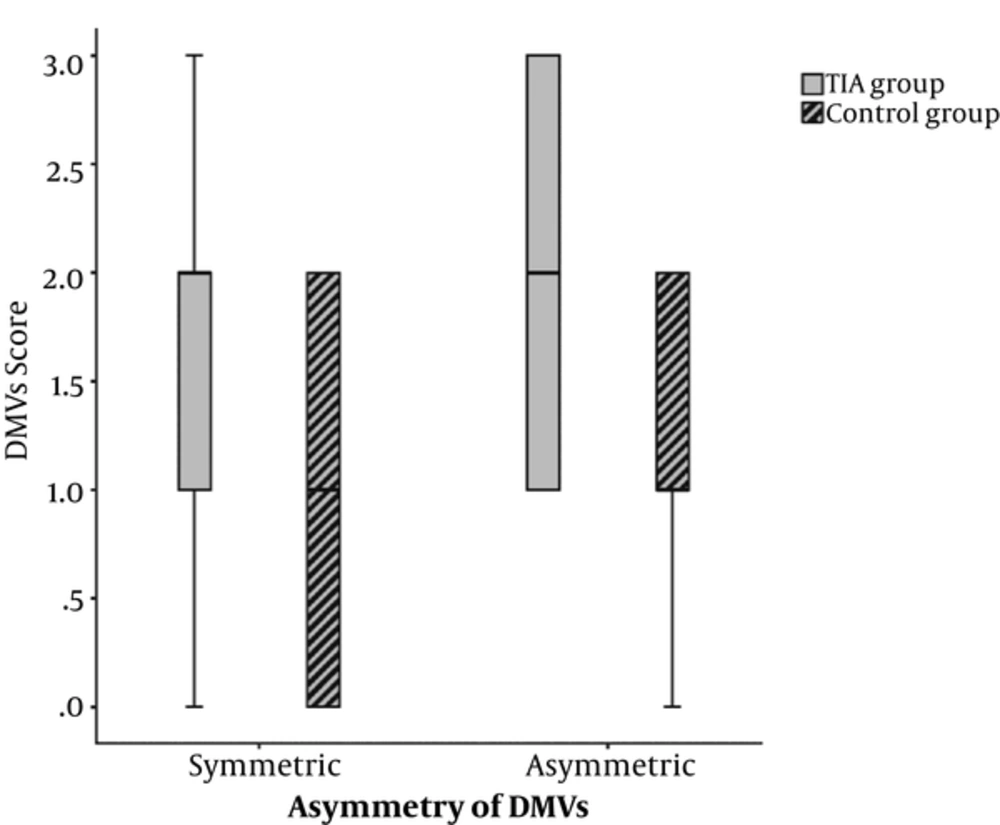
In this study, results indicate that the agreement of asymmetry and score of DMVs were excellent between neuroradiologists (inter-rater) by using SWI. We found that the visibility of DMVs in patients with TIA was increased, with or without ADMVs, including iADMVs and cADMVs.
As we have known, DMVs directly participate the drainage of white matter via the subependymal veins into the internal cerebral vein or the basal vein of Rosenthal (
7). Researchers have demonstrated that DMVs have relative clinical significance for stroke patients. The initial discovery in acute stroke patients on ipsilateral prominent DMVs, which was called the “brush sign”, was made by Morita et al. in 2008 and was rapidly confirmed (
8) by others. Subsequent studies have shown that the presence of ipsilateral or contralateral prominent DMVs in patients with acute or subacute stroke has a relationship with hemodynamic alteration, as well as clinical outcome. Han et al. found that ADMVs have a negative correlation with cerebrovascular reactivity (
2). Mucke et al. also found that ADMVs in acute cerebral infarction on SWI was correlated with poor outcome (
3). In this study, alterations of DMVs in patients with TIA were studied for the first time by using SWI, and we try to interpret them.
We assume that the increased visibility of DMVs on SWI is caused by two possible mechanisms: one is an increased venous volume because of regional ischemia and leads to vasodilation (
9,
10); and the other is that the ratio of deoxyhemoglobin to oxyhemoglobin is increased in the hypoperfused tissue due to an uncoupling between oxygen supply and demand (
11). Thus, neuroradiologists are able to identify DMVs on SWI with excellent agreement for the structure and signal change.
A lot of studies have confirmed that TIA patients are often found with a lesion with hypoperfusion or decreased blood flow (
12-
14). Thus, the decreased blood flow gives rise to a relative increase of oxygen extraction fraction (OEF) spontaneously within the cerebral tissue at risk (
15). These changes increased deoxyhemoglobin concentration in the venous system, and then susceptibility changes lead to iADMVs on SWI (
16). This result is consistent with previous studies on OEF changes after TIA by using positron emission tomography (PET) (
17).
Moreover, cADMVs are observed in this study. These DMV changes with ipsilateral hyperperfusion were reported on subacute stroke by Yu et al. (
4) in 2016. We think that cADMVs reflect a collateral blood flow established spontaneously through Willis’ circle or leptomeningeal vessels, resulting in a decreased concentration of deoxyhemoglobin in the draining veins because of excessive oxygen delivery and thus a more prominent hypointensity within the DMVs.
The alterations of DMVs in TIA patients were not only increased visibility of DMVs, but also presented with or without ADMVs. These may indicate that although focal cerebral blood flow reduced in TIA patients, the whole brain perfusion changed for compensation. On the other hand, we assume that cerebral ischemia is a dynamic process, and iADMVs, cADMVs, and symmetric DMVs may demonstrate changes of a different stage or phase during the ischemia process in TIA. cADMVs may indicate an effective compensation, while iADMVs may indicate a relative decompensation for blood flow. Symmetric DMVs with increased visibility may reflect chronic ischemia, which may share the mechanism in leukoaraiosis demonstrated by Yan et al. (
18).
Above all, whatever the mechanism is, we think the increased visibility DMVs with or without ADMVs would give us additional information for understanding the hemodynamic alteration of TIA. Furthermore, due to DMVs easily identified and well qualified on 3.0 T SWI, it is worth having a further study in the future.
There are limitations to this study. First, it had relatively small samples. A large number of case studies should be included at multiple centers in the future. Second, our results were lack of the perfusion image, because more MR protocols (for example, arterial spin labeling [ASL] perfusion MRI) were not approved by the institutional review board. Third, the evaluation of DMVs’ appearance is based on the degree of visibility by the neuroradiologist’s naked vision, which may lead to bias for quantification of DMVs. With the development of quantitative susceptibility mapping (QSM), it may help improve the accuracy for understanding the change of DMVs correlated with TIA by analyzing the oxygenation level of cerebral veins through conversion of susceptibility values within the veins to oxygen saturation (
19). Finally, our follow up was not continued for a long time. A future study should perform to focus on whether longitudinal changes of DMV would have any correlation with the risk for stroke after TIA.
In conclusion, based on asymmetry and score of DMVs, the visibility of DMVs in patients with TIA increased, with or without ADMVs, and these alterations may reflect hemodynamic information following TIA process, laying foundations for DMVs application in TIA.