

1. Background
2. Objectives
3. Patients and Methods
3.1. Patients
3.2. CT Protocols
3.3. Imaging Analysis
3.4. Statistical Analysis
4. Results
| Parameter | GCTs, % | SCs, % | SSs, % | P value |
|---|---|---|---|---|
| Age, y | 38.85 ± 12.19 | 56.77 ± 9.51 | 44.8 ± 12.56 | 0.000 |
| Gender | 0.001 | |||
| Male | 4 (20) | 17 (77.3) | 9 (47.4) | |
| Female | 16 (80) | 5 (22.7) | 10 (52.6) | |
| Location | 0.006 | |||
| Upper sacrum (above S3) | 17 (85) | 5 (22.7) | 9 (47.4) | |
| Lower sacrum (below S3) | 3 (15) | 17 (77.3) | 10 (52.6) | |
| Tumor size, cm | 6.84 ± 2.15 | 8.28 ± 2.72 | 8.62 ± 3.24 | 0.100 |
| Internal cyst | 0.002 | |||
| Present | 13 (65) | 5 (22.7) | 14 (73.7) | |
| Absent | 7 (35) | 17 (77.3) | 5 (26.3) | |
| Internal calcification | 0.000 | |||
| Present | 1 (5) | 2 (9) | 10 (52.6) | |
| Absent | 19 (95) | 20 (91) | 9 (47.4) | |
| Total | 20 | 22 | 19 |
aValues are expressed as No. (%) or mean ± standard deviation (SD).
![Giant cell tumor (GCT) in a 22-year-old female. The mass was located in the upper sacral vertebra, expanding toward the periphery (A - D). Histopathology (Hematoxylin and eosin [H & E], staining ×10) showed osteoclast-type giant cells and mononuclear cells (D). Sacral chordoma (SC) in a 39-year-old male. The mass was located in the midline lower sacral vertebra (S3 - S5). Residual bone can be seen in the tumor (pink arrow) (E - H). Histopathology showed a hyalinized extracellular matrix with myxoid regions and typical chordoma cells (H). A 50-year-old female with a sacral schwannoma (SS). The mass was located centrally in the upper sacral vertebra (S1-S3). Calcification can be seen in the tumor (yellow arrow). Central cystic areas were not enhanced (red arrow) (I - L). Histopathology showed that the tumors consisted of schwannoma cells (L). Axial CT precontrast scan (A, E, I), arterial phase enhancement (B, F, J), portal venous phase enhancement(C, G, K).](https://brieflands.com/journals/ijradiology/articles/66372/figures/iranjradiol-In_Press-In_Press-66372-g001-preview.webp "Giant cell tumor (GCT) in a 22-year-old female. The mass was located in the upper sacral vertebra, expanding toward the periphery (A - D). Histopathology (Hematoxylin and eosin [H & E], staining ×10) showed osteoclast-type giant cells and mononuclear cells (D). Sacral chordoma (SC) in a 39-year-old male. The mass was located in the midline lower sacral vertebra (S3 - S5). Residual bone can be seen in the tumor (pink arrow) (E - H). Histopathology showed a hyalinized extracellular matrix with myxoid regions and typical chordoma cells (H). A 50-year-old female with a sacral schwannoma (SS). The mass was located centrally in the upper sacral vertebra (S1-S3). Calcification can be seen in the tumor (yellow arrow). Central cystic areas were not enhanced (red arrow) (I - L). Histopathology showed that the tumors consisted of schwannoma cells (L). Axial CT precontrast scan (A, E, I), arterial phase enhancement (B, F, J), portal venous phase enhancement(C, G, K).")
Giant cell tumor (GCT) in a 22-year-old female. The mass was located in the upper sacral vertebra, expanding toward the periphery (A - D). Histopathology (Hematoxylin and eosin [H & E], staining ×10) showed osteoclast-type giant cells and mononuclear cells (D). Sacral chordoma (SC) in a 39-year-old male. The mass was located in the midline lower sacral vertebra (S3 - S5). Residual bone can be seen in the tumor (pink arrow) (E - H). Histopathology showed a hyalinized extracellular matrix with myxoid regions and typical chordoma cells (H). A 50-year-old female with a sacral schwannoma (SS). The mass was located centrally in the upper sacral vertebra (S1-S3). Calcification can be seen in the tumor (yellow arrow). Central cystic areas were not enhanced (red arrow) (I - L). Histopathology showed that the tumors consisted of schwannoma cells (L). Axial CT precontrast scan (A, E, I), arterial phase enhancement (B, F, J), portal venous phase enhancement(C, G, K).
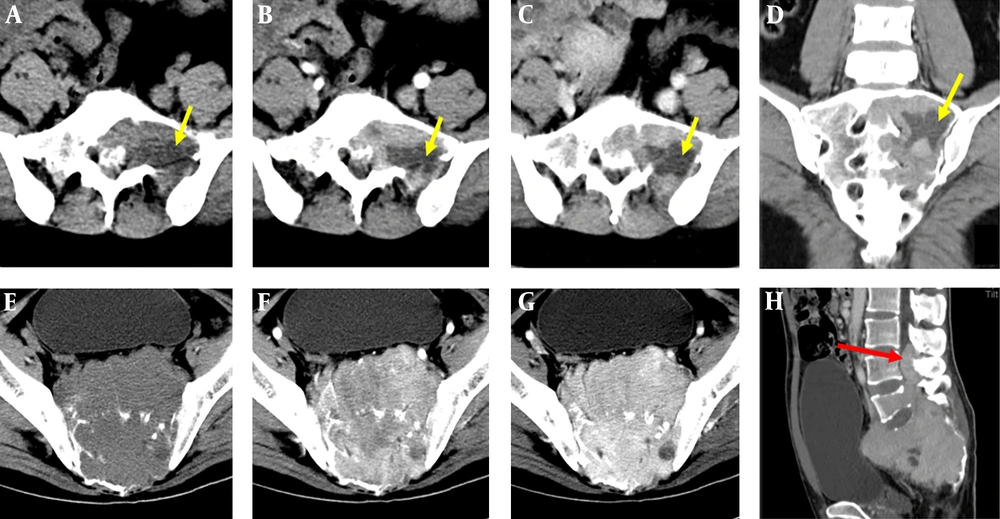
Giant cell tumor (GCT) in a 36-year-old woman. The images show that the mass was located in the eccentric upper sacrum. The precontrast mass CT value was 35 Hounsfield unit (HU), that in the arterial phase was 63 HU, and that in the venous phase was 75 HU. However, the cystic area was not enhanced (yellow arrow) (A - D). GCT in a 27-year-old man. The large mass occupied the entire sacrum, extending forward to the pelvic cavity and extending backward into the spinal canal (red arrow). The enhancement of the mass was clearly persistent across the arterial phase and the venous phase. The maximum enhancement was 80 HU (E - H). Axial CT precontrast scan (A, E), arterial phase enhancement (B, F), portal venous phase enhancement (C, G), coronal reconstruction image (D), and sagittal reconstruction image (H).
Abbreviations: EIa, enhancement index of the arterial phase; EIv, enhancement index of the portal venous phase; Emax, maximum enhancement; HU, Hounsfield unit; GCT, giant cell tumor; SC, sacral chordoma; SD, standard deviation; SS, sacral schwannoma
aValues are expressed as mean ± SD.
bGCTs vs. SSs P = 0.630.
| Parameter | AUC | Cutoff value | Sensitivity | Specificity | PPV, % | NPV, % |
|---|---|---|---|---|---|---|
| Precontrast | 0.678 | 38.50 (HU) | 0.85 | 0.537 | 47.22 | 88.00 |
| EIa | 0.950 | 0.6853 | 0.90 | 0.878 | 78.26 | 94.74 |
| EIv | 0.939 | 1.0326 | 0.95 | 0.805 | 70.37 | 97.06 |
| Emax | 0.964 | 46.50 (HU) | 0.95 | 0.878 | 79.17 | 97.29 |
Abbreviations: AUC, area under the receiver operator curve; EIa, enhancement index of the arterial phase; EIv, enhancement index of the portal venous phase; Emax, maximum enhancement; HU, Hounsfield unit; NPV, negative predictive values; PPV, positive predictive values
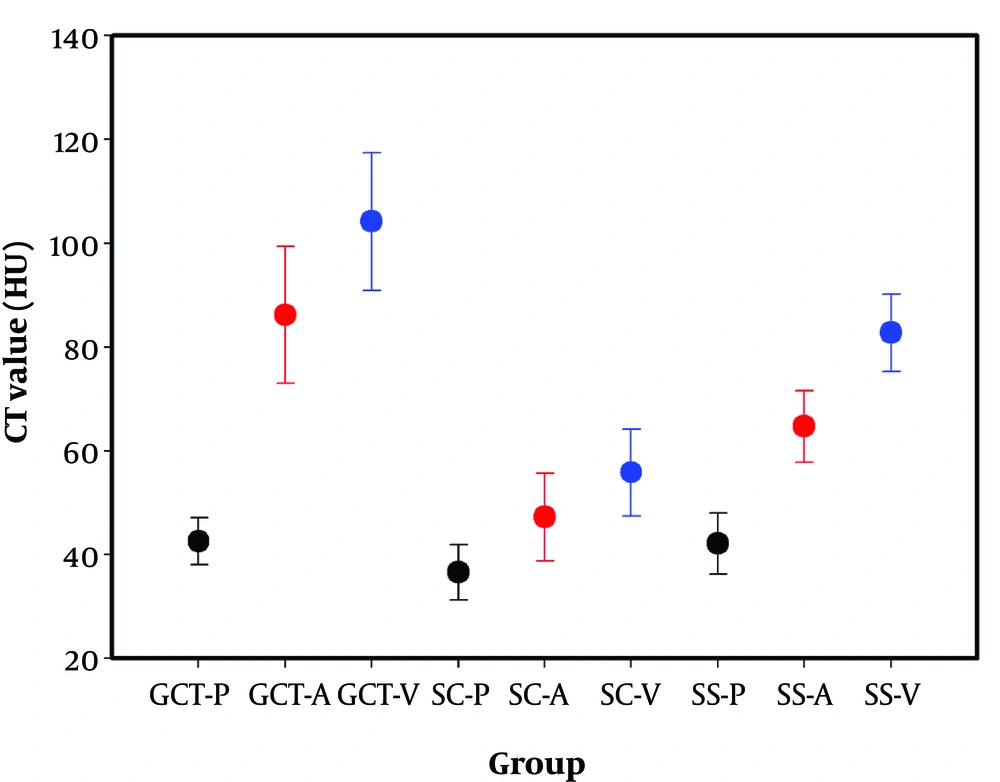
The CT values of the three groups. The arterial phase enhancement and portal venous phase enhancement of GCTs were higher than those of SSs and SCs. P = precontrast (black), A = arterial phase (red), V = portal venous phase (blue). (GCT, giant cell tumors; SC, sacral chordoma; SS, sacral Schwannoma).
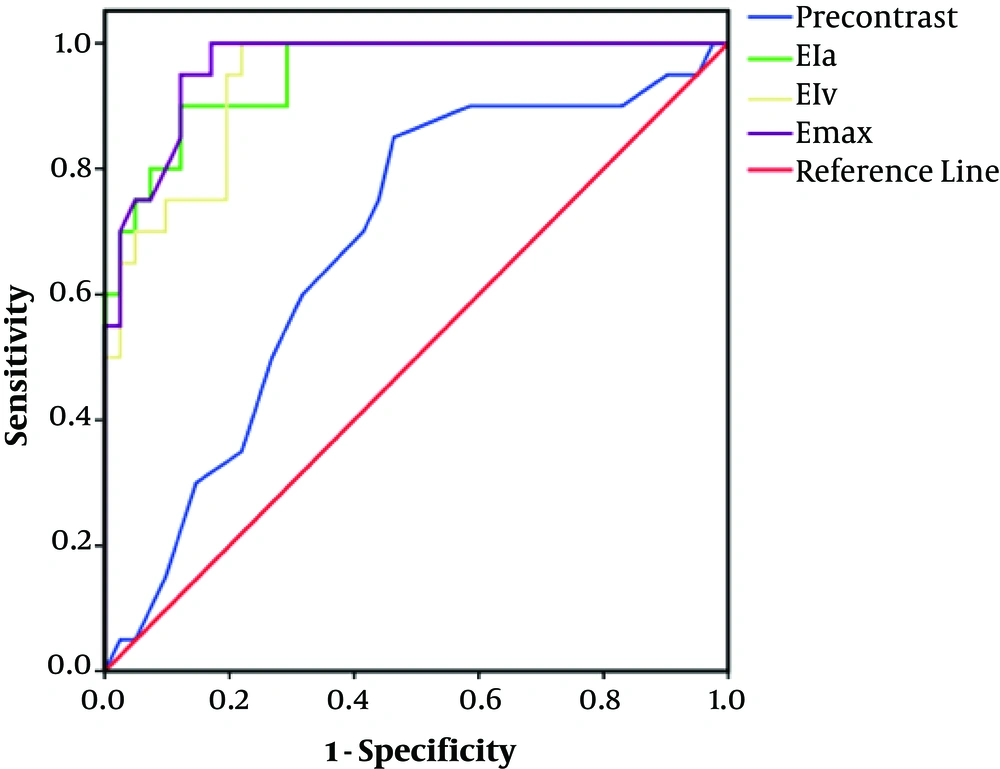
Comparison of the four different parameters of the Receiver operating characteristics (ROCs). The area under the curve (AUC) values of the precontrast, EIa, EIv and Emax curve types were 0.684 (95% CI, 0.548 - 0.820), 0.926 (95% CI, 0.862 - 0.989), 0.898 (95% CI, 0.822 - 0.973) and 0.955 (95% CI, 0.904 - 1.000), respectively. (CI, confidence interval; EIa, enhancement index of the arterial phase; EIv, enhancement index of the portal venous phase; Emax, maximum enhancement).