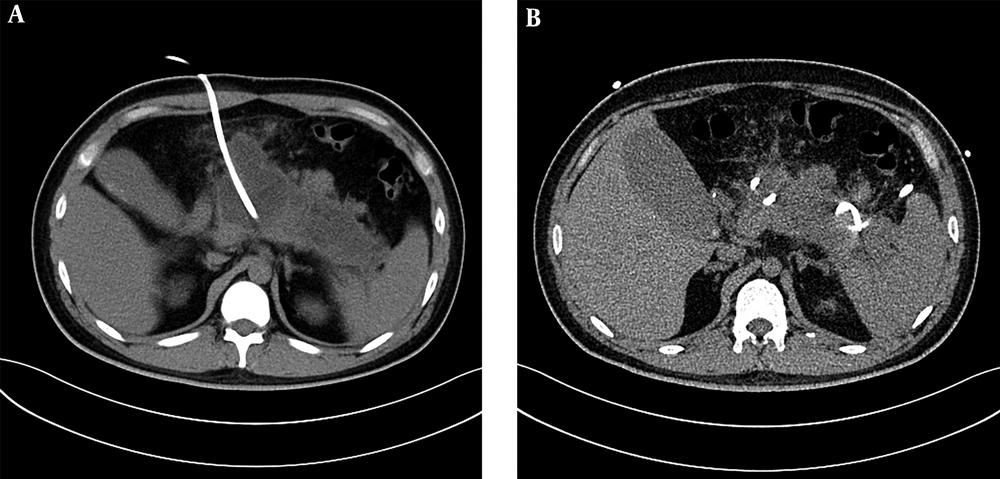
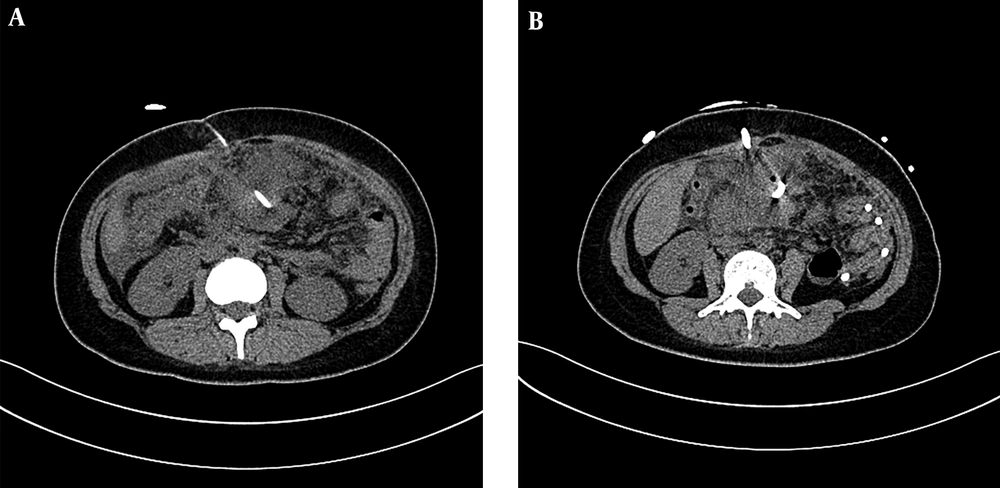
There are two important new findings in our study. First, the CT values of the piercing zone is the major risk factor affecting the curative effect of CT guidance PCD. Second, when the average CT density is higher than 20 HU, PCD treatment under CT guidance should be performed as soon as possible in order to avoid multiple organ failures or death in the acute stage as well as to avoid a prolonged period of infection.
SAP is a complicated and dangerous condition with a high fatality rate. Past practices have shown that early surgery, debridement surgery and multiple surgeries can increase the incidence of postoperative complications (
22). The International Association of Pancreatology (IAP) and the American Pancreatic Association (APA) recommend that the first best treatment for suspected or confirmed pancreatic necrosis should be PCD, and if necessary, followed by endoscopic or debridement operations on the necrotic tissue. The step-up method has been widely recognized (
21,
23). PCD is the initial step of the step-up method and is the core of the entire treatment. Some reports have demonstrated significant difference in terms of the success rate in PCD treatment of IPN (
23). A retrospective study conducted by Sileikis et al. concluded that step-up approach is not always effective for patients with multiple organ failure, which is only about 50% success rate, and they suggest that surgery should not be delayed for more than one month (
24).
In our research, we found that the patients who were successfully treated by PCD were shorter in hospital time and CRP recovery time than those who had PCD combined surgery. We also found that the mortality rate was low, and the incidence of postoperative multiple organ failure was low. So, are there any factors that can predict the effect of PCD before treatment? Are there any measures that can improve the success rate of PCD therapy? It is mainly due to the different body status, the duration of IPN and the degree of necrosis liquefaction in different patients. These factors may significantly influence the successful rate of PCD treatment. The current international guidelines do not provide specific guidance regarding PCD treatment in the step-up regimen (
8,
25), there is no uniform consensus in terms of which factors will affect the efficacy of PCD treatment.
PCD treatment can remove the necrotic materials while draining the effusion at the same time (
26,
27), and solid materials can be drawn from tissues of IPN. However, before the PCD operation, we could predict the proportions of solid and liquid materials by observing the average CT density in the pre-piercing zone on the CT scanning image. This time we mainly study and analyze the treatment of IPN under the guidance of CT. Spiral CT collects the volume data, can carry on the three-dimensional and multi-directional observation, the location is accurate, and the guide puncture is more precise. According to the diagnostic criteria of the Atlanta conference in 1992, (
1) infective pancreatic necrosis must have solid sphacelus components, but not completely liquefied solid sphacelus had higher CT values, similar to soft tissue density. Therefore, a higher value of CT density average indicates a higher content of solid necrosis or blood clot. These results showed that when the average CT value was higher, the chance of PCD failure was also higher, accompanied by a lower cure rate. In our study, only 35.2% of patients in the PCD success group had a CT value greater than 20 HU in the puncture area. (
Figures 1 and
2).These results were consistent with the results from Tong et al.’s research (
11).
A 36-year-old man with acute necrotizing pancreatitis accompanied by acute abdominal pain, vomiting and fever. A, The liquefied area of pancreatic necrosis underwent CT guided puncture and the average CT value of the piercing area was about 10 Hounsfield unit (HU) after successful puncturing and cathetering, and effective flushing through the puncture drainage tube was continued. B, In a month, re-examined abdominal CT and the low density pancreas area reduced obviously. The patient recovered gradually and no open operation was required.
A 66-year-old man with acute necrotizing pancreatitis. A, Under CT guided puncture, the density around the pancreas leakage was higher and the average CT score was more than 20 Hounsfield unit (HU). B, A week later, CT examination was performed and the leakage around the pancreas was more apparent. The patient’s condition was poor and an open debridement surgery was eventually performed.
In 2004, Mortele et al. suggested that the SAP computed tomography severity index, namely MCTSI, reflected organ failure situation and pancreatic complications, as shown by the amount of effusion. The range of pancreatic necrosis was reduced to less than 30% and more than 30%. In MCTSI, the non-pancreas complications were also considered, including peri-pancreatic blood vessel invasion and gastrointestinal tract invasion. Recent studies confirmed that the correlation between MCTSI and the prognosis was good (
28). The present study found that MCTSI index had a good correlation with the curative efficacy of PCD, and the higher the MCTSI index, the higher chance of PCD failure. There are 12 monitoring indicators in APACHE II and if the severity and prognosis of AP can be predicted early, it may significantly improve the treatment efficacy. This scoring system could assess the severity of the disease repeatedly at any time during and after hospitalization. Our study found that APACHE II was also one of the independent risk factors for PCD efficacy.
In addition, the length of time from patient admission to drainage is important for the success of the treatment. A team of researchers suggested that if there was no technical difficulty, PCD should be performed relatively early to reduce the incidence of complications and to shorten the length of hospital stay (
29). The authors evaluated the positive and conventional PCD treatment in patients with infectious necrotizing pancreatitis, and found that an active PCD therapy can reduce the need for surgical necrosectomy (
30). PCD treatment was less effective in patients with a higher CT value in the puncture area, but what factors could reflect the efficacy of the treatment on a deeper level? In our study, we analyzed the patients who had a CT value greater than 20 HU in the puncture area and were successful in the PCD treatment, about 12% of patients received PCD treatment in more than 14 days and most patients (60%) were treated with PCD between 9 days and 14 days. Our results suggested that the first PCD treatment should not be too late. This indicates that when CT images showed a large amount of exudation in the retroperitoneum and peritoneal cavity, the average CT density is higher. After conservative treatment, if the patient’s condition did not improve, PCD treatment under CT guidance should be performed as soon as possible in order to avoid multiple organ failures or death in the acute stage as well as to avoid a prolonged period of infection. When the drainage does not smoothen, we can use a coarser drainage tube or a three-cavity lavage drainage tube promptly. In addition, multiple ports could be maintained for possible follow-up endoscopic removal of necrotic tissues.
CRP is a kind of acute reactive proteins synthesized by the liver. It is mainly produced during the inflammation and acts against the harmful effect of soluble protease released from the trauma and infection site (
31,
32). The increase of CRP is one of the acute phase reactions in the body when infection and injury occur (
33,
34). It is present in serum and reaches a peak level in 24 - 48 hours after the onset of disease. Schutte and Malfertheiner (
32) reported that CRP levels are proportional to the severity of AP. Furthermore, it has important clinical values regarding early disease diagnosis, complications and prognosis (
35). Our results showed that CRP is an independent risk factor in the PCD therapy and patients with a higher CRP level have a poor PCD efficacy.
This study is a single center retrospective analysis, so there may be some empiricism and blindness. Multicenter, prospective, randomized and controlled clinical trials with large sample sizes are required to determine the efficacy of PCD and relevant influencing factors in the future.
In conclusion, our study found that the average CT value from the infection of pancreatic necrotic tissue is a major risk factor for PCD treatment under CT guidance, and the higher the CT value, the higher possibility of treatment failure. The length of time from patient admission to drainage, APACHEII scores, MCTSI scores and C reactive protein levels should be evaluated comprehensively. We think that in patients with an average density higher than 20 HU in the CT puncture zone, PCD treatment should be performed as soon as possible.