


1. Background
2. Objectives
3. Patients and Methods
3.1. Patients
3.2. Imaging Technique
3.3. US-Guided Core Biopsy Procedure
3.4. cDNA Synthesis and Gene Expression Analysis
3.5. Histopathologic Examination
3.6. Statistical Analysis
4. Results
| Measure | |
|---|---|
| Average tumor size, mm | 49.57 ± 9.59 |
| SWE values of the patient group (n = 30) | |
| Average Emean kPa | 146.80 ± 49.73 |
| Average SWE-SD | 26.12 ± 18.35 |
| SWE values of the control group (n = 17) | |
| Average Emean kPa | 39.06 ± 14.1 |
| Average SWE-SD | 2.5 ± 0.5 |
| Histological features of the patient group | |
| Type of carcinoma | |
| In-situ ductal carcinoma | 2 (6.7) |
| Tubular carcinoma | 1 (3.3) |
| Invasive ductal carcinoma | 24 (80) |
| Invasive lobular carcinoma | 1 (3.3) |
| Mixed type | 2 (6.7) |
| Grade | |
| 1 | 1 (3.3) |
| 2 | 19 (63.3) |
| 3 | 10 (33.3) |
| ER (+) | 20 (66.7) |
| PR (+) | 17 (56.7) |
| HER 2 (+) | 13 (43.3) |
| ER (-), PR (-), HER-2 (-) | 8 (26) |
| Axillary node metastasis | 17 (56.7) |
| Distant metastasis | 5 (16.7) |
| Histological features of the control group | |
| Fibroadenoma | 17 (100) |
Abbreviations: Emean, mean stiffness; ER, estrogen receptors; HER-2, human epidermal growth factor receptor-2; PR, progesterone receptors; SWE, shear wave elastography; SWE-SD, SWE-standard deviation
aValues are expressed as No. (%) unless otherwise indicated.
| E mean | E max | SWE-SD | SWE-ratio | |||||
|---|---|---|---|---|---|---|---|---|
| r | P value | r | P value | r | P value | r | P value | |
| LOX central | -0.116 | 0.540 | -0.199 | 0.291 | 0.189 | 0.318 | -0.130 | 0.494 |
| LOXL1 central | -0.181 | 0.347 | -0.130 | 0.502 | -0.018 | 0.927 | -0.085 | 0.663 |
| LOXL2 central | -0.012 | 0.948 | 0.016 | 0.934 | 0.185 | 0.327 | -0.083 | 0.663 |
| LOX peripheral | 0.169 | 0.390 | 0.039 | 0.844 | -0.041 | 0.835 | 0.089 | 0.651 |
| LOXL1 peripheral | -0.004 | 0.985 | -0.208 | 0.289 | 0.115 | 0.562 | -0.243 | 0.213 |
| LOXL2 peripheral | 0.293 | 0.123 | 0.075 | 0.697 | 0.282 | 0.138 | -0.254 | 0.184 |
Abbreviations: Emean, mean stiffness; Emax, maximum stiffness; E-ratio, lesion-to-fat elasticity ratio; LOX, lysyl oxidase; LOXL, lysyl oxidase-like protein; SWE-SD, shear wave elastography-standard deviation
ar, spearman correlation coefficient.
| Parameter | LOX central | LOXL1 central | LOXL2 central | LOX peripheral | LOXL1 peripheral | LOXL2 peripheral | E-mean | E-max | SWE-SD | SWE-ratio |
|---|---|---|---|---|---|---|---|---|---|---|
| Tumor size | 0.523 | 0.740 | 0.297 | 0.838 | 0.093 | 0.359 | 0.853 | 0.914 | 0.590 | 0.826 |
| Tumor grade | 0.308 | 0.076 | 0.542 | 0.307 | 0.463 | 0.027 | 0.484 | 0.946 | 0.403 | 0.804 |
| Axillary node metastasis | 0.457 | 0.879 | 0.869 | 0.837 | 0.837 | 0.650 | 0.653 | 0.592 | 0.014 | 0.048 |
| Distant metastasis | 0.666 | 0.889 | 0.706 | 0.825 | 0.908 | 0.978 | 0.022 | 0.136 | 0.208 | 0.122 |
Abbreviations: Emean, mean stiffness; Emax, maximum stiffness; SWE-ratio, lesion-to-fat elasticity ratio; LOX, lysyl oxidase; LOXL, lysyl oxidase-like protein; SWE-SD, shear wave elastography-standard deviation
aP values for axillary and distant metastases were calculated by Mann Whitney U test; for grade and size, P values were calculated by Spearman’s correlation.
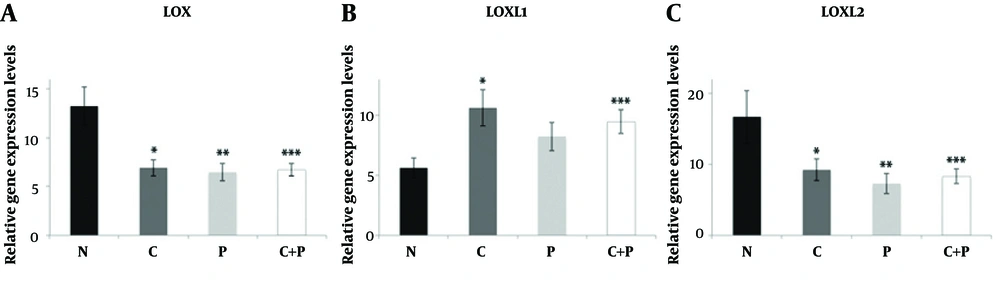
Relative expression levels of LOX (A), LOXL1 (B), and LOXL2 (C) in control and BC patient tissue samples. Data are shown as mean ± standard error of the mean of mRNA levels based on log-transformed values. N: control group, C: samples from central part of the lesions, P: samples from peripheral part of the lesions, C + P: samples from central and peripheral parts together, *P < 0.05; **P < 0.005; ***P < 0.001.(BC, breast cancer; LOX, Lysyl oxidase; LOXL, lysyl oxidase-like).
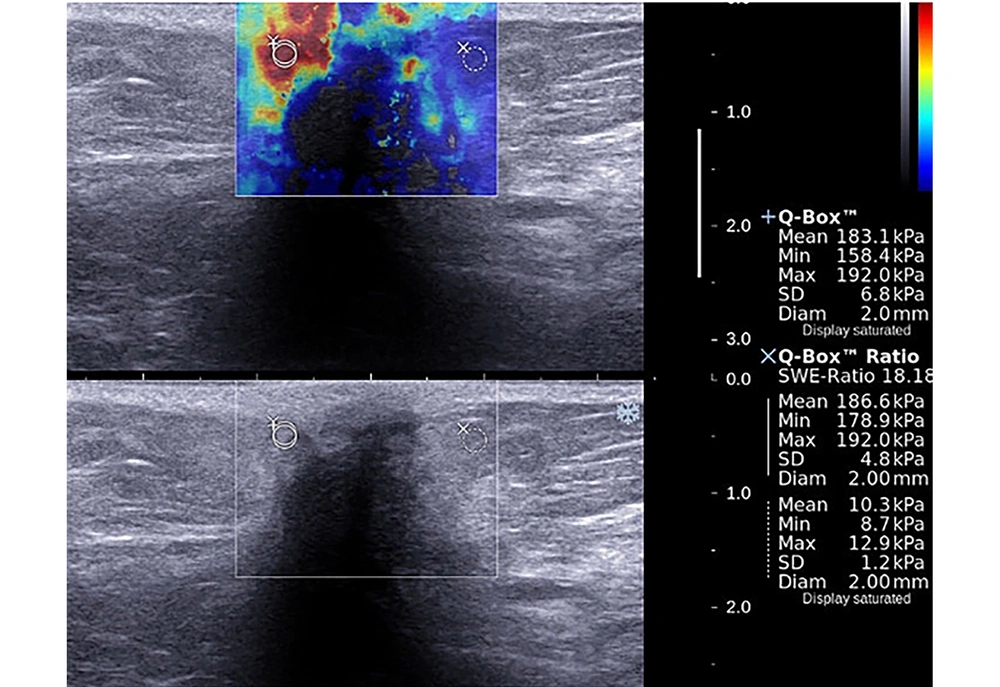
A 40-year-old patient presented with a mass in the upper outer quadrant of the left breast. Shear wave elastography evaluation of the mass showed peritumoral stiffness and central “blind areas”. Regions of interest (ROIs) were placed to the stiffest peritumoral area and perilesional fat tissue (Emean = 183 kPa, Emax = 192 kPa). Gray-scale images showed ill defined, hypoechoic mass with acoustic shadow which is suggestive for malignancy. Histopathological diagnosis was grade 2, ER (+), PR (-) and HER-2 (-) invasive ductal carcinoma. Axillary metastasis was negative.
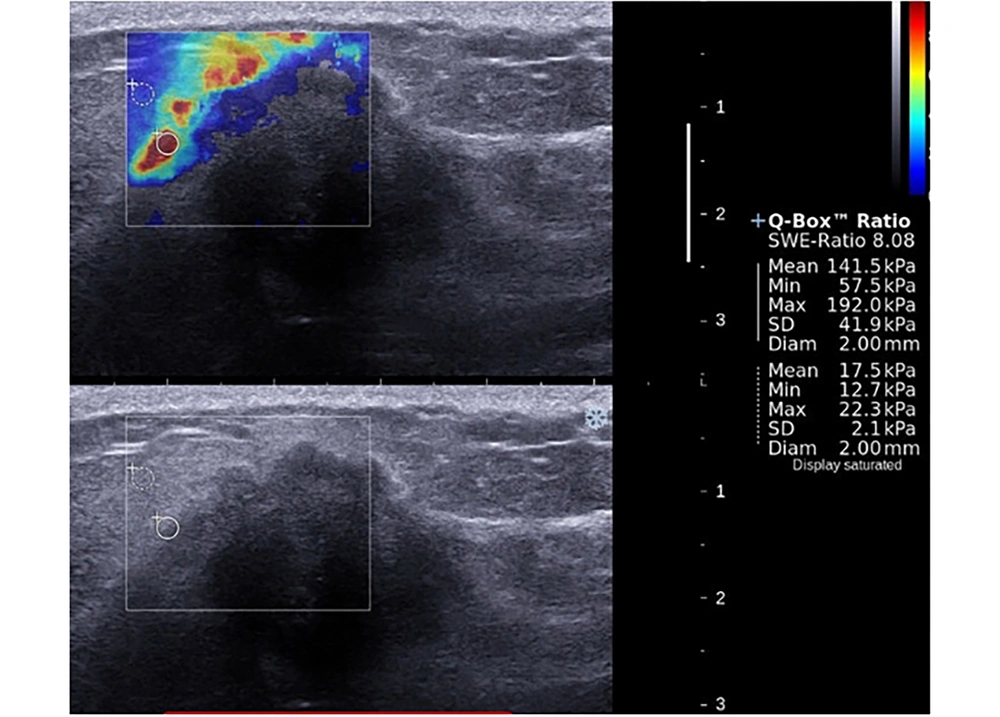
A 39-year-old patient presented with a mass in the upper inner quadrant of the left breast. Shear wave elastography evaluation of the mass showed peritumoral stiffness and central “blind areas”. Regions of interest (ROIs) were placed to the stiffest peritumoral area and perilesional fat tissue (Emean = 141 kPa, Emax = 192 kPa). Gray-scale images showed ill defined, hypoechoic mass with acoustic shadow which is suggestive for malignancy. Histopathological diagnosis was grade 2, ER (-), PR (-), and HER-2 (-) invasive lobular carcinoma. Axillary metastasis was positive.




