Shear wave elastography is an ultrasound imaging technology developed in recent years that directly measures the hardness of biological tissue using ultrasound. Both domestic and international research have demonstrated that elastography has high practical value and broad application prospects in monitoring and evaluating ultrasound ablation (
14). Accurately evaluating the ablation effect is crucial for ensuring the safety and improving the efficacy of ablation. A study by Zhu and Zhu (
10) indicated that ultrasound elastography can preliminarily reflect the degree of coagulative necrosis in liver lesions. Luo et al. (
15) demonstrated that elastography clearly displays the margins of radiofrequency ablation lesions and is expected to become an effective method for evaluating radiofrequency ablation lesions. The preliminary research in this experiment also indicates the feasibility of elastography in evaluating the range of ablation lesions.
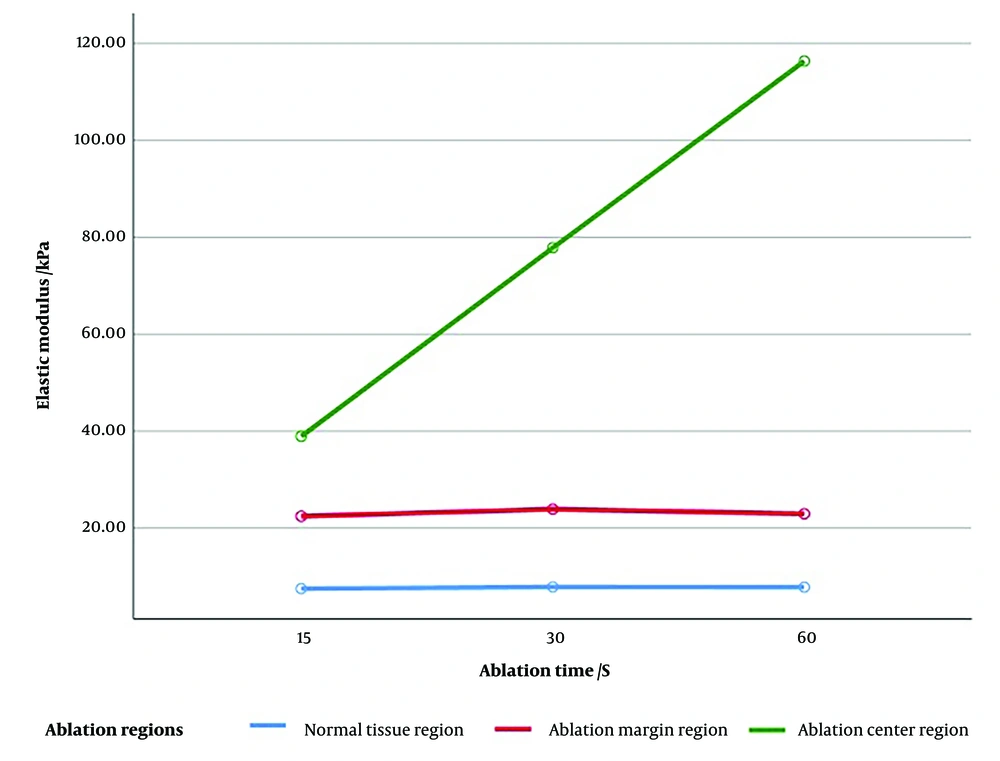
In the present study, using WZSPs as experimental animals, microwave ablation lesions were created in the four hepatic lobes by ablating for 15, 30, and 60 seconds at an ablation power of 40 W. Immediately after surgery, the elasticity images of the ablation lesions were collected, and the elasticities were calculated. Additionally, the feasibility and accuracy of SWE in the quantitative evaluation of microwave ablation margins of the liver were explored. Protein denaturation occurs in liver tissue through an effective thermal field, which leads to a significant increase in hardness. During ablation, the elastic modulus in this region increases significantly and is positively correlated with ablation time, and carbonization may even occur.
The peripheral bleeding zone, also known as the ablation margin region, is a narrow band-like area of bleeding with some inflammatory cell infiltration. Because this study used immediate pathological sections after ablation, inflammatory cell infiltration was not significant. The pathology results revealed that necrotic and heminecrotic tissue coexisted in this (heminecrotic) region. The position of the ablation margin region is not fixed. Generally, as the ablation time increases, the margin region moves away from the ablation center (
16), but its elastic modulus is relatively constant. The SWE image immediately post-ablation displayed the near-field boundary and the vertical and anteroposterior boundaries of the ablated area through color differences, which supports the notion that elastography is less affected by gas (
17).
Elastography is color-coded based on the differences in tissue hardness after ablation, forming three regions centered on the electrode. The ablation center region appeared red or yellow, the ablation margin region appeared cyan, and the surrounding normal tissue region appeared dark blue. Additionally, the distribution of Young’s modulus in these three regions was observed and measured, revealing no statistically significant difference in the elastic modulus between the surrounding normal tissue region and the ablation margin region. This result indicates that for a large or deeply ablated area, SWE measurements may underestimate the vertical diameter. However, in the ablation center region, the elastic modulus decreased progressively with shorter ablation times, showing statistically significant differences.
By analyzing the three ablation time groups separately, it was found that the elastic modulus variation pattern exhibited a regularly decreasing trend centered on the electrode. This indicates that SWE can preliminarily reflect the distribution of tissue hardness immediately after ablation, which is consistent with the conclusions of multiple studies (
18-
20). Luo et al. identified some remaining overestimates in SWE values immediately post-ablation, with most of the SWE values stabilizing at 5 minutes (
21). Therefore, SWE measurements should not be performed too early after ablation. Crocetti et al. determined that SWE was not able to reliably capture changes in stiffness within, at the border of, and outside the necrotic zone in an ex vivo liver model (
20).
Zhou et al. (
22) reported on 18 patients with uterine myoma who underwent microwave ablation and compared the SWE measurement results with those of contrast-enhanced ultrasound and enhanced magnetic resonance imaging (MRI). The outcomes revealed no statistically significant difference between the results of elastography and those of contrast-enhanced ultrasound or MRI, suggesting that SWE is not inferior to imaging methods such as MRI in evaluating the microwave ablation range in uterine myoma. Tian et al. (
23) reported the elastic modulus of 57 patients with liver tumors after radiofrequency ablation at 30 minutes, 1 day, and 1 month, identifying no statistically significant differences and demonstrating that SWE can quantitatively analyze the elastic modulus changes in liver tumors before and after radiofrequency ablation. Kang et al. (
24) used acoustic radiation force impulse to demonstrate the correlation between shear wave echo velocity and the degree of ablation-induced injury, providing a theoretical basis for the use of elastography in evaluating ablation-induced injury. Moreover, according to the research results of Huang et al. (
25) and Zhang et al. (
26), the elastic modulus is positively correlated with the degree of tissue damage during microwave ablation.
5.1. Limitations
The effect of microwave ablation on living tissue differs from that on isolated tissue. Due to the influence of blood flow in living tissue, the ablation volume in living tissue is smaller than that in isolated tissue under the same microwave dose. Moreover, the volume of living liver masses is relatively large, and the internal echo is uneven, which causes interference with SWE imaging. Therefore, this paper only discusses the general pattern of strain elasticity in evaluating the value of ablation lesions through in vitro tissue. To further apply our findings to clinical practice, more comprehensive live animal experiments and clinical case studies are needed.
Challenging factors in applying our results to the evaluation of human ablation lesions remain, including the presence of ribs, abdominal wall thickness, breathing, and heartbeat. Thus, the use of strain elastic imaging to determine the scope of ablation in vivo requires further study. Additionally, in this study, the different areas around the microwave electrode were mainly defined based on pathological findings, such as the percentage of cell necrosis. However, the consistency of these pathological areas with the SWE map was not determined in this study and should be further explored in future research. Finally, the study’s sample size is limited, with only a small number of ablation foci observed and measured, and the display and evaluation capabilities of 2D ultrasound and SWE imaging under the condition of further enlargement of ablation foci were not assessed. Further research is required to increase the ablation power and time.
In conclusion, the range of the elastic modulus in the ablation margin region is relatively fixed, and the elastic modulus in ablation lesions presents a stepped concentric distribution, providing a basis for the use of SWE in the quantitative evaluation of the ablation margin region. By tracking and delineating the ablation margin, SWE can assist operators in further clarifying the effective killing range of microwave ablation. This allows for more precise control of the distribution of completely necrotic and heminecrotic regions and better protection of key peripheral organs and tissues while ensuring the maximum effective destruction of tumor tissue.