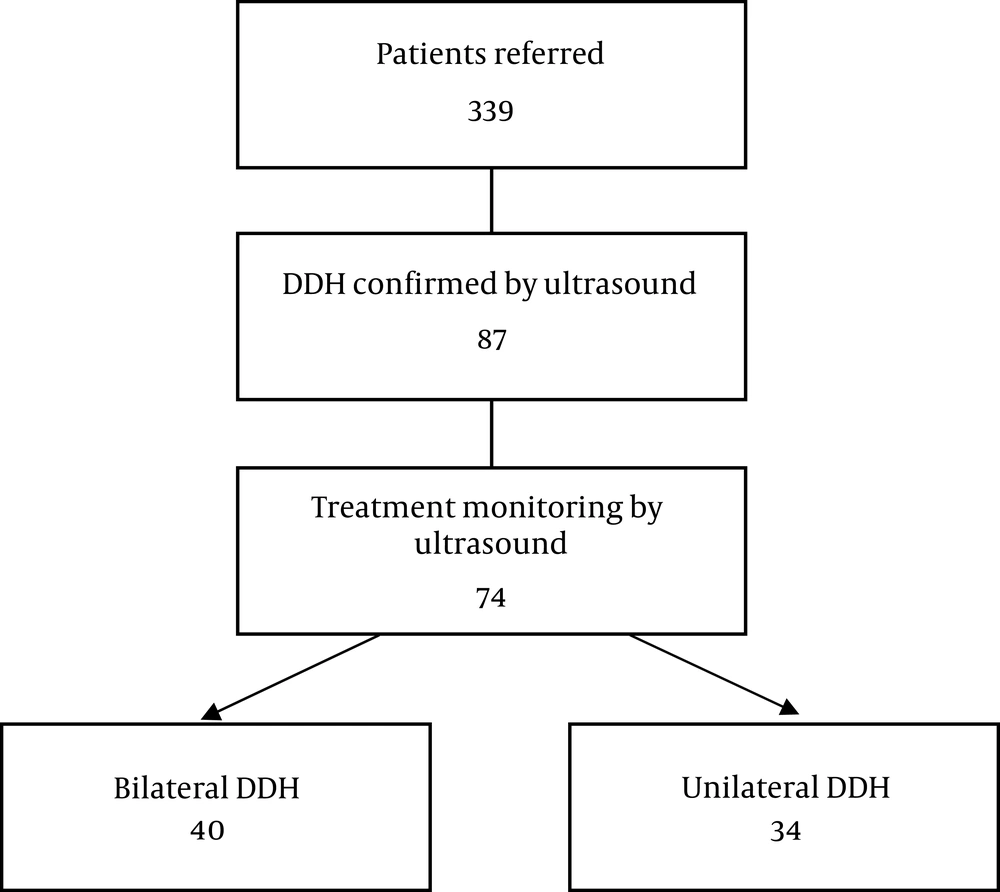
The current study included 58 female and 19 male infants with a mean age of 6.54 weeks. Bilateral DDH was observed in 31 female and nine male patients. All infants were monitored for 3 - 38 weeks (average 6.4). Two infants had just one follow-up ultrasound, 52 patients had two ultrasounds, and the rest underwent 3 - 7 ultrasound exams (
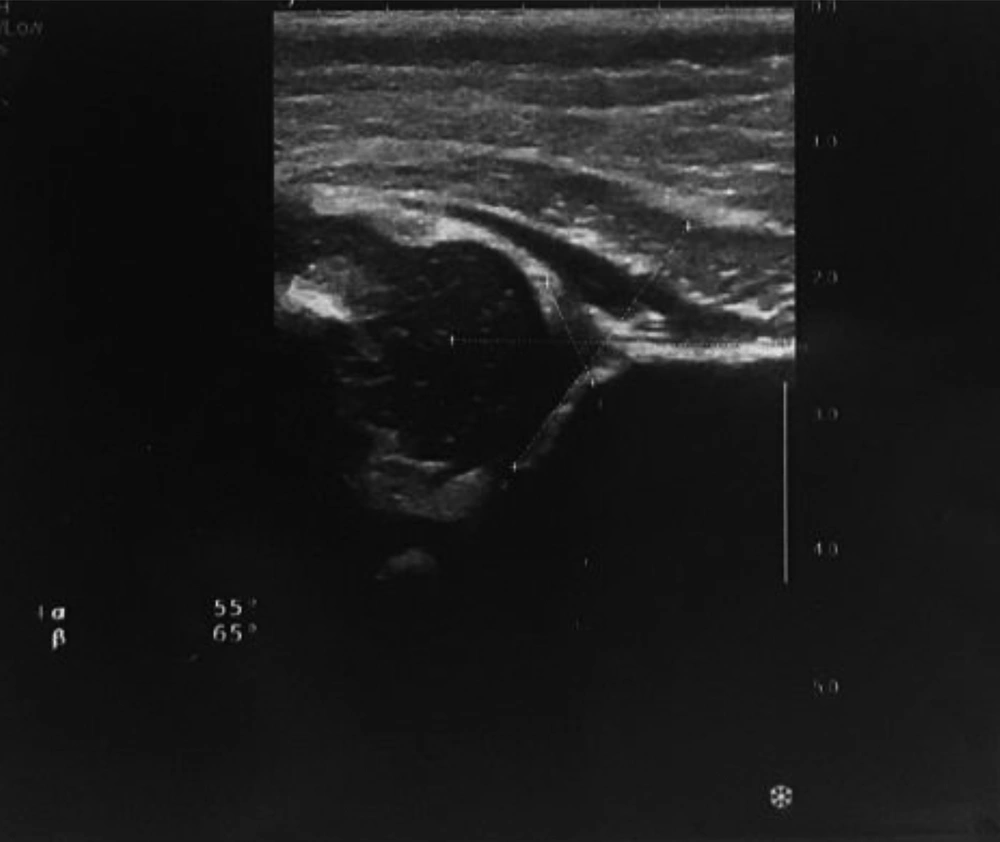
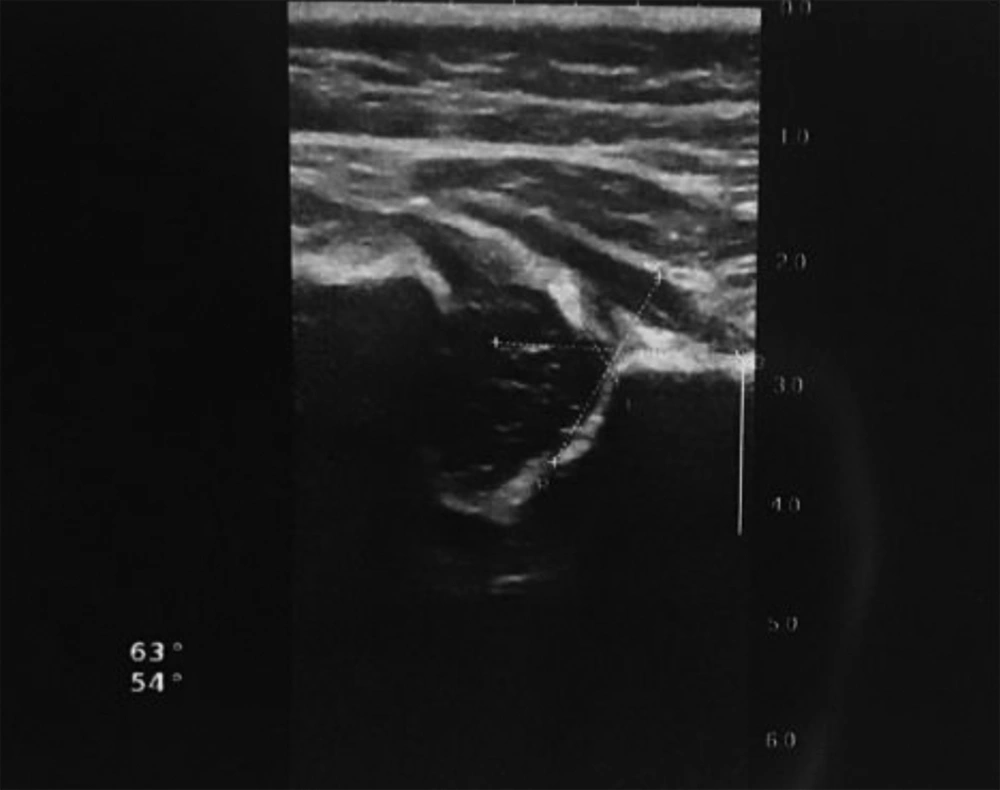
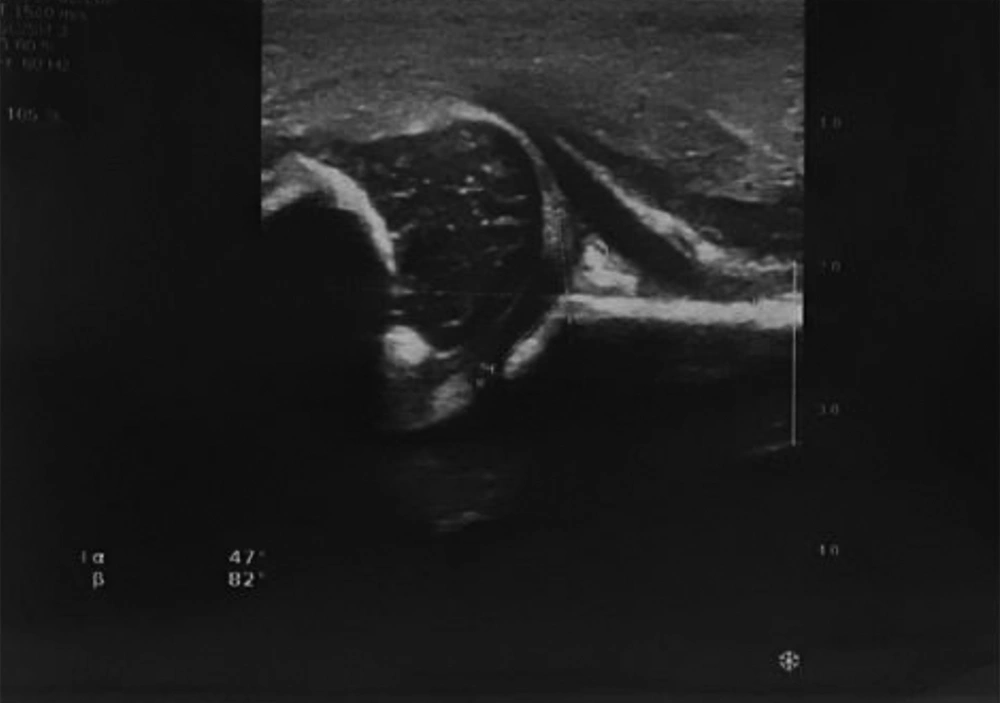
Figures 2-
5). From all 114 hip joints, 63 (55.3%) hips were left-sided, and 51 (44.7%) were right-sided. Mean alpha and beta angles were 53.18 ± 5.7 (range: 39 - 59) and 66.53 ± 6.6 (range: 53 - 83) degrees, respectively. Graf type of involvement was 2a+ in 47 hips, 2a- in 19 hips, 2b in eight hips, 2c in seven hips, type D in 12 hips, type 3 in 13 hips, and the remaining eight hip joints had type 4.
Five-week infant with type II a+ developmental dysplasia of the hip (DDH). Ultrasound measures: alpha 55 and beta 65 degree.
Nine-week infant. The same patients in Figures 1 after 4 weeks shows complete recovery to type 1 (alpha = 63 and beta = 54).
Three-week infant with type D developmental dysplasia of the hip (DDH). Ultrasound measures: alpha 47 and beta 82 degree.
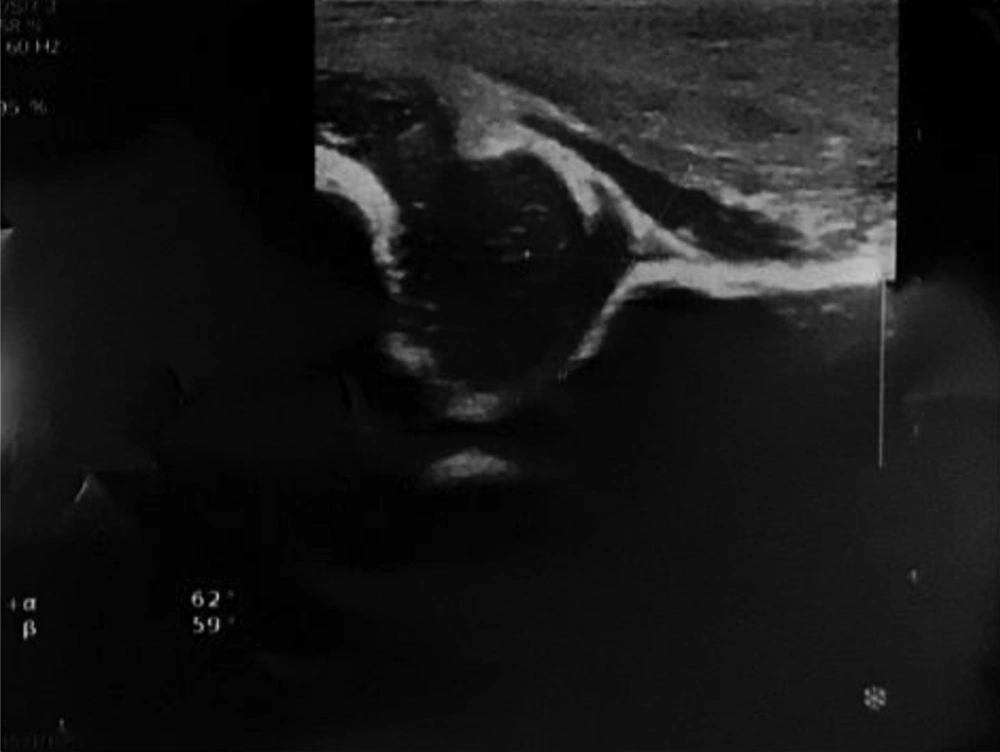
Eleven-week infant. The same patients in Figures 3 after 8 weeks of Pavlik cast shows complete recovery to type I (alpha = 62 and beta = 59).
All hip joints with type 2a involvement were just observed. Treatment by medical brace was done for 19 hips with type 2a. The Pavlik harness orthosis was applied for 15 hips including eight hips with type 2b and seven hips with type 2c. Closed reduction and the Pavlik harness orthosis were applied for 29 joints including 12 hips with type D, 11 hips with type 3, and six hips with type 4. Open reduction was performed for four joints including two type 3 hips and two type 4 hips. Recovery was observed in 98 involved hips (86%), however, 16 joints did not show improvement and required further treatment. Among the subjects, 55 infants were born by cesarean section and the other 19 by vaginal delivery. The cephalic presentation was observed in 68 subjects and breech presentation in the other six patients. Oligohydramnios was observed in four cases; while, 70 patients were reported normal during pregnancy. Forty-four patients were first child, nine patients had a positive family history, and nine patients had limb anomalies. Musculoskeletal anomalies include: clubfoot (8.8%), patella dislocation (0.9%), scoliosis (1.8%), radial dysgenesis (0.9%), and hydronephrosis (2.6%).
A better response was achieved in patients with type 2a and those with milder DDH based on Graf classification. For instance, 8.3% of type D, 53.8% of type 3, and all of the type 4 joints did not respond to treatment. Likewise, the mean alpha angle in the non-responsive group was 43.25 ± 3.2 degree in contrast with 54.02 ± 5 in the responsive group, which was significantly lower (P = 0.006). Similarly, the mean beta angle was 80 ± 7.1 degrees in the non-responsive group compared with 66.38 ± 5.6 in the responsive group, which was significantly higher (P = 0.034).
Of 114 affected hip joints, 89 hips (78%) were observed in female patients and the other 25 (22%) in male ones. Besides, 89.8% of affected hips in females and 72% in male patients showed complete recovery. Overall, 81.6% of treated cases were females and 18.4% were males. These results showed that response to treatment was better in females than males (P = 0.031). Being female increases the treatment response by a factor of 8.21.
Five (4.4%) patients had oligohydramnios history, only two of which (40%) had a good response during follow-up. The amniotic fluid had a significant correlation with response to treatment (P = 0.013). A normal amniotic fluid increases the treatment response by a factor of 16.92.
Among first-born children, 93.8% responded to treatment, the second-born children showed an 80.9% response rate, and the third- and next-born children showed only 42.85% recovery. Overall, 62.2% of the patients were first-born children, 34.7% second-born, and 3.1% next-born children. Treatment response was significantly better among first-born children (P = 0.001).
Treatment was also better (91%) in those without limb anomalies compared with those with anomalies (50%) (P = 0.001), and a significant connection between the presence of anomalies and failure to response (P = 0.002) was noted. Among limb anomalies, the ones associated with poor response were radial dysgenesis, scoliosis, and clubfoot in the order of frequency. Of the patients with renal anomalies, no one showed improvement, while in patients without renal problems, the response rate was 88.2%. Of all patients in the current study, 12.3% had limb anomalies. The average follow-up time in patients with anomalies was 9.6 weeks, and 8.6 weeks in patients without anomalies. Among the infants with limb anomalies, the ones with patellar dislocation had the longest follow-up, 22 weeks, while in scoliosis and clubfoot it was 3 weeks and 10.63 weeks, respectively. Fifty percent of patients with anomaly showed good response compared with a 91% response rate in the group without anomaly. Also, 43.8% of patients in the non-responsive group belonged to the anomaly group. Having no anomaly increases the treatment response by a factor of 5.02. Therefore, the presence of limb anomalies significantly decreased treatment response.
There was no significant correlation between the length of follow-up and response rate. (P = 0.30) Infants with good response attended more in the follow-up sessions. (P = 0.001) All patients that attended five sessions or more showed complete recovery. Twenty-five percent of cases that required further treatment due to their poor response, had only one and 50% of them had two follow-up sessions. Results also showed that gestational age at birth, birth weight, sidedness, laterality, type of delivery (cesarean versus vaginal), fetal presentation, and positive family history were not significantly connected with response to treatment. Natural delivery decreases the treatment response only by a factor of 0.12. Left hip involvement with 55.3% (63 joints) was more common than right side involvement. Of those with good response, 56.1% (64 joints) had left side involvement and 43.9% (50 joints) had right side involvement. However, the difference was not significant (
Table 2).
| Treatment response | Crude OR (95% CI)b | Adjusted OR (95% CI)c |
|---|
| Positive | Negative |
|---|
| Sex | | | 3.45 (1.13 - 10.51) | 8.21 |
| Female | 80 | 9 | | |
| Maled | 18 | 7 | | |
| Gestational age at birth | | | | |
| Pretermd | 12 | 0 | - | - |
| Term | 86 | 16 | | |
| Type of delivery | | | | 0.12 |
| Cesareand | 76 | 9 | - | |
| Vaginal | 22 | 7 | | |
| Fetal presentation | | | | |
| Breechd | 10 | 0 | - | - |
| Cephalic | 88 | 16 | | |
| Amniotic fluid volume | | | 11.07 (1.69 - 72.63) | 16.92 (0.88 - 322.36) |
| Normal | 96 | 13 | | |
| Oligohydramniosd | 2 | 3 | | |
| Order of children | | | 0.23 (0.09 - 0.56) | 0.29 |
| First child | 61 | 4 | | |
| Second child | 34 | 8 | | |
| Third child or next children | 3 | 4 | | |
| Family history of DDH | | | | |
| Positive | 14 | 2 | - | |
| Negatived | 84 | 13 | | |
| Limb anomalies | | | 7.69 (2.31 - 25.59) | 5.02 (0.99 - 25.42) |
| Negative | 91 | 9 | | |
| Positived | 7 | 7 | | |
| Renal abnormality | | | | |
| Negative | 98 | 13 | - | - |
| Positived | 0 | 3 | | |
Abbreviations: CI, confidence Interval; DDH, developmental dysplasia of the hip; OR, odds ratio.
aValues are expressed as median (range).
bSimple logistic regression.
cMultiple logistic regression (there were all variables in the model).
dReference category.