
1. Background
Because of its fast spread, severe infection, mortality rate, and the lack of medications and treatments, COVID-19 is considered a great threat to human health and life (1). General psychological reactions such as tension, anxiety, and fear are expected, which can lead to mental disorders including stress, depression, and suicide (2). The large number of COVID-19 patients has caused a general health crisis, putting treatment teams under physical, mental, and occupational pressure (3). Members of the treatment teams, therefore, are face numerous challenges, including high workload, occupational injury, violence, high risk of infection among themselves and their family members, and supplying personal protective equipment (4). Evidence indicates that because of the nature of their jobs, nurses spend a great deal of time taking care of patients (5). Thus, more attention needs to be paid to emotional issues among nurses.
Stress can also affect nurses' health, increase their vulnerability, reduce their working hours, and decrease the quality of care they provide (6). Thus, the management of stress is more important than its intensity and prevalence, and ways to manage stress are called "coping strategies."
Coping refers to a person's attempt to resolve or reduce stressors, depending on environmental factors and cognitive-behavioral interventions (7). Lazarus and Folkman identified two main methods for coping with stress, namely problem-focused coping and emotion-focused coping. In the first method, the main target is to solve the existing problem. Thus, the person focuses on this objective and genuinely attempting to resolve the stressful situation. In the second method, however, emphasis is put on controlling the emotions resulting from stressors. Thus, this method involves such behaviors as seeking out others and cognitive reactions like denial of the situation (8). Problem-focused coping includes accepting responsibility, seeking social support, positive reappraisal, and planful problem-solving, while emotion-focused coping involves distancing, escape-avoidance, self-controlling, and confrontative coping (9). It should be noted that there is no good or bad coping strategy. In other words, any strategy can be used to cope with a problem in a specific situation and can be either constructive or non-constructive (10). Moreover, individuals choose their coping strategies on the basis of their individual, psychological, and cultural characteristics. Studies have indicated that when individuals are exposed to stress, they show different coping strategies to eliminate or decrease the undesirable effects (11).
2. Objectives
Because of the importance of stress coping strategies in reducing stress and considering nurses' stress during the COVID-19 pandemic, the present study aims to determine the relationship between stress and coping strategies among nurses caring for COVID-19 patients.
3. Methods
This cross-sectional study was conducted on 170 nurses working in the acute respiratory ward of Ganjavian Hospital, Dezful, Iran, from 22 Aug 2020 to 14 Jan 2021. Participants were selected throughsimple random sampling. Inclusion criteria comprised no history of mental illnesses, one month work experience in the Covid ward, and one year work experience in a clinical ward.
After the working method of the samples was explained and informed consent obtained, the study data was collected using Lazarus and Folkman's Ways of Coping Questionnaire and Cohen's Perceived Stress Scale. Lazarus and Folkman designed the “Ways of Coping Questionnaire” in 1985. This scale contains 66 items scored on a four-option Likert scale (1-4). The items assess eight coping strategies divided into problem-focused and emotion-focused categories. A score of 100 is the highest score attainable on this scale. According to Lazarus, the internal consistency of the questionnaire was 0.66 - 0.79 for all coping strategies (12). In their 2013 research, Agha-yousefi et al. reported a Cronbach's alpha of 0.76 for this questionnaire, indicating its high reliability (13). The sample size was calculated using the formula:
Cohen et al. developed the Perceived Stress Scale in 1983, and it has been designed in three versions comprising 4, 10, and 14 items that assess general stress during the past month and explore thoughts and emotions about stressors and controlling, overcoming, and coping with the experienced stress. These items also evaluate the risk factors of behavioral disorders and present the process of stressful relationships. The 14-item version of the Perceived Stress Scale was employed in the current research. The Cronbach’s alpha coefficient of this scale was computed as 0.84, 0.85, and 0.86 in three previous studies. The questionnaire items were rated on a five-option Likert scale with the following options: never (0), almost never (1), sometimes (2), usually (3), and most of the time (4). It should be noted that items 4, 5, 6, 7, 9, 10, and 13 were scored reversely. Thus, the total score of the scale could range from 0 to 56, with higher scores representing higher perceived stress levels (14).
A demographic information form was also used in the present study, which included job tenure, type of shift, position, education level, previous ward, history of COVID-19, and history of underlying diseases.
Participant anonymity was observed in all stages of the research. No cost was imposed on the participants. Participants were given the opportunity to withdraw at any stage of the research and to be provided with the information they needed upon request.
The collected data was analyzed with descriptive statistics (absolute frequency and percentage) and analytical statistics (chi-square), Pearson correlation coefficient, one way ANOVA, independent t test, and Kruskal-Wallis test. A P-value of 0.05 was considered to be significant.
4. Results
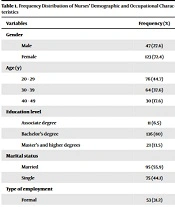
A total of 170 nurses working in the acute respiratory ward of Ganjavian Hospital, Dezful, Iran, participated in this study Among them, 72.4% were female, 44.7% were 20 - 29 years old, 80% had a Bachelor's degree, 55.9% were married, 26.5% were semi-formal employees, 96% were rotating shift workers, 65.3% had fewer than 11 years of work experience, 98.2% lived in urban areas, 40.6% were Fars, and 67.1% had been infected with COVID-19 at least once (Table 1).
Table 1.
Frequency Distribution of Nurses' Demographic and Occupational Characteristics
| Variables | Frequency (%) |
|---|---|
| Gender | |
| Male | 47 (27.6) |
| Female | 123 (72.4) |
| Age (y) | |
| 20 - 29 | 76 (44.7) |
| 30 - 39 | 64 (37.6) |
| 40 - 49 | 30 (17.6) |
| Education level | |
| Associate degree | 11 (6.5) |
| Bachelor's degree | 136 (80) |
| Master's and higher degrees | 23 (13.5) |
| Marital status | |
| Married | 95 (55.9) |
| Single | 75 (44.1) |
| Type of employment | |
| Formal | 53 (31.2) |
| Semi-formal | 45 (26.5) |
| Passing the compulsory medical service program | 26 (15.3) |
| Contractual | 22 (12.9) |
| Corporate | 11 (6.5) |
| Shift work | |
| Rotating | 6 (4) |
| Fixed | 164 (96) |
| Job tenure | |
| < 11 years | 111 (65.3) |
| 11 - 20 years | 46 (27.1) |
| 21 - 30 years | 13 (1.6) |
| History of COVID-19 | |
| Yes | 56 (32.9) |
| No | 114 (67.1) |
| Living place | |
| Urban | 167 (98.2) |
| Rural | 3 (1.8) |
| Ethnicity | |
| Lor | 59 (34.7) |
| Fars | 69 (40.6) |
| Arab | 7 (4.1) |
| Other | 35 (20.6) |
The results of Pearson's correlation coefficient indicated a direct relationship between perceived stress and age of the nurses caring for COVID-19 patients. Accordingly, an increase in age was accompanied by an increase in nurses' perceived stress levels (r = 0.268, P > 0.05). However, the results of Pearson's correlation coefficient revealed no significant relationship between perceived stress and nurses' gender (r = -0.110, P > 0.05) or education level (r = 0.023, P < 0.05) (Table 2).
Table 2.
Correlation Between Perceived Stress and Age, Gender, Education Level, Job Tenure, and History of COVID-19 Infection Among Nurses Caring for COVID-19 Patients a
| Demographic Features | Perceived Stress in the Nurses Taking Care of Patients with COVID-19 | |
|---|---|---|
| Correlation Coefficient | Significance Level | |
| Age | 0.268** | 0.001 |
| Gender | -0.110 | 0.15 |
| Education level | 0.023 | 0.76 |
| Job tenure | 0.256** | 0.001 |
| History of COVID-19 infection | -0.059 | 0.44 |
a ** Significant at 0.01 level, * Significant at 0.05 level
The results of Pearson's correlation coefficient showed a direct correlation between perceived stress and job tenure. Accordingly, the longer the job tenure was, the higher the perceived stress level would be (r = 256, P > 0.05). However, the results revealed no significant relationship between perceived stress and previous history of COVID-19 infection (r = -0.059, P > 0.05) (Table 2).
Based on the results presented in Table 3, there was no significant relationship between confrontative strategy and age, gender, education level, job tenure, or history of COVID-19 infection (P > 0.05). In addition, the distancing strategy was significantly correlated with education level (r = -156, P < 0.05), but not to age, gender, job tenure, or history of COVID-19 infection. Considering the negative correlation with a 95% confidence interval (CI), nurses with higher education levels made less use of the distancing strategy.
Table 3.
Correlation Between Age, Gender, Education Level, Job Tenure, and History of COVID-19 Infection and Emotion-focused Coping Strategies Among Nurses of COVID-19 Patients a
| Demographic Features | Emotion-Focused Stress Coping Strategies Among Nurses of COVID-19 Patients | |||||||
|---|---|---|---|---|---|---|---|---|
| Confrontative | Distancing | Self-controlling | Escape-avoidance | |||||
| Correlation Coefficient | P-Value | Correlation Coefficient | P-Value | Correlation Coefficient | P-Value | Correlation Coefficient | P-Value | |
| Age | 0.011 | 0.88 | 0.038 | 0.62 | 0.124 | 0.10 | -0.164* | 0.03 |
| Gender | -0.091 | 0.23 | -0.118 | 0.12 | -0.168* | 0.03 | 0.170* | 0.02 |
| Education level | 0.026 | 0.73 | -0.156* | 0.04 | -0.038 | 0.62 | -0.138 | 0.07 |
| Job tenure | 0.033 | 0.67 | 0.081 | 0.29 | 0.135 | 0.07 | -0.187* | 0.015 |
| History of COVID-19 infection | -0.092 | 0.23 | -0.085 | 0.27 | -0.155* | 0.04 | 0.152* | 0.04 |
a ** Significant at 0.01 level, * Significant at 0.05 level
The results revealed no significant relationship between the self-controlling strategy and age, education level, or job tenure (P > 0.05). However, this coping strategy was significantly correlated to gender (r = -168, P < 0.05). and history of COVID-19 infection (r = -155, P < 0.05). Considering the negative correlation with 95% CI, females and Nurses who do not have a history of previous infections higher use of the distancing strategy. Additionally, the results showed no significant relationship between the escape-avoidance strategy and education level (P > 0.05). However, this coping strategy was significantly associated with age, gender, job tenure, and history of COVID-19 infection (r = -164, r = 0.170, r = -0.187, r = 0.152, P < 0.05). Considering the negative correlation with 95% CI, nurses of a higher age and who had longer job tenures made more use of the escape-avoidance strategy. On the other hand, considering the positive correlation for gender and history of COVID-19 infection with 95% CI, the escape-avoidance strategy was utilized more by males and those with a previous history of COVID-19 infection (Table 3).
Based on the results shown in Table 4, there was no significant relationship between the seeking social support strategy and age, education level, job tenure, or history of COVID-19 infection (P > 0.05). However, the utilization of this coping strategy was significantly correlated to gender (r = -0.150, P < 0.05). Considering the negative correlation with 95% CI, females were more likely to seek social support. The results also revealed no significant relationship between accepting responsibility and age, education level, and job tenure (P > 0.05). Nonetheless, using this strategy was significantly associated with gender and history of COVID-19 infection (P < 0.05). Considering the negative correlation with 95% CI, females and nurses with a previous history of COVID-19 infection were more responsible.
Table 4.
Correlation Between Age, Gender, Education Level, Job Tenure, and History of COVID-19 Infection and Problem-focused Stress Coping Strategies Among Nurses of COVID-19 Patients a
| Demographic Features | Problem-focused Stress Coping Strategies Among Nurses of COVID-19 Patients | |||||||
|---|---|---|---|---|---|---|---|---|
| Seeking Social Support | Accepting Responsibility | Positive Reappraisal | Planful Problem-solving | |||||
| Correlation Coefficient | P-Value | Correlation Coefficient | P-Value | Correlation Coefficient | P-Value | Correlation Coefficient | P-Value | |
| Age | 0.015 | 0.84 | -0.128 | 0.09 | 0.106 | 0.16 | 0.135 | 0.08 |
| Gender | -0.150* | 0.04 | -0.164* | 0.03 | -0.078 | 0.30 | -0.128 | 0.09 |
| Education level | 0.070 | 0.36 | -0.096 | 0.21 | 0.001 | 0.9 | 0.052 | 0.50 |
| Job tenure | -0.013 | 0.86 | -0.093 | 0.22 | 0.153* | 0.04 | 0.169* | 0.02 |
| History of COVID-19 infection | -0.076 | 0.35 | -0.173* | 0.02 | -0.059 | 0.44 | -0.132 | 0.08 |
a ** Significant at 0.01 level, * Significant at 0.05 level
According to the findings, the positive reappraisal strategy was not correlated with age, gender, education level, or history of COVID-19 infection (P > 0.05). Nevertheless, a significant relationship was observed between this strategy and job tenure (r = 0.153, P < 0.05). Based on the positive correlation and 95% CI, nurses with longer job tenures made more use of the positive reappraisal strategy. Furthermore, the results showed no significant association between planful problem-solving and gender, age, education level, or history of COVID-19 infection (P > 0.05). However, this coping strategy was significantly correlated with job tenure (r = 0.169, P < 0.05). Considering the positive correlation and 95% CI, this strategy was utilized more by nurses with a longer job tenure (Table 4).
Based on the results presented in Table 5, perceived stress was significantly correlated with confrontative, distancing, self-controlling, seeking social support, accepting responsibility, planful problem-solving, and positive reappraisal strategies (r = 0.290, r = 0.200, r = 0.298, r = 0.383, r = 0.335, r = 0.468, r = 0.449, P < 0.05). Considering the positive correlation and 95% CI, the higher the perceived stress level was, the more the above-mentioned strategies were used by nurses of patients with COVID-19. However, no significant relationship was observed between perceived stress and the escape-avoidance strategy (P > 0.05).
Table 5.
Correlation Between Perceived Stress and Stress Coping Strategies Among Nurses of COVID-19 Patients a
| Dependent Variable | Perceived Stress and Stress Coping Strategies Among Nurses of COVID-19 Patients | |
|---|---|---|
| Correlation Coefficient | Significance Level | |
| Confrontative | 0.290** | 0.001 |
| Distancing | 0.200** | 0.001 |
| Self-controlling | 0.298** | 0.001 |
| Escape-avoidance | 0.030 | 0.70 |
| Seeking social support | 0.383** | 0.001 |
| Accepting responsibility | 0.335** | 0.001 |
| Planful problem-solving | 0.468** | 0.001 |
| Positive reappraisal | 0.449** | 0.001 |
a ** Significant at 0.01 level, * Significant at 0.05 level
5. Discussion
The present study aimed to assess the relationship between perceived stress and stress coping strategies among nurses of COVID-19 patients at Ganjavian Hospital, Dezful, Iran. The findings revealed a high intensity of perceived stress among nurses, with a mean of 33.6. Along the same lines, Fallahi-Khoshkenab investigated nurses' mental health and psychological interventions and reported a considerably high incidence of negative mental effects such as post-traumatic stress disorder, anxiety, depression, fear, and sleep disorders, particularly among nurses working in COVID-19 wards (15). Vagni et al. revealed that among healthcare workers, the highest stress scores belonged to physicians and nurses (16). Other studies have also shown that healthcare workers experience various degrees of stress, anxiety, and depression, with higher intensities among nurses and laboratory staff compared to physicians (17-19). In contrast, some studies have referred to mild or weak levels of stress among nurses (20, 21). Another research conducted in Iran prior to the COVID-19 pandemic found nurses' stress levels to be moderate and high. These results may be justified by the unknown nature of the virus, high transmission rate (22), high death rate, loss of self-confidence due to the shortage of personal protective equipment (4, 19), continuous work shifts, and fear of being infected and unable to see one's family members. Furthermore, evidence has indicated that demographic characteristics can affect perceived stress as well as the selection of coping strategies. For example, individuals who live alone or have weaker support systems had higher levels of perceived stress (12).
The present study findings revealed a significant correlation between perceived stress and age among nurses of COVID-19 patients. Accordingly, the level of perceived stress was higher in older participants. Consistently, Hou et al. stated that the incidence of stress, depression, and anxiety was higher among nurses aged above 30 years (12). Conversely, Zhang et al. demonstrated that stress symptoms and job burnout were more evident among younger nurses. They believed that older nurses were more prepared to efficiently face stressful situations and more willing to take avoidance strategies against negative thoughts and emotions (14). the results of the present study can be attributed to the fact that older nurses are more aware of the risks associated with pandemics and feel more responsible towards patients, which causes them to suffer from higher levels of stress.
The current study results showed a significant relationship between perceived stress and job tenure among nurses of COVID-19 patients. Accordingly, the intensity of perceived stress was higher among participants with greater work experience, which was in agreement with the findings of the research performed by Asfour et al. (18). Letvak and Buck found job tenure to be negatively associated with stress level and its symptoms among nurses. In other words, greater work experience resulted in a decrease in stressors (23). Mortaghi Ghasemi et al., however, found no significant relationship between job tenure and stress (24). Generally, individuals with longer job tenure benefit from more personal and occupational experiences and competencies. Therefore, they are able to prevent the penetration of harms, are more committed to taking care of patients with COVID-19, and are not affected by the consequences. Hence, they may suffer from lower stress levels.
The present study discovered no significant relationship between perceived stress and nurses' gender. In contrast, Lai et al. (as cited in Rossi et al.) conducted a study on Chinese nurses and came to the conclusion that female nurses showed more stress symptoms when they were in direct contact with COVID-19 patients (25). Other studies have also indicated that females were more stressed while facing patients in comparison with males (26-28). Up to now, numerous studies have demonstrated that the majority of nurses are female. Creating a balance between life and work is a source of stress, because high workload and being distant from social and family lives can cause women to experience depression and dissatisfaction (29). Nonetheless, Khaghanizadeh showed a higher level of occupational stress among males, which might be associated with higher expectations on the part of family, society, and the workplace. This could, in turn, increase men’s workload, such that they are not able to respond properly to these expectations (29).
The current study results revealed no significant relationship between perceived stress and education level, which was in line with the results obtained by Tavakoli Zadeh et al. (30). On the contrary, Carvello et al. performed research on stress among nurses and indicated that those participants with higher education levels had lower stress levels. They maintained that having a Master's degree could be a positive factor in the nursing profession, because it could increase individuals' self-esteem, thereby helping them seek new projects and present a better performance and more safety while facing stressors (31).
Evidence demonstrates that thinking styles can affect the selection of coping strategies. They are also associated with mental health, negatively among individuals with emotion-focused coping and positively among those with problem-focused coping. In other words, people with a better mental health status tend to make use of problem-focused coping strategies (32).
The present results showed no significant relationship between coping strategies and demographic and underlying features. Nevertheless, the distancing strategy was detected less among nurses with higher education levels. In fact, distancing is the first approach against stress, but it is less utilized by educated nurses due to their higher skills in stress control (33). Additionally, self-controlling was associated with gender and history of COVID-19 infection. Moreover, the escape-avoidance strategy was detected less among older nurses and those with longer job tenures, but this strategy was used more by male nurses and those with a history of COVID-19 infection. Nurses with greater work experience, however, tended to use positive reappraisal and planful problem-solving. Generally, wishful thoughts involve behavioral attempts to avoid or escape stressful situations, similar to wishing for a miracle, excessive sleeping, eating, drinking, smoking, and drug abuse, which equal escaping from reality (34).
In the present study, females were more willing to receive social support and accept responsibility. Acceptance of responsibility was also observed among nurses with a previous history of COVID-19 infection. Moreover, the nurses with higher levels of perceived stress made more use of confrontative, distancing, self-controlling, seeking social support, accepting responsibility, planful problem-solving, and positive reappraisal strategies. Conversely, Jafari et al. found no significant relationship between occupational stress and coping strategies. They believed that personality features were more effective in the selection of efficient coping strategies (33). Several studies have indicated that seeking social support from peers, which has been applied as a stress coping strategy by numerous nurses, can provide them with emotional support and reduce their emotional pressures (35). On the other hand, accepting responsibility is among the basic skills for all people, which makes them committed to fulfilling all their duties. In other words, responsibility refers to the commitment towards one's duties as well as their outcomes (36). Thus, perceived stress can enhance responsibility acceptance.
The current findings revealed a significant correlation between perceived stress and planful problem-solving. Other studies have also shown that individuals with higher problem-solving capabilities are less exposed to stress (34). Furthermore, when encountering problems, some people make genuine attempts to evaluate the situation correctly and properly and cope with it through problem-solving, positive thinking, and appropriate use of support systems. Individuals who are not able to solve problems or tolerate stress may make use of inefficient or even harmful strategies, which can eventually lead to the incidence of more stresses.
5.1. Limitations
One limitation of the current study was ’the limited cooperation of nurses because of their heavy workload as well as their lack of perception of a nurse's role in finding and solving problems. Another limitation of this study is that it was not possible to remove confounding variables
5.2. Conclusions
This study found that nurses faced a large number of stressors during the COVID-19 pandemic. Additionally, the selection of stress coping strategies was somewhat related to factors such as age, gender, and education level. Although many of these factors cannot be changed, nurses' perceived stress can be reduced by training them in effective coping strategies.