
1. Background
Scorpionism is a phenomenon worldwide, but it is a considerable public health problem in tropical and subtropical regions with a high incidence rate and severity (1). In some countries, it has tripled from 2013 to 2017. Also, mortality has increased by 50% in the same period (2). Most of these cases occur in the Middle East, India, the African continent, and Latin America, especially in Mexico and Brazil (3). The venom toxicity varies not only by age, physiology, feeding state, and different species but also among the same species from different geographical parts of the world (4). Various epidemiological studies on scorpions have revealed the dangerous nature of scorpions as a major health problem worldwide, which causes thousands of deaths annually and has contributed to the expansive recognition of harmful scorpion species (5). Most scorpion stings can be local pain, but they may be accompanied by symptoms such as hyperemia, paresthesia, swelling, and piloerection. The exhibition of developed systemic symptoms (gastrointestinal, respiratory, cardiovascular, and/or neurological disorders) can be inferred as increased intensity of envenomation (6). The severity of stung cases can be determined by a scorpion and/or the victim. In the scorpions, the size and species of the animal, the number of stings, the amount of venom injected, venom content and status of the venom canal, and in the victims, age, health status, body mass index, the time elapsed between sting and treatment and part of the body that is stung, are the factors that can influence the severity of scorpion’s sting (6). Iran is one of the countries where different scorpions, especially dangerous types, have been identified and reported (7). Scorpion envenomation is considered one of the major health problems and the leading cause of death, especially in children in the western and southern parts of Iran (8, 9). According to the Iranian Non-Communicable Diseases Committee (INCDC), about fifty thousand cases of scorpion stings are recorded annually (10). Also, more than 75 percent of annual death due to scorpion stings occur in provinces including Khuzestan, Sistan- Baluchistan, Hormozgan, and Kerman, most of which are in Khuzestan province (11). The epidemiological study on scorpion stings revealed that Khouzestan province has the highest prevalence of stings in the country (12).
2. Objectives
Despite the large number of cases reported annually from Shoushtar city, studies on scorpion stings in this region are very limited. So, this study was performed with the aim of assessing the epidemiological features of scorpion stings in this area from 2014 until 2018.
3. Methods
3.1. Study Design and Population
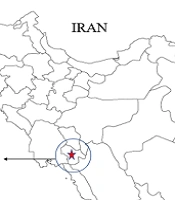
This cross-sectional study was performed on 5479 cases of scorpion stings in Shoushtar city and suburbs of Khuzestan province, Iran.
The sampling was done using the census method. Data were collected from all scorpion sting cases registered in the city health center during the years of study from January 1, 2014, to December 31, 2018. The tool included a checklist that was taken from the study by Khatony et al. (13). it included the demographic information of the cases, the conditions of the stings, and the treatment measures performed for the victims. Coroner's office data were used to match the number of deaths from scorpion stings to ensure that underestimation did not occur.
3.2. Statistical Analysis
In order to calculate the incidence rate, the population in 2015 was obtained from the Statistical National Center of Iran. Based on the population growth rate, we calculated the population for other years. After data collection, Fisher exact test and t-test were used, and graphs were generated to analyze the epidemiological and demographic aspects of scorpion sting by using SPSS software version 23. To assess the incidence trend, the population of 2015 was used as the base population; the age-specific incidence rate was just calculated for 2015.
3.3. Ethics Statement
The present research was supported and approved by the Shoushtar Faculty of Medical Sciences (IR.SHOUSHTAR.REC.1398.006).
4. Results
A total of 5479 scorpion stings were recorded by the health center from January 2014 to December 2018. The patient's mean age was 34.84 ± 15.81 years, and the association between males (34.51 ± 15.60) and females (35.25 ± 16.06) was not significant (P = 0.096).
The incidence rate of scorpion stings in the study years is, on average, 579 per 100,000 people (95% CI: 355 - 804). The highest number of sting cases was recorded in 2015, and there was a gradual decrease in the incidence rate over the period (Figure 1).
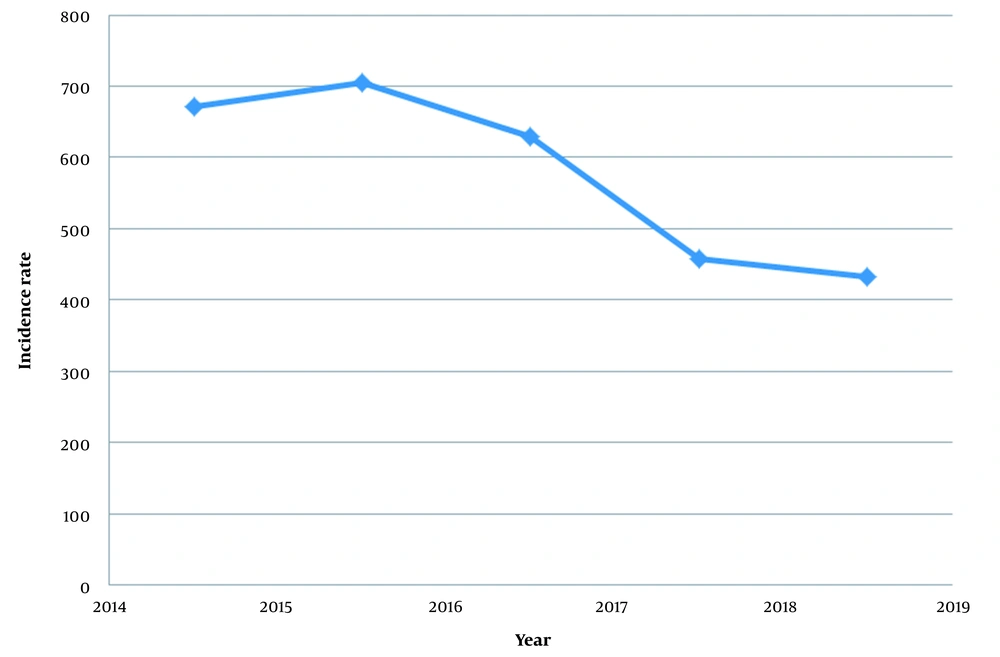
Figure 1.
The incidence rate of scorpion stings in Shoushtar city in 2014 - 2018
Figure 2 shows the distribution of sting cases in all months of the year. In general, the incidence of scorpionism is lower in winter, especially in January and February.
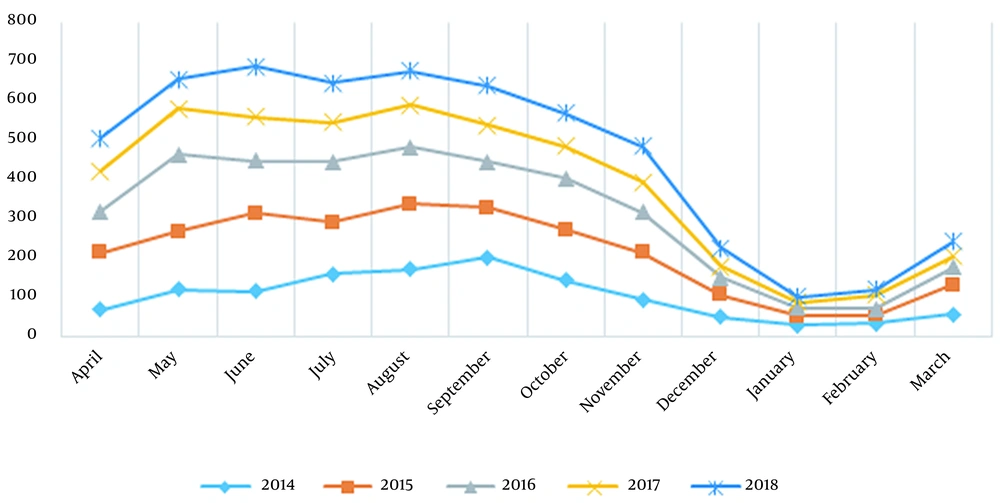
Figure 2.
Distribution of scorpion sting cases by month in Shoushtar during 2014 - 2018
The frequency of stung cases was higher in men than women (2985 and 2518, respectively). Most victims (52.5%) were living in urban areas. According to the results, the Housekeeper women had the highest frequency, so that almost 1 of every 3 victims was Housekeeper women (Table 1). Out of 5479, there was no record of death.
Table 1.
Demographic Characteristics of Patients with Scorpion Sting
| Variables | No. (%) | Min (%) | Max (%) | Overall |
|---|---|---|---|---|
| Sex | Female, 46 | Male, 54 | 5476 | |
| Female | 2518 (46) | |||
| Male | 2958 (54) | |||
| Job | Military, 1.9 | Housekeeper, 32.9 | 3497 | |
| Housekeeper | 1150 (32.9) | |||
| Self-employment | 847 (24.2) | |||
| Farmer | 319 (9.1) | |||
| Student | 475 (13.1) | |||
| Employee | 335 (9.6) | |||
| Manual worker | 137 (3.9) | |||
| Military | 66 (1.9) | |||
| No job | 186 (5.3) | |||
| Place of bite | Rural, 47.5 | Urban, 52.5 | 5394 | |
| Urban | 2834 (52.5) | |||
| Rural | 2560 (47.5) |
The results of the analysis, comparing the scorpion's characteristics and clinical treatment and other characteristics related to the scorpion, are shown in Table 2. According to the findings, concerning the location, most of the stings happened indoors, and there was a significant association between gender and location, so the stings in women were 13 times more than men in an indoor location (P = 0.001, OR = 0.076). The results showed that considering scorpion sting body sites, a higher frequency was found in arms (39%).
Table 2.
Frequency Distribution of Clinical Characteristic of Scorpion Stings Cases
| Variables | No. (%) | Min (%) | Max (%) | Overall |
|---|---|---|---|---|
| Part of the body stung | Head and neck, 3 | Arms, 39.6 | 5479 | |
| Arms | 2168 (39.6) | |||
| Legs | 2075 (37.9) | |||
| Head and neck | 165 (3) | |||
| The middle part of the body | 825 (15.1) | |||
| More than one part | 246 (4.5) | |||
| Location of the case | Outdoor, 46.1 | Indoor, 53.9 | 5215 | |
| Inside | 2810 (53.9) | |||
| Outside | 2406 (46.1) | |||
| Scorpion color | Others, 16.99 | Yellow, 79.6 | 5479 | |
| Yellow | 3572 (65.19) | |||
| Black | 976 (17.81) | |||
| Others | 931 (16.99) | |||
| Frequency of stings in season | Winter, 7.2 | Summer, 35.7 | 5479 | |
| Spring | 1815 (33.7) | |||
| Summer | 1942 (35.7) | |||
| Fall | 1273 (23.3) | |||
| Winter | 449 (7.2) |
5. Discussion
Scorpion envenomation is one of the serious health challenges in tropical and sub-tropical areas. The average incidence rate over the period covered by the study was 579.55 per 100000 inhabitants, which is noticeably high compared to the country's (Iran) and the world's average rate. Due to the climate, Khuzestan province ranks first in the mortality rate and incidence of scorpionism. Unfortunately, despite conducting various studies, only a small number of them have calculated the incidence rate. According to the raw data, estimated population, and the mean of scorpionism in Khuzestan province, Shoushtar city has one of the highest rates. In other studies conducted in the country, only studies carried out in Masjed Soleiman, and Hormozgan reported a higher incidence rate, 1850 and 1300 in 100000, respectively (14, 15).
According to the data reported in 2016, regarding the age range of the victims, the largest cases were in the age group of 35 - 39 years, but the calculated age-specific incidence rate in the 65 - 69 years group was 2953.9 per 100000 which is five-fold higher than the years of the present study. But in similar studies, the age-specific rate was not considered, and only the highest frequency was reported, and most age groups under 35 were considered (6, 12, 16, 17).
The results of the present study indicated that despite the high incidence rate during the investigated period, and an overall increase in the country, there was a decrease from 2014 to 2018. The highest incidence rate was in 2015, which can be attributed to the Shoushtar river flood and residents' homelessness in 2015.
In the present study, Figure 2 showed that scorpion stings occurred in all months of the years investigated, but the highest frequency was related to June and July, and the lowest was reported in January and February. This finding is supported by the studies conducted in Kurdistan (18), Khuzestan (9), and Masjed Soleiman (13), but the study carried out by de Araújo et al. in Brazil showed a slight variation in months with a bit of high frequency in March and September (6). This can be attributed to the temperature stability in this area (Brazil) during the year.
According to the results, 65.19% (3572) of scorpions were yellow, 17.81% (976) were black, and 16.99% (931) other colors. Shoushtar is geographically located in the province with the highest incidence and mortality rate of scorpion stings. Therefore, the mortality rate is expected to be similar to the provincial average, but no deaths have been reported from scorpion stings over the years of study. Given that in %16.81 of scorpion bites, the animal biting was not seen, it seems that overestimation has occurred; in this way that the animal biting was something else and is mistaken for a scorpion.
The gender distribution showed that 46% of victims were women, which is consistent with the study by Amiri et al. (16) and Ebrahimi et al. (15). Our findings about the location of the sting cases were consistent with data from Shahi et al. (19), Talebian and Doroudgar (20), and Bennett et al. (21). The results of the present study showed that about 54% occurred indoors. Scorpions in these areas are likelier to bite their victims indoors. Most of the victims were household women, freelancers, and students, respectively; these findings were supported by Ebrahimi et al.’s study in Hormozgan (15).
The tendency of scorpions to sting indoors can be attributed to the appropriate temperature inside the house for scorpions to live, especially in the warm season, which justifies the high incidence of scorpion stings in household women and students because due to the high temperature; these groups spend the majority of their time inside the house.
In this study, 52.5% of the stings occurred in urban areas. This finding was in contrast with the studies by Amiri et al. (16), Dehghani et al. (12), and Ebrahimi et al. (15). It can be attributed to the different definitions of urban and rural divisions; while many areas of Shoushtar city have features of rural life such as agriculture and livestock, they are defined as a city.
The present study's findings indicated that the most prone body parts to sting were arms and legs (77.50%), and the least frequent were the head and neck (3%). Studies conducted in Khuzestan (9) and Lordegan (16) have presented consistent findings. According to the results, there was no significant association between sting sites and gender (P = 0.22) and job (P = 0.32). The most likely reason that moving parts of the body are at greater risk of scorpion sting is that these parts are more accessible for scorpions to sting, and also, victims do not protect themselves in daily activities. To reduce this problem, it is better to use personal protective equipment such as gloves and safety shoes.
5.1. Conclusions
This study showed that Shoushtar is a city with a high incidence rate of scorpion sting in the country, especially in the warm seasons of the year. Housekeeper women and Self-employment were the victims; scorpions tend to choose their victims indoors.
It can be concluded that renovating houses, using chemical control in roofed areas, and enhancing people's knowledge regarding the advantage of using gloves and boots can be vital in reducing sting incidence.