





1. Background
Thoracoscopic interventions are intrinsically associated with considerable postoperative pain, primarily due to pleural irritation and involvement of the intercostal nerves. Insufficient analgesia in this patient population can exacerbate postoperative pulmonary complications, compromise respiratory mechanics, delay ambulation, and prolong hospital stay, highlighting the pivotal role of optimized multimodal analgesic strategies (1). Opioids, owing to their potent analgesic efficacy and ability to modulate autonomic responses, have traditionally constituted the cornerstone of perioperative pain management. They are utilized both systemically and via regional techniques, including epidural and paravertebral approaches. Nonetheless, opioid administration is associated with respiratory depression, immunosuppressive effects, and immunomodulatory alterations that may increase infection risk (2). Additional adverse effects include postoperative ileus, nausea, vomiting, dizziness, pruritus, delirium, and paradoxical opioid-induced hyperalgesia, all of which can compromise postoperative recovery. Moreover, perioperative opioid exposure carries a risk of subsequent dependency, contributing to the global opioid misuse crisis (1). These considerations underscore the imperative to minimize opioid utilization whenever feasible. Opioid-free anesthesia (OFA) mandates meticulous intraoperative nociception monitoring and judicious titration of non-opioid agents to maintain effective analgesia while mitigating opioid-related adverse effects. Regional anesthetic techniques, including spinal, epidural, and paravertebral blocks, play a central role in OFA, attenuating the surgical stress response and conferring additional benefits such as reduced blood loss, decreased transfusion requirements, and improved analgesia (3, 4). Emerging evidence supports the feasibility of OFA, employing local anesthetics and opioid-free adjuncts, across diverse surgical populations (5). However, thoracic surgery presents unique challenges, characterized by higher pain intensity and elevated risk of postoperative pulmonary complications relative to other surgical procedures. Adequate analgesia is critical for promoting early mobilization, effective cough, and deep breathing, factors integral to reducing the incidence of pneumonia, atelectasis, and postoperative respiratory failure. It is important to note that findings from non-thoracic procedures cannot be directly extrapolated to thoracic surgery due to its distinct pathophysiological and analgesic demands. Previous investigations of OFA in thoracic surgery have been limited by heterogeneity, small cohort sizes, and potential statistical bias, leaving the efficacy of OFA in this context inconclusive (6, 7).
2. Objectives
This study aims to evaluate and compare opioid-based anesthesia (OBA) with OFA in thoracic surgical populations.
3. Methods
3.1. Study Design
The present study was conducted as a randomized clinical trial (IRCT20240407061439N1) after approval by the Biomedical Research Ethics Committee (IR.SBMU.NRITLD.REC.1402.234) of Shahid Beheshti University of Medical Sciences at Masih Daneshvari Hospital in Tehran.
3.2. Patient Selection
A total of 67 patients were assessed for eligibility, of whom 60 met the inclusion criteria and were enrolled in this double-blind randomized clinical trial. This study was conducted as a single-center, double-blind randomized clinical trial. Due to the nature of anesthetic drug administration, blinding of the attending anesthesiologist was not feasible. Patients were not informed of group allocation. Postoperative data collection, including visual analog scale (VAS) pain assessment and evaluation of complications, was performed by a trained nurse who was blinded to the anesthetic technique, thereby reducing assessment bias for subjective outcomes. Participants were randomly allocated into two equal groups using a random number table. Inclusion criteria comprised written informed consent, candidacy for thoracoscopic surgery, and age between 18 and 70 years. Exclusion criteria included hypersensitivity to ketamine or dexmedetomidine, signs of increased intracranial pressure, a history of unstable cardiovascular disease, active peptic ulcer or gastrointestinal bleeding, hepatic or renal failure, a history of drug or alcohol dependence, and corticosteroid use within two weeks prior to surgery (Figure 1).
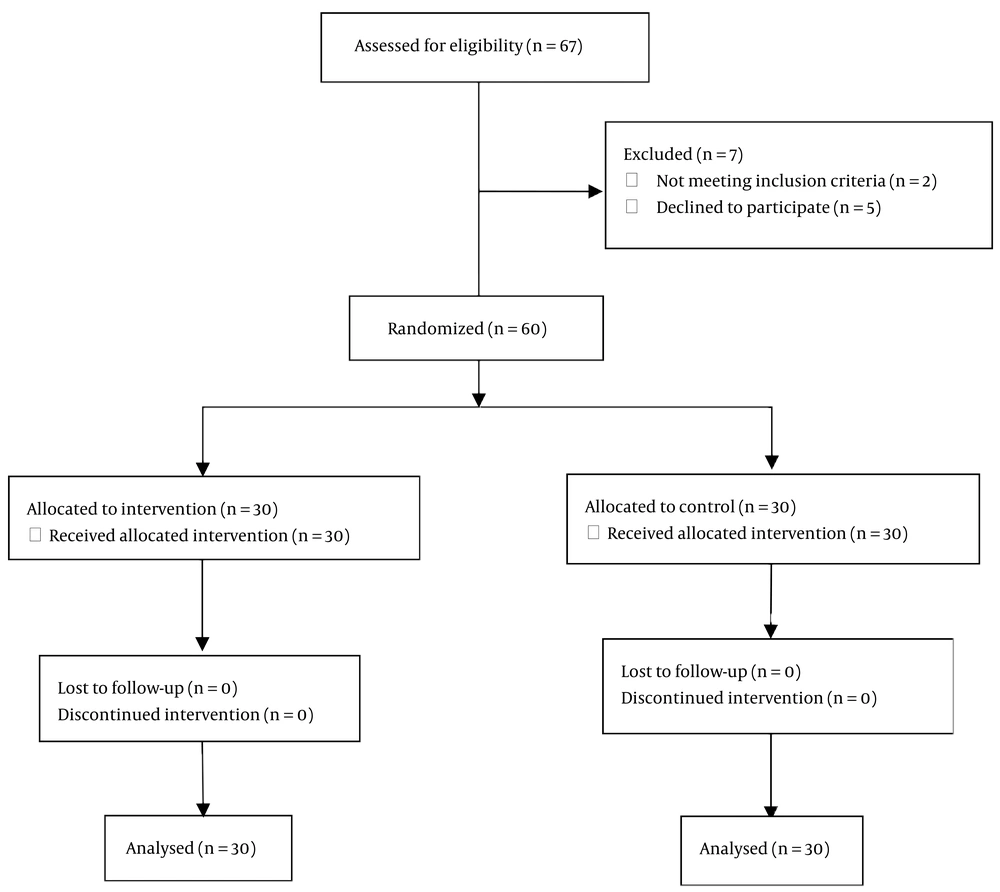
Figure 1.
Sort chart of the participants in the study
3.3. Methods
All patients underwent thoracoscopic surgery with one-lung ventilation using a double-lumen endotracheal tube. Lung isolation and chest tube placement were performed using standardized techniques by the same surgical team. In the control group, anesthesia induction was performed using a standard method with the following drugs: Fentanyl (1 - 3 μg/kg), midazolam (0.02 mg/kg), atracurium (0.5 mg/kg), and propofol (1.5 - 2.5 mg/kg). Anesthesia maintenance in this group was achieved using isoflurane gas at a maximum concentration of 1 minimum alveolar concentration (MAC). In the opioid-free group, induction was carried out using midazolam (0.02 mg/kg), atracurium (0.5 mg/kg), propofol (1.5 - 2.5 mg/kg), and ketamine (0.5 mg/kg), while maintenance was provided using isoflurane gas (up to 1 MAC) in combination with a dexmedetomidine infusion (0.6 μg/kg/hour). Anesthetic depth was standardized using isoflurane at a target concentration of up to 1 MAC. No regional analgesic techniques were employed in either group in order to isolate the effects of the anesthetic regimen. Advanced nociception monitoring tools such as the analgesia nociception index (ANI) or surgical pleth index (SPI) were not available. Intraoperative analgesia was therefore titrated according to predefined hemodynamic criteria, including heart rate and blood pressure responses, in accordance with institutional protocols.
Postoperative pain management was standardized in both groups. Intravenous acetaminophen (10 mg/kg) was administered as rescue analgesia when the visual analog scale (VAS) score exceeded 3. This uniform rescue strategy was selected to minimize confounding from postoperative opioid administration. No patient required escalation to additional systemic or regional analgesic modalities during the first 24 postoperative hours. Respiratory depression was predefined as a respiratory rate below 10 breaths per minute or oxygen saturation below 90% on room air. No patient met these criteria during the postoperative observation period.
Postoperative clinical parameters such as heart rate, systolic and diastolic blood pressure, respiratory rate or respiratory depression, itching, nausea, and vomiting were recorded in both groups at 0, 2, 4, 6, 8, 12, 18, and 24 hours after surgery using a pre-designed checklist. Severity of pain using VAS was evaluated at the same times. Inflammatory marker C-reactive protein (CRP), as well as laboratory parameters including blood urea nitrogen (BUN), creatinine, alanine aminotransferase (ALT), and aspartate aminotransferase (AST), were recorded before and during the recovery period.
3.4. Statistical Analysis
Data were collected and then all data were checked for normal distribution using the Kolmogorov-Smirnov test. Data were summarized as mean ± standard deviation or median, if necessary. All quantitative variables were expressed as mean and standard deviation, and qualitative variables were expressed as number (percentage). The normality of quantitative variables was examined using the Kolmogorov-Smirnov test, box plots, and normal probability. To compare quantitative variables between two groups, the Student's t-test and, if necessary, the nonparametric Mann-Whitney test were used. All statistical tests were performed as two-range and at a significance level of 5%. SPSS 23 software was used to analyze the data.
4. Results
A total of 60 patients undergoing thoracoscopic surgery were included in the study after meeting the inclusion and exclusion criteria in two groups (opioid-free and opioid). The average age of the participants was 54.9 years (opioid-free group: 53.3 and opioid group: 56.5 years), while 63.33% (38 patients) of the patients were men and 36.66% (22 patients) were women (Table 1). Based on the results in Table 1, no significant difference was observed between the demographic indicators of the patients in the two groups (P > 0.05).
Table 1.Comparative Study of the Average Demographic Data in the Two Groups of Patients Studied
| Indexes | Opioid-Free | Opium Group | P-Value |
|---|---|---|---|
| Age | 53.30 ± 14.840 | 56.50 ± 8.276 | 0.120 |
| Weight | 69.20 ± 6.460 | 63.90 ± 17.278 | 0.082 |
| BMI | 19.90 ± 2.424 | 19.40 ± 2.575 | 0.561 |
The study and comparison of hemodynamic indices of patients in the two groups showed that the heart rate (HR) Index in the opioid-free group at 6, 8, and 12 hours after surgery was significantly lower than the average values of this index in the opioid group (P < 0.05). This is also observed in the visual analog scale (VAS) Index, as the VAS score in opioid-free patients was significantly lower during recovery, and at 2, 12, and 18 hours after surgery (Table 2).
Table 2.Study and Comparison of Hemodynamic Indices of Patients in Two Groups in 8 Time Intervals
| Variables | Opioid-Free | Opium Group | P-Value |
|---|---|---|---|
| SBP- R (mmHg) | 110.40 ± 26.328 | 115.80 ± 10.486 | 0.409 |
| SBP-2 (mmHg) | 115.90 ± 14.700 | 113.60 ± 11.530 | 0.720 |
| SBP-4 (mmHg) | 117.20 ± 11.302 | 115.11 ± 11.784 | 0.771 |
| SBP-6 (mmHg) | 113.10 ± 21.304 | 115.89 ± 13.541 | 0.792 |
| SBP-8 (mmHg) | 116.80 ± 19.915 | 114.00 ± 13.191 | 0.789 |
| SBP-12 (mmHg) | 119.60 ± 13.167 | 116.11 ± 15.949 | 0.809 |
| SBP-18 (mmHg) | 117.40 ± 13.318 | 111.44 ± 17.205 | 0.600 |
| SBP-24 (mmHg) | 116.44 ± 15.993 | 107.89 ± 21.676 | 0.538 |
| DBP-R (mmHg) | 70.90 ± 11.435 | 74.70 ± 10.067 | 0.117 |
| DBP-2 (mmHg) | 72.00 ± 7.645 | 71.40 ± 7.214 | 0.218 |
| DBP-4 (mmHg) | 75.10 ± 8.634 | 73.78 ± 6.797 | 0.220 |
| DBP-6 (mmHg) | 73.80 ± 9.953 | 76.67 ± 7.778 | 0.361 |
| DBP-8 (mmHg) | 70.70 ± 9.129 | 77.11 ± 8.007 | 0.194 |
| DBP-12 (mmHg) | 71.50 ± 7.442 | 76.33 ± 11.630 | 0.138 |
| DBP-18 (mmHg) | 69.00 ± 9.416 | 73.56 ± 10.864 | 0.142 |
| DBP-24 (mmHg) | 71.78 ± 9.808 | 78.00 ± 6.083 | 0.109 |
| HR-R (beats per minute) | 73.00 ± 10.414 | 93.50 ± 14.215 | 0.054 |
| HR-2 (beats per minute) | 73.50 ± 12.076 | 92.90 ± 12.087 | 0.058 |
| HR-4 (beats per minute) | 73.50 ± 11.188 | 93.78 ± 13.046 | 0.054 |
| HR-6 (beats per minute) | 71.30 ± 13.039 | 95.00 ± 15.969 | 0.048 a |
| HR-8 (beats per minute) | 69.50 ± 12.177 | 94.78 ± 14.211 | 0.045 a |
| HR-12 (beats per minute) | 69.60 ± 9.058 | 90.44 ± 17.529 | 0.049 a |
| HR-18 (beats per minute) | 68.40 ± 10.977 | 85.89 ± 24.741 | 0.051 |
| HR-24 (beats per minute) | 69.44 ± 9.422 | 81.56 ± 29.513 | 0.052 |
| RR-R (per minute) | 14.20 ± 1.135 | 17.60 ± 3.438 | 0.089 |
| RR-2 (per minute) | 13.80 ± 1.549 | 16.50 ± 2.068 | 0.061 |
| RR-4 (per minute) | 14.10 ± 1.370 | 16.00 ± 2.179 | 0.135 |
| RR-6 (per minute) | 14.10 ± 1.101 | 16.22 ± 1.302 | 0.136 |
| RR-8 (per minute) | 14.10 ± 1.792 | 15.22 ± 1.986 | 0.157 |
| RR-12 (per minute) | 14.50 ± 2.635 | 15.78 ± 1.856 | 0.361 |
| RR-18 (per minute) | 14.00 ± 1.563 | 14.89 ± 1.616 | 0.852 |
| RR-24 (per minute) | 13.67 ± 1.500 | 13.22 ± 4.631 | 0.806 |
| VAS-R | 4.00 ± 1.414 | 4.80 ± 1.229 | 0.046 |
| VAS-2 | 3.50 ± 1.434 | 4.30 ± 1.252 | 0.042 |
| VAS-4 | 3.40 ± 1.578 | 4.00 ± 1.414 | 0.058 |
| VAS-6 | 3.00 ± 1.886 | 3.70 ± 1.889 | 0.052 |
| VAS-8 | 2.60 ± 1.430 | 3.30 ± 2.003 | 0.056 |
| VAS-12 | 2.10 ± 1.449 | 2.80 ± 1.814 | 0.049 |
| VAS-18 | 1.70 ± .949 | 2.40 ± 1.713 | 0.049 |
| VAS-24 | 1.56 ± 1.014 | 2.10 ± 1.524 | 0.051 |
Abbreviations: R, recovery; SBP, systolic blood pressure; DBP, diastolic blood pressure; HR, heart rate; RR, respiratory rate; VAS, Visual Analog Scale.
a Statistically significant.
Based on what is seen in Table 3, the CRP (P = 0.038), BUN (P = 0.027), and creatinine (Cr) (P = 0.040) indices after surgery were significantly higher in the opioid-free group.
Table 3.Study and Comparison of Inflammatory Indices Between Patients in Two Groups in Two Time Periods
| Indexes | Opioid-Free | Opium Group | P-Value |
|---|---|---|---|
| CRP-B (mg/L) | 39.080 ± 24.770 | 25.770 ± 15.3198 | 0.054 |
| CRP-A(mg/L) | 45.00 ± 23.137 | 31.990 ± 18.0985 | 0.038 a |
| BUN-B (mg/dl) | 30.90 ± 18.132 | 36.80 ± 13.750 | 0.060 |
| BUN-A(mg/dl) | 52.20 ± 46.552 | 32.90 ± 8.452 | 0.027 a |
| Cr-B(mg/dl) | 1.120 ± 0.234 | 0.9190 ± 0.250 | 0.105 |
| Cr-A(mg/dl) | 1.910 ± 0.327 | 1.040 ± 0.231 | 0.040 a |
| ALT-B (u/l) | 21.90 ± 6.045 | 28.10 ± 4.138 | 0.193 |
| ALT-A(u/l) | 26.00 ± 6.275 | 26.40 ± 8.863 | 0.882 |
| AST-B(u/l) | 23.30 ± 7.889 | 31.50 ± 5.540 | 0.074 |
| AST-A(u/l) | 26.40 ± 6.452 | 30.30 ± 5.798 | 0.103 |
Abbreviations: CRP, C-reactive protein; BUN, blood urea nitrogen; Cr, creatine; ALT, alanine aminotransferase; AST, aspartate aminotransferase.
a It means there is a significant difference between the mean values in the two groups.
There was no significant difference in the prevalence of complications in the two groups of patients (P > 0.05) (Table 4).
Table 4.Investigating the Prevalence of Complications in Patients in the Two Study Groups a
| Indexes | Opioid-Free | Opium Group | P-Value |
|---|---|---|---|
| Itching | 0 (0.00) | 2 (6.66) | 0. 151 |
| Nausea | 1 (3.33) | 1 (3.33) | 0.782 |
| Vomiting | 1 (3.33) | 0 (0.00) | 0.561 |
a Values are presented as No. (%).
Based on Figure 2, no significant difference was observed between the prescribed dose of acetaminophen in the two groups of patients after surgery.
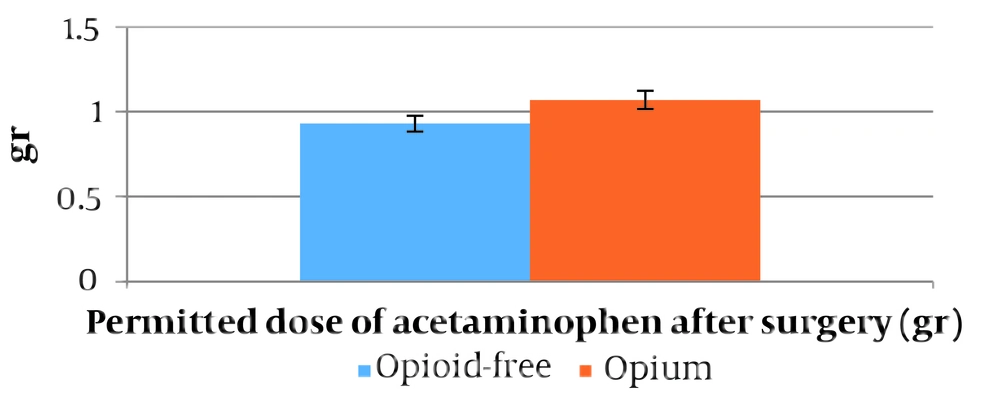
Figure 2.
Comparative study of the dose of acetaminophen consumed in the two groups of patients studied.
5. Discussion
This randomized clinical trial evaluated a ketamine - dexmedetomidine - based opioid-free anesthesia (OFA) regimen compared with conventional opioid-based anesthesia (OBA) in patients undergoing thoracoscopic surgery. The principal findings indicate that OFA was associated with lower early postoperative pain scores and reduced heart rate at selected postoperative time points, suggesting effective analgesia and favorable sympatholytic effects. Importantly, no increase in clinically overt postoperative complications was observed between the two anesthetic strategies.
The lower visual analog scale (VAS) pain scores observed in the OFA group during the early postoperative period may be explained by the complementary mechanisms of ketamine and dexmedetomidine. Ketamine, through N-methyl-D-aspartate (NMDA) receptor antagonism, attenuates central sensitization, while dexmedetomidine provides analgesia and sedation via α2-adrenergic receptor activation. This pharmacologic synergy may be particularly beneficial in thoracoscopic surgery, where pleural irritation and intercostal nerve involvement contribute to substantial postoperative pain.
The reduced heart rate observed in the OFA group at 6, 8, and 12 hours postoperatively is consistent with the known sympatholytic effects of dexmedetomidine. In contrast, higher heart rate and respiratory rate values in the opioid group may reflect increased sympathetic activity or less effective early analgesia. These findings should be interpreted cautiously, as rescue analgesia was deliberately standardized to avoid postoperative opioid exposure.
An unexpected finding of this study was the higher postoperative levels of CRP, BUN, and creatinine in the OFA group. All patients had normal baseline renal function, and perioperative fluid therapy was applied according to institutional protocols. The observed increases likely represent transient physiological responses to surgical stress or perioperative hemodynamic changes rather than established drug-related toxicity. Nevertheless, the magnitude of creatinine elevation warrants cautious interpretation and highlights the need for further investigation in larger studies with detailed perioperative renal monitoring.
However, not all studies have reported superior analgesia with OFA. Beloeil (8), in a multicenter randomized controlled trial on hepato-biliary surgery, observed equivalent postoperative pain scores between OFA and OBA groups, suggesting that the analgesic benefit of OFA may be more pronounced in surgeries with high nociceptive burden, such as thoracic procedures. This notion is supported by the inherently intense postoperative pain associated with pleural irritation and intercostal nerve injury during thoracoscopy (9).
The reduced heart rate observed in the OFA group at 6, 8, and 12 hours postoperatively is consistent with the known sympatholytic effects of dexmedetomidine, which has been shown to attenuate perioperative catecholamine surges and stabilize hemodynamic parameters (10, 11). In a meta-analysis by Schnabel et al. (12), dexmedetomidine use in thoracic anesthesia was associated with lower intraoperative heart rate and blood pressure without increasing the incidence of bradycardia requiring intervention. These effects may be beneficial in patients at risk for myocardial ischemia, as tachycardia and hypertension are common triggers for ischemic events in the postoperative period (13). Ketamine’s hemodynamic effects, in contrast, are more variable and dose-dependent, with potential increases in heart rate and blood pressure due to sympathetic stimulation (14). The combination of dexmedetomidine’s sympatholysis with low-dose ketamine may thus provide a balanced hemodynamic profile, as observed in the present study.
A notable and unexpected finding was the higher postoperative CRP, BUN, and creatinine levels in the OFA group. Elevated CRP is a nonspecific marker of systemic inflammation, influenced by both the magnitude of surgical trauma and the anesthetic technique (15). Previous studies have suggested that dexmedetomidine may actually reduce inflammatory cytokine release via modulation of the NF-κB pathway (16), and ketamine has also been reported to attenuate inflammatory responses in experimental models (17). Therefore, the higher CRP levels in the OFA group may reflect unmeasured confounders such as intraoperative ventilation strategies, surgical duration, or fluid balance rather than a direct drug effect. Similarly, the mild postoperative elevations in BUN and creatinine could be due to perioperative dehydration, transient renal hypoperfusion, or drug-related effects. While dexmedetomidine is generally considered renal-safe, ketamine metabolism generates norketamine, which is excreted renally and may theoretically contribute to transient functional changes in susceptible individuals (18). However, large-scale studies have not established a causal relationship between OFA agents and postoperative kidney injury (19). This finding warrants further investigation in larger, multicenter trials, ideally with perioperative renal biomarker monitoring such as neutrophil gelatinase-associated lipocalin (NGAL) or cystatin C.
The present study’s findings are in partial agreement with the results of Karalapillai et al. (20), who evaluated OFA using dexmedetomidine and lidocaine in cardiac surgery and reported reduced opioid consumption without significant differences in pain or complications. In thoracic surgery, Fiorelli et al. (21) demonstrated that OFA led to shorter hospital stays and fewer postoperative pulmonary complications compared with OBA. However, the current study did not replicate these secondary benefits, possibly due to the smaller sample size and lack of power to detect differences in complication rates. Another consideration is the diversity of OFA protocols. Some regimens incorporate continuous lidocaine infusion, magnesium sulfate, or nonsteroidal anti-inflammatory drugs (NSAIDs), each with distinct anti-inflammatory and analgesic properties (22). The present trial utilized ketamine - dexmedetomidine without systemic lidocaine, which may have influenced the inflammatory marker outcomes.
Safety profile and clinical implications
The absence of significant differences in the incidence of postoperative complications between groups supports the safety of OFA in thoracoscopic surgery. This is consistent with the systematic review by Chou et al. (23), which found no increase in perioperative adverse events with OFA compared to OBA. Nevertheless, OFA implementation requires meticulous intraoperative nociception monitoring, as under-treatment of pain in thoracic surgery can precipitate pulmonary complications such as atelectasis and pneumonia (24). Given the global opioid crisis, strategies that minimize opioid exposure without compromising analgesia are increasingly important (25). In this context, OFA could serve as a viable alternative, especially for patients with known opioid intolerance, high risk of postoperative nausea and vomiting, or history of substance use disorder.
5.1. Limitations and Future Research
Several limitations of this study should be acknowledged. First, the single-center design and relatively small sample size limit the generalizability of the findings. Second, the follow-up period was restricted to the first 24 postoperative hours; therefore, delayed opioid-related effects, long-term pain outcomes, and chronic postoperative pain could not be assessed. Third, advanced nociception monitoring tools and depth-of-anesthesia monitoring were not available, and analgesic titration relied on standard hemodynamic parameters. Fourth, regional analgesic techniques and additional multimodal analgesic agents were intentionally excluded to isolate the effects of the anesthetic regimen, which may limit applicability to routine thoracic anesthesia practice. Finally, the OFA protocol evaluated in this study was limited to ketamine and dexmedetomidine, and the results should not be generalized to all opioid-free anesthesia strategies.
5.2. Conclusions
In conclusion, a ketamine - dexmedetomidine - based opioid-free anesthetic regimen provided effective early postoperative analgesia and acceptable hemodynamic stability in patients undergoing thoracoscopic surgery. However, the observed postoperative increases in inflammatory and renal biomarkers should be interpreted with caution and warrant further investigation. While this approach may contribute to reducing perioperative opioid exposure, definitive conclusions require confirmation in larger, multicenter trials with standardized multimodal analgesic protocols and extended follow-up.
