
1. Background
Rectal bleeding in children is a concerning symptom that can cause parental anxiety. It is a common complaint, and 10 - 20% of referrals to the Pediatric Gastroenterology unit are for this issue (1). Lower gastrointestinal bleeding may be self-limiting and benign. However, due to serious pathology, it can occasionally result in life-threatening hemorrhage (2). Depending on age, its etiology may vary. Anal fistula, food allergies, Meckel diverticulum, inflammatory bowel disease, colon polyps, malignancy, intussusception, and Solitary Rectal Ulcer Syndrome (SRUS) are among the most frequent causes (3). With an estimated prevalence of 1 in 100,000 persons per year, SRUS is a rare but benign disorder of the rectosigmoid (3-6). It was first described by Cruveilhier in 1829, but later, Madigan and Morson identified its clinical and pathological characteristics in 1969 (6, 7). The low prevalence of SRUS in children has been suggested to be due to its frequent unrecognition or misdiagnosis (5). Because the lesion is not always solitary (it can be multiple), not ulcerative (it can be polypoidal/nodular or affect only the erythematous mucosa), and not limited to the rectum (it can also affect the sigmoid colon), the term “SRUS” is misleading and is sometimes referred to as “the three-lie disease” (8). Although the cause of this syndrome is unknown, two major mechanisms for the pathogenesis of the disease include ischemia and direct trauma (self-digitation) (4, 9-11). Although a small number of patients can be asymptomatic, they may suffer from a variety of symptoms (12). The disease usually presents with rectal bleeding, constipation, abdominal pain, mucus discharge, tenesmus, anemia, and rectal prolapse (2, 13). Rectal bleeding is the most typical symptom, with varying levels of blood loss ranging from minimal fresh blood to severe hemorrhage that may require blood transfusion (11). Their symptoms are similar to those of more common diseases like anal fissures, juvenile polyps, and inflammatory bowel disease (4). Both the clinician and the pathologist must have a high index of suspicion because this disease is relatively uncommon in children and its symptoms are not characteristic (11). Even though it is a benign disorder, early diagnosis is essential to avoid long-term consequences, including anemia due to severe rectal bleeding, poor appetite, or distress to other family members (14). The combination of symptoms, endoscopic, and histological results is used to diagnose (11). Colonoscopic findings are not always specific and may resemble other rectal area diseases (11). The lesion may be solitary, multiple, ulcerative, polypoidal, nodular, or erythematous mucosa. The gold standard for diagnosis is histopathology. Thickened mucosal layer (M.M) with crypt distortion and extension of muscle fibers into the lamina propria (L.P) are among the histological findings (3, 15-17). Children with SRUS do not have a conventional course of treatment. Each person has a different treatment, which makes managing them challenging. There is no strong evidence for the effectiveness of the several treatments that have been attempted. The high incidence of recurrence suggests that medical and surgical treatments are not very effective (12). Patients and their parents should be aware that SRUS is a benign, chronic disease and the aim of treatment is to improve the clinical symptoms as well as the improvement of microscopic findings (2, 3). A high-fiber diet, toilet training, stool bulking, enema (sucralfate, mesalazine), oral 5-ASA, and surgery in selected patients are common treatments (3, 8, 15, 18). Results indicate that sucralfate, sulfasalazine, and steroid enema are more effective (3, 9). Solitary rectal ulcer syndrome is a chronic condition that can significantly reduce the quality of life in children. When rectal bleeding, constipation, and tenesmus do not improve with usual treatment, this disease must be considered (9, 19, 20). Furthermore, in order to prevent recurrence and disease complications that could result in progressive disease in adulthood, follow-up is very essential for symptom improvement and confirming treatment strategies (4). In light of non-specific symptoms and the potential for dysplasia and metaplasia in the event of a delayed diagnosis, as well as the fact that there are few studies with a low statistical population and limited data regarding the disease’s complications in children, we chose to perform a retrospective cohort study.
2. Objectives
The purpose of this study is to assess the clinical features, demographic data, pathology, and endoscopy findings. It also aims to look into the treatment and recurrence of SRUS in children.
3. Methods
This retrospective cohort study was conducted at the Department of Pediatric Gastroenterology and Nutrition Clinic, Tehran, Iran, and included patients diagnosed with SRUS between January 2012 and December 2024.
3.1. Patients and Inclusion Criteria
Children and adolescents aged 2 - 18 years with a histologically confirmed diagnosis of SRUS were eligible. Patients with incomplete records or alternative diagnoses were excluded. In total, 101 patients met the inclusion criteria and were enrolled in the study.
3.2. Data Collection
Demographic characteristics (age, sex), clinical presentations (rectal bleeding, abdominal pain, constipation, mucus discharge, tenesmus, diarrhea, digital manipulation, and prolonged toilet sitting), laboratory data [hemoglobin (Hb), stool examination, and fecal calprotectin], and relevant history (chronic constipation, straining during defecation) were extracted from medical records.
3.3. Endoscopic and Histopathological Evaluation
All patients underwent colonoscopy at diagnosis. Endoscopic findings were categorized as solitary ulcer, multiple ulcers, polypoid lesion, hyperemic mucosa, or exudative lesion. Rectal biopsies were reviewed by an experienced gastrointestinal pathologist. Histological criteria included mucosal thickening, crypt distortion, fibromuscular hyperplasia of the lamina propria, and extension of smooth muscle fibers into the mucosa.
3.4. Treatment and Follow-up
Initial management consisted of behavioral interventions, including toilet training and a high-fiber diet. Medical therapies, such as polyethylene glycol (PEG), mesalazine, sucralfate, and corticosteroid enemas, were prescribed according to clinical presentation and physician preference. Patients were followed regularly at one-year intervals for three years, with a final follow-up conducted in 2024. Endoscopy was repeated in cases of persistent or recurrent rectal bleeding. Treatment response was defined as resolution of symptoms and absence of relapse during follow-up.
3.5. Statistical Analysis
Data were analyzed using SPSS Version 27. Continuous variables were presented as mean ± standard deviation (SD) or median (range), and categorical variables as frequencies and percentages. Associations between clinical features, treatment modalities, and outcomes were assessed using Chi-square or Fisher’s exact test for categorical variables and independent t-test for continuous variables. A P-value ≤0.05 was considered statistically significant.
4. Results
The mean age at diagnosis was 10.46 ± 2.94 years (min - max: 2.75 - 16.7), and 77.2% (n = 78) of the patients were male. The most common symptom seen in patients was rectal bleeding (89.1%) followed by constipation (73.3%), abdominal pain (67.3%), and mucus discharge (41.6%). Also, the most frequent findings in their history were staying in the toilet for a long time (56.4%), chronic constipation (53.5%), straining in defecation (54.4%), and digitation (27.7%). The mean Hb level of patients at the time of admission was 12.6 ± 1 (min - max: 9.2 - 14.8) g/dl, and no patient had a blood transfusion throughout the follow - up. 53.5% of the lesions in the endoscopic examination were single ulcers. Additional findings included multiple ulcers 28.7%, hyperemic lesion 21.8%, polypoid lesion 8.9%, and exudate lesion 3%. The pathology findings (smooth muscle fiber in L.P, goblet cell depletion, glandular disorganization, thickening of M.M, and fibromuscular hyperplasia in L.P) in all patients were consistent with a solitary rectal ulcer. Toilet training and a high-fiber diet for all patients were the first steps in the treatment. A laxative, mesalazine, and corticosteroid enema were subsequently added based on other symptoms such as constipation and rectal bleeding. The most common types of treatment are shown in Table 1.
Table 1.
The Most Common Type of Treatment
| Type of Treatment | Percentage |
|---|---|
| PEG + mesalazine | 58.4 |
| PEG + sucralfate | 16.8 |
| PEG | 15.8 |
| PEG + mesalazine + cort enema | 14.9 |
| PEG + mesalazine + sucralfate | 9.9 |
| PEG + mesalazine + sucralfate + cort enema | 7.9 |
| Mesalazine | 5.9 |
Abbreviation: PEG, polyethylene glycol.
For investigation of remaining symptoms, response to treatment, and recurrence of disease, the patients underwent multiple follow-ups after initial symptoms. Data from clinical follow-ups revealed no statistically significant correlation between symptoms and gender (Figure 1).
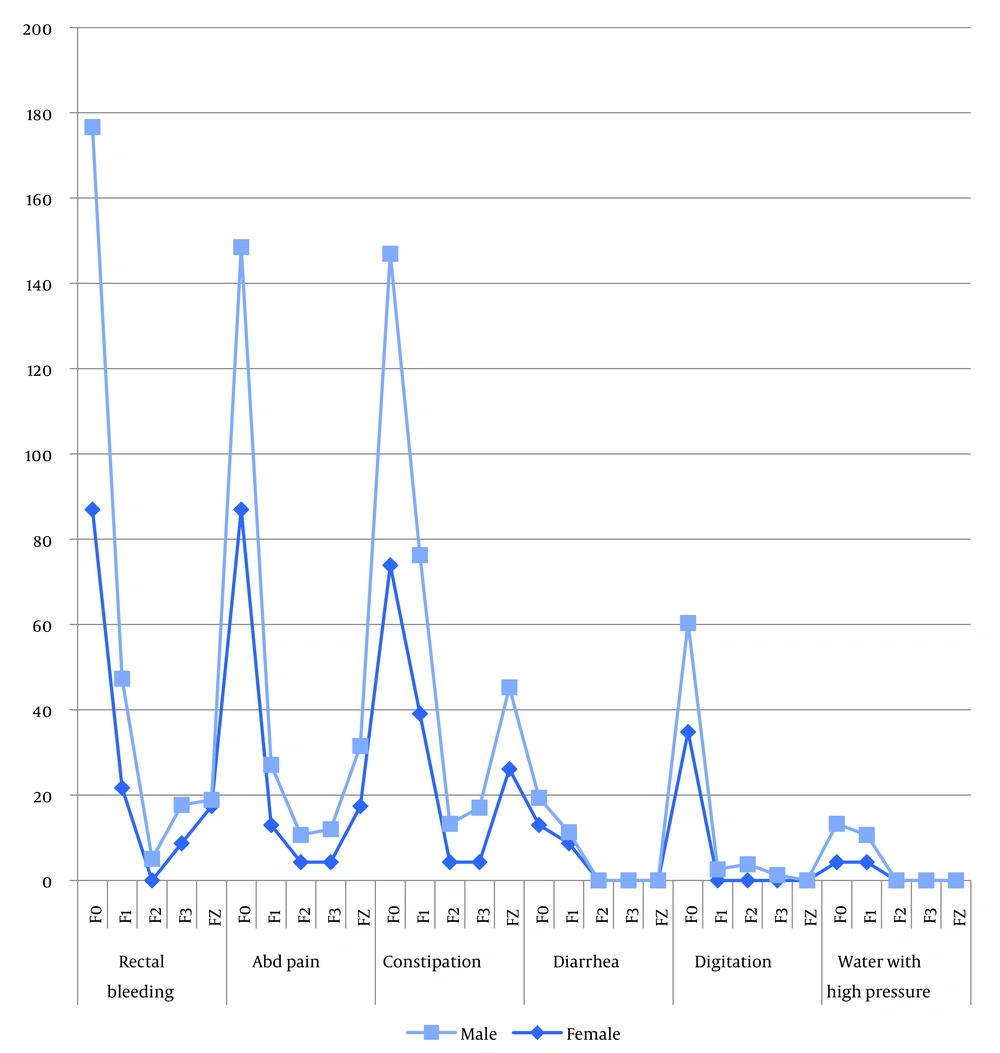
Figure 1.
The relationship between clinical symptoms and in multiple follow ups (F0 = at initial presentation, F1 = 1st follow up, F2 = 2nd follow up, F3 = 3rd follow up, FZ = final follow up)
Endoscopy was not repeated routinely, except in 32 patients with ongoing rectal bleeding who underwent a secondary colonoscopy. Of them, 6.9% (N = 7) had a third colonoscopy due to recurrence of the disease (Table 2).
Table 2.
Colonoscopy Finding a
| Colonoscopy Finding | 1st Colonoscopy | 2nd Colonoscopy | 3rd Colonoscopy |
|---|---|---|---|
| Single ulcer | 54 (53.5) | 18 (56.3) | 6 (85.7) |
| Multiple ulcer | 29 (28.7) | 6 (18.8) | 1 (14.3 |
| Polypoid lesion | 9 (8.9) | 3 (9.4) | 0 (0) |
| Hyperemic mucosa | 22 (21.8) | 13 (40.6) | 1 (14.3) |
| Exudate lesion | 3 (3) | 1 (3.1 | 0 (0) |
a Values are presented as No. (%).
There was no statistically significant relationship between gender and type of treatment (Figure 2).
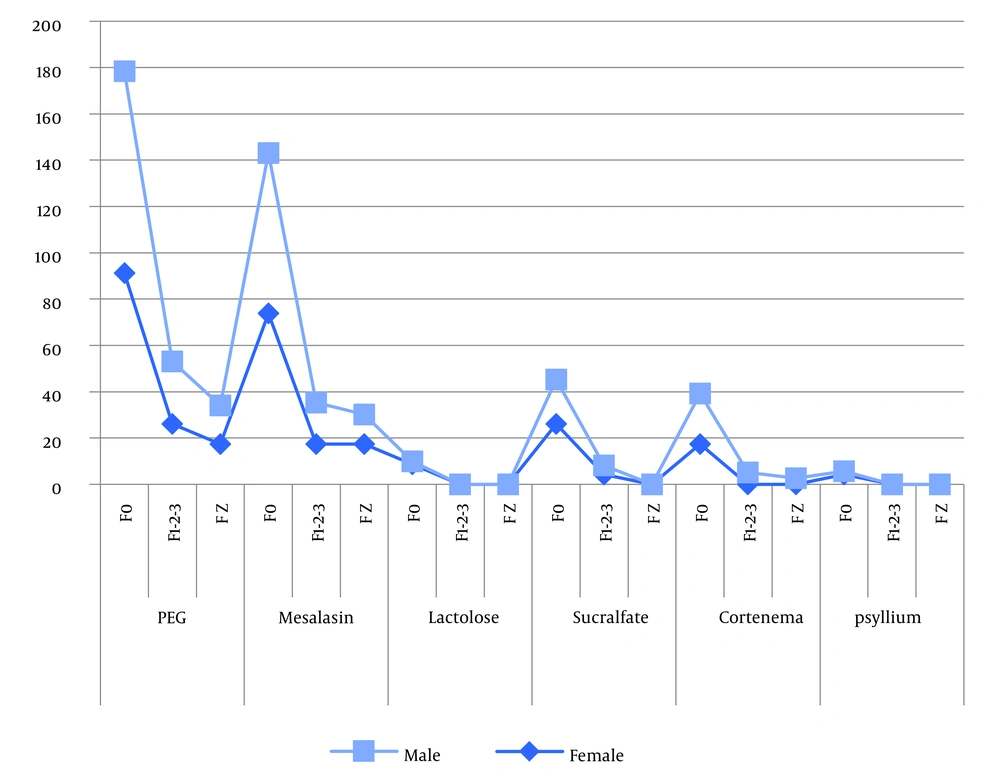
Figure 2.
Relationship between gender and type of treatment in multiple follow ups
Thirty-two patients (32%) needed retreatment secondary to recurrence of symptoms, of which 34.8% (N = 8) were girls and 30.8% (N = 24) were boys. The correlation between the admission symptoms and response to treatment was statistically significant. Patients with rectal bleeding (P = 0.01), constipation (P = 0.02), digitation (P = 0.01), and chronic constipation (P = 0.03) had an inadequate response to treatment (Table 3).
Table 3.
Relationship Between the Admission Symptoms and Treatment Response a
| Variables | Relapse Pos. | Relapse Neg. | P-Value |
|---|---|---|---|
| Gender | 0.71 | ||
| Female | 8 (34.8) | 15 (65.2) | |
| Male | 24 (30.8) | 54 (69.2) | |
| Rectal bleeding | 23 (35.6) | 58 (64.4) | 0.01 |
| Abd pain | 24 (35.3) | 44 (64.7) | 0.26 |
| Constipation | 28 (37.8) | 46 (62.2) | 0.02 |
| Mucus discharge | 12 (28.6) | 30 (71.4) | 0.57 |
| Tenesmus | 4 (44.4) | 5 (55.6) | 0.38 |
| Digitation | 14 (50) | 14 (50) | 0.01 |
| Staying a lot in toilet | 22 (38.6) | 35 (61.4) | 0.08 |
| Straining in defecation | 17 (37) | 29 (63) | 0.29 |
| Chronic constipation | 22 (40.7) | 32 (59.3) | 0.03 |
a Values are presented as No. (%).
Factors affecting the response to treatment in patients are shown in Table 4. Patients who received mesalazine as part of their regimen had more remission.
Table 4.
Factors Affecting Clinical Response in Patients a
| Variables | Relapse Pos. | Relapse Neg. | P-Value |
|---|---|---|---|
| Single ulcer | 15 (27.8) | 39 (77.2) | 0.36 |
| Multiple ulcer | 13 (44.8) | 16 (55.2) | 0.07 |
| Polypoid lesion | 3 (33.3) | 6 (66.7) | 0.91 |
| Hyperemic lesion | 7 (31.8) | 15 (68.2) | 0.98 |
| PEG | 28 (31.5) | 61 (68.5) | 0.89 |
| Sucralfate | 7 (33.3) | 14 (66.7) | 0.85 |
| Cort enema | 10 (47.6) | 11 (52.4) | 0.07 |
| Mesalazine | 27 (38) | 44 (62) | 0.03 |
| Psyllium | 1 (50) | 1 (50) | 0.57 |
Abbreviation: PEG, polyethylene glycol.
a Values are presented as No. (%).
In this study, we investigated the number of disease recurrences. Table 5 demonstrates the relationship between the number of relapses and affecting factors. Patients with rectal bleeding and digitation had a higher chance of relapse.
Table 5.
Relationship Between the Number of Relapses and Affecting Factors a
| Variables | Relapse Neg. | Relapse Pos. | Relapse › 1 | P-Value |
|---|---|---|---|---|
| Gender | 0.9 | |||
| Female | 15 (65.2) | 6 (26.1) | 2 (8.7) | |
| Male | 54 (69.2) | 19 (24.4) | 5 (6.4) | |
| Rectal bleeding | 58 (64.4) | 25 (27.8) | 7 (7.8) | 0.05 |
| Abd pain | 44 (64.7) | 18 (25.6) | 6 (8.8) | 0.42 |
| Constipation | 46 (62.2) | 22 (29.7) | 6 (8.1) | 0.08 |
| Mucus discharge | 30 (71.4) | 9 (21.4) | 3 (7.1) | 0.8 |
| Tenesmus | 5 (55.6) | 2 (22.2) | 2 (22.2) | 0.16 |
| Digitation | 14 (50) | 11 (39.3) | 3 (10.7) | 0.05 |
| Staying a lot in toilet | 35 (61.4) | 17 (29.8) | 5 (8.8) | 0.23 |
| Straining a lot | 29 (63) | 14 (30.4) | 3 (6.5) | 0.48 |
| Chronic constipation | 32 (59.3) | 17 (31.5) | 5 (9.3) | 0.1 |
| Single ulcer | 39 (72.2) | 13 (24.1) | 2 (3.7) | 0.36 |
| Multiple ulcer | 16 (55.2) | 8 (27.6) | 5 (17.2) | 0.02 |
| Polypoid lesion | 6 (66.7) | 1 (11.1) | 2 (22.2) | 0.13 |
| Hyperemic lesion | 15 (68.2) | 6 (27.3) | 1 (4.5) | 0.85 |
| PEG | 61 (68.5) | 22 (24.7) | 6 (6.7) | 0.97 |
| Sucralfate | 14 (66.7) | 6 (23.8) | 2 (9.5) | 0.87 |
| Cort enema | 11 (52.4) | 7 (33.3) | 3 (14.3) | 0.14 |
| Mesalazine | 44 (62) | 20 (28.2) | 7 (9.9) | 0.06 |
| Psyllium | 1 (50) | 0 (0) | 1 (50) | 0.04 |
Abbreviation: PEG, polyethylene glycol.
a Values are presented as No. (%).
Despite SRUS being a common disease in adults, it has been diagnosed infrequently in children due to unrecognized or misdiagnosis. Non-specific symptoms cause a delay in the disease’s diagnosis (5). In this study, 101 children with the final diagnosis of solitary rectal ulcer were evaluated over 12 years. To put our findings into context, Table 6 summarizes pediatric case series reported in the literature, including patient numbers, age at diagnosis, and gender distribution. Twenty-one children were assessed in Abusharifah et al. over 14 years (21). Also, a study conducted by Dehghani et al. on 55 children was done over 11 years (12). The mean age of the patients was 10.46 years, and the youngest and oldest patients were 2.75 and 16.7 years at the onset of the symptoms. Most of the patients (77.2%) were male in this study. These results are similar to the Anjum et al. study in which the mean age of children was 10.29 years, and these findings differ from Thirmual et al.’s study in which the mean age was 8 years. The youngest patient in the Duran et al. study was 16 months and the mean age was 12 years (2, 6, 9).
5. Discussion
In the literature, diagnosis is determined by colonoscopy, pathology findings, and symptoms. Rectal bleeding was the most common symptom in this study. Ninety patients (89.1%) had complaints of rectal bleeding. According to this study and other related studies, it seems that rectal bleeding is the most common symptom, although in these studies, the percentage of rectal bleeding was higher than in our study (8, 12, 21). Constipation was the second most common symptom. 73.3% (N = 74) of patients had constipation. In the series reported by Thirmual et al., it was the second most common symptom in patients (79%) (9). According to the current study, abdominal pain was the third most common clinical finding (67%). Duran et al. reported that the rates of these complaints were 45.5% for abdominal pain and 27.7% for constipation, respectively (6). In another study by Abusharifah et al., all of the patients experienced rectal bleeding and 76.1% of them had passage of mucus, and the rates of constipation and abdominal pain were 61.9% and 66%, respectively (21). In Thirmual’s study, mucus discharge was the third most common symptom (9). Mucus discharge (41.6%), tenesmus (8.9%), diarrhea (7.9%), and bloody diarrhea (7.9%) were other symptoms observed in this study.
The main causes of this disorder are still unknown. Previous studies determined that this disease is caused by several factors. In most of them, it has been stated that the main mechanism of this disorder is mostly excessive straining during defecation, which leads to increased intra-abdominal pressure, which in turn causes puborectalis muscle contraction. If this condition persists, it can result in edema, hyperemia, and finally hypoperfusion, ischemia, and ulceration (4, 9, 11, 19). In the present study, 45.5% (N = 46) of patients had excessive straining during defecation. In addition, 56.4% of patients had a history of staying a long time in the toilet, 53.5% reported a history of chronic constipation, and 27.7% of patients had a history of digitation during defecation, which are thought to be contributing factors to this condition because of mucosal trauma. The excessive straining during defecation was less than in Dehghani et al. (90.9%) and similar to Abusharifah et al. (42.9%) (12, 21). Based on this study, there was no statistically significant relationship between gender and initial symptoms.
Endoscopy is very necessary for diagnosis of SRUS. However, endoscopic findings are variable. It is important for the clinician and pathologist to have a high index of suspicion in order to arrive at the diagnosis (11). All patients underwent colonoscopy. Similar to Abusharifah et al. and Thirmual et al., the most common colonoscopy finding was single ulcer, which was seen in 54 patients. The second most common finding was multiple ulcers (28.7%), which was lower than in Thirmual et al. but similar to Abusharifah et al. (9, 21). SRUS in all patients has been confirmed by a pathologist. The most common pathology findings reported in this study were eosinophilia <30 (49.5%), smooth muscle fiber in L.P (46.5%), chronic inflammation in L.P (38.6%), and lymphoid follicle in L.P (27.7%). Fibromuscular hyperplasia in L.P, superficial mucosal ulceration, and minimal inflammation were noted by Varol et al. (5). Abusharifah et al. stated that fibromuscular hyperplasia (100%), crypt abnormality (61.9%), and ulceration (42.8%) (21). Anjum et al. reported crypt destruction, hypertrophy of M.M, and invasion of muscularis in L.P (2).
The treatment of SRUS is usually individualized and there is not a standard guideline (12). In this study, the most common type of treatment was PEG + mesalazine (58.4%), PEG + sucralfate (16.8%), PEG (15.8%), PEG + mesalazine + cort enema (14.9%), PEG + mesalazine + sucralfate (9.9%), PEG + mesalazine + sucralfate + corton (7.9%), and mesalazine (5.9%). Although toilet training was the first step in the treatment, all patients were given a high-fiber diet. According to the Dehghani et al. study, mesalazine accounted for 45.1% of all treatments, followed by conservative (21.6%) and sucralfate enema (12). Abusharifah et al. used mesalazine + sucralfate enema (26.3%), mesalazine + cort enema + sucralfate enema (21%), cort enema (15.7%), sucralfate enema (15.7%), stool softener alone (10.5%), and mesalazine (5.2%) in medical treatment (21).
In this study, we found that 68% of patients had all symptoms resolved, but 32 patients (32%) needed retreatment due to recurrence of symptoms. The response to treatment has been different in studies such that in Thirmual et al. study, 18 patients (75%) responded to treatment and were symptom-free at one-year follow-up, which is higher than in our study (9). Similar to our literature, Dehghani et al. stated 69.8% of patients’ symptoms were completely improved and 30.2% still had their symptoms (12). Approximately 36 percent of children in Abusharifah et al.’s study demonstrated a clinical response to treatment (21).
In our study, the relationship between presentation symptoms and response to treatment was found to be significant (P-value ≤ 0.05). Patients with rectal bleeding, constipation, digitation, and chronic constipation did not respond well to treatment, similar to the Duran et al. study. In their study, patients who had rectal bleeding alone, constipation with rectal bleeding, and rectal bleeding with mucus-containing defecation responded positively to the treatment (6). The colonoscopy finding did not have a significant relationship with the recurrence of the disease. The study by Duran et al. also noted that the number of lesions and type of colonoscopy lesions are not effective on response to treatment (6). The relationship between neutrophil exudate in pathology findings and response to treatment was statistically significant (P-value = 0.01). Other pathological findings did not exhibit this significant association. This has not been mentioned in other studies. We found treatment type (using mesalazine) affected the clinical response. The treatment method used in Duran et al.’s study did not improve the therapeutic response (6).
It is difficult for children to accept treatment, especially if they are young; therefore, it is critical to follow up with them. Most pediatric patients with SRUS respond well by using a simple behavioral modification strategy, but follow-up is essential to avoid prolonged, treatment-resistant illness into adulthood (6). With this attitude, all patients underwent clinical follow-up in the form of three one-year follow-ups; additionally, patients were evaluated in the final follow-up for remission. Patients in Varol et al. study underwent follow-up every three months (5). In several follow-ups, we found there was no statistically significant relationship between gender and symptoms. Also, patients who experienced rectal bleeding and digitation had a higher chance for relapse (P-value ≤ 0.05). On the other hand, there was a statistically significant correlation between multiple ulcers in colonoscopy and neutrophil exudate in pathology findings.
5.1. Conclusion
Solitary rectal ulcer syndrome is a rare disease in children with involvement of the rectosigmoid. The most common symptoms were rectal bleeding, abdominal pain, and mucus discharge. For confirming the disease, colonoscopy and histopathology are crucial. To improve treatment adherence, close follow-up and early treatment are recommended. On the other hand, because there are no standard treatment strategies for SRUS, it is recommended to conduct a clinical trial to compare various treatment plans.