
1. Background
Empyema is accumulation of infected fluid within the thoracic cavity, which most commonly occurs secondary to post-infectious pneumonia. An increase in the incidence of empyema worldwide could be related to invasive pneumococcal disease (1). Streptococcus pneumoniae is the most common organism identified. Parapneumonic empyema, if not treated adequately, would be an aggressive disease with many complications (2). Complete treatment of empyema includes broad antibiotics administration in the first week of the disease and follow-up is good (3). However, in some cases, organized fibrinous deposits appear early in the disease, preventing complete drainage of the fluid as well as penetration of antibiotics. An inflammatory peel forms and prevents complete treatment. When fever persists beyond 72 hours despite appropriate antibiotic therapy, surgical drainage may be required. More investigations include chest X-ray, CT scan, smear and culture of empyema, and finally surgical interventions (4). Proper surgical interventions may decrease the morbidity rate or admission duration. Surgical interventions including decortications are safe and effective in pediatrics (5).
Improvement of equipment and thoracoscopic techniques as well as expansion of videothoracoscopy application have modified the outcomes of empyema (6). There is a general agreement that empyema in the fibrinopurulent stage should be treated thoracoscopically (7); however, there are a few studies comparing the medical and surgical outcomes in patients during early stages of acute empyema. The general concept is that delayed referral and delayed surgical interventions in empyema could increase the mortality rate and late complications.
2. Objectives
The aim of the current study was to compare the duration of admission, duration of intravenous antibiotic therapy, between medical and surgical interventions.
3. Patients and Methods
In retrospective observational study, 60 patients with empyema were included; 35 were treated medically (medical group) and 25 surgically (surgical group). Patients below 18 years of age with empyema, admitted to Masih Daneshvari tertiary referral respiratory hospital (Tehran, Iran), were included in the study. The inclusion criteria were patients with empyema, under 18 years old, and empyema following parapneumonic pleural effusion (PPPEs). The exclusion criteria were empyema diagnosed with other causes and longer than 15 days.
3.1. Data Collection
All the data including age, sex, history of antibiotic usage prior to admission, duration of admission, fever, and respiratory dyspnea during admission were recorded. Lab data including erythrocyte sedimentation rate (ESR), C-reactive protein (CRP), blood culture, pleural fluid culture, CT scan, intravenous antibiotics, surgical intervention and decortications, and fibrinolysis were also recorded.
3.2. Empyema Diagnosis
Diagnosis of empyema was confirmed by one of the following criteria: 1. drainage of grossly purulent pleural fluid, 2. pleural fluid culture or Gram staining showing bacteria or three biochemical parameters of empyema (pH < 7.2, lactate dehydrogenase level > 1000 IU/L, glucose level < 40 mg/dL). This diagnosis was corroborated by illness durations of less than 15 days before definitive treatment as well as supportive imaging findings, such as constriction of the chest cavity. Exudative criteria were: pleural fluid [protein]/plasma [protein] > 0.5 and/or pleural fluid [LDH]/plasma [LDH] > 0.6; transudative: neither of the above was true.
3.3. Antibiotic Therapy
Broad-spectrum antibiotics administration were started at the day of admission and continued for two weeks. If symptoms and fever persisted beyond 72 hours, surgical intervention was considered. Antibiotics used for the medical group were metronidazole, ciprofloxacin, vancomycin, clindamycin and meropenem, which were selected by a related specialist.
3.4. Surgical Intervention
The surgical approach was orientated by imaging the study findings, using limited incision or postero-lateral thoracotomies. Surgery included evacuation of all purulent materials and formal decortication with the aim of obtaining the largest possible pulmonary expansion. In most cases, decortication of parietal pleura was partial and performed in accordance with the need for complete decortication of the visceral pleura. The diaphragm was routinely separated from the lung and from adhesions to promote as much obliteration of the empyema cavity as possible.
4. Results
From 60 patients, 35 were treated medically and 25 underwent surgical intervention. Ages in medical group were 15 (ranging 10 months to 18 years) and 16 (ranging 2-17 years) in the surgical group; 35% of the medical group and 24% of the surgical group were female. Comorbidities in the medical group were hydatid cyst (one case), tuberculosis (TB) (four cases), Zolinger-Elison (one case), Down syndrome (one case), and SLE (one case). Although it was not necessary to workup all patients for immune deficiency, multiple screening tests as part of the routine follow ups in our center were performed for these patients. Only one of the patients in the medical group had Job's syndrome and one patient in surgical group had Chronic Granulomatosis Disease (CGD). Symptom of cough was present in 25 patients in the medical group and 17 in the surgical group. Other symptoms are listed in Table 1.
Table 1.
Comparison of Comorbidities, Sign and Symptoms in Medical and Surgical Groups
| Medical (n = 35) | Surgical (n = 25) | P Value | |
|---|---|---|---|
| Co-morbidities, No (%) | |||
| Pneumonia | 29 (82) | 21 (84) | 0.085 |
| Immunodeficiency | 1 (2) | 1 (4) | 0.25 |
| Hydatid cyst | 1 (2) | 2 (8) | 0.066 |
| Tuberculosis | 4 (8) | 1 (4) | 0.082 |
| Cerebral palsy | 3 (6) | 2 (8) | 0.071 |
| Trauma | 3 (6) | 2 (8) | 0.18 |
| Kawasaki | 1 (2) | 0 | 0.45 |
| Appendectomy | 1 (2) | 1 (4) | 0.25 |
| Fever before hospital admission, Mean ± SD, d | 13.2 ± 11.5 | 12.6 ± 11.3 | 0.075 |
| Symptoms, No (%) | |||
| Fever | 30 (85) | 21 (84) | 0.095 |
| Cough | 25 (71) | 17 (68) | 0.22 |
| Chest pain | 9 (25) | 11 (44) | 0.037 |
| Dyspnea | 16 (45) | 7 (28) | 0.045 |
| Tachypnea | 5 (14) | 1 (4) | 0.077 |
| Signs, No (%) | |||
| Reduce breath sounds | 34 (97) | 25 (100) | 0.17 |
| Crackle | 6 (17) | 3 (12) | 0.060 |
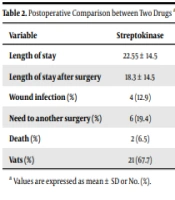
The range of number of days from symptoms manifestations to hospital admission (prehospital days) was not significantly different between medical and surgical groups (P = 0.33), while days of hospital admission were significantly lower in the medical group compared with the surgical group (P = 0.041) (Table 2). Only five patients in medical and seven in surgical group needed ICU admission. Median days of ICU admission was one (range: 1-4) day in medical group and four (range: 3-8) days in surgical group, which was significantly lower in medical group compared with surgical group (P = 0.018) (Mann-Whitney U-test). Duration of intravenous antibiotic therapy was not significantly lower in the medical group compared with the surgical group (P = 0.085). Time to response to treatment (from the day of admission to the clinical improvement) was significantly lower in the medical group compared with the surgical one (P = 0.024).
Table 2.
| Medical Group (n = 35) | Surgical Group (n = 25) | P Value | |
|---|---|---|---|
| Stay days, d | |||
| Pre-hospital | 16.1 ± 10.8 | 12.9 ± 12.8 | 0.33 |
| Hospital | 12.4 ± 5.5 | 20.4 ± 5.2 | 0.041 |
| ICU admission | |||
| Number of patients | 5 (14) | 7 (28) | 0.078 |
| Duration of ICU stay, d | 1 [1 - 4] | 4 [3 - 8] | 0.018 |
| Duration of intravenous antibiotic therapy | 14.15 ± 12.33 | 11.4 ± 9.28 | 0.085 |
| Time to response to treatment, d | 11.5 ± 8.3 | 19.7 ± 6.4 | 0.024 |
a Abbreviation: ICU, intensive care unit.
b Data are presented as mean ± SD, No. (%) or No. [range].
CRP was negative in seven patients, but others had positive CRP. Mean ± SD was 80.2 ± 30.5. Other lab test results are depicted in Table 3 in medical and surgical groups. Exudative pleural fluid based on criteria, mentioned in materials and methods section, was diagnosed in 20 patients of the medical group and 11 of the surgical group. CT scan findings are shown in Table 3. As noted in Table 3,eight patients in medical group with loculated empyema were treated medically, whereas four patients in surgical group with loculated empyema were treated surgically. Although, loculated empyema is usually indicator of primary Video Assisted Thorachoscopy (VAST) or use of fibrinolytic agents; however, medical treatment was performed prior to CT imaging, which was performed later in the course of disease. Finally, out of eight medically-treated patients, four with loculated empyema needed surgical intervention later, but four responded to medical treatment.
| Medical Group (n = 35) | Surgical Group (n = 25) | P Value | |
|---|---|---|---|
| ESR | 85.4 ± 3544 | 72.44 ± 30.2 | 0.082 |
| WBC count | 16391 ± 11081 | 12752 ± 5058 | 0.058 |
| Positive blood culture | 2 (4) | 1 (4) | 0.65 |
| Positive pleural fluid culture | 1 (2) | 1 (4) | 0.92 |
| Exudative pleural effusion | 20 (58) | 11 (44) | 0.073 |
| CT findings | |||
| Pleural thickening | 11 (32) | 9 (36) | 0.22 |
| Loculation | 8 (23) | 4 (16) | 0.069 |
| Consolidation | 5 (14) | 5 (20) | 0.33 |
aAbbreviations: ESR, Erythrocyte sedimentation ratio; WBC, white blood cell.
b Data are presented as mean ± SD, No. (%).
The average time prior to definitive surgery was 17 days (ranging 5-40). The average surgical time was 132 minutes (ranging 70-214) and the average blood loss was 330 mL (ranging 80-800). Unilateral chest tube was inserted in 17 (68%) and bilateral in 8 (32%) of surgically treated and 0% of medically treated group patients. The chest tube was removed after an average of three days (ranging 2-9). The average postoperative stay was nine days (ranging 4-35).
Follow up durations in patients were two years (ranging 1-8) in medical group and two years (ranging 1-6) in surgical group. Interestingly, none of the patients in medical or surgical groups had complications in long-term follow-ups. There was no mortality or recurrence of empyema in both surgical and medical groups.
5. Discussion
Pleural empyema in pediatric patients should be treated early to avoid complications, extensive operations, and long hospital stays. In some patients, early treatment is not possible and in patients with chronic empyema it will develop mainly due to delayed diagnosis or delayed referral. At this stage, the standard treatment are open thoracotomy and decortication.
Patients managed medically and surgically had no significant differences in their comorbidities. Interestingly, only one patient in medical (2%) and one in surgical group (4%) had accompanying immune deficiencies. Many previous reports indicated that empyema was accompanied with severe underlying diseases such as tuberculosis, cerebral palsy and immune deficiencies; besides, they suggested an increase in the incidence of empyema in children with immune deficiencies. However, our study did not show such pattern, indicating that empyema could occur in significant number of pediatric patients without immune deficiencies.
Another important aspect of our study was that results of medically treated patients were same as surgically treated ones. In fact, medical group, with broad antibiotics administration had prognosis without any complications or mortalities, similar to surgically treated patients. This is the important result of our study, showing that if medical treatment initiates early in course of disease, the outcome would be excellent and equal to surgical interventions. Some studies support the use of thoracoscopic surgery as the primary therapeutic modality in children presenting empyema. In the present work, both surgically and medically treated patients had no short or long-term complications; but, duration of hospital stay and ICU admission time were significantly longer in surgically treated patients compared with medically treated ones. Our results showed fewer hospital stay days and similar morbidity and mortality rates in medically treated patients compared with patients treated surgically, similar to other studies (8). However, some authors believed that decortication was a highly effective treatment for chronic parapneumonic empyema, may be performed with low morbidity and mortality, and patients can spent less time in hospital (9). Time to response to treatment (from day of admission to clinical improvement) was significantly lower in medical group compared with surgical one in our study. The reason of these results may be related partially to the less sever disease in medical group than surgical group.
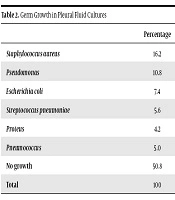
In our study, pleural fluid cultures showed bacterial growth only in less than 4% of patients, which was in contrast with several previous reports, probably because empyema occurs as parapneumonic pleural effusions (PPPEs), which is culture negative in most cases. Besides, chest CT demonstrated thickening of pleural cortex in most cases (about 30%). It was particularly useful for showing the loculations and consolidations, which was not significantly different between medically or surgically treated patients. Besides, other causes of empyema in children such as tuberculosis should be ruled out (10). It might be possible that patients in surgical group could actually have a more severe disease and this could be a selection bias. However, we did not find any change in sex, age, BMI, illness, blood count and differentials (band cells and neutrophils), and culture in our patients. In our study ten of our patients had reactive airway disease and the incidence of depression was found to be 45% (11, 12).
One of the limitations of current study was that the number of cases was relatively small and a larger number could exclude the chance of selection bias. Besides, future studies should focus on more sensitive and specific lab tests to determine the serotypes and bacteria involved in empyema, to initiate more specific antibiotics administrations instead of empirical broad-spectrum antibiotic therapy. Besides, surgical intervention also depends on parents’ acceptance and careful attention should be paid to prevent development and aggravation of anxiety in parents.
In conclusion, empyema in the pediatrics group is a grave disease with high mortality rate and chronic complications. However, if medical treatment gets started early, prognosis would be similar to surgical interventions in long-term. Finally, patients with empyema did not have greater incidence of underlying immune deficiencies.