
1. Background
Ilam Province shares a border with Iraq. The land of Karbala every year hosts a large number of pilgrims; they are infected due to underlying diseases or population density and refer to hospitals in Ilam for infectious and contagious diseases, weakness, and anxiety. Most of the patients are elderly pilgrims (1, 2) physiologically have poor physical strength. Due to physiological changes and immune system problems such as impaired immune system and humeral immunity, the elderly are at greater risk of infectious diseases (3, 4) such as herpes zoster, listeriosis, and urinary tract infection, which leads to a higher mortality rate among the elderly compared to the other age groups. The major reasons affirming that the population density causes infectious and contagious diseases can be categorized as follows:
1.1. Water and Foodborne Diseases
Diarrhea is the most common symptom in such diseases. Acute gastroenteritis is considered as a major cause of morbidity and mortality in pilgrims; therefore, if it is left untreated, it may result in death (5).
1.2. Vector-Borne Diseases (e g, Arthropods and Insects)
Despite many efforts, the infectious diseases transmitted by vectors during travelling are still a major problem. Some examples of these diseases include dengue fever in Haiti, malaria in Somalia and Afghanistan, and coetaneous and visceral leishmaniasis in Iraq. The main to be mentioned include mosquitoes that spread malaria, dengue fever, yellow fever, viral encephalitis, and lymphatic filariasis. Phlebotomies sand flies are vectors of bartonellosis, leishmaniasis, and pappataci fever. Ticks transmit Crimean-Congo hemorrhagic fever (CCHF), encephalitis, relapsing fever, babesiosis, and rickettsials infections. Some insect vectors can transmit parasitic diseases (6).
1.3. Respiratory Tract Infections
Due to psychological conditions of the body, close interactions between a host and a susceptible individual, and loss of personal hygiene, airborne diseases transmitted through airways and respiratory secretions are common in such travels. Among these diseases, upper respiratory tract infections, tuberculosis, Q fever, and meningococcal infections can be pointed out. In such cases, a cluster of person-to-person transmission is caused by aerosols or droplets dispersed from the mouth or nose. Recently, eosinophilic pneumonia is observed in the pilgrims to Iraq, but its causes and mode of transmission are unidentified (7).
1.4. Zoonoses
Zoonoses are infectious diseases transmissible from animals to humans; therefore, this group of diseases can differently cause a reduction in strength in bad weather. For example, following bites by animals, rabies may be transmitted. Moreover, human contact with urine of rodents and inhalation of respirable droplets of rodents’ urine can lead to leptospirosis, Lassa fever, and hantavirus pulmonary syndrome. The consumption of food contaminated with animal feces is associated with hydrated cyst infection (echinococcosis). The consumption of raw and unpasteurized dairy products and also uncooked or half-cooked meat may lead to brucellosis and trichinosis in the pilgrims, respectively. Contact with birth products of infected animals is associated with Q fever and the transmission of brucellosis. Exposure to infected animal products such as skin and wool may cause anthrax infection (8).
1.5. Blood-Borne Diseases
Such diseases may be transmitted through direct contact with blood and other body fluids, and the transmission intermediaries include contaminated needles, blood transfer, and cosmetic procedures such as tattooing etc. Hepatitis B, hepatitis C, HIV, and hemorrhagic viruses such as Ebola and Marburg are examples of pathogens causing blood-borne diseases (9).
1.6. Water-Borne Diseases
After crossing the irrigated areas, bathing, boating, swimming or floating on the water, and the exposure of the gastrointestinal mucus and normal or injured skin to contaminated water, diseases such as leptospirosis and schistosomiasis are caused (10).
1.7. Soil-Borne Diseases
Human exposure to contaminated soil or its ingestion is associated with the infection risk of anthrax, ascariasis, trichuriasis, hookworms, strongyloidiasis, and coetaneous larva migrants (11).
1.8. Physical Injuries and Trauma
Injuries and damages caused by encountering powerful or low-speed weapons, small mortars, mines, and improvised explosive devices (IEDs) can lead to diseases such as tetanus and bacterial infections (12).
2. Objectives
Based on the foregoing, the present study aimed at scrutinizing the contagious diseases and related risk factors among the pilgrims admitted to medical-teaching hospitals on the Day of Arbaeen (the 40th day) in 2017.
3. Methods
3.1. Study Setting and Sample
The current cross sectional study was conducted in Ilam University hospitals in Arbaeen (September 2017). The source information was manipulated by a list of the patients who were referred to the hospitals in Ilam. The sample size and the population under study were determined by census.
3.2. Instrumentation
The required data were collected from the teaching-medical hospitals of Ilam at the time of hospitalization of the patients. Based on the selected sample size, 105 patients were enrolled in the study. After obtaining written permission from the hospital authorities and formal written consent of patients, sampling was started. A checklist consisting of two sections of demographic and infectious diseases information was used for data collection. Pathogens included Staphylococcus aureus, Klebsiella pneumoniae, Haemophilus influenzae, Pseudomonas aeruginosa, Streptococcus pneumoniae, hospital-acquired infections, and multi-pathogens. The information related to the infectious diseases included the time of diagnosis, final diagnosis, type of treatment, hospitalization period, and overall survival rate.
3.3. Ethical Consideration
The protocol of the project was approved by the Ethics Committee of Ilam University of Medical Sciences (code number A-10-2298 and IR. Medilam.REC.1396.62).
3.4. Statistical Analysis
SPSS version 19 was used for data analysis. The results were reported using descriptive statistics (i.e., frequency, mean, and standard deviation) and inferential statistics (chi-squared test, t-test, and one-way ANOVA). P values less than 0.05 were considered statistically significant. Declaration of Helsinki was observed in all procedures and patients did not pay a charge for their items. The ethical considerations of the research were as follows: the participants were informed that the data of the study were confidential and anonymous and would be used for scientific purposes only. Moreover, the participation of patients in the study was voluntary and, finally, at any stage the participants in the study could avoid completing and delivering the questionnaire without providing any reasons.
Admission in hospital two weeks before or after Arbaeen, and presenting signs and symptoms of infectious diseases were the inclusion criteria. People with non-infectious diseases such as diabetes, hypertension, and trauma were excluded from the study.
4. Results
A total of 105 pilgrims were admitted to teaching hospitals in Ilam on the day of Arbaeen in 2017. However, 63 patients (60%) were male and 42 (40%) female. And the largest age groups with infectious diseases were above 60 and under 20 years, which included 28 patients (26.7%). Other demographic data are presented in Table 1. Descriptive statistics of laboratory values including mean, standard deviation, and maximum and minimum values are provided in Table 2.
Table 1.
Demographic Information of the Pilgrims with Infectious Diseases Hospitalized in the Teaching Hospitals of Ilama
| Demographic Information | Results |
|---|---|
| Gender | |
| Male | 63 (60) |
| Female | 42 (40) |
| Age, y | |
| < 20 | 28 (26.7) |
| 20 - 30 | 14 (13.3) |
| 31 - 40 | 21 (20) |
| 41 - 60 | 14 (13.3) |
| > 60 | 28 (26.7) |
| Ward/department | |
| Internal medicine male/female male/female | 42 (40) |
| Surgical male/female | 21 (20) |
| ICU | 35 (33.3) |
| Pediatrics | 7 (6.7) |
| Education | |
| Less than high school diploma | 63 (60) |
| High school diploma | 32 (30.5) |
| Associate degree | 10 (9.5) |
| Bachelor’s degree or higher | 0 (0) |
aValues are expressed as No. (%).
Table 2.
Descriptive Statistics of Laboratory Values
| Laboratory Value | Mean ± SD | Max | Min |
|---|---|---|---|
| ESR | 54.66 ± 1.8 | 86 | 15 |
| CRP | 2.6 ± 0.63 | 4 | 2 |
| WBC, per µL blood | 14700 ± 1650 | 22000 | 2600 |
| Urea, mg/dL | 69.6 ± 1.25 | 220 | 26 |
| Cr, mg/dL | 1.54 ± 1.25 | 54 | 0.8 |
| FBS, mg/dL | 102 ± 2.75 | 176 | 58 |
| PLT, per µL blood | 17300 ± 9210 | 32000 | 13400 |
Figure 1 shows the frequency of infectious agents; the most frequent multi-pathogen affected 50% of studied patients. And the frequencies of other factors are also shown in this figure. The results of statistical correlations between demographic variables and laboratory values had a significance level of less than 0.05 (P < 0.05). The results indicated statistically significant associations between the WBC count and urea and creatinine serum levels (Cr), and the patients’ gender and age (P < 0.05); thus, with increasing the age of subjects, the values of urea and Cr increased. Therefore, the higher the age was, the greater the values were. But WBC counts in the age group of above 20 years also increased; hence, there was a direct relationship between the increase of age and WBC counts.
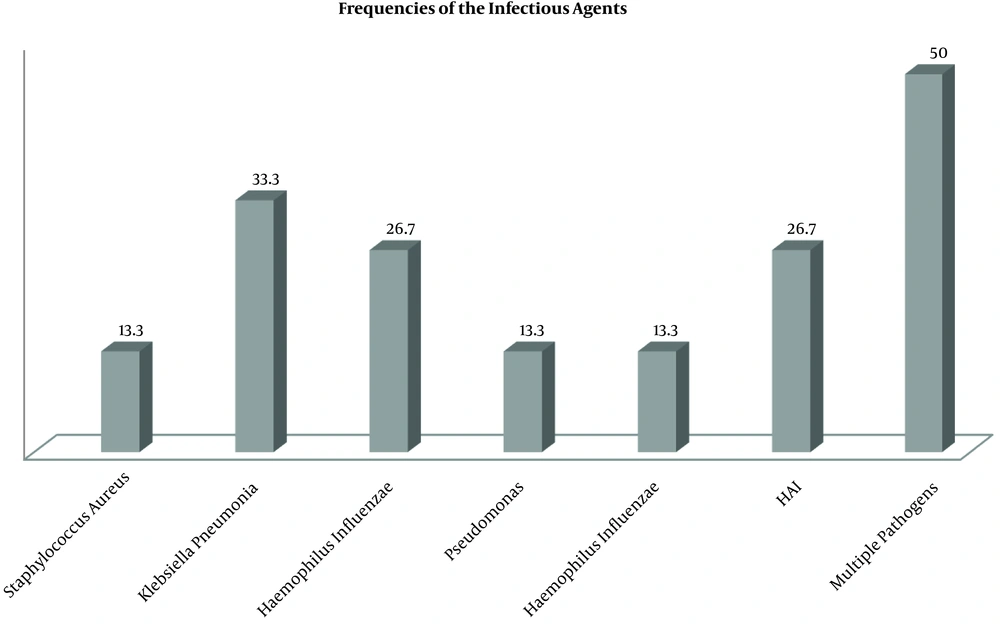
Figure 1.
Depicts the frequency of the infectious agents with the maximum frequency of 50%
Table 3 demonstrates the overall survival rates of the patients based on their diseases; the highest mortalities were due to acute gastroenteritis with severe dehydration (30% of the total died and 70% were treated) and the least common disease was common colds that had no fatalities and were treated.
Table 3.
Frequency of Mortality by Type of Disease Among Pilgrimsa
| Disease | Number | Mortality |
|---|---|---|
| Pneumonia | 30 | 3 (10) |
| Gastroenteritis | 12 | 2 (16.7) |
| SARS | 40 | 2 (5) |
| Influenza | 20 | 1 (5) |
| A cold | 3 | 0 (0) |
aValues are expressed as No. (%).
5. Discussion
The current study aimed at identifying the relevant factors and the most common types of contagious diseases in pilgrims, providing recommendations to correct the weaknesses, promote the health status, and prevent infections in the pilgrims. The study results indicated that infectious diseases were more common in the age groups of less than 20 and older than 60 years; hence, the finding correlated to the results of some other studies (7-9). According to the previous studies, these two groups, namely children and the elderly, are among at-risk groups and are prone to infectious diseases; thus, in conditions where the population density is high, they will be easily infected with pathogens and can easily transmit their diseases.
The study results indicated that infections were more prevalent among males than females. Although the immune system of males is stronger than that of females, males are more susceptible to infectious diseases than females since males observe their personal hygiene and health less than females and consume more fast foods (10, 11). Moreover, males take more journeys than females; therefore, it is perhaps is one of the reasons why infectious diseases are more common among males than females (1-3).
Most patients with infectious diseases belonged to the group with less than high school diploma education. And since most of them were aged individuals who did not observe health and personal care tips on journeys, they were easily infected (1, 3, 11). Therefore, it seems that education is associated with the occurrence of such diseases; the higher educational level the individuals had, the fewer infectious diseases they got. However, further research in this regard is needed.
The current study results showed that the laboratory values such as ESR, WBC, CRP, and PLT values of the hospitalized patients were too high; therefore, they had infectious diseases. Individuals with any underlying diseases such as diabetes or hypertension are more prone to infectious diseases especially while traveling (6-9). If they do not appropriately take care of themselves, they experience damages and infection transmission; consequently, they can also infect a large number of healthy people with different infectious diseases.
According to the results of the current study, the most common infectious agent causing such diseases in the pilgrims was the multi-pathogen factor with a frequency of 50% and other pathogens included Klebsiella pneumonia, hospital-acquired infections, Staphylococcus aureus, Pseudomonas spp., and Haemophilus influenza; the results were consistent with those of some similar investigations (13-15). It seems that the pathogens causing infectious diseases are common while traveling due to failure to comply with hygiene and health and safety requirements as well as consuming unhealthy food and water shortages.
The current study results designated that there were statistically significant associations between the levels of WBC, urea, and Cr and the patients’ gender and age (P < 0.05); the urea and Cr values increased with an increase in the age of the subjects; therefore, the more the age of the participants, the higher urea and Cr values. However, the WBC value increased in the age group of above 20 years; so there was also a direct relationship between the increase of age and WBC. There was no research in this regard; so it seems that more research is required to prove the current study finding.
The obtained results revealed that acute gastroenteritis with severe dehydration caused the highest mortality in patients and common colds caused the least. The other infectious diseases were pneumonia, SARS, and influenza; hence, the results of the current study also corresponded with those of some other studies (16-18). Highly contagious and lethal disease was the acute gastroenteritis with severe dehydration. If an individual is infected with a pathogen, it can easily be transmitted and cause the mortality of a large number of people. If it is properly observed and diagnosed, it can be prevented and treated easily.
5.1. Conclusions
Children and the elderly are at risk for infectious diseases. Observing health tips such as using healthy water and healthy food can help prevent infectious diseases. In addition, teaching hygiene tips in class and pamphlets can be helpful.
Since the current study investigated only infectious diseases and only the subjects referred to the healthcare centers, it is noteworthy that perhaps a number of other pilgrims were also infected, but did not refer to the centers and were not included in the current study. The number of people with infectious diseases was maybe much higher than released reports, but some of the patients did not undergo specialized tests and, the performed procedures were not clear. Thus, such information was not included in the study. And finally, the current study could not find out the overall survival rate of the patients after the pilgrimage due to failure to deal with and find all the patients.
Given that most pilgrims mostly come to make their journey for the pilgrimage from other different cities, they do not observe hygiene standards and do not consume healthy food and safe drinking water; these factors pave the way for the pilgrims to be infected with different infectious diseases. Due to the lack of familiarity with the diseases, before travelling, initial training classes should be held for training pilgrims on various infectious diseases, their symptoms, transmission routes, and prevention. Moreover, the regular distribution of healthy food and potable water can seriously reduce the spread of infectious diseases.
5.2. The Application of Research Findings into Clinical Practice
If people exposed to infectious diseases are identified, treatment can be started to save a lot of time and money; furthermore, the overall survival rate of the infected patients can be also increased; therefore, it is an important step in reducing the morbidity and mortality rates of patients with infectious diseases.