


1. Background
Group B Streptococcus (GBS), originally a livestock pathogen, was linked to human infections in 1938 and became a major cause of infant illness in the United States after the 1970s (1). Though part of the normal flora, it can cause serious infections in newborns and vulnerable individuals, including neonatal meningitis, and is one of the most common causes of meningitis in neonates; however, it can rarely cause meningitis in adults (2). This bacterium uses various factors, including polysaccharide capsules and surface proteins, to attach to host cells, invade tissues, and avoid the immune system (3). The capsular polysaccharide (CPS) is a major factor in its virulence and determines its serotype — ten of which have been identified. Infection involves several complex steps, often driven by these surface proteins, that lead to tissue damage (4).
Key surface proteins involved in GBS attachment and invasion include C5a peptidase, fibronectin-binding proteins (fbsA and fbsB), laminin-binding protein (lmb), and hypervirulent adhesin (hvgA). C5a peptidase, encoded by the scpB gene, inactivates the human C5a protein, which impairs neutrophil recruitment and dampens the host's inflammatory response (1). The GBS binds to human fibrinogen to aid in colonization and invasion. Fibronectin-binding proteins fbsA and fbsB play key roles — fbsA promotes adhesion to epithelial and endothelial cells, while fbsB facilitates bacterial invasion. The GBS also binds to laminin, a major basement membrane protein, through the lmb lipoprotein, which is commonly expressed and helps the bacteria colonize and invade damaged tissue (5).
The GBS expresses the lipoprotein lmb, which binds laminin, a major glycoprotein component of the basement membrane. This interaction facilitates bacterial colonization and invasion, particularly in damaged host tissues. The lmb gene is conserved across most clinical GBS isolates, underscoring its importance in pathogenesis (6). Another surface protein, hvgA, promotes intestinal colonization in infants and enables the bacteria to cross intestinal and blood-brain barriers, potentially leading to meningitis (7). Since 1990, the incidence of GBS diseases has decreased significantly due to the use of antibiotics during pregnancy (8). The GBS is sensitive to beta-lactams, but in recent years, strains resistant to erythromycin, tetracycline, and clindamycin have increased in several countries (9)
2. Objectives
This study aims to identify virulence factors (adhesion-aggressiveness) and antibiotic resistance genes in pregnant women's urine and vaginal samples and investigate the relationship between different genes found in GBS isolates.
3. Methods
3.1. Samples
Ninety archived GBS isolates (57 vaginal swabs and 33 midstream urine samples), previously serotyped using multiplex PCR, were stored at -70°C and used in this study. All 90 available archived GBS isolates collected during the study period were included, ensuring an adequate sample size for descriptive analysis. The recommendation to screen all pregnant women for GBS colonization between 35 and 37 weeks of gestation was first released in 1996 by the American College of Obstetricians and Gynecologists (ACOG), and was quickly followed by the Centers for Disease Control and Prevention (CDC) and the American Academy of Pediatrics (AAP). All isolates were handled under standardized conditions, and laboratory assessments were performed blinded to patient information to minimize potential sources of bias.
3.2. Group B Streptococcus Isolates Confirmation
The GBS isolates were recultured on blood agar (Liofilchem, Italy) and incubated at 37°C for 24 hours. Colonies showing β-hemolysis, gram-positive cocci, and a negative catalase test were identified as GBS. Final confirmation of Streptococcus agalactiae was done using the CAMP test and hippurate hydrolysis (10).
3.3. Antimicrobial Susceptibility Testing
Antimicrobial susceptibility testing was performed on 90 GBS isolates using the Kirby-Bauer disc diffusion method on Mueller-Hinton agar with 5% sheep blood. The antibiotics tested included clindamycin (2 μg), penicillin (10 μg), levofloxacin (5 μg), erythromycin (15 μg), and tetracycline (30 μg) (MAST, England), with results interpreted according to CLSI 2022 guidelines (11). Bacterial suspensions were prepared by adjusting pure GBS colonies in saline to match a 0.5 McFarland standard. The medium was inoculated with a sterile swab in three directions, antibiotic discs were placed, and plates were incubated at 37°C for 24 hours. Streptococcus pneumoniae ATCC 49619 was used as a control strain.
3.4. Double Disc Diffusion
The detection of inducible clindamycin resistance was done using the D test method. Briefly, erythromycin (15 μg) and clindamycin (2 μg) were placed 12 mm apart edge to edge (12).
3.5. DNA Extraction and Molecular Detection of Group B Streptococcus and Serotyping
Genomic DNA was extracted using a streamlined boiling-lysis method (thermal lysis), wherein bacterial cells were lysed by heating at ~100°C for 10 minutes (13). Molecular identification targeted the 952-bp dltS gene using specific primers (14). For each sample, a PCR reaction mixture of 20 μL was prepared, consisting of 4.5 μL sterile distilled water, 10 μL 2X PCR master mix (Amplicon, Denmark), 2.5 μL primers (with a final concentration of 10 pmol), and 3 μL template DNA. Amplification was processed as follows: First denaturation at 94°C for 300 seconds, followed by 35 denaturation cycles at 94°C for 60 seconds, annealing of cycles at 55°C for 60 seconds, and an extension cycle at 72°C for 60 seconds. The final extension cycles were done at 72°C for 300 seconds. Then, the amplicons were visualized using 1% agarose gel and a Gel Documentation System (Life Technologies, USA). Serotyping of the initial 80 isolates had been previously performed, while the 10 replacement isolates were serotyped in this study using multiplex PCR as described by Poyart et al. (15).
3.6. Detection of Resistance and Virulence Genes
Amplification of all virulence factor genes, including scpB, lmb, fbsA, fbsB, and hvgA, was done by the PCR method, and molecular investigation of antibiotic resistance genes (ermB, tetL, tetK, tetO, linB, ermA, tetM, and int-Tn) was done by PCR and multiplex PCR methods. The primers used for detecting resistance and virulence genes are listed in Table 1. For each DNA isolate, a 20 μL reaction mixture was prepared, containing 5 μL of nuclease-free water, 10 μL of 2X PCR master mix (Amplicon, Denmark), 2 μL of the primer (with a final concentration of 10 pmol), and 3 μL of DNA template.
The PCR program was performed with an initial denaturation at 94°C for 300 seconds, followed by 35 denaturation cycles at 94°C for 60 seconds, annealing of cycles at 58°C for 30 seconds for lmb, fbsA, fbsB, hvgA, tetL, tetK, linB, and tetO genes, and 60°C for 30 seconds for the scpB gene, and 53°C for 30 seconds for the ermB gene, with an elongation cycle at 72°C for 60 seconds. The final elongation cycle was done at 72°C for 300 seconds. The amplicons were then visualized using 2% agarose gel and a Gel Documentation System (Life Technologies, USA). Additionally, multiplex PCR was used to detect ermA, tetM, and int-Tn genes as previously described by Poyart et al. (16).
Table 1.Sequences of Primers and Amplicon Size of PCR Products Expected for Each Streptococcus agalactiae Antibiotic Resistance and Virulence Gene
| Primers | Forward 5ʹ-3ʹ | Reverse 5ʹ-3ʹ | Amplicon (bp) |
|---|---|---|---|
| int-Tn (16) | GATGGTATTGATGTTGTAGG | GGTCTATATTGACAAGACG | 528 |
| ermA(17) | TCAGGAAAAGGACATTTTACC | ATACTTTTTGTAGTCCTTCTT | 423 |
| ermB (17) | GGTAAAGGGCATTTAACGAC | CGATATTCTCGATTGACCCA | 454 |
| tetM (17) | GTGGAGTACTACATTTACGAG | GAAGCGGATCACTATCTGAG | 359 |
| tetL(18) | TGAACGTCTCATTACCTG | ACGAAAGCCCACCTAAAA | 993 |
| tetO (18) | AACTTAGGCATTCTGGCTCAC | TCCCACTGTTCCATATCGTCA | 538 |
| tetK (18) | TCCTGGAACCATGAGTGT | AGATAATCCGCCCATAAC | 552 |
| linB (18) | CCTACCTATTGTTTGTGGAA | ATAACGTTACTCTCCTATTC | 944 |
| lmb (19) | GACGCAACACACGGCAT | TGATAGAGCACTTCCAAATTTG | 300 |
| hvgA (20) | ATACAAATTCTGCTGACTACCG | TTAAATCCTTCCTGACCATTCC | 210 |
| fbsA (19) | TGTAGCTAATGGACCGATGTT | TTTTCATTGCGTCTCAAACC | 156 |
| fbsB (19) | ACAACTGCGGAAATGACCTC | ACGAGCGACGTTGAATTCTT | 186 |
| scpB (21) | ACAACGGAAGGCGCTACTGTTC | ACCTGGTGTTTGACCTGAACTA | 250 |
Abbreviation: Lmb, laminin-binding protein.
For internal positive control, seven samples containing lmb, fbsA, fbsB, scpB, tetK, tetO, and linB genes were sequenced, and the results were analyzed. As for tetM, ermB, ermA, and int-Tn genes, previously sequenced isolates were used as positive control samples.
3.7. Statistical Analysis
The chi-square test was conducted using SPSS version 16 software for evaluation.
4. Results
4.1. Participant Characteristics
In this study, out of 90 GBS isolates, eighty isolates presented as GBS strains according to phenotyping tests. Among the 90 collected samples, 80 (88.9%) were identified as S. agalactiae by phenotypic methods. All were confirmed by PCR targeting the dltS gene, showing 100% concordance between culture and molecular identification. Ten GBS isolates collected from the same pregnant women were replaced due to contamination. The predominant serotype was serotype III (54.4%), followed by serotype II, Ia, Ib, and V, at 25.6%, 14.4%, 3.3%, and 2.2%, respectively. This study did not observe serotypes IV, VI, VII, or VIII.
4.2. Antibiotic Susceptibility
Table 2 shows that 100% of vaginal and urine isolates were sensitive to penicillin and levofloxacin, while over 90% of both vaginal and urine isolates were resistant to tetracycline. No significant difference was observed between the antibiotic resistance of vaginal and urinary isolates.
| Antibiotic | Resistant | Intermediate | Susceptible |
|---|---|---|---|
| Penicillin | 0/0 | 0/0 | 57 (100)/33 (100) |
| Levofloxacin | 0/0 | 0/0 | 57 (100)/33 (100) |
| Tetracycline | 54 (94.18)/30 (90.9) | 1 (1.17)/1 (3) | 2 (3.15)/2 (6.1) |
| Clindamycin | 7 (12.3)/5 (15.1) | 2 (3.5)/1 (3) | 48 (84.2)/27 (81.9) |
| Erythromycin | 7 (12.3)/4 (12.1) | 12 (21)/6 (18.2) | 38 (66.7)/23 (69.7) |
a Values are expressed as No. (%) vagina/urine.
b P > 0.05.
4.3. Virulence Genes
In the 90 strains studied, the frequencies of scpB, lmb, fbsA, and fbsB genes in vaginal samples were 97.8%, 93.3%, 96.7%, and 83.3%, respectively, and in urine samples, 100% of the samples had these four genes. However, the hvgA gene was not found in any of the vaginal and urine isolates. The frequency of the fbsB gene in vaginal samples is less compared to other genes (Table 3 , Figure 1).
Table 3.Frequency of Virulence and Antibiotic Resistance Genes in Vaginal and Urine Samples (N = 90) a
| Gene | Gene Type | Total (N = 90) | Vaginal (N = 57) | Urine (N = 33) |
|---|---|---|---|---|
| scpB | Virulence | 88 (97.8) | 55 (96.5) | 33 (100) |
| lmb | Virulence | 84 (93.3) | 51 (89.5) | 33 (100) |
| fbsA | Virulence | 87 (96.7) | 54 (94.7) | 33 (100) |
| fbsB | Virulence | 75 (83.3) | 42 (73.7) | 33 (100) |
| hvgA | Virulence | 0 (0) | 0 (0) | 0 (0) |
| ermA | Antibiotic resistance | 38 (42.2) | 23 (40.4) | 15 (45.5) |
| ermB | Antibiotic resistance | 11 (12.2) | 7 (12.3) | 4 (12.1) |
| tetM | Antibiotic resistance | 79 (87.8) | 50 (87.7) | 29 (87.9) |
| tetO | Antibiotic resistance | 7 (7.8) | 4 (7.0) | 3 (9.1) |
| tetK | Antibiotic resistance | 1 (1.1) | 0 (0) | 1 (3.0) |
| tetL | Antibiotic resistance | 0 (0) | 0 (0) | 0 (0) |
| linB | Antibiotic resistance | 1 (1.1) | 1 (1.8) | 0 (0) |
| int-Tn | Antibiotic resistance | 65 (72.2) | 42 (73.7) | 23 (69.7) |
Abbreviation: Lmb, laminin-binding protein.
a Values are expressed as No. (%).
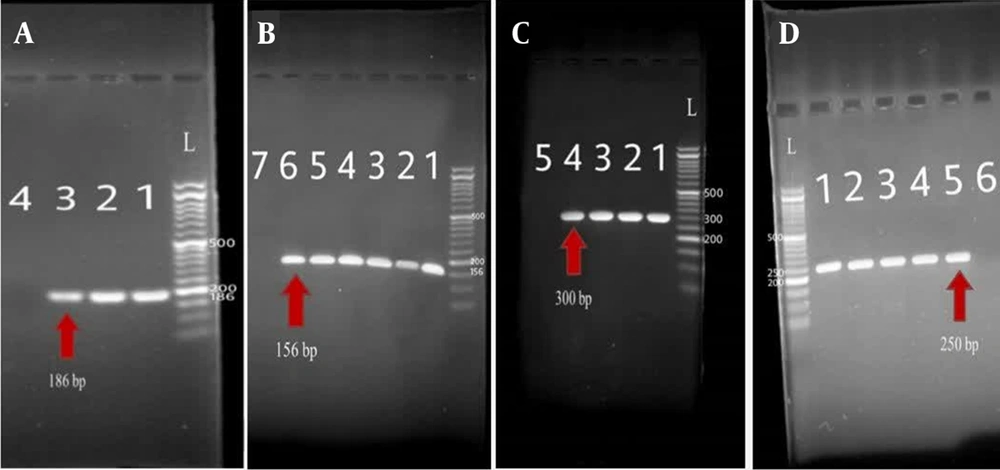
Figure 1.
PCR amplification of virulence genes in group B Streptococcus (GBS) isolates: A, fbsB; B, fbsA; C, laminin-binding protein (lmb); and D, scpB. Specific bands indicate gene presence.
4.4. Antibiotic Resistance Genes
The highest frequency in antibiotic resistance genes is related to the tetM gene (87%), and the frequency of other resistance genes, in order from high to low, is related to int-Tn (72.2%), ermA (42.2%), ermB (12.2%), tetO (7.8%), tetK and linB (1.1%), and tetL (0%). As Table 3 shows, the abundance of these genes in vaginal and urine samples was almost equally distributed (Figure 2).
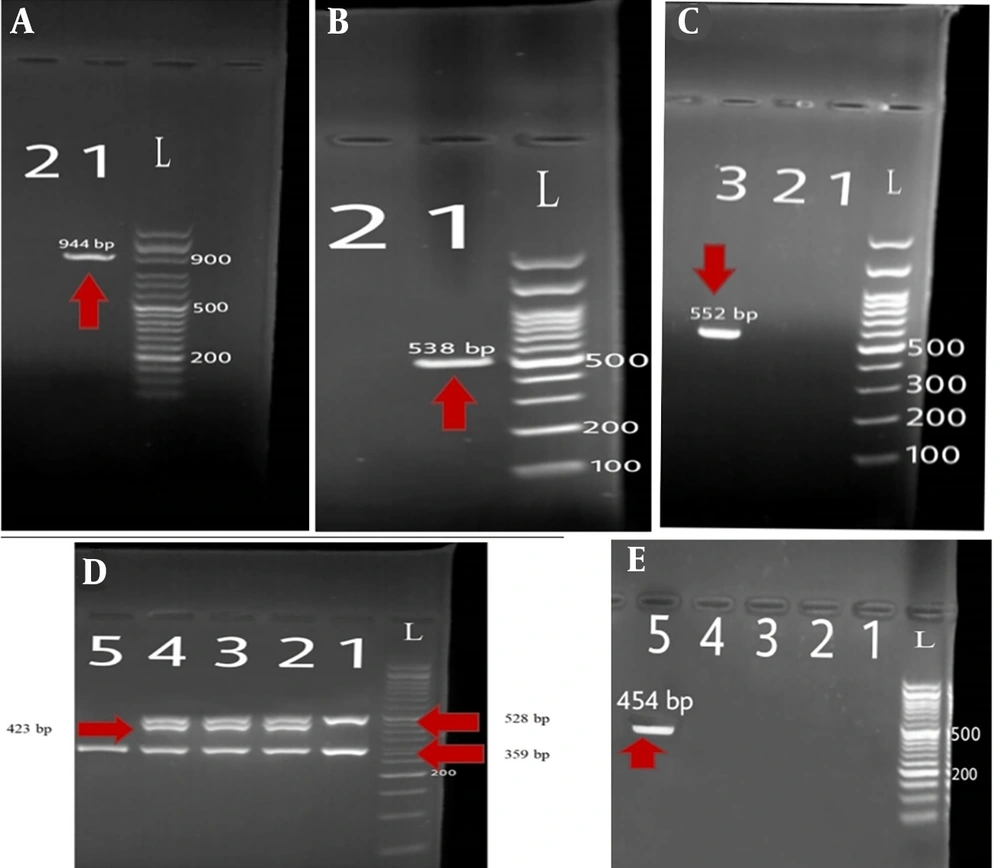
Figure 2.
PCR amplification results of antibiotic resistance genes in vaginal and urine isolates: A, linB; B, tetO; C, tetK; D, multiplex PCR showing ermA, tetM; and E, int-TnermB.
4.5. Association of Virulence and Resistance Genes with Capsular Serotypes
As Table 4 shows, no significant difference was observed in the presence of virulence genes in different serotypes (P > 0.05). Also, capsular serotype III was associated with the most resistant S. agalactiae isolates with tetM, int-Tn, and ermA genes.
Table 4.Frequency of Virulence Genes and Antibiotic Resistance According to Capsular Serotypes a
| Gene | Serotype (N) | Total | ||||
|---|---|---|---|---|---|---|
| Ia (13) | Ib (3) | II (23) | III (49) | V (2) | ||
| Virulence genes | ||||||
| scpB | 12 (92.3) | 3 (100) | 23 (100) | 48 (98) | 2 (100) | 88 |
| lmb | 12 (92.3) | 3 (100) | 19 (82.6) | 48 (98) | 2 (100) | 84 |
| fbsA | 13 (100) | 3 (100) | 21 (91.3) | 48 (98) | 2 (100) | 87 |
| fbsB | 11 (84.6) | 3 (100) | 15 (65.2) | 44 (89.8) | 2 (100) | 75 |
| hvgA | 0 (0) | 0 (0) | 0 (0) | 0 (0) | 0 (0) | 0 (0) |
| Antibiotic resistance genes | ||||||
| ermA | 26 (46) | 1 (33.3) | 2 (8.7) | 28 (57.1) | 1 (50) | 38 |
| ermB | 3 (23.1) | 2 (66.7) | 3 (13) | 2 (4.1) | 1 (50) | 11 |
| tetM | 11 (84.6) | 2 (66.7) | 3 (13) | 2 (4.1) | 1 (50) | 79 |
| tetO | 1 (7.7) | 2 (66.7) | 2 (8.7) | 2 (4.1) | 0 (0) | 7 |
| tetK | 0 (0) | 1 (33.3) | 0 (0) | 0 (0) | 0 (0) | 1 |
| tetL | 0 (0) | 0 (0) | 0 (0) | 0 (0) | 0 (0) | 0 (0) |
| linB | 0 (0) | 0 (0) | 1 (4.3) | 0 (0) | 0 (0) | 1 |
| int-Tn | 10 (76.9) | 2 (66.7) | 12 (52.2) | 40 (81.6) | 1 (50) | 65 |
Abbreviation: lmb, laminin-binding protein.
a Values are expressed as No. (%).
5. Discussion
In this study on 90 GBS isolates from vaginal (57) and urine (33) samples of pregnant women in Yazd hospitals, resistance was lowest to penicillin (0%) and levofloxacin (0%), followed by erythromycin (12.2%), clindamycin (13.7%), and highest to tetracycline (92.85%). The frequency of five virulence genes — scpB, lmb, fbsA, fbsB, and hvgA — and eight resistance genes — ermA, ermB, tetL, tetK, tetM, tetO, linB, and int-Tn — was assessed. Vaginal isolates had scpB (97.8%), fbsA (96.7%), lmb (93.3%), and fbsB (83.3%), while all urine isolates carried these four genes; hvgA was absent in all.
Hannoun et al. (22) reported lmb (96.1%) and scpB (94.7%) in 76 isolates from pregnant women in Lebanon, aligning with our findings. Udo et al. (23) found scpB and lmb in 88.3%, and fbsA and fbsB in 49.5%. All urine isolates had lmb, scpB, fbsA, and fbsB; vaginal isolates had lower frequencies. Rosenau et al. (24) studied 111 isolates from vaginal and cerebrospinal samples, finding fbsA in 81.1%; 49.5% had both fbsA and fbsB, while 31.6% had only fbsA. They concluded fbsB is not expressed without fbsA, consistent with our data. The absence of hvgA in our isolates and its presence in infant GBS isolates, Li et al. (25) suggests it's infant-specific. In vaginal isolates, fbsB was less frequent and, due to its aggressive role, may be more common in neonatal isolates. Overall, scpB, lmb, and fbsA were dominant virulence genes in vaginal and urine samples.
Regarding resistance genes, tetM had the highest frequency (87%), followed by int-Tn (72.2%), ermA (42.2%), ermB (12.2%), tetO (7.8%), tetK and linB (1.1%), and tetL (0%), with similar distribution in both sample types. Boswihi et al. (26) reported tetracycline resistance in 89.5% of 128 samples, with tetM (94.5%), tetO (3.9%), tetL (2%), and tetK (1%), consistent with our findings. TetM’s ~88% prevalence in our isolates likely explains the high tetracycline resistance. Modzana et al. (9) found 97.7% tetracycline resistance with tetM (97.6%) and tetO (2.4%), consistent with our results. We found linB in one vaginal isolate; Modzana et al. (9) reported none. Clindamycin resistance (13.7%) correlates with erm gene presence; low linB frequency aligns with this. Poyart et al. (16) found int-Tn commonly co-occurred with tetM in erythromycin-resistant isolates; similarly, we found int-Tn (72.2%) and tetM (87.7%) frequently co-present. Li et al. (25) reported in neonatal isolates: TetO (75%), tetM (46%), linB (6.24%), ermB (7.85%), differing from our results due to sample type. Resistance patterns in neonatal and maternal isolates differ.
Most isolates had ≥ 3 virulence genes; virulence and resistance gene profiles were similar across vaginal and urine samples. hvgA was absent in all, suggesting infant-specificity. fbsB was less frequent in vaginal samples and may be more common in neonatal isolates due to its virulence. Penicillin and ampicillin remain first-line GBS treatments, but for allergic patients, alternatives require antibiogram guidance. High erythromycin and tetracycline resistance warrants antibiograms for all GBS isolates. Given similar gene profiles in urine and vaginal samples, urine may be suitable for screening, and antibiograms are essential for effective therapy.
5.1. Conclusions
Serotyping of S. agalactiae is an important epidemiological marker, as certain serotypes such as III and V are commonly associated with higher virulence and antibiotic resistance. In Iran, studies have shown that serotypes III, V, and Ia are the most prevalent among pregnant women, which is consistent with global patterns. These serotypes are particularly relevant for neonatal infections and should be considered in prevention strategies.




