
1. Background
Extended-spectrum beta-lactamases (ESBLs) are enzymes that confer resistance to penicillins, third-generation cephalosporins, and monobactams, thereby limiting treatment options for infections caused by ESBL-producing Escherichia coli (ESBLEC) and Klebsiella pneumoniae (ESBLKP) to last-resort antibiotics such as carbapenems (1). Globally, since the early 2000s, blaCTX-M has emerged as the most prevalent ESBL gene family (2). Within this family, blaCTX-M-15, a member of the blaCTX-M-1 group, has become dominant worldwide (2). blaCTX-M-15 was first detected in 1999 in India and then rapidly achieved pandemic spread across both community and healthcare settings internationally (3). This global expansion established blaCTX-M-15 as the predominant blaCTX-M variant in many regions, including Malaysia, where it was first detected locally in 2006 by Sekawi et al. (4). Subsequently, blaCTX-M-15 was identified in 76.9% of blaCTX-M-positive ESBLEC isolated from a southern Malaysian tertiary hospital in 2010 (5). Meanwhile, the prevalence of blaCTX-M-15 in ESBLKP was 91.3% at the University Malaya Medical Centre in the central region from 2010 to 2012 and 40.7% in a tertiary hospital in southern Malaysia in 2014 (6, 7).
A previous study conducted in 2016 at Hospital Canselor Tuanku Muhriz (HCTM) reported a high prevalence of blaCTX-M-1 genes among ESBL-producing strains (8). A similar trend was observed in other Malaysian clinical settings, where blaCTX-M-1 was detected in a substantial proportion of ESBL-producing strains, ranging from 37% in ESBLEC to 80% in ESBLKP (9). Given the global dissemination of blaCTX-M-15, the apparent local persistence of the blaCTX-M-1 group may be driven largely by this highly successful subvariant, although this has not been routinely examined in previous studies. Therefore, this study evaluated the prevalence of blaCTX-M-15 among ESBLEC and ESBLKP strains from HCTM across two sampling periods to assess its temporal persistence within a single tertiary care center.
2. Objectives
This study aimed to determine the prevalence of blaCTX-M-15 in ESBLEC and ESBLKP strains collected during two sampling periods at HCTM.
3. Methods
3.1. Strain Collection
This study was conducted at HCTM during two sampling periods: June 2022 to January 2023 and December 2023 to March 2024. Strains purified from all specimen types, including those from infection, colonization, and infection-control screening, and identified as ESBLEC and ESBLKP by the Department of Diagnostic Laboratory Services (JPMD), HCTM, were included in the study. For patients from whom multiple strains were isolated, only the first strain was included. Strains were stored at -20°C as 20% glycerol stocks until further use for genotyping.
3.2. Antibiotic Susceptibility Testing
Antibiotic susceptibility testing (AST) was performed by JPMD, HCTM, using the VITEK 2 system (bioMérieux, France), and results were interpreted according to the Clinical and Laboratory Standards Institute (32nd edition). The antibiotics tested were ampicillin (AMP), cefuroxime (CFU), cefotaxime (CTX), ceftazidime (CAZ), cefepime (FEP), amoxicillin-clavulanate (AMC), piperacillin-tazobactam (TZP), ciprofloxacin (CIP), imipenem (IMP), meropenem (MEM), and ertapenem (ETP). AST results were obtained from the WHONET system (https://whonet.org/) and analyzed to construct AST profiles for all tested strains. No additional phenotypic confirmatory ESBL testing was performed by JPMD because routine quality checks (QC) for ESBLEC were performed weekly using the VITEK 2 system.
3.3. DNA Extraction, ESBL Genotyping, and blaCTX-M-15 Genotyping
DNA was extracted from ESBLEC and ESBLKP strains using the boiling method (10). ESBL genotyping (blaTEM, blaCTX-M-1, blaCTX-M-9, blaSHV, and blaOXA-1) was performed as described by Ogutu et al. (11). DNA extracted for ESBL genotyping was also used for blaCTX-M-15 genotyping, as described by Muzaheed et al. (12). The control strain used for blaTEM, blaCTX-M-9, blaSHV, and blaOXA-1 genotyping was 2022-ESBLEC-HCTM-28, whereas the control strain for blaCTX-M-1 was 2022-ESBLEC-HCTM-8; all genes were confirmed by Sanger sequencing (unpublished data). A clinical strain of K. pneumoniae (2025-ESBLKP-HCTM-19) was used as the control for blaCTX-M-15 genotyping.
3.4. Statistical Analysis
Data analysis was performed using the Statistical Package for Social Sciences (SPSS) version 22 (IBM Corp., Armonk, NY, USA). Categorical variables were summarized as frequencies. The chi-square test or Fisher exact test, as appropriate, was used to compare AST profiles between ESBLEC and ESBLKP strains across the sampling periods and to compare the prevalence of ESBL genes and blaCTX-M-15. A P value of < 0.05 was considered statistically significant.
4. Results
4.1. ESBLEC and ESBLKP Strain Collection
A total of 54 ESBLEC and 56 ESBLKP strains were collected from JPMD, HCTM, between June 2022 and January 2023 (HCTM 2022 - 2023). Subsequently, 47 ESBLEC and 31 ESBLKP strains were obtained between December 2023 and March 2024 (HCTM 2023 - 2024). Among the HCTM 2022 - 2023 isolates, both ESBLEC and ESBLKP were predominantly recovered from blood (42.6% and 51.7%, respectively) and urine (40.7% and 19.7%, respectively). A similar distribution pattern was observed for the HCTM 2023 - 2024 isolates; both ESBLEC and ESBLKP were most frequently obtained from blood (46.8% and 45.2%, respectively) and urine (29.8% and 32.3%, respectively).
4.2. ESBLEC and ESBLKP Antibiotic Susceptibility Profiles
All ESBLEC strains from both sampling periods exhibited resistance to AMP and at least one third-generation cephalosporin (Figure 1A). In contrast, although ESBLKP strains from HCTM 2022 - 2023 showed resistance to AMP and at least one third-generation cephalosporin, strains from HCTM 2023 - 2024 exhibited resistance to AMP and fourth-generation cephalosporins (Figure 1B). The proportion of ESBLEC strains resistant to CAZ and FEP decreased (Figure 1C) (P = 0.02), whereas resistance to AMC and TZP increased, although these differences were not statistically significant. For ESBLKP, the difference in AMC resistance between the two sampling periods (Figure 1D) was negligible (P = 0.053) but may warrant further monitoring. Notably, a carbapenem-resistant ESBLEC strain was detected in HCTM 2023 - 2024. For ESBLKP, resistance to most antibiotics remained largely stable, with slight decreases observed for AMC, TZP, and CIP and an upward trend in resistance to carbapenems (IMP, MEM, and ETP). However, this increase should be interpreted with caution because not all HCTM 2022 - 2023 strains were tested against carbapenems (IMP and MEM: 3 strains not tested; ETP: 1 strain not tested), which may have influenced the observed differences.
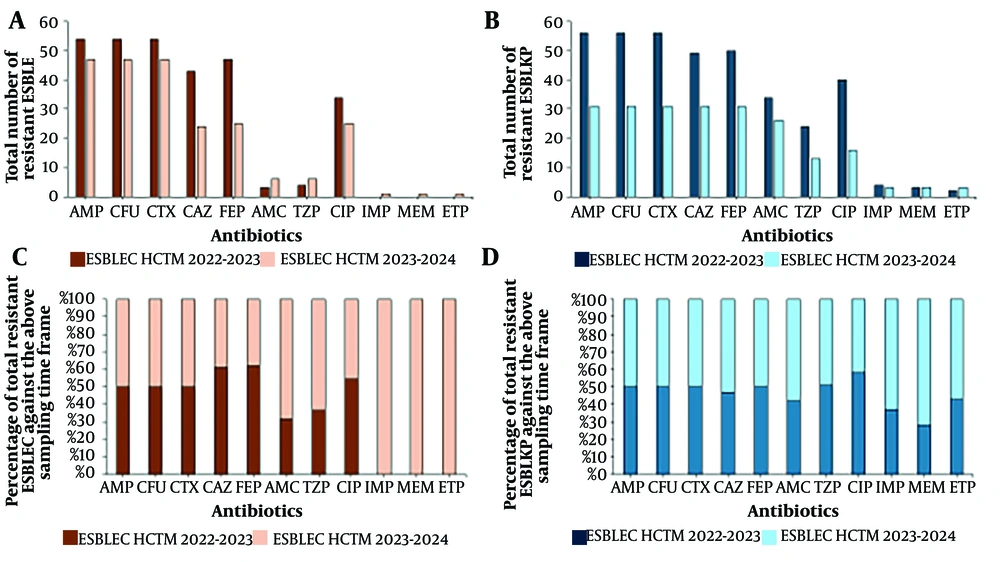
Figure 1.
A, ESBLEC strains resistant to tested antibiotics; B, ESBLKP strains resistant to tested antibiotics; C, distribution of total ESBLEC strains according to antibiotic resistance across two sampling periods; D, distribution of total ESBLKP strains according to antibiotic resistance across two sampling periods.
4.3. ESBL Genotyping
Distinct differences in ESBL gene distribution were observed between the two species and across the two sampling periods (Table 1). Among ESBLEC, blaCTX-M-1 was present in all strains collected in HCTM 2022 - 2023 but declined markedly in HCTM 2023 - 2024, coinciding with the emergence of blaCTX-M-9 (42.6%) and blaOXA-1 (23.9%). Although blaTEM remained common, its prevalence showed a slight decrease over time. This temporal shift was also reflected in the ESBL gene profiles; isolates from HCTM 2022 - 2023 were predominantly characterized by the blaTEM + blaCTX-M-1 combination, whereas those from HCTM 2023 - 2024 displayed greater genotypic diversity, including profiles associated with blaCTX-M-9 and blaOXA-1. In contrast, ESBLKP demonstrated a more conserved ESBL genotype. blaCTX-M-1 and blaSHV were consistently dominant across both sampling periods, with blaSHV detected in all strains from HCTM 2023 - 2024. These genes frequently co-occurred, although the prevalence of the triple-gene combination (blaTEM + blaSHV + blaCTX-M-1) decreased in the later period.
Table 1.
ESBL Genotypes of ESBLEC and ESBLKP Strains a
| Variables | ESBLEC | ESBLKP | ||||
|---|---|---|---|---|---|---|
| HCTM 2022 - 2023 (n = 54) | HCTM 2023 - 2024 (n = 47) | P Value, 95% CI | HCTM 2022 - 2023 (n = 56) | HCTM 2023 - 2024 (n = 31) | P Value, 95% CI | |
| ESBL gene | ||||||
| blaTEM | 31 (57.4) | 23 (48.9) | 43 (76.8) | 21 (67.7) | ||
| blaCTX-M-1 | 54 (100) | 24 (51.1) | < 0.001, 1.480 - 2.591 | 56 (100) | 28 (90.3) | 0.042, 0.987 - 1.242 |
| blaCTX-M-9 | 0 (0) | 20 (42.6) | < 0.001, 1.361 - 2.226 | 0 (0) | 0 (0) | |
| blaSHV | 0 (0) | 2 (4.3) | 43 (76.8) | 31 (100) | 0.004, 0.665 - 0.887 | |
| blaOXA-1 | 0 (0) | 11 (23.9) | < 0.001, 1.115 - 1.529 | 0 (0) | 3 (9.7) | |
| ESBL genotype | ||||||
| blaTEM | 0 (0) | 2 (4.3) | 0 (0) | 0 (0) | ||
| blaCTX-M-1 | 23 (48.9) | 9 (19.1) | 0.012, 1.267 - 7.743 | 0 (0) | 0 (0) | |
| blaCTX-M-9 | 0 (0) | 7 (14.9) | 0 (0) | 0 (0) | ||
| blaSHV | 0 (0) | 0 (0) | 0 (0) | 0 (0) | ||
| blaOXA-1 | 0 (0) | 0 (0) | 0 (0) | 0 (0) | ||
| blaTEM + blaCTX-M-1 | 31 (57.4) | 8 (17.0) | 0.012, 2.586 - 16.676 | 0 (0) | 0 (0) | |
| blaTEM + blaCTX-M-9 | 0 (0) | 9 (19.1) | 0 (0) | 0 (0) | ||
| blaTEM + blaSHV | 0 (0) | 1 (2.1) | 0 (0) | 3 (9.7) | ||
| blaSHV + blaCTX-M-1 | 0 (0) | 0 (0) | 13 (23.2) | 8 (25.8) | ||
| blaCTX-M-1 + blaOXA-1 | 0 (0) | 6 (12.9) | 0 (0) | 0 (0) | ||
| blaCTX-M-9 + blaOXA-1 | 0 (0) | 3 (6.4) | 0 (0) | 0 (0) | ||
| blaTEM + blaSHV + blaCTX-M-1 | 0 (0) | 0 (0) | 43 (76.8) | 17 (54.8) | 0.034, 1.063 - 6.979 | |
| blaTEM + blaCTX-M-1 + blaOXA-1 | 0 (0) | 1 (2.1) | 0 (0) | 0 (0) | ||
| blaTEM + blaCTX-M-9 + blaSHV | 0 (0) | 1 (2.1) | 0 (0) | 0 (0) | ||
| blaCTX-M-1 + blaOXA-1 + blaSHV | 0 (0) | 0 (0) | 0 (0) | 2 (6.4) | ||
| blaTEM + blaCTX-M-1 + blaOXA-1 + blaSHV | 0 (0) | 0 (0) | 0 (0) | 1 (3.2) | ||
a Values are expressed as No. (%) unless otherwise indicated.
4.4. blaCTX-M-15 Genotyping
All blaCTX-M-1-positive strains were further typed for blaCTX-M-15. Although the overall distribution of blaCTX-M-1-harboring strains differed between the two sampling periods, analyses restricted to these strains showed that blaCTX-M-15 remained highly prevalent and stable over time. Among ESBLEC carrying blaCTX-M-1, blaCTX-M-15 was detected in 68.5% (37/54) of isolates in HCTM 2022 - 2023 and 66.7% (16/24) in HCTM 2023 - 2024, indicating minimal temporal variation. Among ESBLKP with blaCTX-M-1, the prevalence of blaCTX-M-15 was substantially higher than that in ESBLEC and was identical in both sampling periods at 92.9% (52/56 and 26/28, respectively). A significant difference was observed between ESBLEC and ESBLKP harboring blaCTX-M-15 when sampling periods were not considered (P < 0.001, 95% CI: 0.063 - 0.425).
5. Discussion
blaCTX-M-15 is carried on highly transmissible plasmids, which have most likely facilitated its global dissemination (13). Accordingly, this gene has contributed to the widespread distribution of ESBL-producing strains. This dissemination has important clinical implications, including reduced therapeutic options for infections caused by ESBL-producing strains and increased selective pressure for antibiotic resistance. In this study, we aimed to determine the prevalence of blaCTX-M-15 among ESBLEC and ESBLKP in our center. Across both sampling periods, both species exhibited similar distribution patterns, with blood and urine consistently representing the predominant sources of pathogen isolation. Although ESBL-producing strains may initially exist as gut colonizers, transmission to other body sites can occur, and factors such as prolonged hospitalization, advanced age, prior antibiotic exposure, and immunocompromised status increase the risk of progression to invasive infection (14). Environmental spillover from the initial host and subsequent forward transmission to other patients have also been reported (15).
In our center, ESBLEC strains from HCTM 2023 - 2024 showed a decreasing trend in resistance to CAZ and FEP, whereas a nonsignificant increase was observed for AMC and TZP. In contrast, ESBLKP demonstrated a largely stable resistance profile across both sampling periods. Beta-lactam antibiotics remain central to the treatment of gram-negative infections; however, CAZ and FEP are categorized under the Watch group of antibiotics by the World Health Organization. Recent national reports indicate reduced cephalosporin utilization, particularly ceftriaxone, and a declining trend in CAZ and FEP use in public hospitals. Reduced antibiotic selective pressure may have contributed to the observed decline in resistance to these agents among ESBLEC strains. Another explanation may be the concurrent increase in the prevalence of blaCTX-M-9, which codes for a lower level of resistance to CAZ than the blaCTX-M-1 group (16).
Across both sampling periods and in both ESBLEC and ESBLKP, blaCTX-M-1 was the most prevalent ESBL gene identified. This finding is consistent with a previous study conducted at the same center (8). However, notable shifts in ESBL genotypes were observed over time, particularly among ESBLEC strains. These changes may reflect the influence of antibiotic selective pressure and the hospital environment, which serves as an important reservoir facilitating horizontal gene transfer between strains of the same and different Enterobacterales species. The dissemination of ESBL-producing strains is a multifaceted process involving both the clonal spread of successful lineages between patients and the transfer of resistance determinants via mobile genetic elements across diverse bacterial backgrounds (17). To date, the blaCTX-M family comprises more than 250 genotypes. Among these, blaCTX-M-15 has been recognized as one of the most widespread and clinically significant variants (2, 18). The global dissemination of blaCTX-M genotypes reflects their strong association with mobile genetic elements and successful bacterial lineages.
5.1. Study Limitations
This study has several limitations. First, the temporal gap between the sampling periods was relatively short, which may explain why few significant differences were observed. Second, the study focused only on a single subtype of blaCTX-M; other emerging subtypes were not tested. Third, ethical approval for the study covered only strain collection; demographic and clinical data for the associated patients were not included and therefore were not collected or analyzed, limiting interpretation of disease burden, patient distribution, and specimen distribution in HCTM. Future studies should address these limitations and consider collecting patient data and sequencing blaCTX-M genes and plasmids harboring ESBL genes to better characterize circulating ESBL variants. Importantly, implementing routine genomic and plasmid sequencing surveillance would enable more precise tracking of transmission dynamics, clonal spread, and plasmid-mediated dissemination of ESBLs within the hospital setting, thereby strengthening infection control and antimicrobial stewardship efforts.
5.2. Conclusions
In conclusion, blaCTX-M-15 was highly prevalent among both ESBLEC and ESBLKP in HCTM across two sampling periods. The continued presence of blaCTX-M-15 is a concern; continuous ESBL genotypic surveillance and, where feasible, genomic surveillance of ESBL strains in the hospital will be important.