1. Background
The genera of Neisseria and Moraxella include Gram-negative and oxidase-positive diplococci that are mostly isolated from the upper respiratory tract of humans (1, 2). Neisseria lactamica is a commensal species, which is colonized more frequently in the oropharynges of young children than those of the adults, and the colonization rate decreases with age increase (2-6). Among nonpathogenic Neisseria species, N. lactamica shows close antigenic similarities with N. meningitides. Yazdankhah et al. demonstrated that the carriage of N. lactamica is associated with a high titer of antibodies against N. meningitides (7). Previous studies showed that the development of cross-protective immunity against N. meningitides is observed in N. lactamica carriers. Therefore, it is proposed that colonization with N. lactamica during early childhood will protect the host against the colonization with N.meningitides by natural immunity (2, 3, 8, 9). Local monitoring of the colonization due to N. lactamica in the young children should be considered to learn about the immunity of these children to the life-threatening meningococcal infection. Investigation of the N. lactamica carriage rate is rarely performed on a frequent basis in the healthy children in Iran (10). Epidemiological and regional evaluation of nonpathogenic Neisseria species should be considered in the future studies. There is no information about the frequency of nonpathogenic Neisseria species in children living in the area under study.
Moraxella catarrhalis is part of the commensal species in the upper respiratory tract of approximately 7% to 36% of the healthy children, but decreases substantially in adulthood. Otitis media is an infection of the upper respiratory tract in children that is closely related to the colonization of M. catarrhalis. Therefore, colonization of M. catarrhalis in the healthy carriers may be as a predisposing factor for otitis media and is now firmly established as an etiological cause of otitis media (11-13). Therefore, the high colonization rate of M. catarrhalis in oropharynx during the childhood is related to the high sensitivity to the otitis media infection. Surveys on M. catarrhalis carriage rates among young healthy children are rarely performed in Iran (14, 15).
2. Objectives
The current study aimed to investigate the frequency of N. lactamica, other nonpathogenic Neisseria species, and M. catarrhalis such as Gram-negative, oxidase-positive diplococci in the oropharynges of young healthy children in Ahvaz, Iran by the two phenotypic tests and Polymerase Chain Reaction (PCR).
3. Materials and Methods
3.1. Oropharyngeal Sampling
A total of 192 young normal healthy children from some kindergartens, preschool and schools of Ahvaz city were studied from November 2012 to March 2013. The healthy children under 10 without any respiratory infections were eligible for inclusion. The present study was approved by the Ahvaz Jundishapur University of Medical Sciences Ethics Committee (code number: ETH609). The oropharyngeal samples were obtained from children`s oropharynx by sterile Dacron swab. The pharyngeal swabs were inoculated directly onto the Modified Thayer-Martin medium (MTM agar), including GC gonococcal agar supplemented with Vitox, hemoglobin powder, vancomycin, colistin, trimethoprim and nystatin (Oxoid, Basingstoke, UK). Plates were incubated at 37°C in a 5% CO2 atmosphere and investigated after 48 hours. Oxidase-positive and Gram-negative diplococci were isolated for the present study. The pure colonies were stored in skimmed milk broth (Sigma Aldrich, USA) with 10% (v/v) glycerol at -80°C for later use.
3.2. Identification of Isolated Strains
Gram-negative and oxidase-positive diplococci were identified by their patterns of growth in different culture media and several biochemical tests shown in Table 1 (16).
Table 1.
| Species | No. (%) =192 | Acid produced from | Polysac-charide Produced from 5% sucrose | Reduction of NO3 | Pigment | Growth on | DNase | |||||||
|---|---|---|---|---|---|---|---|---|---|---|---|---|---|---|
| Glu-cose | Mal-tose | Lactose (ONPG) | Suc-rose | Fruc-tose | MTM medium | Blood agar at 22°C | Blood agar at 37°C | Nutrient agar at 37°C | ||||||
| N. lactamica | 42 (21.9) | + | + | + | - | - | - | - | Y | + | - | + | - | - |
| N. mucosa | 12 (6.3) | + | + | - | + | + | + | + | slY | - | + | + | + | - |
| N. sicca | 15 (7.8) | + | + | - | + | + | + | - | - | - | + | + | + | - |
| N. cinerea | 3 (1.6) | - | - | - | - | - | - | - | G | +w | - | - | - | - |
| N. subflava | ||||||||||||||
| Biovar subflava | 8 (4.2) | + | + | - | - | - | - | - | Y | - | + | + | + | - |
| Biovar perflava | 54 (28.1) | + | + | - | + | + | + | - | Y | +w | + | + | + | - |
| Biovar flava | 14 (7.3) | + | + | - | - | + | - | - | Y | - | + | + | + | - |
| M. catarrhalis | 82 (42.7) | - | - | - | - | - | - | + | p | +w | + | + | + | + |
a All species were oxidase-positive, catalase (3% H2O2)-positive.
b+, Positive Reaction; - , Negative Reaction; +w, Weak Positive Reaction; Y, Yellow; sl, Slightly; G, Grayish; P, Pinky; ONPG, 0-Nitrophenylβ-D-galactopyranoside; MTM, Modified Thayer-Martin.
Identification of N. lactamica may be confirmed by detecting beta-galactosidase in an enzyme substrate test. Therefore, β-galactosidase activity was tested with ο-nitrophenyl-β-D-galactopyranoside disc (ONPG) (Rosco Diagnostica, Denmark) as the substrate. ONPG test was performed according to the manufacturer`s instructions. ONPG-positive isolates were yellow after incubation at 37°C for more than one hour (17). Furthermore, superoxol (30% hydrogen peroxide [H202]) test was performed after incubation of the test isolate on Brain-Heart Infusion (BHI) agar (Merck, Germany) for 24 hours. N.lactamica usually produces weak brisk bubbling with delayed bubbling (16). Identification of M. catarrhalis may be confirmed by Deoxyribonuclease (DNase) activity (16, 18, 19).
Identification of other nonpathogenic Neisseria species are based on their patterns of growth in different culture media and biochemical tests (16). All of the diagnostic tests were performed three times for each sample.
3.3. Molecular Characterization
3.3.1. DNA extraction.
Chromosomal DNA of N. lactamica and M. catarrhalis isolated strains were extracted by the boiling method. Extracted DNA samples were stored at -20°C for later use.
3.3.2. Polymerase Chain Reaction (PCR)
All of the N. lactamica and M. catarrhalis isolates were tested by PCR for the presence of pdhC (6) and glyRS (20) genes; respectively. To evaluate glyRS gene, the primers previously described by Post et al. were used, and to evaluate pdhC gene, newly designed primers were applied (Table 2). Primers were purchased from TAG Copenhagen A/S, Denmark. In each assay, the final 25 μL reaction mixture contained 2.5 μL of the 10× reaction buffer; 1 μL of 50 mM MgCl2; 0.5 μL of 2.5 mM dNTPs; 0.5 μL of each primer (20 pmol/μL); 0.2μL Taq polymerase (5 U/μL); and 18.8 μL sterile distilled water. The PCR assays were performed in a Mastercycler Eppendorf (Eppendorf, Germany). Amplicons were analyzed by electrophoresis on a 1.5% agarose gel. PCR products were visualized and photographed under ultraviolet illumination. All the chemical materials used in this study were purchased from CinnaGen, Iran. Two reference strains were used as controls: N. lactamica (ATCC 23970) and M. catarrhalis (ATCC 25240). The results were analyzed using the SPSS software version 19.
Table 2.
Oligonucleotides and Polymerase Chain Reaction Condition
| Oligonu-cleotide | Sequence | Gene Amplified | Amplicon Length (base pair) | PCR condition for two species | Reference |
|---|---|---|---|---|---|
| NL1 | 5'-AATGTTTGGACGGCGACTAC-3' | pdhC | 161 | 94°C/5 min, 57°C/45 sec, 72°C/45 sec, 35 cycles of (94°C/45 sec, 57°C /45 sec, 72°C /45 sec and elongation 72°C for 5 min | This study |
| NL2 | 5'-GTACACTTTTTGCGGGTCGT-3' | ||||
| MCAT1 | 5'-TTGGCTTGTGCTAAAATATC-3' | glyRS | 140 | (20) | |
| MCAT2 | 5'-GTCATCGCTATCATTCACCT-3' |
4. Results
The carriage of N. lactamica, other nonpathogenic Neisseria spp. and M. catarrhalis were studied in a total of 192 young healthy children with the mean age of 5.93 ± 2.5903 year, including 106 (55.2%) male and 86 (44.8%) female in Ahvaz, Iran, from November 2012 to March 2013. All of the Gram-negative and oxidase-catalase positive diplococci were investigated by several biochemical tests and cultural characteristics as shown in Table 1. N. lactamica colonies were > 50 CFU and M. catarrhalis colonies ≤ 10 CFU on MTM medium. The most common bacteria isolated from the oropharynx were M. catarrhalis (42.7%, n = 82), N. subflava Biovar perflava (28.1%, n = 54) and N. lactamica (21.9%, n = 42), respectively. In some of the oropharyngeal swab samples at least two Neisseria species were identified with the same subject. Also, some of the biochemical properties and the colony shape of the Neisseria species were similar which could lead to misdiagnosis, and sometimes two different species were recognized as one.
PCR analysis was performed for all the N. lactamica and M. catarrhalis isolates. Amplified products of pdhC and glyRS genes underwent bidirectional sequencing by the ABI 3730XL DNA Analyzer (Applied Biosystems, USA). The sequences of the pdhC and glyRS genes were entered into a BLAST search (http://blast.ncbi.nlm.nih.gov/Blast.cgi). Multiple sequence alignments were performed with the MEGA (version 4). Comparing the sequence of PCR product of pdhC gene with that of registered in GeneBank confirmed a new sequence, in one of the isolates (NL2) (accession no. HG416927). Also the sequence of glyRS gene PCR product confirmed the accuracy of PCR results.

Figure 1.
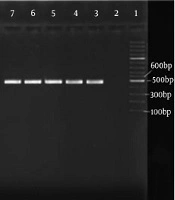
A) glyRS gene of M. catarrhalis strains. Lanes 2-8, isolated strains; lane 9, negative control; lanes 10-11, standard strains; lanes 1 and 12; 50 bp DNA marker. B) pdhC gene of N. lactamica strains. Lane 2, standard strain; lanes 3-6, isolated strains; lanes 7-8, negative controls; lanes 1 and 9, 50 bp DNA marker

Figure 2.
Frequency of the Isolated Species in Oropharynx of the Studied Children
5. Discussion
Oropharyngeal colonization by oxidase-positive and Gram-negative diplococci in young healthy children should be considered in Iran, because there are only a few studies have been conducted in this regard. In contrast to the results of the current study, Pourmand et al. reported 3% N. lactamica among 364 of the healthy children aged 10-12 years old in Tehran (10). As mentioned above, the studied bacterial species are colonized more frequently in the oropharynx of young children and colonization rate decreases with the age increase (2-6). Results of the study by Fahimzad et al. were similar to those of the current study. They showed a frequency of M. catarrhalis (13.5%) colonization in the oropharynx of 296 healthy children aged 2-6 years old (14). In another study, Bakhshaee et al. demonstrated that exposure to tobacco smoke significantly increased the carriage rate of M. catarrhalis in children (15). There are no reference data available on the isolation of nonpathogenic Neisseria spp. in Iran.
Evans et al. showed that some individuals are intrinsically resistant to N. lactamica carriage and also other reports mentioned that colonization peak of N. lactamica in the upper respiratory tract increases 21% at 18 months of age, followed by a decrease to 1.8% by the age of 14 to 17 years (6, 16). In the current study, the frequency of N. lactamica was 21.9% in young children aged one to nine years old. Similar to the obtained results (Figure 2), Sáez Nieto et al. (21) found N. subflava (biovar perflava) with the highest (28.1%) and N. cinerea with the lowest (1.6%) frequency in the oropharynx of young children. Also the prevalence of M. catarrhalis (42.7%) was considerable more than any other Neisseria species. Ejlertsen et al. showed that a high rate of colonization is associated with an increased risk of otitis media (22). No significant relationship was found between the gender and bacterial colonization in the current study. Also, the sampling time (month of sampling) had no effect on the bacterial colonization, since these organisms are commensal in the upper respiratory tract of children, especially N. lactamica and M. catarrhalis.
Neisseria species are very susceptible to environmental changes compared to M. catarrhalis. Therefore, they may be lost in the process of diagnosis. Furthermore, they may overgrow in the primary isolation by the other microflora in the upper respiratory tract (21). In addition, Neisseria species and M. catarrhalis are not colonized only in the oropharynx. The results of the current study showed that Neisseria spp. and M. catarrhalis were not isolated from all of the studied subjects. Hence, to evaluate the reliable frequency of Neisseria species and M. catarrhalis in pharynx, other identification techniques are necessary to obtain accurate results. N. lactamica is colonized more frequently in the oropharynges of young children. There are numerous reports illustrating that carriage of N. lactamica may assist in the development of natural cross-protective immunity to N. meningitidis serogroup B strains, the cause of life-threatening bacterial meningitis (3, 8, 9, 17, 23-25). Therefore, screening the young children for N. lactamica in their upper respiratory tract is very important to determine the susceptibility to meningococcal meningitis.
In conclusion, the present study was the first report from Ahvaz, Iran, and demonstrated that the rate of colonization and success in detecting the living bacteria in the upper respiratory tract was influenced not only by age but also by site of colonization and sampling, physiology of bacteria, genetic, and host immune system.