
1. Background
Black people (African) and Yellow people (Asian) ethnic groups are more different in terms of their environmental structures, habitats and, their adaptation to local survival. Also, there are more variations in their ethnicity and susceptibility to infectious diseases. Therefore, studying their adaptive immune responses to various infectious diseases might add new findings to our knowledge. The immune responses of Black African race populations might be strong against various diseases, so their resistance and defense to various infections can be attributed to their ability to adapt and survive in local conditions. In this case, we compare the characteristics of antibodies against different infectious diseases in Black and Yellow individuals.
Antibody and antigen interactions play an important role in most of our numerous life processes and there is a property of how strong an antigen binds its related antibody, which is known as the affinity (1). In the process of an immune response, B-cells produce antibodies that have a stronger and higher affinity to the target pathogen, which attacks the human (2-4). This process, which is called affinity maturation, strengthens the attachment to the pathogen and leads to a higher immune defense efficacy (1, 5). Another property of the antibody is the activity. The activity of an antibody depends on its affinity and protein content; therefore, the identification of different antibodies in clinical laboratory specimens must encompass the quantification of these detailed characteristics of antibody. The protein content, activity, and affinity are important parameters that determine the role of antibody in the interactions between antigens and antibodies. However, these parameters are rarely studied between Black and Yellow individuals.
Antibody affinity, protein, and activity are valuable parameters that should be analyzed and measured to understand the differences in immune responses to infectious diseases between Black and Yellow different ethnic populations. Natural antibodies are blood group antibodies, which are developed early in life and produced in response to either the presence or absence of a pathogen (6). Blood group antibodies play a protective and preventive role in autoimmunity and homeostasis, which are thought to form a strong link between the adaptive immunity and innate immunity (5, 6). Hepatitis B virus (HBV) infection is a worldwide disease in which the liver inflamed and this inflammation is divided into acute and chronic hepatitis (7-10).
Most acute infections of HBV occurring in adults may be self-limited (11-14). Serum antibody markers against HBV indicate the status of HBV infection, and the antibody against hepatitis B surface antigen (anti-HBs) only presents in a convalescence stage, and its existence is considered to be a protective factor against HBV infection (15-19). Salmonella is a causative agent of typhoid fever, which is a worldwide bacterial disease and a public health problem (20-22). Salmonella infection affects primarily children and young adults (20, 22-25). Studying or measuring the serum antibody markers to assess the health status of the patient is an essential and important issue (26-28).
2. Objectives
This study aimed to investigate and compare the entire properties of antibodies against blood group, HBV, and Salmonella between Black and Yellow healthy individuals to explain the difference of these antibodies for answering and understanding the differences in anti-infectious immune responses to infectious diseases.
3. Methods
3.1. Subjects and Specimens
One-hundred and thirty-two serum samples of 66 Sudanese (Black) and 66 Chinese (Yellow) healthy individuals were collected. All serum samples were analyzed and checked for anti-A/B blood group antibodies, antibody against HBs antigen, and Salmonella typhi O antibody. Serologically all serum samples were divided into anti-A/B blood group positive group, anti-HBs antibody positive group, and S. typhi O antibody positive group. Each group included equal individuals (male: female = 1:1; age ranged from 16 to 50 years). This study was approved by the Institutional Ethics Committee of Dalian Medical University with a collaboration of the Hospital Ethics Committee of Kosti Teaching Hospital, Kosti, Sudan (Approval No. 201805-K.T.H/E.A.L/1/3).
3.2. Agglutination Reaction Method
3.2.1. Treatment of Reaction Condition for Detection of Anti-A/B Blood Group
Phosphate buffer saline (PBS) solution was prepared in order to prepare three sets of four serial dilutions (20, 40, 80, and 160) of the test specimen (Black and Yellow healthy human serum antibodies to blood types A and B). Followed by the addition of 50 µL of 2% red blood cells (type A and type B) to each dilution. The tubes were centrifuged for few seconds to make sure that the mixtures were homogeneous, and the three sets of tubes were treated to incubate at 37°C, and 56°C for one hour.
3.2.2. Treatment of Test Specimens for Detection of Salmonella typhi O Antibody
Firstly, serum samples were treated by PBS solution, which prepared without 8 mol/L of urea for standard reaction in order to prepare one set of four serial dilutions (20, 40, 80, and 160 dilutions). Secondly, the standard reaction changed by using 8 mol/L of urea in PBS solution in order to prepare the other sets of four serial dilutions (20, 40, 80, and 160 dilutions). Widal test using O antigen was performed according to the manufacturer’s instructions (BioSystems S.A. Costa Brava 30, 08030 Barcelona, Spain). One drop (~50 µL) of S. typhi O antigen suspension was added to each test specimen (Serum samples of Black and Yellow individuals) prepared, mixed well, and the mixtures were incubated at 50°C for 4 hours.
3.2.3. Interpretation of Agglutination Reaction Results
The agglutinations of 100%, 75%, 50%, and 25% were recorded as score of 4+, 3+, 2+, and 1+, respectively. A case of no agglutination was scored as 0. To simplify calculations, serum-dilution factors (1: 2, 1: 4, 1: 8, and 1: 16) were calculated by logarithmic transformations.
3.3. Enzyme-Linked Immunosorbent Assay (ELISA) for Anti-HBs Antibody
3.3.1. Treatment of the Test Specimens
The method was similar to those described in section 3.2.2. The test specimen consisted of healthy human serum with an antibody for HBs antigen serially diluted.
3.3.2. Determination of Hepatitis B Surface Antibody
To detect anti-HBs in Black and Yellow healthy individuals, a double-antigen sandwich ELISA method was used according to the manufacturer’s instructions associated with the diagnostic kit for antibody against hepatitis B surface antigen (Shenyang Huimin Biotechnology Co. Ltd, Shenyang, China).
3.4. Antibody Affinity Quantifications
3.4.1. Affinity of Anti-A/B Blood Group and Salmonella typhi O Antibodies
Calculation of affinity of anti-A/B blood group antibody and S. typhi O antibody were quantified according to that described by Shang et al. (29). in which the affinity resulting from the division of changed reaction condition values by the standard reaction condition values.
3.4.2. Affinity of Hepatitis B Surface Antibody
A terminal antibody (TA) method based on enzyme-linked immunosorbent assay (ELISA) (30-32) was used for the measurement and calculation of the affinity of anti-HBs among Black and Yellow individuals. In this method, the Black and Yellow human serum samples were serially diluted 20-, 40-, 80- and 160-fold, measured under standard reaction condition and after changing the standard condition, the values of these dilutions under these conditions were analyzed by ELISA, and OD values for each dilution were recorded. The 80-fold dilution and its OD value were selected in the standard reaction condition as a TA concentration, and the 40-fold dilution and its OD value were selected after the reaction changed and the affinity was calculated according to Shang et al. (29).
3.5. Antibody Activity Quantifications
3.5.1. Activity of Anti-A/B Blood Group Antibodies
3.5.2. Activity of Salmonella typhi O Antibody
3.5.3. Activity of Hepatitis B Surface Antibody
The total activity of anti-HBs antibody quantification depends on the OD value measured by ELISA; therefore, the total activity was calculated according to Liu et al. and Han et al. (33, 34) in which the OD values for the 80-fold dilution factor under standard reaction was used as the total activity quantification value of anti-HBs.
3.6. Total Protein Component Quantifications
The antibody affinity and the total protein component together constitute the activity of the antibody, according to this principle, the total protein component was calculated according to the results obtained from the affinity and the total antibody activity of anti-A/B blood group antibodies, antibody against HBs antigen and S. typhi O antibody as described by Liu et al. and Han et al. (33, 34) in which the value of protein content obtained from the division of total activity by affinity.
3.7. Statistical Analysis
The difference of antibodies to blood group, HBV, and Salmonella for the total protein content, the total antibody activity, and antibody affinity among Black and Yellow healthy individuals were normally distributed. Independent t-tests were used to analyze the difference between antibody affinity values of anti-A/B natural antibodies, anti-HBs, and S. typhi O antibody in the clinical serum samples of Black and Yellow individuals. Binary logistic regression analysis (Backward method) was used to screen independent variables in Black and Yellow individuals. The difference of antibodies for antibody activity, protein content, and antibody affinity were displayed by Graph Prism 5.0 software. The calculation was performed using Windows software for Social Sciences (SPSS 21.0). Data were considered to be statistically significant when the probability of type I error was 0.05 or less.
4. Results
The parameters for antibody production characteristics of natural antibodies, HBV, and Salmonella among Black and Yellow healthy individuals presented in Tables 1 - 3, respectively. The affinity of natural antibodies, HBV, and Salmonella in clinical samples of Black individuals were statistically higher than in the clinical samples of Yellow individuals (P < 0.05). The analysis of the total activity value of these antibodies in Black individuals was significantly higher than that of Yellow individuals (P < 0.05). The protein content of anti-A/B blood group antibodies, anti-HBs, and S. typhi O antibody was lower among Yellow individuals than Blacks, but statistically not significant (P > 0.05).
Table 1.
Antibody Affinity, Protein Content, and Activity of Anti-A/B Natural Antibodies in the Two Groupsa
| Groups | Affinity | Protein Content | Total Activity |
|---|---|---|---|
| Sudaneseb | 0.090 ± 0.055 | 348.94 ± 191.38 | 22.84 ± 3.22 |
| Chineseb | 0.057 ± 0.011 | 327.22 ± 115.85 | 17.70 ± 2.95 |
| P valuec | < 0.001 | 0.442 | < 0.001 |
aValues are expressed as mean ± SD.
bSudanese (Black individuals) and Chinese (Yellow individuals).
cP values less than 0.05 are considered statistically significant.
Table 2.
Antibody Affinity, Protein Content, and Activity of Antibody Against Salmonella typhi O Antigen in the Two Groupsa
| Groups | Affinity | Protein Content | Total Activity |
|---|---|---|---|
| Sudaneseb | 0.298 ± 0.109 | 81.91 ± 47.20 | 20.25 ± 4.05 |
| Chineseb | 0.221 ± 0.073 | 79.63 ± 20.11 | 16.50 ± 1.93 |
| P valuec | < 0.003 | 0.815 | < 0.001 |
aValues are expressed as mean ± SD.
bSudanese (Black individuals) and Chinese (Yellow individuals).
cP values less than 0.05 are considered statistically significant.
Table 3.
Antibody Affinity, Protein Content, and Activity of Anti-HBs Antibody in the Two Groupsa
| Groups | Affinity | Protein Content | Total Activity |
|---|---|---|---|
| Sudaneseb | 0.458 ± 0.103 | 0.385 ± 0.134 | 0.168 ± 0.055 |
| Chineseb | 0.400 ± 0.040 | 0.316 ± 0.064 | 0.124 ± 0.016 |
| P valuec | < 0.001 | < 0.001 | < 0.001 |
aValues are expressed as mean ± SD.
bSudanese (Black individuals) and Chinese (Yellow individuals).
cP values less than 0.05 are considered statistically significant.
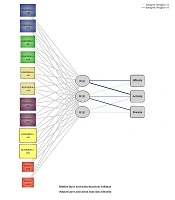
The comparison of antibodies of blood group, HBV, and Salmonella for affinity, activity, and protein content among Black and Yellow individuals are shown in Figures 1 - 3 respectively. In this study, we further used logistic regression to determine and assess whether protein, activity, and affinity parameters are independent variables or not for Black and Yellow healthy individuals. For anti-A/B natural antibodies; affinity, activity, and protein content were independent variables as shown in Table 4. For S. typhi O antibody; the protein content, activity, and affinity were independent parameters, which is presented in Table 5. For the anti-HBs, protein content was removed from the equation, only activity and affinity remained in the equation (P < 0.05) as shown in Table 6.
Table 4.
Logistic Regression Analysis to Assess Whether the Total Antibody Activity and Protein Content are Independent Variables for the Affinity of Anti-A/B Natural Antibodies in the Two Groupsa
| Items | Bb | S.Eb | P Valuec | Exp (B) |
|---|---|---|---|---|
| Affinity | -400.988 | 207.946 | 0.054 | 0.000 |
| Activity | -3.263 | 1.875 | 0.082 | 0.038 |
| Protein content | 0.042 | 0.034 | 0.224 | 1.043 |
aSudanese (Black individuals) and Chinese (Yellow individuals).
bB refers to the regression coefficient and S.E refers to the standard error of the mean.
cP values less than 0.05 are considered statistically significant.
Table 5.
Logistic Regression Analysis to Assess Whether the Total Antibody Activity and Protein Content are Independent Variables for the Affinity of Salmonella typhi O Antibody in the Two Groupsa
| Items | Bb | S.Eb | P Valuec | Exp(B) |
|---|---|---|---|---|
| Affinity | 18.043 | 7.213 | 0.012 | 68578363.412 |
| Activity | 0.334 | 0.172 | 0.052 | 1.396 |
| Protein content | 0.033 | 0.019 | 0.071 | 1.034 |
aSudanese (Black individuals) and Chinese (Yellow individuals).
bB refers to the regression coefficient and S.E refers to the standard error of the mean.
cP values less than 0.05 are considered statistically significant.
Table 6.
Logistic Regression Analysis to Assess Whether the Total Antibody Activity and Protein Content are Independent Variables for the Affinity of Anti-HBs Antibody in the Two Groupsa
| Items | Bb | S.Eb | P Valuec | Exp(B) |
|---|---|---|---|---|
| Affinity | 20.380 | 4.590 | 0.000 | 709768020.05 |
| Activity | 93.006 | 21.111 | 0.000 | 2.465E + 040 |
| Proteind | Remove in Step 2 | |||
aSudanese (Black individuals) and Chinese (Yellow individuals).
bB refers to the regression coefficient and S.E refers to the standard error of the mean.
cP values less than 0.05 are considered statistically significant.
dNot independent variable.
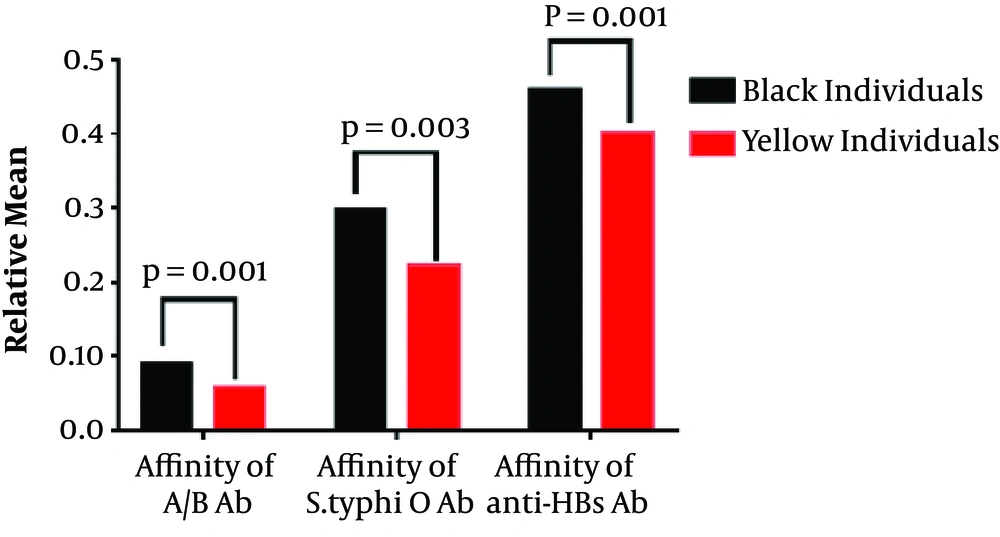
Figure 1.
Comparison of different antibodies for affinity distributed in the two groups is shown
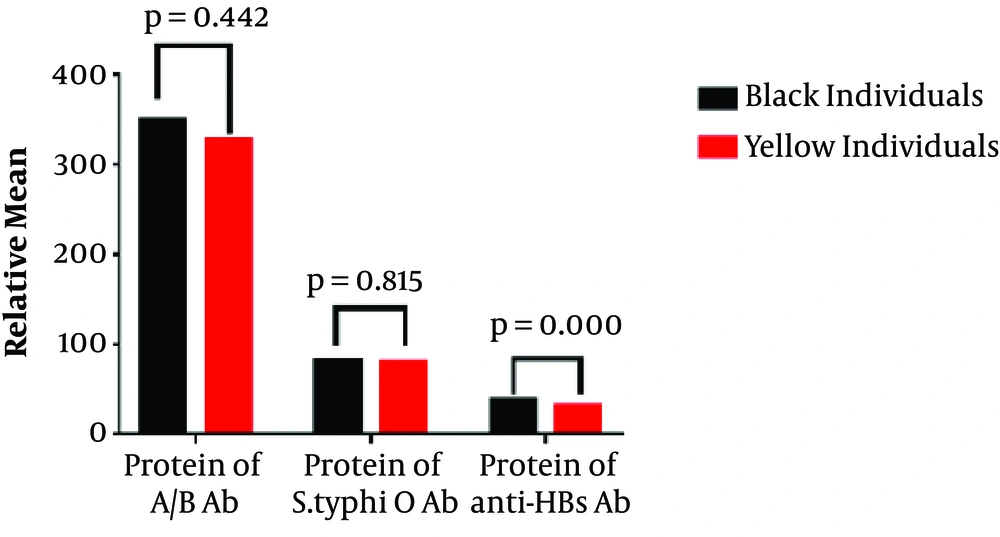
Figure 2.
Comparison of different antibodies for total protein content distributed in the two groups is indicated
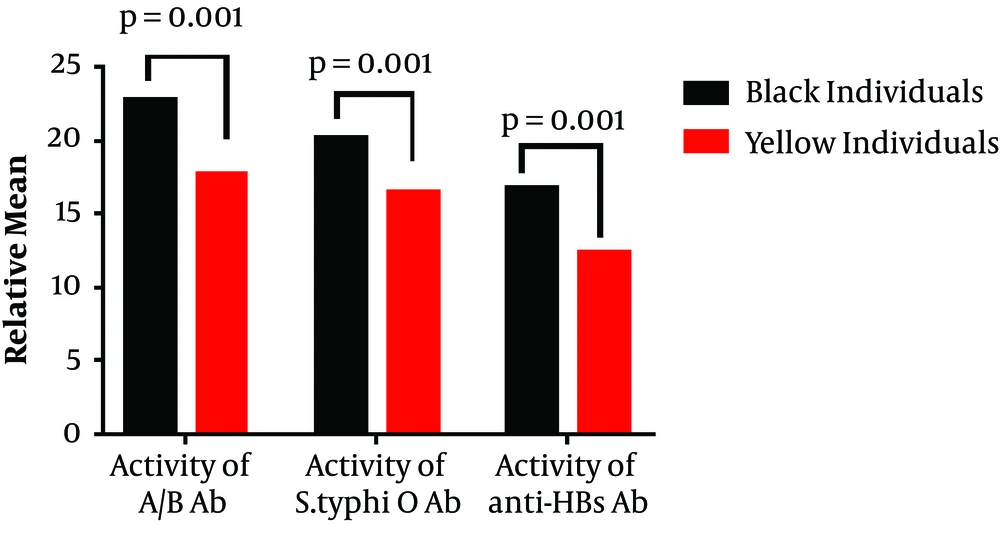
Figure 3.
Comparison of different antibodies for antibody activity distributed in the two groups is shown
5. Discussion
Our study aimed to detect and determine the detailed properties of different antibodies in Black (Sudanese) and Yellow (Chinese) healthy individuals. The measured values of protein content, activity, and affinity of antibodies against anti-A/B blood group were obtained by methods described by Liu et al., and Han et al. (33, 34), for anti-HBs the values of three parameters obtained by the method described by Shang et al. (29), and also the entire antibody parameters for S. typhi O antibody values obtained from the methods described by Liu et al. and Han et al. (33, 34). These parameters are very important to be included in measuring the difference in adaptive immune responses. However, these parameters are rarely used to observe the characteristic changes among different antibodies in Black and Yellow individuals. Thus the study of these parameters in Black and Yellow individuals can determine and predict the status and condition of different infectious diseases such as HBV and Salmonella infections. Also, these parameters can be used to express individual adaptation to geographical and environmental conditions, and their differences in the resistance to diseases to obtain unique information in order to understand their variation in anti-infectious immunity mechanisms.
In our study, Black and Yellow various ethnic groups are healthy volunteers and the results explained in detail the antibody production features, the affinity of anti-A/B blood group antibodies, S. typhi O antibody, and anti-HBs antibody in Black individuals were statistically higher than Yellow individuals. The termination of infections in the human body is a result of high antibody affinity to antigen that finally clears the antigen (35-37). Our study revealed that the total protein contents of anti-A/B natural antibodies, S. typhi antibody, and anti-HBs antibody were higher in Black than in Yellow individuals, and the results showed that the protein content of anti-HBs antibody was statistically higher in Black individual than Yellow individuals, but no significant differences were observed in the protein contents of anti-A/B blood group and S. typhi O antibody among the two groups of individuals.
The protein content of an antibody and affinity constitute the antibody activity; thus the protein content is affected by changes in affinity and activity of the antibody. Further analysis revealed that the total activities of anti-A/B natural antibodies, S. typhi O antibody, and anti-HBs antibody of Black individuals were statistically higher than Yellow ones. A change in properties of antibody affinity and the total protein content of these different antibodies among Black and Yellow healthy individuals may result in a change of the total antibody activity. The present study indicates more variations and clear differences in the measured values of the three parameters of anti-A/B blood group (Table 1), S. typhi antibody (Table 2), and anti-HBs (Table 3) for different antibodies of various infectious diseases.
We further used logistic regression analysis to assess and determine whether the parameters of total protein content, total activity, and affinity of each antibody are independent variables for Black and Yellow individuals. For anti-A/B blood group antibodies, the present findings revealed that the total antibody activity, total protein content, and affinity were in the equation, implying that protein content, activity, and affinity, which reflected the natural immunity in the two groups, were independent variables for Black and Yellow individuals (Table 4). For S. typhi O antibody, our results showed that the total antibody activity, total protein content and affinity were also in the equation, indicating that protein content, activity, and affinity, which reflected the immune responses to Salmonella infection in the two groups, were independent variables for Black and Yellow individuals (Table 5).
Our findings for antibody against HBV showed that total activity and affinity were in the equation, but the protein content was removed from the equation, implying that total activity and affinity, which reflected the resistance to HBV infection in the two groups, were independent variables for Black and Yellow individuals (Table 6). In fact, the protein content changed with the change of total activity and total affinity. Our present findings showed that there was more increase in affinity, protein content, and activity of natural antibodies, S. typhi O antibody, and anti-HBs antibody in Black ethnic individuals compared to Yellow ethnic individuals. Therefore, these differences in the level of antibody production properties reflected the difference in the anti-infectious immunity between Black and Yellow individuals.
Black and Yellow individuals vary in ethnicity, and the quantification of total protein, activity, and affinity of different antibodies against A/B blood group, HBV, and Salmonella might be used to predict and determine the status of infectious diseases which play an important role in understanding the adaptive immune responses in resistance to HBV and Salmonella infections. Our study is the first report discussing in detail the antibody production characteristics of different antibodies against infectious diseases in Black and Yellow individuals. Further studies should be conducted to investigate the difference in anti-infectious immunity to various infectious diseases in order to understand the features of various antibodies in different ethnicities.
5.1. Conclusions
From this study, we concluded that serum samples of Black individuals had a higher affinity, protein content, and activity in all antibodies compared with yellow individuals. Therefore, the quantification of the entire antibody production level of different antibodies in clinical samples of Black and Yellow individuals may determine and explain the status of infectious diseases. Additionally, the differences in anti-infectious immunity to infectious disease may lead to new and modern approaches in understanding the differences in adaptive immune response between black and yellow individuals.