1. Background
COVID-19 has led to the sudden upheaval of the very fabric of modern society. The World Health Organization (WHO) declared COVID-19 a global pandemic on Mar 11, 2020 (1). Since then, the disease has affected all aspects of life and all professions. In India, as of Sept 1, 2020, the reported cases reached a peak of 785,996 with reported 65,288 deaths (2).
In the forefront for providing treatment for SARS CoV2 infection, the medical profession to deliver medical education to its students. Dentistry is the severely hit branch of medicine as it is at most risk while delivering patient care (3, 4). The existing predicament is a lack of clear view towards the way forward in terms of patient care, clinical teaching, theoretical course completion, and meeting demands of the hidden curriculum.
Dental education not only deals with the theoretical understanding of disease and treatment, but also with practical skill development in implementing various procedures. The profession relies on a hands-on approach with patient work starting from the third year of undergraduate training. The lack of this exposure will affect the quality of dental professionals. In the current situation, the normalcy of events with free access to patient care looks like a far-fetched dream. New strategies and techniques need to be worked upon to optimize and strengthen traditional means to impart knowledge and skills to undergraduate and postgraduate dental students. This predicament has shaken the very foundation of dental education, leaving a big question towards the future of dental profession.
Dental academicians all over the country need to collaborate and exchange ideas to slowly and steadily rebuilt and strengthen the future means of delivering dental education and optimizing patient care. With the partial lifting of lockdowns and easing up of rules across the country, dental schools are also thinking about reopening their gates to the physical presence of dental students and patients.
2. Objectives
The objective of this survey was to gather views of dental academicians on student assessment, future of dental education, clinical teaching, challenges faced during all this upheaval of shutting down and resuming work policy, and possible solutions through both quantitative and qualitative data. This mixed closed- and open-ended questionnaire was thus constructed with the aim to understand the current situation of dental education in the COVID-19 crisis era and to seek solutions for its effective management.
3. Methods
This questionnaire-based survey was designed to record the initial response of dental schools across India to the COVID-19 crisis and to understand the adaptations undertaken to tackle the situation at the current time. The questionnaire takes its inspiration from the pre-existing questionnaire by the Association of Dental Education in Europe (ADEE) (5). A new questionnaire was developed through group discussion based on the prevailing shortcomings in dental education pertaining to the Indian context by the expert panel consisting of the Dean of Dental Faculty and the study authors. An unstructured focused group discussion was conducted to gather points regarding which aspects of dental academics were affected the most during COVID-19 and subsequent framing of questions. Face validity of the framed questionnaire was done through the dichotomous scale. The interrater kappa score of > 0.60 was considered as a valid question to be used in the survey. The pilot run of the finalized questionnaire was done on faculty from each dental department of the same institute to further validate the questionnaire. Test-retest reliability of the questionnaire was also performed to ascertain correlation coefficient (r) of ≥ 0.70.
The questionnaire was divided into four sections as discussed by the expert panel:
Section I dealt with the general overview of the academic institute and the type of COVID-19 disease severity in the area where the dental school was situated:
Zone in which dental school was situated (red, green, orange, containment);
Level of dental school (undergraduate, postgraduate, dental + medical school);
Level of academic activity in dental school at present;
Level of patient care in dental school at present;
Section II dealt with the current situation prevailing in the dental school regarding online lectures and assessment:
Level of clinical work;
Dental school access to students;
Online teaching availability and the mode;
Assessment pattern in the current situation;
Planning for assessment of clinical competence;
Decision making regarding assessment;
Planning regarding dissertation completion and submission.
Section III dealt with the return to work policy and the preparations in dental schools for resuming work:
Assessing the preparedness of the dental school to return to work;
Limitations towards resuming work;
Factors determining students return to clinical work;
Provision for psychological and emotional support to the students;
Preparation of standard guidelines for student and patient safety on resuming work.
Section IV explored the perceptions of academicians across the country regarding the current crisis on the future of dental education. Open-ended questions were also asked to get a deep insight into measures to uphold the future of dental education:
Measures through which dental education is upgraded to make students clinically competent in patient care during COVID-19 crisis phase;
Measures through which assessment of students can be effectively achieved without compromising their time and health;
Opinions regarding challenges faced in opening dental school/university to dental education.
Issues related to fighting against COVID-19, the availability of personal protective equipment (PPE) kits, and other necessary armamentarium were not asked. The questionnaire was electronically distributed among 138 dental schools across India through WhatsApp groups and emails from Jun 1, 2020, to Jul 31, 2020. The questionnaire mentioned that submission of response would be considered as the participant’s willingness to participate, and their identity would not be disclosed.
The questionnaires were sent to the principals, deans, and faculty at the administrative level of dental schools. The response was answered through clerical staff or non-academic staff, and > 80% of the responses were excluded from the analysis.
The collected data was assessed through descriptive statistics for quantitative data by the statistician. Qualitative data analysis was done by two independent authors. The transcripts were first coded, and then broad themes were derived. Triangulation of data was done by a third author on these transcripts and coded scripts to draw final conclusions.
4. Results
A total of 89 responses were received out of 138 questionnaires distributed among administrative faculty of various dental schools across India from Jun 1, 2020, to Aug 10, 2020.
1- A general overview of dental schools that responded to the questionnaire is depicted in Figure 1.
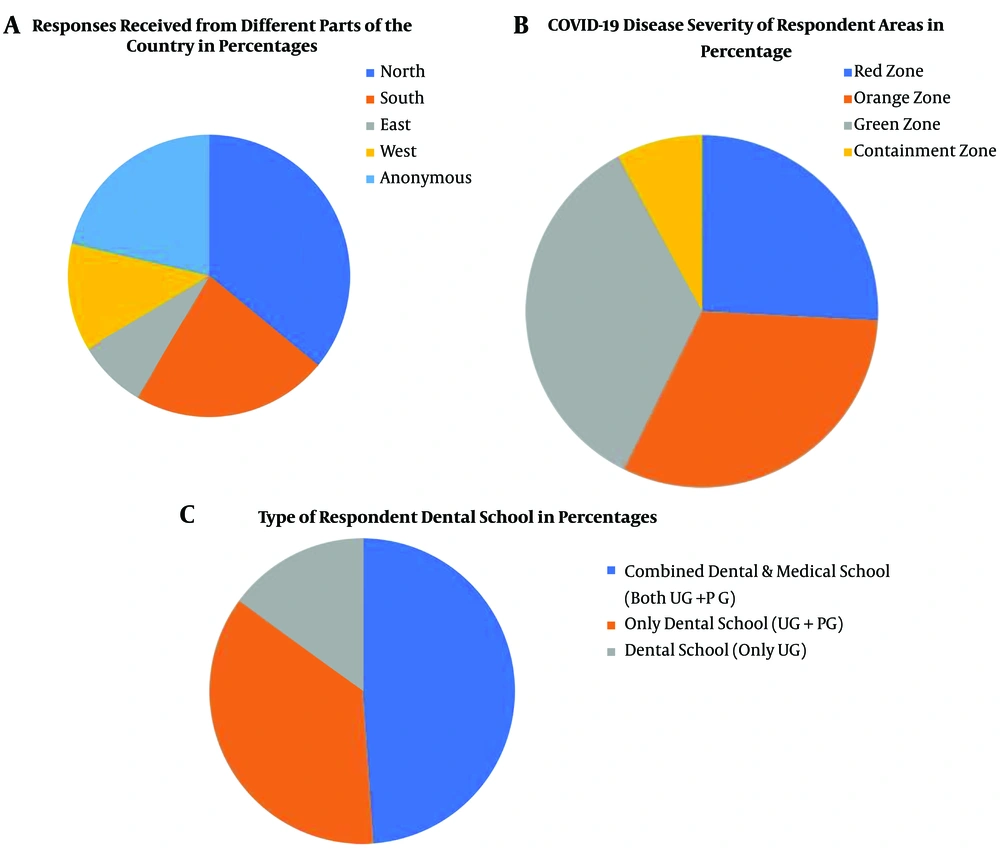
Figure 1.
General Overview of Respondent Dental Schools. Abbreviations: UG, undergraduate; PG, postgraduate
2- Current Opinions on Teaching and Assessment: Level of Shutdown: Out of the 84 responses received (five did not answer this question), only three dental schools were found to be opened as usual for undergraduate, postgraduate, and faculty (3.37%) (Figure 2).
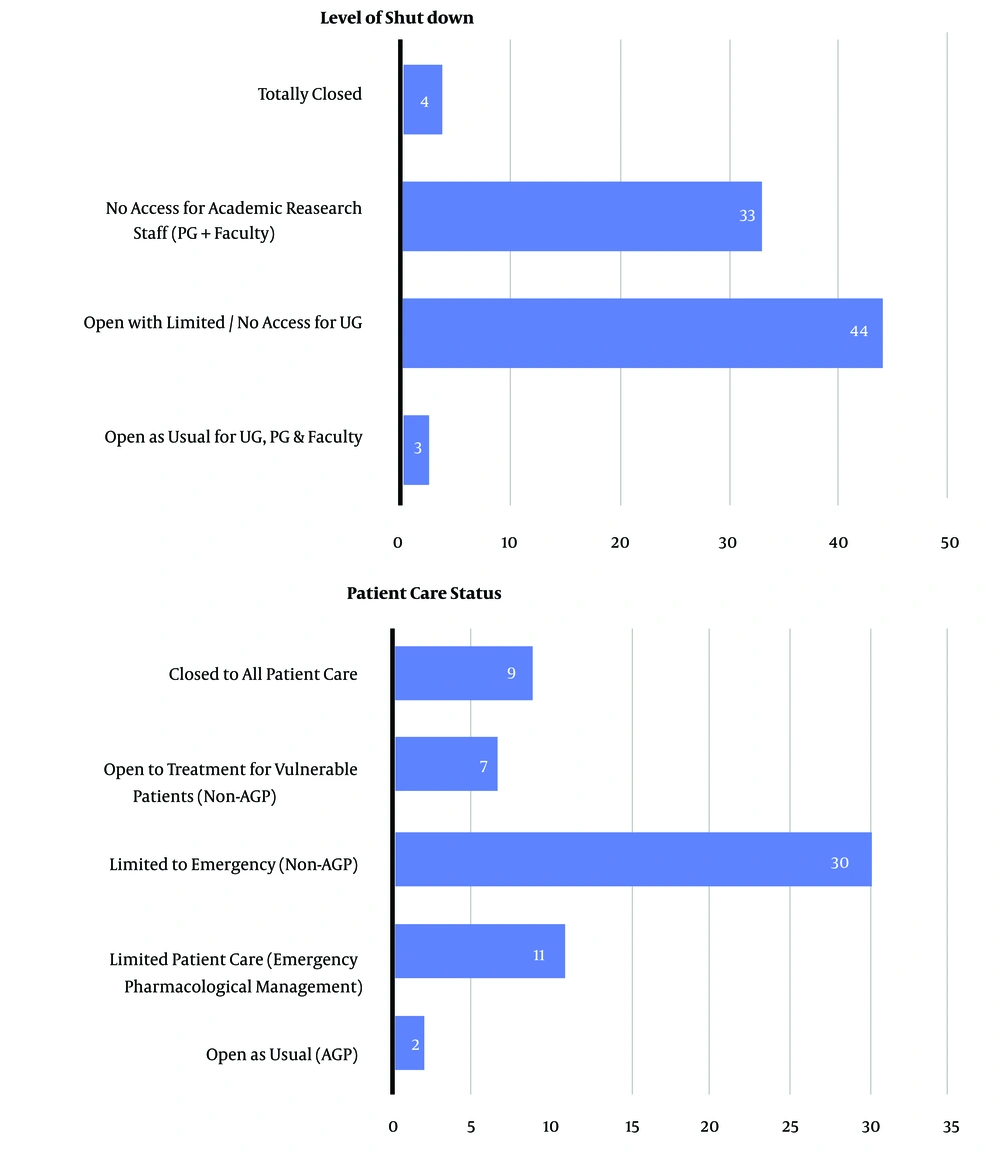
Figure 2.
Level of Shutdown and Patient Care Status of Dental Schools. Abbreviations: UG, undergraduate; PG, postgraduate; AGP, aerosol-generating procedures; non-AGP, non-aerosol generating procedures.
Patient-Care Status: The status of dental schools regarding the level of patient care is depicted in Figure 2. Vulnerable patients were defined based on health status, age, special needs, or patients undergoing radiotherapy. The responses received were 66.3% (n = 59).
Online Teaching: Online teaching arrangements were made by 100% of dental schools for the undergraduate curriculum. The platforms enlisted by respondents included Zoom (n = 52, 58.42%), Google platforms (n = 23; 23.84%), WebEx (n = 12; 13.48%), and various other platforms like Microsoft sheets, Jio-meet, Moodle, WhatsApp, work assignments, institutional webpage, or multiple platforms.
Assessment Pattern: None of the dental schools were considering this academic year as zero-year, 28 were contemplating a total online examination for students (31.46%), 30 were waiting for directives from the government (33.7%), nine were uncertain regarding the best course of action (10.11%), nine were considering summative assessment through proper examination once the situation normalizes (10.11%), and 15 were thinking of formative assessment of students through previous records and assignments (16.85%).
The final decision regarding student assessment was considered a prerogative of the University administration (n = 62, 69.66%), while few were awaiting government directives.
Overall, an uncertainty prevailed amongst dental schools on decision-making responsibility regarding assessment.
Assessment of Clinical Competence: According to the results, 42.70% (n = 38) of dental schools were contemplating assessment of clinical competence of undergraduate students, whereas 57.30% (n = 51) of schools were not considering the evaluation of clinical competence for this academic session.
The alternatives to patient treatment for assessment of clinical competence mentioned by respondents were evaluation through case-scenario based multiple choice questions on diagnosis and management, history taking skills on patients, clinical simulations, virtual patient scenarios, procedural skills on skull/phantom heads, role-play, mannequin exercises, etc.
Most schools were waiting for directions from the government, dental council, or for the situation to normalize.
Postgraduate Dissertations: In a dental school teaching to postgraduate students, 50% of respondents felt that the time for dissertation submission should be extended, 25% were unsure how to manage thesis submission, 7.5% were considering changing topics, and 17.5% favoured reduced sample size/samples committed for study completion.
Varied views were gathered through an open-ended question regarding plan-of-action for dissertation completion. A synopsis of respondents’ views was as follows: “since only four months were lost (at the time of response), so if the duration of the clinical case follow-up could be shortened, a dissertation could be completed on time; the dissertation could be submitted after the final year exams with provisional results declared”.
Respondents felt that online face-to-face discussion could be done between the chief guide and students to find solutions.
3- Returning to Work Policy: Only 25.84% (n = 23) of respondents were prepared to return to teaching students in clinical settings in the next month or so; meanwhile, 19.1% (n = 17) were not prepared, and 55.06% (n = 49) were uncertain. Also, 64.04% (n = 57) of respondents felt that standard operating procedures specifically prepared for the COVID-19 pandemic would be required before resuming student teaching activities in clinical settings. In addition, 33.7% (n = 30) of respondents believed that the directives for opening dental schools should be given by national-level authorities like the Ministry of Health or the Dental Council.
Preparation for Resuming Work: Out of the dental schools prepared to resume work, 39.13% (n = 09) were preparing protocols for smooth functioning in the current changed situation, 26.08% (n = 6) were training the students, staff, and faculty to adapt to the changed situation, and another 26.08% (n = 6) were thinking about getting infrastructure modified and strengthened. Moreover, 8.7% (n = 2) were procuring necessary armamentariums like PPE to help resume work. The other preparations mentioned were the constitution of a special COVID-19 task force that could formulate protocols following government guidelines.
Limitations to Opening Dental Schools: The limitations mentioned were lack of clear-cut guidelines (50.5%; n = 08), lack of manpower (13.3%; n = 2), and lack of space for managing patients and students while maintaining social distancing (13.3%; n = 2). Other reasons were the fear of the social stigma attached to COVID-19, lack of initiative by authorities, and monetary constraints.
Mental Well-Being: The majority of respondents (73.03%, n = 65) felt that the current situation was going to affect the mental well-being of students attending patients during the COVID-19 crisis, while 20.22% (n = 18) were uncertain. Also, 61.8% (n = 55) of dental schools planned to provide psychological and emotional support to stressful students, while 25.84% (n = 23) were not sure whether they would be able to provide such supports.
4- Perceptions of Academicians
On a Likert scale (Table 1), the perceptions of academicians from across the country responding on behalf of their dental school were recorded regarding the changes brought about by COVID-19 towards teaching methods, assessment protocols, patient-work, future of dentistry, and clinical competence of students.
Table 1.
Perceptions of Academicians Regarding Changes to Dental Education During the COVID-19 Pandemic
| Question | Strongly Agree, % | Agree, % | Neutral, % | Disagree, % | Strongly Disagree, % |
|---|---|---|---|---|---|
| COVID-19 crisis can permanently change the teaching methods in dental education | 32.7 | 51 | 14.3 | 6.1 | 2 |
| COVID-19 crisis can permanently change the assessment methods in dental education | 24.5 | 61.2 | 8.2 | 4.1 | 4.1 |
| COVID-19 crisis can replace patients in teaching and assessment of dental students | 14.3 | 38.8 | 32.7 | 18.4 | 0 |
| COVID-19 crisis can adversely affect the future of dentistry in the long term in India | 14.3 | 32.7 | 20.4 | 34.7 | 0 |
| COVID-19 crisis can adversely affect the future of dentistry in the short term in India | 22.9 | 50 | 22.9 | 4.2 | 0 |
| COVID-19 crisis can adversely affect the competency of dental graduates passed during this time | 22.9 | 41.7 | 20.8 | 12.5 | 4.2 |
Views of academicians were also explored regarding measures through which dental education could be upgraded to make students clinically competent in patient care during this COVID-19 crisis phase. The opinions can be summarised as:
Motivation and support through a motivational speech at the start of the work routine to generate positive energy.
Virtual Case-Based Teaching: Clinically oriented case discussions, case presentations, video case-vignettes, webcasting, and online chatrooms.
Simulation Exercises: Clinical exercises on phantom heads, typodonts, and virtual reality simulation to get the real feel of patients.
Clinical Guidelines for Every Clinical Scenario: Completing the theoretical aspect of the curriculum during lockdown so that students have more time for clinical work once normal functioning resumes.
Modification of Infrastructure to maintain adequate distancing and ventilation.
Strict infection control arrangements, including fumigation and sanitization facility available with each department and COVID-19 testing for patients visiting the dental faculty.
Training for adaptation to the changed situation: donning & doffing of PPE and other related protocols.
Futuristic Approaches: Development of oral cavity like environment in pre-clinical phantom heads
Regarding the effective assessment of students without compromising their time and health, the views expressed are summarised as follows:
Alternatives to Clinical Assessment: Simulation models, case-based discussions, online viva-voce, online assessment, patient-simulation exercises, and problem-solving exercises.
Formative assessments based on year-round performance and selection of cases from the student’s record for discussion.
Selective Patient Treatment: Minimal aerosol-generating procedures (AGP) or non-aerosol generating procedures (Non-AGP).
Clinical assessment to be done on novel Coronavirus RT-PCR negative patients.
Protective Measures: Use of PPE and other protective gear, proper ventilation, fumigation/sanitization after the procedure, use of rubber dams, HEPA filters, and a high evacuation system.
Decreased number of students per day appearing for exams to maintain adequate distance and provide proper preventive measures.
Assessment of Protocols Followed in These Changed Situations: Pre-appointment patient evaluation, donning and doffing of PPEs, infection control measures (use of mouth wash, suction, and rubber dam), bio-medical waste segregation and disposal, an expedition of clinical work to reduce the chair-side time, and telephonic consultation.
Strengthening infrastructure to conduct an online exam.
On being asked about the challenges faced in opening dental school/university to dental education, the responses mentioned the following issues:
Financial Constraints: Inadequate means to control the spread of infection;
Student uptake to dentistry would be reduced due to the present phobia;
Inadequate space for safe distancing protocols to be followed;
Responsibility to keep students safe and pay attention to the concerns of parents;
Inadequate guidelines by the government, dental council, and dental associations;
Lack of provision of COVID-19 testing facilities;
Difficulty in maintaining a safe distance in hostels (food and lodging).
5. Discussion
In these uncertain COVID-19 times, dental schools worldwide face some form of challenges or dilemmas (5-7). The severe acute respiratory syndrome coronavirus-2 (SARS CoV-2) has literally brought the world to a standstill. Since this is a new situation globally, guidelines are being framed, modified, and reframed according to the ever-changing nature of evidence.
This survey represented the views of dental schools in the entire country (Figure 1A). A varying degree of severity existed in areas where dental colleges were located at the time of response collection (Figure 1B). This variability added to the richness of data through collecting opinions regarding challenges faced, solutions planned, and the requirement of preparedness to face these situations. Irrespective of the area-specific disease severity, the majority of dental schools have closed their doors for elective patient care. The onus for safeguarding the safety of dental students, faculty, and staff, along with reducing transmission rates and thus flattening the curve of the pandemic, lies with the dental schools (8). Dental schools across the country have conscientiously safeguarded students and upheld the safe-distancing policy, thus shifting to online teaching portals.
Understanding the prevailing conditions in India regarding dental education and patient care needs further evaluation. Dentists come under a very high-risk group due to the strong transmission possibility from SARS CoV-2, as dental procedures involve working close to the patient’s high-risk area (oral cavity) and through aerosols (3, 4).
The present survey gathered responses representative of all parts of the country. It also found that the areas where dental schools were situated had different severity of disease prevalence at the response time (Figure 1B). However, despite this variability, the level of preparedness, online teachings, assessment needs, and level of uncertainties were similar.
Since this is an unprecedented situation, all dental schools are tackling it customized to their convenience or as directed by local/state government policy. Lack of uniform conduct has given rise to newer innovative means in delivering dental education. E-learning platforms were explored as an effective teaching-learning medium even before COVID-19 transmission (9). The current situation has made these platforms accessible, given everyone concerned a hands-on experience, removed inhibitions/biases, trained learner/ facilitator, and established comfort level in their use. Since all (100%) respondents expressed that they were using some form of an e-learning tool to deliver curricular needs, it can be concluded that e-learning would have a much significant role in the post-COVID-19 era as well (10).
Institutional heads are raking their minds on how best to impart clinical training to students and conduct session-end examinations for undergraduates and postgraduates. There are different opinions (Table 1) and methodologies to assess students without compromising their time and health. Government policy is strictly required at this point to get uniformity in the pass-out Indian dental graduate competence level across the nation.
A big concern exists regarding the clinical training of students since dentistry relies on a very hands-on approach. Despite the suddenness of the pandemic, the schools have responded admirably through pre-emptive measures towards continuing education of the fledgling future dental professionals. Challenges are being listed, solutions drafted, and measures planned to safeguard the competence of dental students.
Another concern is about dealing with the anxiety levels of dental students who are faced with the challenge to adapt to newer teaching methodologies, grapple with the fear of unexplored assessments, and the daunting task of patient work in changed circumstances (11). This survey found that the majority (73.03%) of dental schools are aware of the mental stress on dental students and were prepared to take measures for safeguarding their students (61.8%).
There is a strong requirement from the governing bodies to constitute a task force at the national level to draft recommendations towards the way forward to dental education. Individualized attempts, though effective at the local level, will create a lot of disparity in the longer run. We need to understand the fear and concern of the dental fraternity dedicated to training the future of this profession. This survey highlighted the concerns of the dental fraternity across the country regarding dental education, clinical assessment, and various means to overcome the barriers.
The main limitation of this study was that it relied on electronic media to gather qualitative responses; so, data saturation could not be reached. Furthermore, since the responses were dependent on voluntary participation, this survey does not represent the collective data of dental schools in-toto.
The present survey evaluated various aspects of dental education affected by the pandemic, gathered opinions of academicians, perceived the general fear in the dental community, listed the challenges faced at the individual level, and gathered the possible solutions to those challenges. The indefiniteness of the duration of the pandemic, the challenge of distance education, lack of clinical chair-side training, unprecedented fear, and monetary and infrastructural constraints have shaken the very foundation of the future of dentistry.