
1. Background
The primary objective of medical education is to achieve a high level of competence among students (1). However, despite efforts to implement this approach, there are still instances of unsafe and low-quality health care, diagnostic and treatment errors, and other related issues worldwide, which adversely affect patients and their families (2). These challenges reflect the existing model of medical education (2).
Furthermore, in the rapidly changing modern era, where knowledge quickly becomes outdated and ineffective, knowledge itself is no longer the sole goal but rather a component of individuals' abilities and competencies (3). This shift in perspective has led to changes in societal expectations (4), moving from the mere retention and recall of information to the development of capabilities and skills (5, 6).
This shift is particularly evident in the field of medical sciences, where there is a strong tendency toward a competency-based approach (2, 3, 5).
Competence, in general, includes the ability to perform complex tasks that go beyond the acquisition of simple knowledge and skills (7). It refers to the integrated abilities of individuals (8), resulting from a combination of practical and theoretical knowledge, cognitive skills, behavior, and values that enhance performance or enable the fulfillment of specific roles (9). Consequently, medical students need to acquire a diverse range of skills to confidently work in complex, dynamic, and unpredictable clinical environments upon graduation (10). Achieving this ability requires deep, meaningful, and transferable learning (11). However, evidence indicates a gap between the country's medical science education and the realization of this goal (12).
Hashemiparast et al.(13), in a research titled: Challenges of using theoretical knowledge in the clinical field, which was conducted with the method of qualitative study - contractual content analysis and semi-structured interview, inefficient teaching-learning was introduced as one of the challenges. which includes the lack of theoretical knowledge reserves, the weakness of practical exercises and the lack of motivation for clinical learning opportunities. Also, Chabook et al. (14), in a study entitled: Evaluation of the quality of higher education from the perspective of students, which was conducted as a descriptive survey, showed that the quality of higher education in Urmia University of Medical Sciences is less than desirable.
However, the present research aimed to provide a clearer understanding of competency-oriented education in the field of medical sciences in the country. The research question under investigation is: What is the current state of competency-oriented education in the field of medical sciences in the country?
2. Objectives
The objective of this study is to examine the current state of competency-oriented education in the field of medical sciences in Iran.
3. Methods
This research is of a qualitative-analytical-applied type and uses 2 methods: Research synthesis and qualitative content analysis.
3.1. Synthesis Section
Synthesis is conducted by Scoping review with the method of Arksey & O’Malley,2005 (15), Because the method not create restrictions on the use of different forms of literature(validity measurement). Therefore, it can provide an outline of any study done in relation to the subject. This process is shown in Figure 1.

Figure 1.
The synthesis research process with Scoping review.
3.2. Selection of Cases
In the synthesis research section, the data were selected using the purposeful sampling method, from the whole collection method or criterion sampling method. This means that all the studies that met the criteria for entering the research were included in the research (16).
The search strategies involved using specific research keywords such as medical science, education, evaluation, qualification, review, competency, and Iran and using logical operators (OR/AND) to combine them. The selection of articles was based on a thorough examination of credible and relevant sources.
Various databases and websites were used for the search process, including SID, Noormags, Web of Science, Scopus, PubMed, Google Scholar, and the website of Iran's scientific education publications.
Research inclusion criteria was as follow: (1) Related to the research question; (2) qualitative research or quantitative research with qualitative analysis; (3) researches conducted in Iran from 1402 to 1395; (4) printed in English and Farsi.
Exclusion criteria was as follow: (1) Articles before "1395"; (2) researches that compared teaching and learning methods in an experimental way; and (3) articles that were not in Farsi or English.
The chosen timeframe aimed to include more recent studies that reflect the changes and improvements in medical sciences education in recent years.
The screening process involved carefully reading the abstract, methods, and outcomes of the identified articles. Ultimately, 11 articles that aligned with the research objectives were selected. Then, with a more detailed review of the articles, the necessary data, including methods, tools, findings, and in some cases, analyzes and discussions, were selected and recorded in the data table. Then, classification, analysis and interpretation of the data were done and it was prepared for integration with the qualitative analysis results of the group discussion and to identify the state of medical science education in terms of competence-oriented in the country. The process of selecting articles is shown in Figure 2.
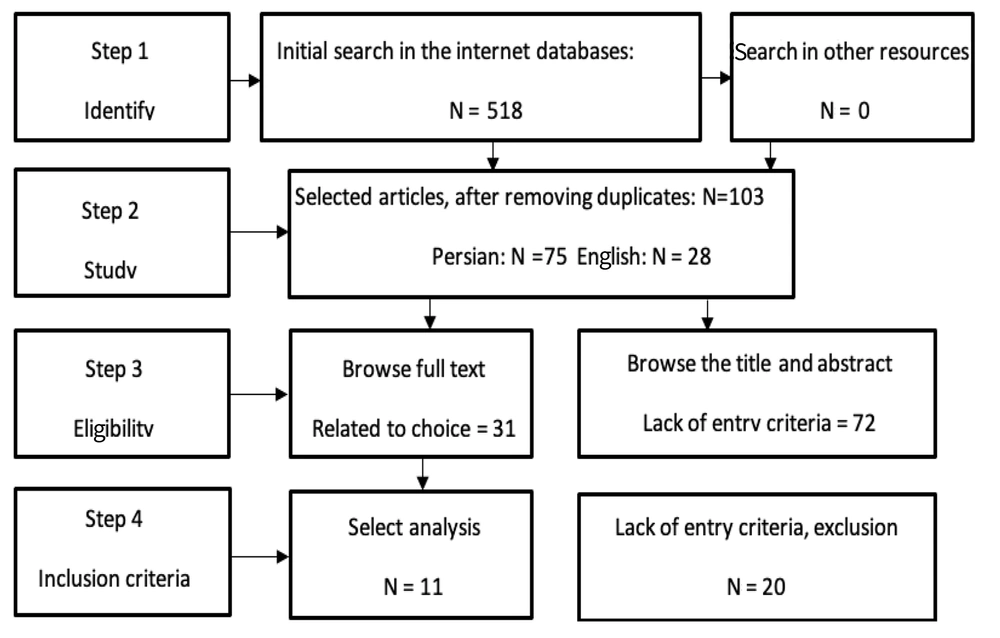
Figure 2.
The process of data collection.
3.3. Qualitative Content Analysis
The second method used in this research was qualitative content analysis. The data for this section were collected through focus group discussions, following the model proposed by Graneheim and Lundman (17) (Box 1). This approach involved identifying semantic units, creating categories, and ultimately developing themes based on the collected data.
Box 1.
The Model of Graneheim and Lundman (2004)
| Determining of Semantic Units | Summary and Compression of Semantic Units | Create Floors | Creating Themes (Contents) |
3.4. Participation
The participants in the focus group discussion included 14 doctoral students and medical science professors from Shahid Beheshti University. They were selected using purposeful sampling, specifically the snowball sampling method (16). The focus group discussion took place both online and face-to-face, lasting for a 4-hour group session. The discussion continued until data saturation was achieved, which means that no new information or themes were emerging. The discussions were audio recorded for data recording purposes.
3.5. Analysis
Within 48 hours following the meeting, the recorded materials were thoroughly listened to and transcribed verbatim using Word software. No parts of the transcription were omitted, including repeated words. The data were then analyzed using the qualitative content analysis model proposed by Graneheim et al. (18). To ensure research validity, the recorded content was repeatedly listened to, and the transcriptions were carefully read (immersed) by the researcher. Additionally, a second reviewer participated in all stages of data recording and analysis. The findings of this section are presented in Table 1.
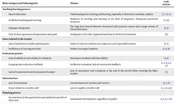
Table 1.
The Current Status of Competency-Oriented Medical Science Education (Synthesis Research)
| Main Category and Subcategories | Themes | Code Articles |
|---|---|---|
| Teaching-learning process | ||
| Passive education | Traditional passive teaching and learning, especially in theoretical and basic subjects | (5, 7, 8, 11) |
| Inefficient teaching and learning | Weakness in teaching and learning in the field of diagnostic, therapeutic-protective measures | (5, 10) |
| Improper integration | The long time interval between theoretical and practical courses and a large volume of theoretical topics | (3, 9) |
| Lack of clear expression of expectations and goals | Ambiguity in the roles of general medicine in the field of treatment | (11) |
| Issues related to the learner | ||
| Lack of attention to student participation | Failure to educate students in a responsive and responsible manner | (2, 5) |
| Inefficiency of learning activities | Surface learning of students | (5, 9, 11) |
| Evaluation process | ||
| Lack of validity or low validity of evaluation | Assessment methods with low validity | (3, 8) |
| Inappropriate evaluation feedback | Ineffective evaluation, lack of constructive feedback | (1, 2, 4, 5, 8, 11) |
| Lack of measurement and evaluation of output | Lack of assessment and evaluation at the end of the period before entering the labor market | (5) |
| Infrastructure | ||
| Lack of motivation | Low motivation of teachers and learners | (4, 5, 9) |
| Issues related to scientific staff | Lack of capable scientific staff | (1, 3, 4, 6, 11) |
| Planning process | ||
| Inconsistency in the quantitative and qualitative growth of education | Quantitative development, regardless of quality | (1, 2, 6, 7, 10) |
4. Results
The results of the synthesis study and qualitative content analysis (focus group discussion with experts) are presented in Tables 1. and 2. The combined results of these steps are summarized in Table 3. It is important to note that to shorten the tables (synthesis and focus group discussion), 1 theme has been selected for each subcategory.
Table 2.
The Current Status of Competency-Oriented Medical Science Education (Focus Group Discussion)
| Category and Subcategory | Theme |
|---|---|
| Educational process | |
| Knowledge transfer than competence-oriented approach | Lecture and knowledge transfer is the dominant teaching method in theoretical and basic science classes |
| Inactive teaching methods | In bachelor's degree, the student's participation is less, and the professor talks more |
| Unexpressed goals and expectations | Large content and a large number of students only give the professor the opportunity to present the course material in the form of a lecture in the basic science classes |
| Non-integration of theoretical and practical topics | Diversity of student level, lack of training in hospitals, and large number of patients make it difficult to integrate theoretical topics and their applications |
| Learning process | |
| Issues related to the learner | Non-participation of students in basic and theoretical courses |
| Student activity | With 150 students in the primary class, the only opportunity is to present the lesson as a lecture |
| Evaluation-feedback process | |
| Evaluation validity | The impossibility of accurate evaluation due to the large number of students |
| Implementation problems of evaluation | The impossibility of accurate evaluation and feedback (based on competence) due to the large number of students |
| Infrastructure | |
| Issues related to scientific staff | The need for scientific reinforcement of professors |
| Limitation of opportunities and possibilities | The lack of possibility for the student to face the real situation, practical exercises, and integration of knowledge and practice (experience) |
Table 3.
The Current Status of Competency-Oriented Medical Science Education (Synthesis and Focus Group Discussion)
| Category and Subcategory | Theme |
|---|---|
| Instructional process | |
| Passive instruction | Failure to clearly express expectations and goals; emphasis on presentation knowledge; improper quality of teaching; non-use of active teaching methods; inattention to the level and experience of learners; failure to allow students' participation |
| Improper integration | The long time gap between theoretical and practical courses (impossibility of adaptation); inattention to integrated and coherent ability (medical competence) |
| Passive learner | Lack of active student participation in the learning process; inefficiency of learning activities; superficial and ineffective learning |
| Evaluation process | |
| Lack or low evaluation validity | Assessment methods with low validity and non-standard; lack of evaluation at the end of the period before entering the labor market |
| Inappropriate evaluation-feedback | Unfavorable and low credibility evaluation methods; lack of non-constructive feedback; defects in evaluation, monitoring, and appropriate feedback in the clinical environment |
| Infrastructure | |
| Issues related to the learner | Low motivation and self-confidence of students to learn or effective learning |
| Issues related to scientific staff | Low motivation; lack of capable scientific staff; weakness in teaching methods and academic ability of teachers; unfamiliarity of many professors with active methods |
| Facilities and equipment | Limited opportunities and facilities, especially at the undergraduate level; lack of qualified human resources (professors) |
| Planning process | |
| Inconsistency in the quantitative and qualitative growth of education | The inconsistency of student acceptance with facilities, equipment, educational space, and professors |
The combined results of the 2 parts of the research highlighted a significant gap between medical science education and competency-oriented approaches across various dimensions. These findings were classified into 4 themes and 12 subcategories. The themes identified are the instructional process, evaluation process, context-infrastructure, and planning process.
5. Discussion
The aim of this research was to examine the state of medical science education in Iran from the perspective of competency-oriented approaches. The results of the synthesis research, which included 11 articles, and the focus group discussion with 14 experts in the field of medical sciences reveal a significant gap between medical science education and competency-oriented practices. This gap is categorized into 4 themes: Instructional process, evaluation process, context-infrastructure, and program process.
The educational process includes all activities carried out by teachers and learners to facilitate learning. The discrepancy between the educational process and competency-oriented approaches was attributed to inactivity and a lack of proper integration (medical competence), unclear expectations and goals, insufficient support for participation in learning activities, and inefficiency.
These findings are consistent with the results of previous studies, including studies on students' perspectives (19), challenges in medical science education (13, 20-23), dimensions of common educational methods in medical science as perceived by students (24, 25), and evaluation of education quality (14, 26). Meanwhile, the importance of a supportive learning environment based on the dynamic and active nature of the learning process was confirmed to facilitate deep and meaningful learning, which is a key characteristic of competency-oriented education (27).
The category of evaluation plays an essential role in education as it not only demonstrates the achievement of educational goals but also contributes to a deeper learning process (28). This aspect becomes even more significant in competency-oriented education or deep and meaningful learning. Deep and meaningful learning is facilitated through authentic and constructive evaluation that aligns with the direction of learning (29). In this research, the gap between medical science education and competency-oriented approaches in terms of the evaluation process encompasses the lack or low validity of evaluation, inappropriate evaluation methods, and insufficient or inadequate feedback. These findings are consistent with previous studies on the challenges of medical science education in Iran (13, 20-23, 26) and the evaluation of education quality (14, 19).
In the category of context infrastructure, consideration should be given to factors such as motivation and issues related to academic staff. Various dimensions, ranging from scientific-professional preparation to motivation, need to be addressed. Studies have indicated that a continuous decline in motivation leads to a decrease in teaching and learning effectiveness, thereby increasing the gap between education and competency-oriented approaches. These findings are supported by studies on the evaluation of education quality (26), challenges in medical science education (20, 21, 30), and students' perspectives on achieving competence (24). Physical facilities and equipment, along with the ease of teaching and learning, play a crucial role in creating a pleasant and motivating educational environment, which ultimately leads to effective learning outcomes.
The category of planning process includes inconsistency in the quantitative and qualitative growth of education, the compactness of educational programs and materials, the density of students compared to facilities and time, the inexperience and unfamiliarity of professors with active methods, the gap between theoretical and practical or clinical education. which is one of the factors of inefficiency of teaching and learning, or superficial learning of students or according to Renkl. et al. 1996 (as cited in Schindler et al.) is known as inefficient knowledge development.
The gap between medical science education and competency-oriented approaches is particularly prominent at the bachelor's level and in basic and theoretical courses. The compactness of the curriculum and the lack of resources often lead to a predominant reliance on lecture-based teaching methods. Consequently, there is limited opportunity to engage with practical aspects, conduct evaluations with constructive feedback, and facilitate cooperative and active learning. The lack of proper integration between theoretical and practical education exacerbates this issue. These dimensions have been emphasized in various studies (14, 24, 31-33).
5.1. Conclusions
Based on the research findings, despite the notable achievements of medical science education in recent decades, a significant gap is observed in terms of efforts to train and equip the community health system staff to enhance the qualifications of graduates in this field. This gap is particularly evident in educational methods, active student engagement in lessons, appropriate evaluation and feedback, as well as the contextual aspects, especially at the bachelor's level and in basic and theoretical science courses.
5.2. Highlights
- This research showed, the policymakers and those involved in medical science education should pay attention to and emphasize qualitative growth along with quantitative growth.
- The qualitative development of medical science education requires coordination in the ratio of student acceptance to facilities and equipment, including experienced professors familiar with active educational methods and technical equipment needed to create a suitable educational environment, which should be taken into consideration by practitioners.
- In order to achieve qualitative growth, instead of providing a mass of information to students, learning to learn, how to obtain the required information, evaluate and use them, should be emphasized.
5.3. Lay Summary
The education of medical sciences in our country shows a significant gap up to the level of competenceـ oriented, so those involved in the education system of medical sciences should try to reduce this gap. Contains; Coordination in quantitative and qualitative growth, providing a suitable learning environment, in order to promote understanding and a higher level of thinking and applying knowledge, instead of memorizing and accumulating information, in medical students.