1. Context
Biomimetics or imitation of natural organisms is the knowledge that can be used to improve human life based on the research achievements of biologists with the help of engineering and technology. The use of this knowledge in architecture can improve the performance of elements and thus make users more comfortable (1). Because of the contact surface of a building form with the surrounding environment, it is constantly interactable due to the presence of environmental forces such as structural loads, climatic loads, and weather conditions. The improvement of this part of the building in terms of shape and details can lead to an increase in the quality of the form. One of the best biological patterns for finding natural solutions to external building shell problems is the human skin. The skin is a vital organ without which the body will not be able to survive. It is the body’s first point of contact with the external environment. Its thickness is not uniform in all parts of the body and varies between one and four millimeters. The features of this biological element create ideas for the design and construction of external shells. It has a pivotal role in human life.
This descriptive and analytical research tried to identify the properties, characteristics, and structure of human skin by using library resources and documents. While decoding the data, these features were analyzed and some were chosen, and finally, by changing and adapting them to the external shell of the building form, suitable ideas for improving the external shell of the form were proposed, which can be adjusted to see more manageable and flexible environmental factors.
2. Evidence Acquisition
2.1. Human Skin and Its Composition for Environmental Adaptation
Human skin can be identified by its three main layers. The thickness of the epidermis as the first layer of the skin varies in different parts of the body and its main constituent cells are keratinocytes, melanocytes, Langerhans cells, and Merkel cells. Merkel cells act as tactile receptors in this area (2). Keratinocytes have desmosomes that are drawn between epidermal cells and resist mechanical stress because of their hyper-adhesive characteristics. In melanocytes, there are organs called melanosomes, in which the process of melaninization takes place. Differences in the number, size, and distribution of melanosomes cause skin discoloration, and factors such as sunlight and stress stimulate melanocytes to produce melanosomes (3). Langerhans cells are among the keratinocytes, and these cells originate from the monocytes of the bone marrow and play an important role in delayed allergic reactions. Thus, the epidermal layer is a layer of the skin that acts as a barrier against environmental conditions and contamination. This layer is responsible for the synthesis of lipids and factors that counteract free radicals such as vitamins E and C.
The dermis layer is five to seven times thicker than the epidermis and is attached to it by a basement membrane. The dermis is made up of a thick communicative membrane. It is a network of blood and lymph capillaries, nerve, and sensory fibers and their terminals, collagen, and elastin protein fibers (4). Hair follicles, blood capillaries, fat glands, and sweat glands are also found in this layer. This layer strengthens the skin tissue, creates elasticity and plasticity, and protects the skin against physical damage (5). Figure 1 shows an example of a rabbit’s skin being stretched. The elasticity of the skin prevents it from complete disintegration, makes it last longer, and prevents it from expansion, damage, and weakness. The third layer of the skin is the hypodermis, which connects the skin to muscle tissue. This layer, with the abundance of fat cells, has a lot of elasticity. It also plays a very important role in maintaining blood capillaries and neural terminals (6).
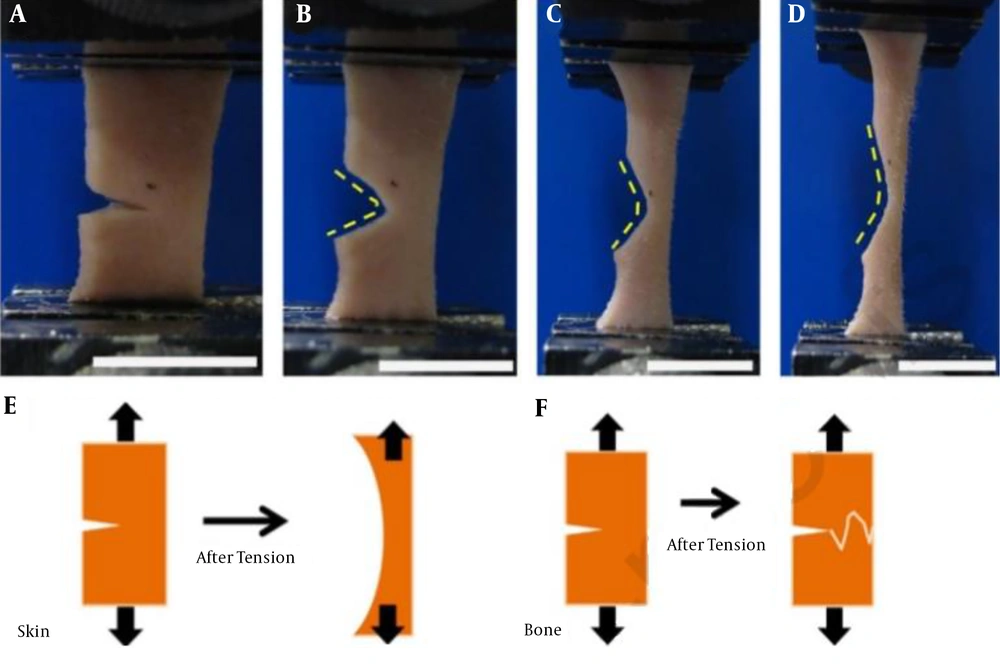
Figure 1.
Rabbit skin in traction and comparison with bone tissue (6).
On the other hand, the form of skin cells called squamous cells is an interesting pattern found in the cellular tissue of many microorganisms. The same pattern can be seen in the micro dimensions in nature (clay cracks after drying) and is a manifestation of fractal geometry. This hexagonal pattern was first discovered in the cellular systems of the human skin by the Italian mathematician Voronoi, and it can be drawn in two and three dimensions. In summarizing the practicable characteristics of the human skin in architecture, the following characteristics can be briefly mentioned (Figure 2).
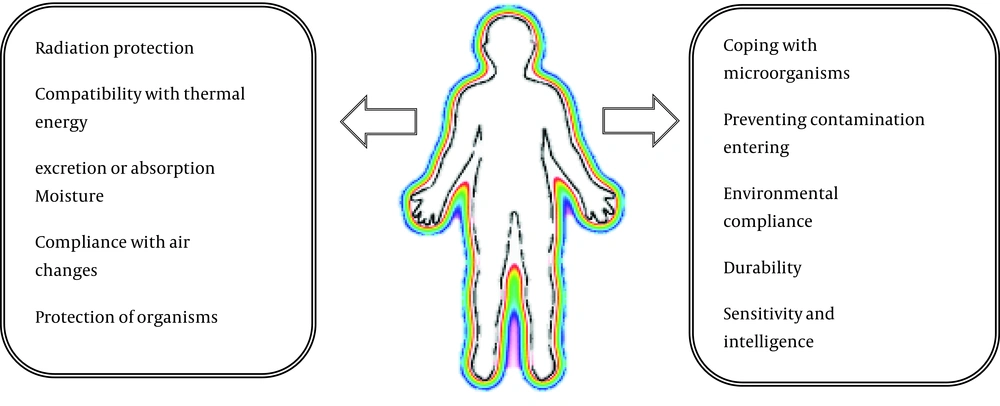
Figure 2.
Summarized features of human skin that can be used in architecture
2.2. Characteristics of the Skin Used in the Architectural Form
The pattern of the human skin, or the Voronoi pattern, has been used in some scientific sources and projects. The Voronoi pattern consists of a spatial space filled by continuously discrete convex polygons without overlapping. It is the same as the squamous cell pattern. The pattern can be applied in two-dimensional and three-dimensional drawing and was discovered by the Italian mathematician Veronoi. Applying the Voronoi pattern, as a model for structural and architectural design, can eliminate problems such as loss of comfort of residents, destruction, and corrosion of structural and non-structural elements, energy consumption for ventilation, etc. Similar to the skin, it presents a smart surface to respond the structural necessities. Figure 3 shows the Voronoi model and C wall project with soft borders. Figure 4 illustrates two design projects inspired by the Voronoi model of the human skin.
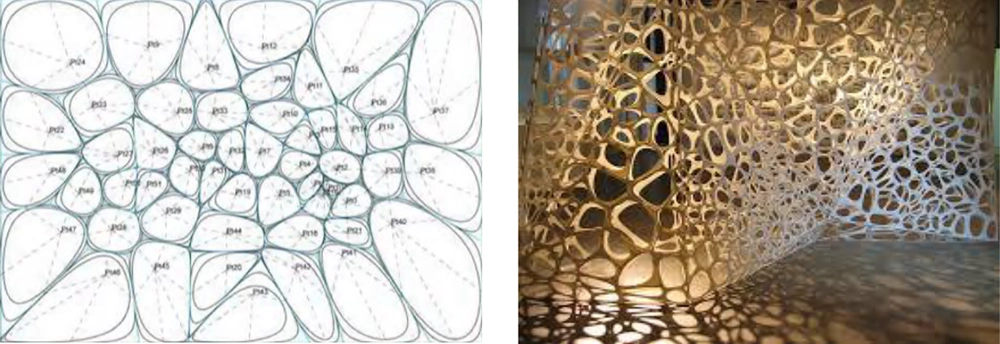
Figure 3.
Left, Voronoi model with a soft borderline; right, C Wall, 2004.
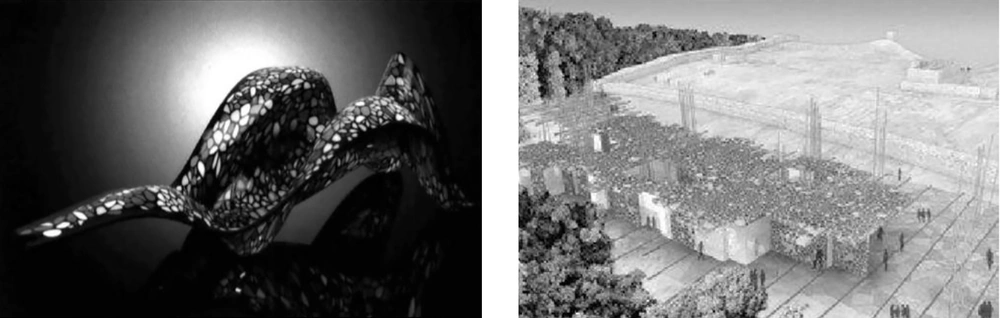
Figure 4.
Projects inspired by the Voronoi model, left, Tulum museum, 2005; right, Monocot prototype.
According to its specifications, the skin is thicker in areas that are more prone to mechanical damage, and the thickness of the skin is proportional to the function of each organ and the requirements of each part of the body to protect itself. These features can be generalized to shells, and this can be the first point for their optimal design; the more concentrated the stress, the thicker the shell, and where it is less likely to be stressed, there is less thickness (6). In the case of keratinocyte cells, which are cells with water reserves like most of the cells, the production of new keratinocyte cells brings the previous cells closer to the outer surface and as close as possible to the outermost layer of the skin. By decreasing the water supply for these cells, they become denser to the point that they completely lose their water content and turn into dead cells. The layering structure of this tissue, its condensation, and movement the inside to outside layers create an insulating and protective tissue for younger cells. Squalene, an oil found in dead cells, also helps remove impurities and reduce the effects of natural pollutants on the body. This function and pattern in the epidermis layer of the skin can also be used in the design of walls to have both filtering property and protective function against air pollution. The presence of abundant fat cells in the hypodermic layer has given a lot of elasticity and plasticity to the human skin. This capability can be used in the design of shells with the ability to close the arms, elastic structures, etc. There is another type of deformation in the human skin that, if you bite your hand, its effect will be left on the skin, but will disappear in a short time. This reformation is also due to the tightness in the adipose tissue of the skin and causes elasticity and self-healing, which is very important in buildings and smart materials. One of the inspirations from skin elasticity is in designing smart alloys. Another one is to create elasticity in materials or a set of external shell mechanisms so that they deform against incoming forces while, after removing the force, they again back to their original forms. In smart alloys, the mechanism is clear, but in the elastic mechanism, we can use a variety of dampers and springs and elastic joints.
The skin of the human body begins to produce melanin in the presence of sunlight, and this is a reaction of the skin, which undergoes hypercoloration to protect itself from ultraviolet radiation in the light. Various emotional behaviors such as fear, embarrassment, and stress may also change the skin color. The mechanism of this reaction can be used in the design of building facades and is effective in distributing the received radiation and ambient temperature, especially exposed in the more radiation side of the building, and it creates more uniform conditions in the overall construction form. This can be performed by selecting smart materials that can change color in the body of the facades, while providing more uniform conditions in the shell, causing variety and beauty in the exterior of the shell (7). Examples of these materials can be pointed to photochromic and thermochromic materials that change color in the face of different radiations or thermal conditions. In response to external changes such as ambient temperature, some mechanisms are activated on the surface of the skin that can help maintain body temperature by closing and opening the pores of the skin surface. Of course, in this process, skin surface secretions, such as sweat gland secretions, also play an important role in lowering the body temperature. This mindset has also been used to control the radiation entering the building, internal heat, greenhouse conditions, and generation of airflow inside the shell. Skin pores can be used for air purification and dehumidification mechanisms. This is a mechanism that can be useful and efficient today to overcome the industrialization and air pollution challenges in cities. The covering tissues of human skin can be classified into two forms: simple and stratified. These different cellular arrangements in human skin are effective in insulating (thermal) and skin thickness. This type of makeup can be used in the design of thermal insulation of buildings in different climatic conditions and even fronts.
Therefore, it can be suggested that by imitating different patterns in the human skin, it is possible to identify and apply three categories, including protective patterns, adaptability patterns, and smart patterns in the building. Protective patterns with a variable thickness protect the internal components by diverse layers, with different densities comprising various filters to prevent the entrance of environmental pollution to the form, protecting it against radiation and external mechanical forces. Adaptability patterns include elasticity and ductility due to dynamic forces, and surface layer changes for adaptation to climate changes, such as temperature and humidity; in other words, it means the ability to change the mode for adapting to new conditions while considering the least changes in optimal conditions. In smart models, we can point to the ability to self-repair, warn of changes, injuries, and diseases, change management, and adaptation. Table 1 shows skin specifications and their capabilities in architecture.
Table 1.
Building Characteristics Inspired by Human Skin Characteristics and Functions
| Function | Skin Characteristics | Application in External Shell Form | Usable Structure |
|---|---|---|---|
| Alignment-protection | Thickness change | Thickness changes due to structural reasons due to erosion and weather conditions due to energy absorption and excretion | Resistant and flexible materials with sufficient thermal capacity |
| Intelligence | Touch receivers (in the epidermis) | Connecting intelligent light and energy receivers | Smart sensors and BMS systems |
| Control-beauty | Stretching due to accumulation of water (in the epidermis) | Relaxation and change in the shell shape due to moisture | Water-resistant and durable materials and deformable shells |
| Beauty | The process of melanin production and skin color difference | Color change in facade materials | Color changeable materials |
| Intelligence-control | Stimulation by the sun and stress (melanocytes) | Smart terminal sensitivity to light, pressure, shock, abrasion, and warning | Reaction systems against forces |
| Intelligence-control | Delayed reaction (Langerhans cells) | Creating an alarm against the threat of pollutants | Alarm systems |
| Control | Environmental control (epidermis) | Controlling body temperature with openings, air movement, thermal insulation, and thermal capacity of materials | Thermal insulation and controllable smart openings and photovoltaic cells |
| Protective-control | Contamination control (epidermis) | Cleaning the air or preventing the entry of polluted air | Mechanical filtration and air purification walls and anti-UV materials |
| Alignment Protection | Stretching (caused by the fat synthesis in the epidermis) | Flexibility and impactability | Flexible and stretching shells |
| Protection | Factors fighting free radicals (in epidermis) | Absorption of nutrients and preventing the penetration of corrosive substances | Use of smart materials and weak electric currents |
| Protection | Existence of a connective membrane (between the dermis and the epidermis) | Making connections in different layers of the shell | Sturdy and continuous structures in shell layers of the form |
| Intelligence-alignment | Existence of thick communication membranes including blood and lymphatic capillaries, nerves, collagen, elastin protein (its job is to maintain the nerve) hair follicles, sebaceous glands, sweat glands (dermis) | Placement of shell intelligent systems in the middle membrane, including light, energy, pollution, humidity sensors, various types of stresses, restoration of materials, and strengthening the elasticity of the shell over time | Use in building intelligence systems |
| Protection | Tissue strength and elasticity (elastic) | Creating resistance in the middle layer by elastic materials | Reusable shells |
| Protection | Skin-to-muscle binder (hypodermis) | Connecting the outer shell by the inner layer to the form stabilizing structure | Durable intermediate bonding of shell layers |
| Protection | Elasticity and impact (hypodermic fat cells) | Resistance to external stresses | Resistant and shock absorbing materials |
3. Conclusions
Natural organs and related mechanisms can be the best mimetic design patterns. Human skin is no exception to this rule and can be used as a model for design. Characteristics such as protection of the body against pollution, microorganisms, radiation, and adaptation to environmental conditions are the features that express the maximum adaptation of the skin to its surroundings. On the other hand, the internal layout of textures, the way of protection, and the connection of each layer with another layer of the skin can be a suitable model in design. In this study, we divided human skin patterns into three categories: protective, adaptable, and intelligent. We divided the use of protective patterns into mechanical protection of the design, protection against environmental pollution, radiation control, and insulation. For each of these categories, a similar pattern was introduced for human skin, including layered structures, thickness changes, and cellular appearance. Thermal and moisture adaptability was introduced with the help of water and fat storage capability of the skin. In the smart model, the ability to warn and manage different reactions and conditions was pointed out.