
1. Background
Osteoarthritis (OA) is a common degenerative condition that predominantly impacts weight-bearing joints, with the knee being the most affected (1). Knee OA results from multifactorial risk factors, including joint integrity, genetic predisposition, local inflammation, mechanical forces, and cellular processes (2). It can affect the cartilage, bone, synovium, and surrounding tissues in the three biomechanically distinct knee compartments, irrespective of the cause (3, 4).
Globally, the observed prevalence of knee OA is 16%, with an incidence of 203 per 10,000 person-years (5). Osteoarthritis is the leading cause of chronic disability in individuals older than 70 years and has been designated a ‘priority disease’ by the World Health Organization (WHO). Osteoarthritis is one of the ten most disabling diseases in developed countries (6). According to WHO estimates, 9.6% of men and 18.0% of women aged over 60 years have symptomatic osteoarthritis. Approximately 80% of people with osteoarthritis will have limitations in movement, and 25% cannot perform their major daily activities (7).
The diagnosis of knee OA depends on clinical manifestation, imaging features, and laboratory biomarkers. The widely utilized diagnostic criteria are outlined by the American College of Rheumatology (ACR), the European League Against Rheumatism (EULAR), and the National Institute of Health and Care Excellence (NICE) (8, 9). In clinical settings, knee OA is typically diagnosed when three symptoms (knee pain, morning stiffness, and functional limitation) coexist with three signs (crepitus, limited movement, and bony enlargement). The inclusion of additional plain radiography helps identify atypical cases of knee OA, especially when there is accompanying pathology (4, 10).
Different guidelines, such as those by the Osteoarthritis Research Society International (OARSI), ACR, and the American Academy of Orthopaedic Surgeons (AAOS), are employed for preventing and managing knee OA and addressing symptoms throughout life (11).
This scoping review addresses the imperative need to comprehensively understand the prevalence of knee OA in the UAE. Knee OA, while not fatal, poses a significant burden due to its progressive nature, leading to activity limitations and reduced quality of life (12). The associated physical and psychological impairments, coupled with substantial lifetime costs, underscore the urgency of examining the prevalence of knee OA in the UAE. Given the staggering economic burden, assessing the proportion of the population affected in the UAE is crucial for effective healthcare planning and intervention strategies. The prevalence of knee OA demonstrates regional variations shaped by diverse factors such as demographics, lifestyle, genetics, and environment. Recognizing these variations is pivotal for developing tailored interventions that address the specific challenges posed by knee OA in diverse geographic contexts, ensuring more effective and targeted healthcare strategies (4, 13).
2. Objectives
Therefore, this scoping review aims to synthesize existing literature, providing a foundational understanding of knee OA prevalence in the UAE and facilitating informed decision-making for healthcare professionals, policymakers, and researchers in the region.
3. Methods
3.1. Study Design
A scoping review was conducted and reported using the preferred reporting items for systematic reviews and meta-analyses (PRISMA) extension for scoping reviews (14). In addition, the methodological framework followed guidelines proposed by Arksey and O'Malley, with refinements proposed by Levac et al., and the Joanna Briggs Institute (15, 16).
3.2. Study Team
To enhance the robustness of the scoping review, the team included physiotherapists with expertise in both OA research and healthcare delivery. This comprehensive approach merges theoretical and practical knowledge, providing valuable insights into the methodology, critical evaluations, and nuanced considerations in identifying studies with knee OA cases (17).
3.3. Selection Criteria
All studies with participants aged 18 years and above, conducted from 1990 to 2023, and diagnosed with knee OA recruited from the general population were included in the current scoping review. All types of studies were included. The searches were limited to studies available in the English language. Studies were excluded if they were conducted outside the UAE, if the diagnosis of knee OA was congenital, or if there were comorbidities present. Grey literature (abstracts, conferences, commentaries, and editorials) was also excluded.
3.4. Data Sources and Search Strategy
Both primary (Ebscohost-Medline, Embase, Scopus, Web of Sciences, ScienceDirect, Springer, and Cochrane) and secondary (manual probing of reference lists of all the retrieved literature) searches were carried out from inception until June 2023. Keywords were identified through advanced search engines and the Medical Subject Headings Index (MeSH). Constructs (keywords and Boolean phrases) were drafted iteratively through team discussion. Keywords were categorized into two groups (prevalence and its synonyms; OA and its synonyms) to identify relevant studies. The search string was as follows:
("epidemiology"[MeSH Subheading] OR "epidemiology"[All Fields] OR "prevalence"[All Fields] OR "prevalence"[MeSH Terms] OR "prevalance"[All Fields] OR "prevalences"[All Fields] OR "prevalence s"[All Fields] OR "prevalent"[All Fields] OR "prevalently"[All Fields] OR "prevalents"[All Fields]) AND ("knee"[MeSH Terms] OR "knee"[All Fields] OR "knee joint"[MeSH Terms] OR ("knee"[All Fields] AND "joint"[All Fields]) OR "knee joint"[All Fields]) AND ("osteoarthritis"[MeSH Terms] OR "osteoarthritis"[All Fields] OR "osteoarthritides"[All Fields]) AND ("united arab emirates"[MeSH Terms] OR ("united"[All Fields] AND "arab"[All Fields] AND "emirates"[All Fields]) OR "united arab emirates"[All Fields]).
All identified studies were exported and organized using the reference management software Endnote X9.
3.5. Screening
To locate the potentially relevant studies, a primary and secondary search was conducted independently by two reviewers. Duplicate studies were identified and removed using the Endnote plugin and visual scanning. Title, abstract, and full-text screenings were performed sequentially to meet the selection criteria. Studies were considered as contributing to the evidence upon meeting all the selection criteria during the full-text screening. At each stage, a consensus meeting was held to resolve any disagreements on the potential inclusion of the studies. Additionally, a secondary search was performed by probing the final studies identified in the primary search using a similar process.
3.6. Data Extraction and Synthesis
A priori data extraction form was created mutually by the two reviewers, which included the following: Author, study year, study design and setting, sample characteristics (age, gender, and sample size), diagnostic instruments, study results, and quality of studies (17). Both reviewers individually charted the data in the data extraction form in an iterative process. Any initial disagreement was resolved upon a consensus meeting with all the authors. Each author carefully reviewed the paper to assess its validity, experimental design quality, method appropriateness, significance, contribution to advancement, findings importance, and originality, evaluating the research's contribution to the field. Studies were grouped and summarized according to the setting, populations, study design, measures used, and broad findings in terms of quantitative and qualitative data.
3.7. Quality Assessment
The methodological quality of all the studies contributing to the evidence was assessed by four reviewers independently using the Newcastle-Ottawa Quality Assessment Scale for case-control studies and the scale adapted from the Newcastle-Ottawa Quality Assessment Scale for cohort studies to provide a quality assessment of cross-sectional studies (Tables 1 and 2). For the current review, the quality rating was categorized based on the total number of stars scored on the scale: Five and above as satisfactory and four and below as unsatisfactory. Discrepancies in the scoring categorization were resolved by consensus among the reviewers (18).
Table 1.
Quality Assessment of Case-Control Study Contributing to the Prevalence of Knee Osteoarthritis in the United Arab Emirates a
| Authors and Year | Selection | Comparability | Outcome | Total Points | Quality | |||||
|---|---|---|---|---|---|---|---|---|---|---|
| Adequate Case Definition | Representativeness of Sample | Selection of Control | Definitions of Controls | Based on Design and Analysis | Ascertainment of Exposure | Same Method for Cases and Control | Nonresponse Rate | |||
| Al-Saleh et al. (2022) (19) | * | * | * | * | * | - | * | * | 7 | Satisfactory |
a Scoring is done using Newcastle-Ottawa Quality Assessment Scale for case-control studies.
Table 2.
Quality Assessment of Cross-Sectional Studies Contributing to the Prevalence of Knee Osteoarthritis in the United Arab Emirates a
| Authors and Year | Selection | Comparability | Outcome | Total Points | Quality | ||||
|---|---|---|---|---|---|---|---|---|---|
| Representativeness of Sample | Sample Size | Non-respondents | Ascertainment of the Exposure | Control of Confounding Factor | Assessment of Outcome | Statistical Test | |||
| Al Saleh et al. (2016) (20) | * | * | * | - | - | - | * | 4 | Unsatisfactory |
| Abdullah et al. (2014) (21) | - | - | - | - | - | - | * | 1 | Unsatisfactory |
a Scoring is done using an adapted scale from the Newcastle-Ottawa Quality Assessment Scale for cohort studies.
4. Results
An overview of the prevalence studies identification process is provided in Figure 1. Of the 25,009 potential records identified in the primary search, 5,421 underwent title and abstract screening, and 117 underwent full-text screening. On full-text screening of 91 studies, three studies met all the selection criteria. Five studies were identified through the secondary search; however, none of these studies contributed to the evidence. Thus, a total of three studies contributed to the evidence in the current scoping review (Table 3).
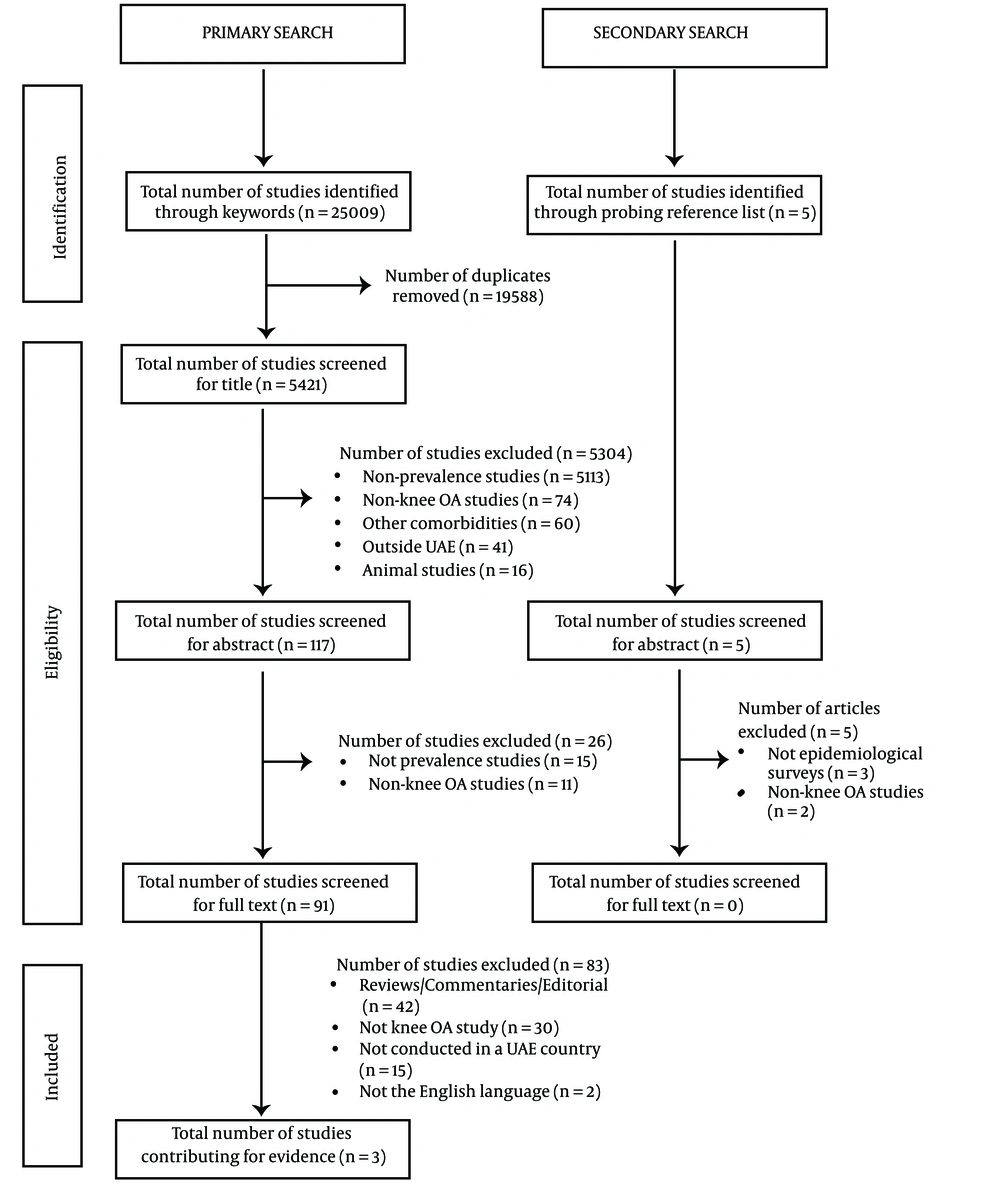
Figure 1.
Methodological framework on studies locating prevalence and associated risk factors of knee osteoarthritis in United Arab Emirates
Table 3.
Studies Contributing to Prevalence and Risk Factors of Knee Osteoarthritis in United Arab Emirates
| Authors and Year | Study Design and Setting | Sample Characteristics | Outcome Measures | Prevalence Rate and Risk Factors |
|---|---|---|---|---|
| Al-Saleh et al. (2022) (19) | Retrospective longitudinal case-control study and general population | Sample size: 11651, age: Above 18 years, gender: Male: 7177, female: 4474 | Secondary dataset | Knee OA prevalence: 1.40% |
| Al Saleh et al. (2016) (20) | Cross-sectional study and primary health care clinic | Sample size: 3985, age: 18 - 85 years, gender: Male: 901, female: 3084 | Questionnaire and locomotor examination | Knee OA prevalence: 25.8%, risk factors: Age: 41 - 60 years, BMI: Overweight (odds ratio 1.6, 95% CI: 1.3 to 2, P < 0.001) and obese (odds ratio 2.2, 95% CI: 1.8 to 2.8, P < 0.001) |
| Abdullah et al. (2014) (21) | Cross-sectional study and outpatient department of the hospital | Sample size: 304 | Questionnaire | OA: 47.1% |
In 2022, a retrospective longitudinal case-control study aimed to investigate the impact of OA on the Dubai healthcare system, utilizing the Dubai Real World Claim Database and analyzing 11,651 samples. The study revealed a 1.4% average prevalence of knee OA among individuals aged 45 - 54 years, with minimal variation noted between Emiratis (local nationals) and expatriates. Despite the overall satisfactory quality, the findings underscore the substantial healthcare and economic burden imposed by OA in the UAE. This burden signals the strain on healthcare resources and economic costs in the country. Notably, the study identified an unmet need among patients with challenging OA cases, suggesting current treatments may not fully address their requirements, emphasizing the potential for further research and therapeutic development. By acknowledging these challenges, researchers and healthcare professionals can strive to create interventions that alleviate OA's impact, enhancing patient outcomes in the UAE (22).
In 2016, a cross-sectional study utilizing a questionnaire was conducted on 3,985 Emiratis aged 18 - 85 attending 12 primary healthcare clinics in Dubai to investigate musculoskeletal disorders. Participants were diagnosed with rheumatic diseases using a validated questionnaire (kappa coefficient = 0.87) and locomotor examination. The study identified a 25.85% prevalence of knee OA. Notably, individuals aged 41-60 years and those with an overweight or obese body mass index (BMI) were associated with an increased risk of developing knee OA. However, the study's overall quality was deemed unsatisfactory (Tables 1 and 3). The findings underscore the prevalence of rheumatic diseases, particularly lower back pain and knee OA, among Emiratis attending primary healthcare (PHC) clinics. It's essential to acknowledge that this study specifically represents a rheumatic disease cohort attending PHC clinics and may not accurately reflect the overall prevalence of knee OA in the entire Emirati population (19).
In 2014, a cross-sectional investigation involving 304 patients attending outpatient departments at GMC Hospital in Ajman, Dubai, aimed to examine the prevalence and influencing factors of arthritis. The study reported a noteworthy 47.1% prevalence of OA; however, it is essential to note the study's suboptimal quality (Tables 1 and 3). The research discovered that approximately one-fifth of the surveyed patients experienced arthritis, underscoring its significant presence in the studied cohort. Furthermore, the study revealed a higher prevalence of arthritis among individuals who smoked and those classified as obese. These findings emphasize crucial modifiable risk factors for arthritis, specifically smoking and obesity. Raising awareness among patients about the adverse effects of smoking and the importance of maintaining a healthy weight could potentially contribute to reducing the incidence and burden of arthritis. Nevertheless, it is important to note that the study did not specifically focus on knee osteoarthritis (20).
5. Discussion and Conclusions
The current scoping review identified three studies addressing the prevalence of knee OA in the UAE population, reporting a prevalence range of probable knee OA cases from 1.4% to 25.8%. These findings align with the global pooled prevalence of knee OA at 16% (95% CI, 19.8% - 26.1%) (21, 23). However, a critical concern emerged regarding the lack of methodological rigor in the examined studies, raising doubts about the accuracy and validity of the reported prevalence estimates.
Variations in the prevalence of knee OA in the UAE are linked to potential cultural acceptability issues affecting sample selection, questionnaire use, and case definition. Differences in study design elements introduce errors and uncertainties into prevalence estimates, emphasizing the need for representative patient recruitment and rigorous methodologies. Heterogeneity in case definition, sample selection, and questionnaire use underscores cultural acceptability concerns, raising doubts about the reliability and comparability of knee OA prevalence data in the UAE. Adapting study components to align with cultural norms is crucial for enhancing validity, reliability, and fostering community engagement and acceptance. This highlights the urgency for future research to employ robust methodologies for accurate prevalence assessments.
The reported variations in knee OA prevalence in the UAE have broad consequences for healthcare planning and resource allocation. These variations pose challenges in allocating resources within the healthcare system, potentially leading to disparities in access to care and strains on healthcare infrastructure. The effectiveness of interventions may vary, necessitating tailored strategies to address the diverse needs of different demographic or geographic groups. Public health messaging and education efforts must be carefully adjusted to reflect these variations, ensuring targeted awareness campaigns. Policymakers face the challenge of balancing policies between regions with high and low prevalence rates, necessitating research priorities directed at understanding contributing factors to these variations.
Furthermore, the scoping review underscores age and BMI as globally recognized risk factors associated with knee OA. The age-associated changes seen in cartilage, muscle (sarcopenia), bone (increased remodeling), fat (increased depots), and the nervous system (altered proprioception) could play a role in the development of knee OA among older adults (24). Increased BMI often imposes an excessive load on the weight-bearing joint along with hormonal and cytokine dysregulation (25).
Assuming a causal relationship, it is plausible that the prevalence of knee OA among patients in the UAE is intricately influenced by a combination of risk factors, with a particular emphasis on the substantial impact of BMI and lifestyle choices embedded within the cultural context. The escalating rates of obesity in the UAE are likely to significantly contribute to the burden of knee OA, given that elevated BMI is hypothesized to exert heightened mechanical stress on weight-bearing joints (26). Furthermore, the cultural and lifestyle characteristics of the UAE, encompassing dietary habits and attitudes towards physical activity, play a pivotal role in either exacerbating or mitigating this risk. Traditional diets and sedentary lifestyles influenced by modernization are assumed to collectively contribute to the intricate interplay of factors leading to knee OA. Additionally, cultural preferences and attitudes towards exercise, along with genetic predispositions, further shape the landscape of joint health in the UAE. Recognizing these intricate connections is crucial for developing effective public health strategies tailored to the cultural nuances of the UAE population, with the intent to address risk factors, promote healthy lifestyles, and ultimately alleviate the burden of knee OA (27).
The scoping review, conducted meticulously with stringent guidelines, likely represents all published studies on knee OA prevalence in the UAE. The exclusion of grey literature in the current review is attributed to quality control, validity, reliability, and the desire to maintain a higher standard of evidence. Grey literature, lacking the formal peer-review process, may vary widely in quality, making it a potential source of bias. By focusing solely on peer-reviewed literature, researchers aim to enhance clarity, reproducibility, and the overall rigor of the scoping review, prioritizing information from more established and scrutinized sources.
Without a comprehensive understanding of prevalence and associated risk factors, planning and implementing appropriate prevention and management measures become difficult, especially considering the rapidly changing social, economic, and cultural landscape of the UAE (28). The need for an updated and detailed understanding of knee OA prevalence and associated risk factors is emphasized, calling for further research to fill this gap and enable the implementation of effective strategies to alleviate the burden of knee OA in the UAE.
The prevalence of probable knee OA in the UAE ranges notably from 1.4% to 25.8%, with age and BMI identified as significant associated risk factors. However, it is crucial to acknowledge that the reported studies lack methodological rigor, raising concerns about the reliability of these findings. Healthcare professionals and policymakers should exercise caution when interpreting and applying these results in clinical practice. This emphasizes the need for future research with more robust methodologies to enhance the accuracy and credibility of prevalence assessments in the context of knee OA in the UAE.