
1. Background
Artificial intelligence (AI), a new technology and a multidisciplinary field of study, aims to use machines as smart agents for perceiving data, performing inferences, and achieving intelligence. Artificial intelligence employs a variety of computational tools to attain intelligence, such as machine learning algorithms, fuzzy logic and control, and optimization algorithms. The integration of AI into daily tasks enhances the efficacy and quality of performance. In this paper, we aim to utilize AI for the optimal placement of medical Mokebs. We employ a genetic algorithm (GA), and Particle Swarm Optimization (PSO) algorithm considering key factors such as the pilgrims’ population density, proximity to hospitals and health centers, and the budget allocated for medical Mokebs.
Previously, GA has been used for optimized placement of various resources. For example, GA has been applied to define the optimal placement of self-centering damage-free joints at beam-to-column joints in steel moment-resisting frames (1). Additionally, using an artificial neural network and feedback mechanism, a well-placement search for reservoir production has been presented (2). Moreover, an extended form of GA has been used to find the optimal location and size of distributed generation with the aim of minimizing power loss in the network (3). Among other applications of GA for finding optimal placement, another study (4) utilized GA for optimal virtual machine placement in data centers. Moreover, PSO, by concentrating on exploration rather than exploitation, is a proper optimization algorithm for finding an appropriate path for resource allocation.
Artificial intelligence and optimization algorithms can also be applied to medical resource placement in mass gathering medicine. There are numerous complexities and uncertainties in mass gathering medicine (5), making AI an ideal tool for handling resource allocation. This paper is structured into five sections. In section II, we discuss basic concepts, and in section III, we present the proposed method. Sections IV and V cover the results and conclusion, respectively.
2. Objectives
In this paper, we propose AI-based medical Mokeb placement for mass gathering medicine in the context of Arbaeen health. In optimization problems (OPs), the goal is to maximize or minimize a desired function through the systematic selection of input values. Constraints can also be defined within OPs to limit the range of possible solutions. Optimization problems can involve one or more objectives, known as single-objective or multi-objective/many-objective problems, respectively. In multi-objective OPs, solutions can be categorized as superior or inferior, referred to as dominated and Pareto-optimal solutions, or non-dominated solutions.
3. Methods
In this paper, we employ an optimization algorithm to determine the optimal placement for medical Mokebs using a GA for optimization. By considering expert-defined factors such as the pilgrims’ population density along the nearest route, distance to hospitals, distance to health centers, and the budget allocated for medical Mokebs, we calculate a placement index for each potential location. The point with the best placement index is then selected as the optimal location for the medical Mokeb.
3.1. Problem Formulation
We model the optimal placement of medical Mokebs as a graph G = (N, E), where (N) represents the set of nodes (medical Mokebs), and (E) represents the set of links between nodes {i, j}. We also assume that dij is the shortest distance between the nodes (i) and (j). This graph-based representation allows us to effectively analyze and optimize the placement of medical Mokebs by considering the distances and connections between potential locations.
3.2. Methodology
To solve the OP, we utilize a GA. We begin by initializing a population of potential medical Mokeb placement solutions, represented as chromosomes. Each chromosome encodes the number and location of medical Mokebs. The fitness function evaluates the quality of each solution based on defined parameters, such as the pilgrims’ population density along the nearest route, distance to hospitals, distance to health centers, and the budget for medical Mokebs.
The GA regenerates the population using crossover and mutation operators. Offspring are created through the mixing and perturbation of chromosome components. The selection process then chooses the more fitted solutions. With each iteration, the GA moves closer to converging on the desired or approximate solution by exploring the search space. The final solution is reached when the termination condition is met. Figure 1 illustrates the section of the performed GA.
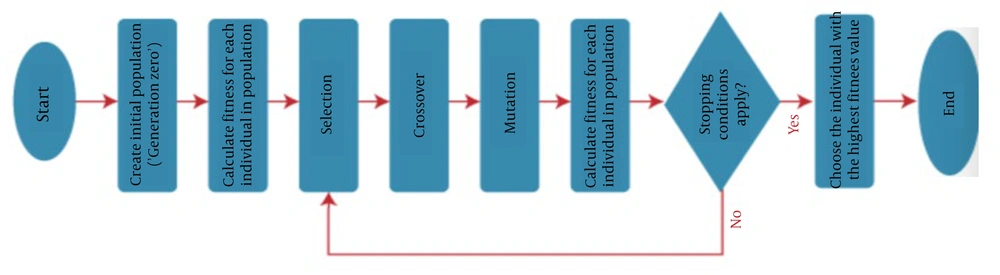
Figure 1.
Genetic algorithm
Our goal is to find the best network node locations for medical Mokeb placement. We divide the city into different areas and perform the following tasks separately in each area. Each chromosome in the initial population represents a medical Mokeb placement scheme with binary coding; its length equals the number of free network nodes in each city section. Free network nodes are those that do not correspond to a hospital or health center and are available for allocation to medical Mokebs. Each bit in the chromosome represents a network node, where a bit of 1 indicates the node is assigned to a medical Mokeb, and a bit of 0 indicates no assignment.
We evaluate the fitness of each chromosome in a random population. The fitness function, which we aim to maximize, considers four factors: The pilgrims’ population density along the nearest route, distance to hospitals, distance to health centers, and the budget for medical Mokebs.
where α, β and γ are weighting factors that determine relative importance of the number of crowded paths, the number of paths that end to hospital or health center, and average amount of budget. Since the objective is to maximize (Equation 1), we provide α and γ a greater value and β a smaller value. Figure 2 shows the parameters.
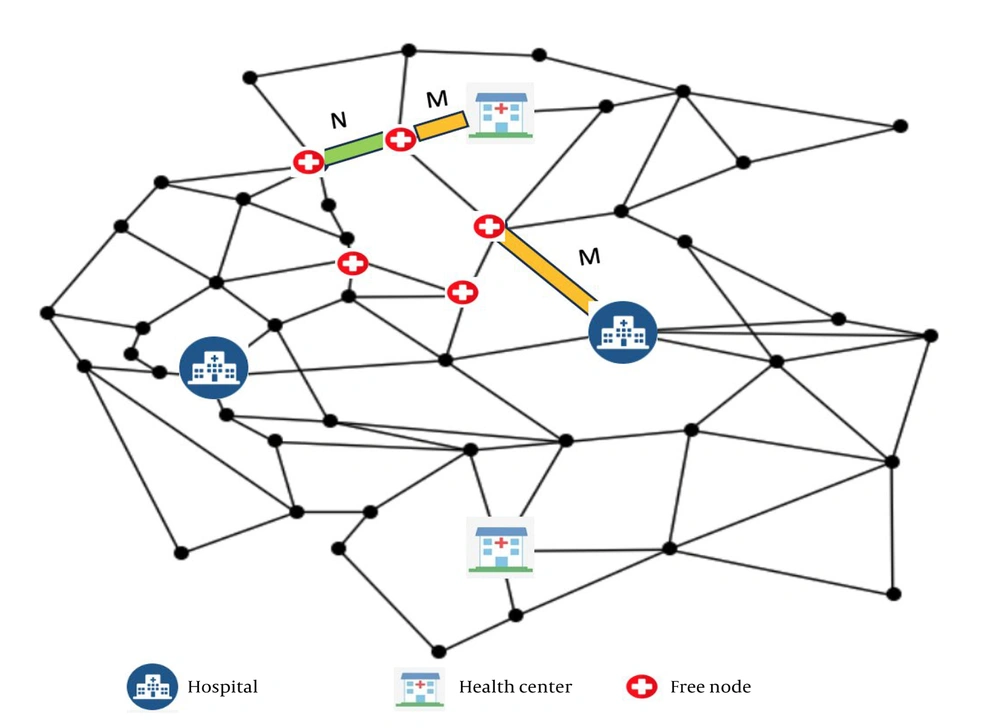
Figure 2.
Proposed method
For the selection process, we use the Roulette-Wheel method, which probabilistically selects chromosomes based on their fitness scores. New offspring are generated using single-point crossover and mutation, with a mutation probability of 0.1. The termination criteria for the algorithm are set to either 100 iterations or the absence of improvement in the solution. Our termination condition is specifically set at 100 iterations.
3.3. Recommender System
The results of the proposed system can be beneficial for both medical clerks and pilgrims. Medical clerks can use this system to launch medical Mokebs, ensuring optimal placement based on the calculated indices. Pilgrims, on the other hand, can be informed about the facilities available at each Mokeb and select a medical Mokeb according to their specific needs. This approach helps prevent overcrowding at certain medical Mokebs and avoids the wastage of resources at others with no pilgrims. By balancing the distribution of resources and pilgrims, the system enhances the efficiency and effectiveness of medical service delivery during the pilgrimage.
4. Results
In this section, we first analyze the results of the proposed method and then compare the outcomes with different parameter values. Figure 3 illustrates the results of the proposed method. As shown in Figure 3A, the potential field highlights the optimal locations with a dark brown color, indicating the best places for medical Mokeb placement. In Figure 3B, the defined locations are presented within a simulation environment with a random size of 2000 × 2000. This visual representation helps to identify the most suitable areas for establishing medical Mokebs based on the calculated indices and parameters, allowing for a clear comparison of different placement scenarios. We further compare the results by using the PSO algorithm. The GA algorithm outperforms PSO in this placement problem. However, generally, PSO will complete the GA result.
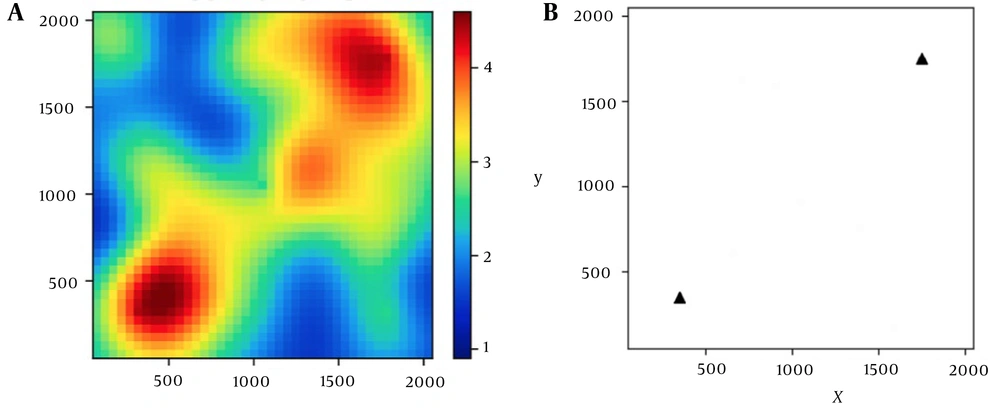
Figure 3.
Result of simulation for optimal placement of medical Mokeb in a random pairwise with size of 2000 × 2000
5. Discussion
In this research, an AI-based approach for medical Mokeb placement is presented within the context of Arbaeen health services, aimed at monitoring the health of patients in mass gathering medicine. This approach can be extended for the optimized placement of virtual medical Mokebs, which could provide point-of-care personal telemedicine using AI-based wearable sensors in the future. Furthermore, the proposed method can be applied to optimize the placement of various resources using geographical information systems (GIS) data, particularly in scenarios such as natural disasters. This adaptability highlights the potential of the approach to enhance resource allocation and service delivery across different contexts and challenges.