
1. Background
Cancer is a disease process in which cells proliferate abnormally and ignore growth-regulating signals around the cells (1). The disease affects people of all ages, cultures, races, and socioeconomic classes. Some of the cancers have a significant impact on the quality of life of patients due to the disabilities they cause (2). In Iran, cancer is known as the third leading cause of death after cardiovascular diseases and accidents, accounting for more than 30,000 deaths annually (3). Breast cancer (BC) is the most common malignant disease of women worldwide and accounts for 28% of all cancers (4). Annually, more than 1.1 million new cases of BC are reported, accounting for about 10% of all new cancers and 23% of all women’s cancers (5). The most common age of the onset of the disease in Iranian women is 47 years, which is one decade lower than the age in the developed countries. About 76% of the most common women’s cancer cases in Iran are BC, and the incidence of BC in Iranian women is 22 per 100,000, and the prevalence is 120 per 100,000 people, which is a very shocking statistic. The total number of BC patients in Iran is 40,000, and more than 7,000 patients are added to this number annually (6).
One of the most important treatments of BC that kills 90% of malignant cells is chemotherapy, which is widely used to increase the survival rate with as little damage as possible (3). The use of chemotherapy drugs is generally associated with various serious and non-serious complications (7). One of the important complications of chemotherapy that is far from the view of the treatment staff is neuropathy. Neuropathic pain is a chronic pain that results from damage to the central or peripheral nerves. In this type of injury, the sensory and motor fibers, as well as the receiving field of the fibers, are disturbed, and its most important symptom is increase in pain (8), which is in the form of spontaneous burning pain at the site of injury, hyperalgesia (increased response to a stimulus that is normally painful) and allodynia (a response to a stimulus that does not cause pain normally) (9). Peripheral neuropathy is an important complication of chemotherapy that occurs following the use of drugs such as taxanes, which are mainly used in the treatment regimens of women with BC (10, 11). Neuropathy of these drugs manifests itself in the form of peripheral sensory neuropathy with symptoms such as distal paresthesia of the limbs, loss of sensation, and weakening of deep tendon reflexes (12). With the increasing number of women with BC, it is necessary to pay attention to the complications of neuropathic pain that have negative and adverse effects on various aspects of their lives. In many patients with neuropathy, pain is a common symptom. Symptoms of the disease are usually concentrated in the lower limbs and first in the soles of the feet and toes, which in addition to causing discomfort affects all aspects of their lives. It can be said that BC is associated with a lot of stress. On the other hand, the side effects of the treatment have a double effect on patients’ perceived stress (13, 14). Stress refers to situations or events that a person faces in life but are not in harmony with the current facilities and capabilities of the person; therefore, she/he suffers from psychological conflict (15). Stress can increase tumor growth by affecting the immune defenses and the tumor itself; it can also lead to poor diet and sleep, as well as less physical activity. Finally, women who experience stress following BC are less likely to follow their doctor’s recommendations, instructions, and prescriptions (16). In addition to medication, non-pharmacological measures, such as patient education, may help reduce the symptoms of neuropathy and stress to some extent. There are several methods used to educate patients, but one of the comprehensive educational programs is supportive educational package, which considers all the physical and mental dimensions of patients. In fact, supportive educational programs are a process in which individuals and patients learn to behave in a way that promotes, maintains, and improves health (17, 18). So, social support is the interaction between the provider and the recipient of support (19). In other words, social support includes emotional, instrumental, information, and evaluation support. While emotional support emphasizes the empathetic relationships with members of the social network, instrumental support refers to routine activities (20). Nurses, as the most important members of the treatment team, have an important role in caring for cancer patients under treatment and are in a good position to train and support them due to their long-term contact (21).
2. Objectives
The present study aimed to investigate the effect of supportive educational intervention on perceived stress and severity of chemotherapy-related neuropathy in patients with BC.
3. Methods
The present quasi-experimental study included two groups with a pre-test and post-test design. The study was approved by the ethics committee of Zahedan University of Medical Sciences (code: IR.zaums.REC.1398.516). The sample size was determined as 30 individuals in each group based on similar studies with 95% confidence interval, 95% statistical test power, and considering the possible dropout (22).
In this study, 60 cancer patients undergoing chemotherapy in the oncology wards of Khatam al-Anbia and Ali Ibn Abitaleb (AS) hospitals in Zahedan, Iran, were selected. The patients were selected by convenience sampling method and randomly assigned into two groups of intervention and control.
The inclusion criteria were: definitive diagnosis of BC, being in the age range of 20 - 60 years, starting taxanes from the second session, having no metastatic malignancy, no addiction to drugs, having no mental illnesses and physical disability, not suffering from diabetes or grade 2 and 3 cancer, not being pregnant, being fluent in Persian, and having no other cancers.
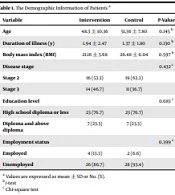
Data collection tools included a demographic information questionnaire, the Perceived Stress Scale (PSS) developed by Cohen, and the Leeds Assessment of Neuropathic Symptoms and Signs (LANSS) Pain Scale. The demographic information questionnaire included information such as age, occupation, level of education, duration of suffering from cancer, disease stage, and body mass index (BMI) (Table 1). The PSS consists of 14 items to measure general perceived stress in the past month. The questionnaire is scored on a 5-point Likert Scale with a minimum score of zero and a maximum score of 56. A higher score indicates more perceived stress. The reliability of this questionnaire was 0.80 (23) in the research by Sepahvand. In the current study, the questionnaire reliability was determined as 0.85.
Table 1.
The Demographic Information of Patients a
| Variables | Intervention | Control | P-Value |
|---|---|---|---|
| Age | 48.3 ± 10.36 | 51.36 ± 7.80 | 0.145 b |
| Duration of illness (y) | 1.94 ± 2.47 | 1.37 ± 1.80 | 0.130 b |
| Body mass index (BMI) | 21.16 ± 3.68 | 26.48 ± 6.04 | 0.597 b |
| Disease stage | 0.432 c | ||
| Stage 2 | 16 (53.3) | 19 (63.3) | |
| Stage 3 | 14 (46.7) | 11 (36.7) | |
| Education level | 0.683 c | ||
| High school diploma or less | 23 (76.7) | 23 (76.7) | |
| Diploma and above diploma | 7 (23.3) | 7 (23.3) | |
| Employment status | 0.399 c | ||
| Employed | 4 (13.3) | 2 (6.6) | |
| Unemployed | 26 (86.7) | 28 (93.4) |
a Values are expressed as mean ± SD or No. (%).
bt-test
c Chi-square test
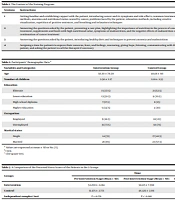
The LANSS Pain Scale has seven items and assesses the severity of neuropathy. Scores range from 0 to 24, and scores above 12 indicate a higher severity of neuropathy. The reliability of this questionnaire was obtained in Bennett’s study with a Cronbach’s alpha coefficient of 0.74 (24). In the current study, the questionnaire reliability was determined as 0.86. Before the intervention, the LANSS and the PSS were completed by the patients in both groups. The questionnaires were completed through interviews. Patients in the control group only received the ward’s routine care. In the intervention group, in addition to the routine care, from the second session of starting taxanes in the chemotherapy regimen, the researcher provided the patients with the necessary supportive educational measures based on the common problems of BC patients, including neuropathy, during four weekly sessions of 30 - 45 minutes in the ward. The educational measures were completed by question & answer and face-to-face interviews using an educational booklet. In the sixth week, after the educational sessions, the questionnaires were completed again through interviews in the hospital. At the end of the study, the educational booklet was provided to the control group and the contact number of the researcher was provided to the control group. Research data was analyzed by SPSS Software (V22). First, frequency, percentage, mean, and standard deviation were determined using descriptive statistics. Shapiro-Wilk test was used to determine normality. The independent t-test was used to compare the means before and after the intervention between the two groups. The paired t-test was used to compare the means before and after the intervention in each group. The chi-square test was used to compare the frequency of qualitative variables between the two groups. The significance level in this study was less than 0.05.
4. Results
Table 1 shows the demographic information of patients with BC in intervention and control groups.
Table 2 shows that the mean and standard deviation of perceived stress score decreased in the intervention group
Table 2.
Comparison of Mean and Standard Deviation of Perceived Stress Score Before and After Implementation of Supportive Educational Intervention a
| Variables | Before Intervention | After Intervention | Paired t-test |
|---|---|---|---|
| Intervention | 56.8 ± 5.92 | 50.36 ± 3.89 | 0.001 |
| Control | 55.6 ± 3.65 | 54.8 ± 3.53 | 0.258 |
| Independent t-test | 0.349 | 0.001 |
a Values are expressed as mean ± SD. (P < 0.001) more than of the control group (P = 0.258)).
The independent t-test showed that after implementing the supportive educational intervention, there was a significant difference between the two groups in terms of mean and standard deviation of stress score (P < 0.001).
Table 3.
Comparison of Mean and Standard Deviation of Neuropathic Severity Score Before and After Implementation of Supportive Educational Intervention a
| Variables | Before Intervention | After Intervention | Paired t-test |
|---|---|---|---|
| Intervention | 12.90 ± 1.66 | 8.43±2.16 | 0.001 |
| Control | 12.56 ± 2.28 | 13.03±1.93 | 0.276 |
| Independent t-test | 0.521 | 0.001 |
a Values are expressed as mean ± SD.
Table 3 shows that the mean and standard deviation of the neuropathic severity score decreased in the intervention group (P < 0.001), but increased in the control group (P = 0.276). The independent t-test showed that after the implementation of supportive educational intervention, there was a significant difference between the two groups in terms of the mean and standard deviation of neuropathic severity score (P < 0.001).
5. Discussion
The results of the present study showed that supportive educational intervention is effective in reducing the perceived stress and severity of neuropathy. Despite the importance of diagnosis and consequences of cancer, the existing policies in the hospital are limited to providing physical care, especially medication. Therefore, in the outpatient wards, in addition to physical care, paying attention to the psychological dimensions of the disease, including stress and drug side effects and its various aspects is of particular importance. In other words, the non-existence of supportive educational interventions is very important.
The nature of cancer and its treatment is extremely stressful for patients. Studies show that the stress of these patients is related to the prognosis of treatment and unknown complications of the disease and the risk of involvement of other organs (13, 16). Therefore, performing supportive educational intervention in the ward can create communication and interaction between the patient and the treatment staff. On the other hand, raising the level of patient knowledge and performing supportive educational interventions by nurses can help reduce patients’ perceived stress and concerns. In a study by Neisani Samani et al., supportive educational program was effective in reducing patients’ stress (25). These results are consistent with those of the present study. Nevertheless, in their study the emphasis was mostly on information support, while in the present study, in addition to information support, practical and applied stress control methods such as relaxation, creative illustration, repetition of positive sentences, and breathing techniques were also taught. The study by Amir Zehani revealed that although a considerable time has passed since the diagnosis and treatment of the disease, a significant number of patients suffer from the destructive psychological and emotional effects of diagnosis and treatment of their disease (26).
Due to the psychological effects associated with the diagnosis and treatment of cancer, the need for supportive educational interventions in different ways is felt more than ever. Besides, in a study by Emami et al., it was found that in addition to individual training, cognitive-behavioral stress management therapy had an effect on increasing resilience and stress control in women with BC (27). So, it can be said that the reason for the effectiveness of cognitive-behavioral intervention on increasing resilience is learning and acquiring skills, which help the patient to know how to face the inevitable problems and difficulties of life and have a better performance in coping with stressful situations (including cancer disease) and unpleasant events and enhancing skills in disease control and management (28). The results of a study by Ataollahi et al. on comparing dimension of perceived social support and perceived stress in women with and without BC showed that the perceived stress was higher in women with BC than in normal women (P = 0.04), which is in a way consistent with the present study (29). The diagnosis and treatment of BC is associated with a lot of stress and anxiety. In addition, the cancer patients’ exposure to stress increases the severity of the disease (30). Some studies have also emphasized that there is an inverse relationship between perceived stress and the pursuit of health behaviors in women with BC (31). Researchers believe that different intervention methods should be considered to identify and reduce the perceived stress symptoms in patients. This led to the use of different methods such as self-healing, which is one of the new approaches highly emphasizing stress control and management. Latifi and Sharifi Isfahani evaluated the effect of self-healing training on stress, death anxiety, and depression in cancer patients and reported the effect of this educational method on controlling the perceived stress. In their study, self-healing was taught in 12 sessions, each of which lasted for 90 minutes. Their results showed the effect of this training method on controlling the perceived stress (32).
In addition to the mentioned methods, the results show the positive effect of group education of stress management methods in women with BC (33). The results of a study by Rezaei Ardani showed that cognitive-behavioral stress management training is effective in negative emotions and quality of life of women with BC (34). One of the most important issues affecting the perceived stress in these patients is the lack of control over the conditions and outcome of the disease. In general, the effect of the disease on the individual’s role in society and life aggravates the psychological problems and disrupts the advancement of treatment programs. The general rule of supportive educational intervention is based on the principle that everyone could have a better understanding of their situation and, as a result, will feel more relaxed and in control, therefore those involved more actively in their self -management and prevention of disease recurrence.
In other words, using this type of intervention targets the feeling of control and belief in one’s destiny as one of the important components. Therefore, the patients’ participation in the treatment process and emphasis on creating a set of skills to manage perceived stress can improve the living conditions of patients and reduce stress. Overall, the results of the present study confirmed that supportive educational intervention can reduce perceived stress in patients with BC.
Due to the increase in the number of women with BC, it is necessary to pay attention to the complications of neuropathic pain, which has negative and adverse effects on various aspects of their lives, as neuropathic pain can reduce the patients’ quality of life, cause frustration and unwillingness to continue treatment, and increase mental illnesses, stress, and sleep disorders (35). There is limited similar studies in the literature and most studies have been performed on other chronic diseases. In a study by Ahrary et al., the effect of supportive educational intervention on the symptoms and severity of mild to moderate diabetic peripheral neuropathy was examined in diabetic women. Although their study was slightly different from the present study in terms of methodology, the results were in line with our study (36). One of the important and influential factors affecting the severity of neuropathy is diet. Hence, one of the major concerns of the present study was educating patients in this field because studies show that the diets containing vitamin D, which has been included in the educational content of the present study, can be somewhat helpful in controlling the patients’ peripheral neuropathy. In this regard, Hosseini et al. showed the positive effect of vitamin D intake in controlling the symptoms associated with neuropathy (37). Consistent with the present study, Khanbabaei Gol et al. evaluated the prevalence of neuropathic pain and factors affecting sleep quality in women with BC after radiotherapy; however, the stage of intervention in the mentioned study was different from the present study. In their study, the intervention was performed during radiotherapy, while in the present study, the intervention was performed during chemotherapy. The results of their study also showed that neuropathy in women with BC leads to physical disorders (38). Usually, neuropathy is associated with chemotherapy and lasts for half of the life of patients, and radiotherapy has no role in exacerbating or intensifying it. However, since radiotherapy can also worsen the condition by causing certain side effects, it is necessary to pay special attention to this group of patients during the treatment period and even after it, because persistent neuropathy can severely affect the patient’s living conditions (39). A study by Manas et al. examined patients 18 months after recovery and found that a history of chemotherapy caused neuropathic pain and psychological complications in patients (40). The above-mentioned studies are in line with the present study. Studies show that progress in hyperalgesia (increased pain sensitivity) and decreased pain threshold lead to physical and psychological consequences (41). The results of studies emphasize that neuropathic pain can occur in patients with BC as a symptom of the disease, which is mainly due to the side effects of treatment, that is less addressed. Therefore, it is necessary to consider it. Apoptosis is one of the most common effects of medicines such as paclitaxel, which is caused by the cessation of cell mitosis (42). Peripheral polyneuropathy is one of the most common side effects of this class of medicines, that is caused by morphological or functional changes in peripheral nerves in the form of nerve axon disorders or myelin peripheral nerve disorders, but in fact the exact mechanism of this neuropathy has not been identified yet (43).
Clinically, medicines such as pregabalin and duloxetine are used to control neuropathic pains. In the present study, our patients received these medications for five weeks. However, despite the effect of pregabalin in controlling neuropathy, patients complain of some degree of neuropathy (44). It seems that since the pain caused by neuropathy occurs in patients with different spectrums, supportive educational interventions are needed to address the aspects and effects of this complication.
5.1. Conclusions
Due to the positive effect of supportive educational interventions on perceived stress and reducing the severity of neuropathy, it is necessary to include these interventions in educational and care programs, and the role of nurses in providing these services to patients is very important. Therefore, it is necessary for nurses to be available for providing information, and to strive for educating the client to improve their psychological status. It can also help to manage and control the psychological reactions of patients by attracting their cooperation and follow-up treatment, ultimately providing conditions for the control and relief of complications related to chemotherapy, especially neuropathy.
5.2. Limitations of the Study
One of the most important limitations of this study was the time limit. Also, since this study was performed during the course of chemotherapy, generalizing the results to other therapeutic interventions such as radiotherapy and immunotherapy should be done with caution.
5.3. Suggestions
According to our results, neuropathy is one of the most important and lasting complications in BC patients. It is suggested that in future studies, these interventions be continued during the course of radiotherapy and even after discharge to determine the effect of interventions over time.