


1. Background
Benign prostatic hyperplasia (BPH) is a common condition in older men (1), affecting over 80% of those around 70 years old, and is linked to degenerative and metabolic disorders (2, 3). If untreated, BPH can cause lower urinary tract symptoms (LUTS) and serious complications, significantly reducing quality of life (4).
Management strategies range from watchful waiting to medical and surgical treatments. Transurethral resection of the prostate (TURP) remains the preferred surgical method (5, 6); however, despite advances in surgical techniques, TURP is still associated with a considerable risk of intraoperative and postoperative bleeding, sometimes necessitating blood transfusion due to the rich vascular supply of hyperplastic prostatic tissue (7).
Several strategies, including estrogen therapy, intraprostatic vasopressin injection, and 5-alpha-reductase inhibitors, have been proposed to reduce perioperative blood loss; however, these approaches are not routinely used in clinical practice because of limited efficacy, delayed onset of action, or potential adverse effects (8). Transurethral resection of the prostate can induce a hypercoagulable state, which is not directly correlated with the amount of resected tissue or intraoperative blood loss but may influence postoperative bleeding (9, 10).
In addition to mechanical vascular injury, activation of the fibrinolytic pathway plays a significant role in bleeding associated with TURP. Elevated urinary fibrinolytic activity, resulting from the release of urokinase from prostatic tissue during resection, has been shown to contribute substantially to perioperative blood loss (11). Urine and the urothelium are rich sources of plasminogen activators (12), which accelerate fibrin clot degradation and impair stable clot formation at the surgical site. Therefore, inhibition of fibrinolysis represents a rational therapeutic target for reducing bleeding during and after TURP (13, 14).
Tranexamic acid (TXA), a synthetic lysine derivative, exerts antifibrinolytic activity by reversibly binding to plasminogen (15). Previous studies investigating the effects of TXA on TURP-associated bleeding have reported conflicting results (16-19). Most existing evidence focuses on systemic administration of TXA, which may raise concerns about thromboembolic complications in elderly patients undergoing urologic surgery.
Nevertheless, growing evidence indicates that TXA is effective in reducing bleeding in cardiac, orthopedic, and hepatic surgeries and can also decrease secondary bleeding associated with TURP (20-22). Furthermore, two recent studies conducted in Iran demonstrated that topical administration of TXA significantly reduced postoperative bleeding following prostatectomy and prevented postoperative hemoglobin decline (23, 24). However, data regarding the efficacy of locally administered TXA via irrigation fluid during TURP remain limited, and the influence of this approach on intraoperative bleeding has not been fully elucidated.
2. Objectives
The aim of this study was to evaluate the effect of topical TXA administration through irrigation fluid on intraoperative and postoperative blood loss in men undergoing TURP for BPH.
3. Methods
3.1. Study Design and Participants
This randomized controlled study was conducted on 54 patients who were candidates for TURP and attended the Urology Clinic of Golestan Hospital, Ahvaz, over a one-year period. Written informed consent was obtained from all participants. Eligible patients meeting the inclusion criteria were enrolled in the study. This study is approved under the ethical approval code of IR.AJUMS.REC.1404.123 and clinical trial code: IRCT20250601066013N1.
3.2. Inclusion and Exclusion Criteria
Patients aged 50 years or older, who were considered suitable candidates for TURP based on clinical evaluation, were included in the study. Patients with stable and controlled systemic diseases were not excluded, provided that they were medically fit for surgery.
Exclusion criteria were previous finasteride use, prostate cancer or prior prostate surgery, history of thromboembolic events or seizures, known coagulation disorders, severe uncontrolled cardiovascular disease, renal failure, and known hypersensitivity to TXA.
3.3. Randomization and Interventions
Participants were randomly assigned to two groups using simple randomization based on a computer-generated random sequence. Allocation was performed in a 1:1 ratio.
The TXA group received 500 mg (5 mL) of TXA per 3 liters of sterile distilled water irrigation solution (maximum 50 mg/kg), while the control group received 5 mL of distilled water (placebo) per 3 liters of irrigation solution.
3.4. Data Collection
Preoperative data included age, prostate volume, hemoglobin level, and blood pressure. During surgery, intraoperative blood loss was estimated by measuring the hemoglobin concentration in the irrigation fluid, and the total volume of irrigation fluid used was recorded. Postoperative measurements included hemoglobin levels at 4 and 24 hours, operative time, and transfusion requirements. All data were collected using a structured data collection form.
3.5. Sample Size Calculation
Using G*Power and based on Samir et al. (11), the sample size was calculated for a quantitative outcome with two groups, an effect size of 0.8, 95% confidence, and 80% power, requiring at least 27 patients per group (total: n = 54).
3.6. Statistical Analysis
Continuous variables were expressed as mean ± SD and categorical variables as frequencies (%). Normality was assessed using the Kolmogorov–Smirnov test. Group comparisons were performed using the independent t-test for normally distributed variables and the Mann–Whitney U test for non-normally distributed data. Categorical variables were analyzed using the chi-square test. Correlation analyses were conducted using Pearson’s correlation coefficient. A P-value < 0.05 was considered statistically significant. Analyses were performed using SPSS version 23.
3.7. Ethical Considerations
The study was conducted according to the principles of the Declaration of Helsinki. Each participant was assigned a unique study identification code, and all personal and clinical information was kept confidential.
4. Results
The baseline characteristics of patients in both groups are summarized in Table 1. There were no significant differences between the groups in age (68.13 ± 6.68 vs. 71.25 ± 5.34 years, P = 0.16), prostate volume (55.00 ± 27.82 vs. 51.11 ± 28.44 mL, P = 0.77), preoperative hemoglobin levels (12.91 ± 1.83 vs. 12.85 ± 2.11 g/dL, P = 0.95), systolic blood pressure (131.1 ± 12.3 vs. 129.5 ± 20.1 mmHg, P = 0.98), or diastolic blood pressure (78.03 ± 3.23 vs. 77.54 ± 2.87 mmHg, P = 0.99).
Table 1.Patient’s Characteristics a
| Variables | Group 1 | Group 2 | P-Value |
|---|---|---|---|
| Age (y) | 68.13 ± 6.68 | 71.25 ± 5.34 | 0.16 |
| Prostate (v) | 55.00 ± 27.82 | 51.11 ± 28.44 | 0.77 |
| Preoperative Hb (g/dL) | 12.91 ± 1.83 | 12.85 ± 2.11 | 0.95 |
| Systolic blood pressure (mmhg) | 13.11 ± 1.23 | 12.95 ± 2.01 | 0.98 |
| Diastolic blood pressure (mmhg) | 78.03 ± 3.23 | 77.54 ± 2.87 | 0.99 |
Abbreviation: Hb, hemoglobin.
a Data are presented mean ± SD.
Table 2 shows the comparison of intraoperative and postoperative outcomes. Intraoperative blood loss was significantly higher in the placebo group (group 1) than in the TXA group (group 2) (158.23 ± 32 mL vs. 65.07 ± 14.80 mL, P = 0.03). There were no significant differences in irrigation fluid volume (10.56 ± 2.65 vs. 9.81 ± 2.77 L, P = 0.21) or operating time (38.75 ± 7.44 vs. 37.58 ± 10.35 min, P = 0.78) between the two groups.
Table 2.Comparison of Outcomes and Secondary Parameters in Study Groups a
| Variables | Group 1 | Group 2 | P-Value |
|---|---|---|---|
| Hb loss at 4 h (g/dL) | 11.79 ± 1.39 | 12.28 ± 1.86 | 0.51 |
| Hb loss at 24 h (g/dL) | 10.60 ± 4.08 | 12.65 ± 2.32 | 0.04 |
| Intraoperative blood loss (mL) | 158.23 ± 32 | 65.07 ± 14.80 | 0.03 |
| Irrigation fluid volume (L) | 10.56 ± 2.65 | 9.81 ± 2.77 | 0.21 |
| Operating time (min) | 38.75 ± 7.44 | 37.58 ± 10.35 | 0.78 |
Abbreviation: Hb, hemoglobin.
a Data are presented mean ± SD.
Postoperative hemoglobin changes are presented as hemoglobin levels. At 4 hours postoperatively, hemoglobin was 11.79 ± 1.39 g/dL in Group 1 and 12.28 ± 1.86 g/dL in group 2 (P = 0.51). At 24 hours postoperatively, hemoglobin levels were significantly lower in group 1 than in Group 2 (10.60 ± 4.08 vs. 12.65 ± 2.32 g/dL, P = 0.04), indicating greater postoperative hemoglobin decline in the placebo group.
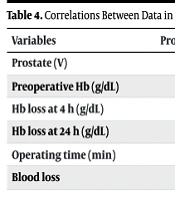
In group 1 (placebo), prostate volume showed strong positive correlations with operating time (R = 0.68) and intraoperative blood loss (R = 0.63), while it demonstrated moderate negative correlations with hemoglobin levels at 4 and 24 hours postoperatively (R = -0.59 and R = -0.61, respectively). These findings indicate that larger prostate volume was associated with longer operative duration, increased blood loss, and greater postoperative hemoglobin reduction.
In group 2 (TXA group), prostate volume maintained a strong positive correlation with operating time (R = 0.89); however, its correlations with intraoperative blood loss (R = 0.17) and postoperative hemoglobin levels were weak and negative (R = -0.41 at 4 hours and R = -0.36 at 24 hours). These correlation patterns suggest an attenuation of the relationship between prostate size and perioperative bleeding in the TXA group (Tables 3 and 4).
Table 3.Correlations Between Data in Group 1
| Variables | Prostate (V) | Preoperative Hb (g/dL) | Hb at 4 h (mg/dL) | Hb at 24 h (mg/dL) | Operating Time (min) | Blood Loss |
|---|---|---|---|---|---|---|
| Prostate (V) | 1 | -0.48 | -0.59 | -0.61 | 0.68 | 0.63 |
| Preoperative Hb (g/dL) | -0.48 | 1 | 0.78 | 0.38 | -0.25 | -0.39 |
| Hb loss at 4 h (g/dL) | 0.59 | 0.78 | 1 | 0.48 | -0.36 | -0.42 |
| Hb loss at 24 h (g/dL) | 0.61 | 0.38 | 0.48 | 1 | -0.15 | -0.29 |
| Operating time (min) | 0.68 | -0.25 | -0.36 | -0.15 | 1 | -0.31 |
| Blood loss | 0.63 | -0.39 | -0.42 | -0.29 | -0.31 | 1 |
Abbreviation: Hb, hemoglobin.
Table 4.Correlations Between Data in Group 2
| Variables | Prostate (V) | Preoperative Hb (g/dL) | Hb at 4 h (g/dL) | Hb at 24 h (g/dL) | Operating Time (min) | Blood Loss |
|---|---|---|---|---|---|---|
| Prostate (V) | 1 | -0.54 | -0.41 | -0.36 | 0.89 | 0.17 |
| Preoperative Hb (g/dL) | -0.54 | 1 | 0.93 | 0.57 | -0.37 | -0.14 |
| Hb loss at 4 h (g/dL) | -0.41 | 0.93 | 1 | 0.47 | -0.27 | -0.03 |
| Hb loss at 24 h (g/dL) | -0.36 | 0.57 | 0.47 | 1 | -0.32 | -0.19 |
| Operating time (min) | 0.89 | -0.37 | -0.27 | -0.32 | 1 | -0.1 |
| Blood loss | 0.17 | -0.14 | -0.03 | -0.19 | -0.1 | 1 |
Abbreviation: Hb, hemoglobin.
5. Discussion
Analysis of secondary outcomes revealed that hemoglobin levels at 4 hours postoperatively did not differ significantly between groups; however, at 24 hours, the TXA group maintained higher hemoglobin levels than the placebo group, suggesting a sustained hemostatic effect associated with TXA administration. Intraoperative blood loss was higher in the placebo group, whereas irrigation fluid volume and operative time did not differ significantly between the two groups.
Correlation analyses revealed notable differences between the study groups. In the placebo group, prostate volume showed a strong positive correlation with intraoperative blood loss (R = 0.63) and a negative correlation with hemoglobin levels at 4 and 24 hours (R = -0.59 and -0.61, respectively), while it was positively correlated with operative time (R = 0.68). These findings are consistent with the established relationship between prostate size, surgical complexity, and bleeding risk during TURP.
In contrast, in the TXA group, prostate volume exhibited a very strong positive correlation with operative time (R = 0.89) but only a weak correlation with intraoperative blood loss (R = 0.17). Additionally, preoperative hemoglobin was strongly positively correlated with hemoglobin levels at 4 hours postoperatively (R = 0.93). Although correlation analyses cannot establish causality or independence, these patterns suggest that topical TXA administration may attenuate the association between prostate size and perioperative blood loss.
Tranexamic acid binds to lysine-binding sites on plasmin and plasminogen, displacing plasminogen from the fibrin surface and thereby inhibiting fibrinolysis. Bleeding during TURP is strongly influenced by local activation of fibrinolysis due to urokinase release from prostatic tissue; therefore, the antifibrinolytic mechanism of TXA provides a plausible biological explanation for the observed reduction in blood loss. Topical or systemic administration of TXA has been shown to reduce bleeding in gynecologic and obstetric surgeries, urological procedures, oral surgeries in hemophilic patients, and neurosurgical operations (25, 26). Tranexamic acid also inhibits urokinase activity, a physiological thrombolytic enzyme presents in renal parenchymal cells and urine. Urokinase, a physiological fibrinolytic enzyme present in renal parenchymal cells and urine, converts plasminogen to plasmin—a process inhibited by TXA. TXA can be administered orally or intravenously (27, 28).
Several studies have demonstrated the role of TXA in reducing blood loss during prostate surgeries. Mina and Garcia-Perdomo performed a meta-analysis and reported that intravenous TXA effectively reduces bleeding during prostate surgery (7). Meng et al. indicated that TXA can reduce perioperative bleeding without thrombolytic complications (29). Other studies, consistently showed that TXA, whether oral, intravenous, or topical, significantly reduces intraoperative blood loss and transfusion requirements in prostate surgery (24, 30-33). The findings of the present study are in agreement with this body of evidence and extend previous observations by supporting the potential benefit of topical TXA administered via irrigation fluid during TURP.
The use of TXA in patients undergoing TURP can significantly reduce intraoperative blood loss and help maintain postoperative hemoglobin levels within 24 hours, emphasizing its important role in hemostatic control and patient safety. However, previous studies indicate that while TXA minimizes blood loss and hemoglobin reduction, it does not significantly affect transfusion requirements, operative time, or length of hospital stay (34). Our results similarly showed no significant differences in operative duration or irrigation fluid volume between the TXA and placebo groups, supporting the safety of this intervention.
This study has several potential limitations. First, the relatively small sample size and single-center design may limit the generalizability of the findings. Second, correlation-based analyses were used, and no multivariable adjustment models were applied; therefore, an independent effect of TXA cannot be conclusively established. Third, hemoglobin reduction and bleeding were assessed only within the first 24 hours postoperatively, and long-term outcomes were not evaluated. Finally, although the two groups were homogeneous in age, prostate volume, preoperative hemoglobin, and blood pressure, other variables such as baseline coagulation status and controlled comorbidities were not analyzed and may have influenced perioperative bleeding outcomes.
5.1. Conclusions
Our study demonstrates that topical administration of TXA via irrigation fluid is associated with a significant reduction in intraoperative bleeding and postoperative hemoglobin decline in patients undergoing TURP. Patients receiving TXA experienced lower blood loss and better preservation of hemoglobin levels within the first 24 hours after surgery compared with the placebo group.
Correlation analyses indicated that the relationship between prostate volume and perioperative bleeding parameters was weaker in the TXA group than in the placebo group. Although these findings suggest a potential modulatory effect of TXA on bleeding dynamics during TURP, correlation-based analyses alone cannot establish causality or confirm an independent treatment effect.
These findings are consistent with previous evidence supporting the antifibrinolytic efficacy of TXA in urological and other surgical settings and suggest that topical TXA administration may represent a safe and effective adjunct for reducing bleeding during TURP. Future studies employing larger sample sizes and multivariable or adjusted statistical models are warranted to further clarify the independent effect and optimal clinical application of TXA in this setting.