


1. Context
Aging is a natural and inevitable stage of human life, accompanied by extensive changes across physical, psychological, social, and cognitive domains (1). As individuals grow older, the functionality of various bodily systems declines, motor abilities diminish, and the likelihood of developing chronic conditions such as diabetes, hypertension, cardiovascular, respiratory, and musculoskeletal diseases increases. Alongside these physiological changes, elderly individuals may also face psychological challenges such as anxiety, depression, memory loss, and feelings of isolation (2). These factors collectively render older adults one of the most vulnerable populations in special circumstances, including mass gatherings and religious events (3).
Among such events, the Arbaeen pilgrimage stands out as one of the largest religious gatherings in the world, annually attracting millions of pilgrims from various countries to Karbala, Iraq (4). Rooted in Shia Islamic tradition, this pilgrimage symbolizes devotion, sacrifice, solidarity, and loyalty to the ideals of Imam Hussain (AS) (5). Pilgrims often walk long distances — sometimes exceeding 80 kilometers — under challenging environmental conditions, including extreme weather, crowded pathways, and limited access to facilities (6). The participation of elderly individuals in this pilgrimage, despite physical and psychological limitations, reflects deep religious conviction, spiritual motivation, and a desire for active engagement in sacred rituals (7).
However, the involvement of older adults in the Arbaeen pilgrimage presents serious health challenges (8). Long walking distances, adverse environmental conditions, inadequate hygiene and medical services, and the absence of tailored support systems can jeopardize their physical and mental well-being (9). Moreover, the lack of comprehensive planning, infrastructural weaknesses, and insufficient training for volunteers and caregivers further increase their vulnerability (10). In such a context, a systematic and scientific examination of the health challenges faced by elderly pilgrims during Arbaeen becomes an urgent necessity (11).
Studying this issue is not only important from a public health perspective but also holds ethical, cultural, and social significance. Addressing the needs of elderly participants in religious ceremonies reflects societal maturity and respect for human dignity. Furthermore, enhancing the health and safety of this group can improve their spiritual experience, reduce medical burdens, and contribute to better management of large-scale events. Therefore, this review article aims to explore the multifaceted health challenges of elderly individuals during the Arbaeen pilgrimage by analyzing existing literature and offering practical recommendations to improve their conditions.
2. Evidence Acquisition
This study was conducted using a narrative review approach. Scientific sources were retrieved from reputable databases, including PubMed, Scopus, Google Scholar, the Scientific Information Database (SID), and Magiran, covering the time span from 2010 to 2025. The search strategy employed keywords such as “elderly”, “geriatric health”, “Arbaeen pilgrimage”, “religious mass gatherings”, “pilgrim hygiene”, and “travel health care”. Boolean operators (AND, OR) were used to refine the search and ensure comprehensive coverage.
After initial screening, 42 relevant articles were selected for in-depth analysis. These included qualitative and quantitative studies, field reports, and previous review articles. Inclusion criteria focused on studies that addressed health-related challenges of elderly individuals in mass gatherings, particularly religious pilgrimages. Exclusion criteria involved articles unrelated to aging populations or those lacking empirical data.
The selected studies were categorized based on thematic relevance to physical health, psychological well-being, hygiene and nutrition, and logistical or managerial aspects. Data extraction was performed manually, and findings were synthesized narratively to identify recurring patterns, gaps in knowledge, and practical implications for improving elderly care during the Arbaeen pilgrimage.
3. Results
The review of 42 scholarly articles, field reports, and prior reviews revealed a complex and multifaceted landscape of health challenges faced by elderly pilgrims during the Arbaeen pilgrimage. These challenges span across five major domains: Physical and physiological, psychological and cognitive, hygienic and nutritional, managerial and infrastructural, and sociocultural and communicative. Each domain is explored below with detailed subcategories and contextual insights (Figure 1).
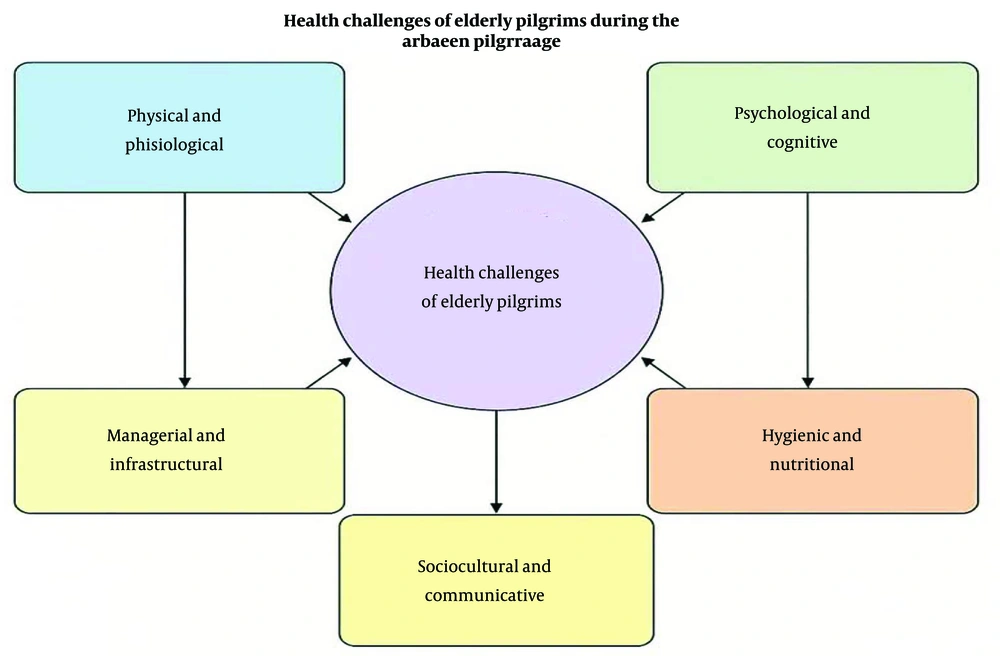
Figure 1.
Health challenges of the elderly during the Arbaeen pilgrimage
3.1. Physical and Physiological Challenges
3.1.1. Musculoskeletal Limitations
Age-related degeneration of joints, muscles, and connective tissues significantly impairs mobility (12). Elderly pilgrims often report joint stiffness, lower back pain, and reduced walking endurance. Studies show that prolonged walking exacerbates osteoarthritis symptoms, especially in the knees and hips (13).
3.1.2. Cardiovascular and Respiratory Vulnerabilities
The physical exertion required during the pilgrimage can strain the cardiovascular system. Elderly individuals with pre-existing conditions such as arrhythmia, congestive heart failure, or chronic obstructive pulmonary disease (COPD) are at increased risk of cardiac events (8). Exposure to dust and pollutants along the route can trigger asthma attacks and respiratory distress (14).
3.1.3. Neurological and Balance Disorders
3.1.4. Heat Stress and Thermoregulation
Older adults have a diminished ability to regulate body temperature (16). In high-temperature environments, they are more susceptible to heat exhaustion, dehydration, and heatstroke (6). Conversely, nighttime cold can lead to hypothermia, particularly in those with poor circulation or low body mass (17, 18).
3.1.5. Medication Adherence and Accessibility
3.2. Psychological and Cognitive Challenges
3.2.1. Anxiety and Emotional Distress
3.2.2. Depression and Mood Disorders
3.2.3. Cognitive Impairments and Disorientation
Pilgrims with mild cognitive impairment (MCI), Alzheimer’s disease, or vascular dementia may struggle with orientation, memory recall, and decision-making. These impairments increase the risk of getting lost, misinterpreting instructions, or failing to recognize danger (24).
3.2.4. Sleep Disruption and Circadian Misalignment
Irregular sleep schedules, noise pollution, and overcrowded sleeping areas contribute to insomnia and circadian rhythm disturbances. Sleep deprivation can impair judgment, worsen mood, and increase susceptibility to illness (25).
3.2.5. Psychological Resilience and Coping Mechanisms
3.3. Hygienic and Nutritional Challenges
3.3.1. Sanitation and Personal Hygiene
Limited access to clean, accessible toilets and washing facilities poses a major challenge. Elderly individuals with mobility impairments or incontinence require specialized hygiene accommodations, which are often unavailable (28). Poor sanitation increases the risk of urinary tract infections, skin rashes, and gastrointestinal illnesses (29).
3.3.2. Infection Control and Communicable Diseases
3.3.3. Nutritional Deficiencies and Dietary Incompatibility
3.3.4. Hydration and Electrolyte Imbalance
3.3.5. Preventive Health Services and Screening
3.4. Managerial and Infrastructural Challenges
3.4.1. Route Design and Accessibility
Pilgrimage routes are not optimized for elderly mobility. The lack of ramps, handrails, shaded rest areas, and tactile signage makes navigation difficult. Uneven pavement and long walking distances without rest stations increase fatigue and injury risk (31).
3.4.2. Emergency Response and Medical Evacuation
3.4.3. Volunteer Training and Geriatric Awareness
3.4.4. Coordination Between Health Authorities
3.4.5. Infrastructure for Assistive Devices
3.5. Sociocultural and Communicative Challenges
3.5.1. Cultural Perceptions of Aging
3.5.2. Language Barriers and Information Access
Non-Arabic-speaking pilgrims face difficulties understanding signage, medical instructions, or announcements. This barrier can lead to miscommunication, medication errors, or missed opportunities for assistance (32).
3.5.3. Social Inclusion and Peer Support
Elderly individuals traveling alone or without family may experience loneliness and social isolation. Lack of peer support groups or designated gathering spaces for seniors reduces opportunities for meaningful interaction and emotional comfort (33).
3.5.4. Religious Motivation vs. Physical Limitation
Many elderly pilgrims are driven by deep spiritual conviction, which may lead them to ignore physical warning signs or medical advice. This tension between faith and frailty requires sensitive, culturally informed health messaging (35).
4. Conclusions
This systematic review of health challenges faced by elderly pilgrims during the Arbaeen pilgrimage reveals a complex and multilayered set of physical, psychological, hygienic, managerial, and sociocultural issues. Long walking distances, harsh environmental conditions, limited access to medical and sanitary services, infrastructural shortcomings, and insufficient volunteer training all contribute to elevated health risks for older adults. In addition, cognitive impairments, anxiety, dependency, sleep deprivation, and inadequate nutrition further compromise their mental and social well-being.
The findings indicate that many of these challenges are preventable or manageable — provided that there is comprehensive planning, inter-agency coordination, and culturally sensitive attention to the specific needs of elderly participants. While their participation is often driven by profound spiritual and religious motivation, this should not overshadow the physical and psychological realities they face. Respecting the dignity of older adults must go beyond cultural rhetoric and be reflected in the design of walking routes, medical services, nutrition, transportation, and volunteer education.
Ultimately, addressing the health needs of elderly pilgrims in mass religious gatherings such as Arbaeen is not only a humanitarian and ethical imperative but also a public health priority. It contributes to crisis preparedness, enhances the quality of the spiritual experience, and promotes inclusive participation. By highlighting these challenges and offering a comprehensive overview of the current landscape, this review lays the groundwork for developing practical solutions to improve the safety and well-being of elderly individuals in future pilgrimages.


