
1. Context
The phenomenon of heat exhaustion among Arbaeen pilgrims represents a significant public health challenge that demands urgent attention and strategic planning (1, 2). The annual Arbaeen pilgrimage, one of the largest religious gatherings in the world, involves millions of devotees traveling to Karbala, Iraq, under often harsh environmental conditions (3). These extreme conditions, characterized by high temperatures and prolonged physical exertion, significantly increase the likelihood of heat-related illnesses, such as heat exhaustion (4). Given the recurring health risks associated with the pilgrimage, it is essential to examine contributing factors and develop targeted interventions to mitigate heat exposure in this unique context (5).
Heat exhaustion arises from prolonged exposure to high temperatures, inadequate hydration, and physical overexertion (6, 7). Symptoms include fatigue, dizziness, headache, excessive sweating, and nausea (8). In severe cases, it may progress to heatstroke, a life-threatening condition marked by confusion, loss of consciousness, and organ dysfunction (9). Pilgrims face compounded risks due to the journey’s intensity, crowded conditions, and limited access to cooling systems and medical facilities. Therefore, understanding the epidemiological dynamics of heat exhaustion is critical to informing effective preventive strategies (10).
The environmental factors during Arbaeen play a critical role in the onset of heat exhaustion. Pilgrims often endure temperatures exceeding 40°C alongside high humidity levels, which impair the body’s cooling mechanisms (11). Iraq’s arid climate exacerbates dehydration, as pilgrims may fail to consume adequate water to offset fluid loss (12). Furthermore, heavy clothing and prolonged sun exposure heighten the body’s thermal load, while crowded conditions restrict airflow and intensify heat exposure (13, 14). To minimize the risk of heat exhaustion, it is necessary to assess the interplay between climate and pilgrimage behaviors.
Social and cultural aspects also contribute to pilgrims’ vulnerability to heat exhaustion (15). Many individuals view the pilgrimage as a deeply spiritual commitment, sometimes overlooking physical distress symptoms in pursuit of religious devotion (16). Additionally, participants vary in age, health status, and physical preparedness. Elderly pilgrims and those with pre-existing medical conditions — such as cardiovascular or respiratory diseases — face heightened susceptibility to heat exhaustion (16). A holistic approach addressing both physiological and behavioral risk factors is essential for effective prevention.
Despite the serious challenges posed by heat exhaustion, preventive strategies can significantly mitigate risks (17). Public health campaigns targeting pilgrims can raise awareness about heat exposure and emphasize hydration and rest (3). Simple measures — including wearing breathable clothing, using shaded areas for respite, and consuming electrolyte-rich fluids — can lower the likelihood of heat exhaustion (18). Deploying mobile clinics and hydration stations along pilgrimage routes offers timely medical assistance, ensuring rapid intervention for those experiencing heat-related distress (19).
This study examines the factors influencing heat exhaustion among Arbaeen pilgrims and evaluates strategies to mitigate the associated risks. Given the increasing number of pilgrims and the challenging environmental conditions, gaining a deeper understanding of the causes of heat exhaustion and proposing practical preventive measures is of great importance. By analyzing the strengths and weaknesses of existing measures, this study offers recommendations to reduce heat exhaustion and enhance the well-being of pilgrims in future journeys. Therefore, this study identified the dimensions and components of environmental and social factors influencing heat exhaustion among Arbaeen pilgrims.
2. Methods
This narrative review synthesizes existing literature, reports, and observational accounts related to the topic to examine the environmental and social factors contributing to heat exhaustion among Arbaeen pilgrims. The methodology followed in this review is designed to provide a comprehensive understanding of the interplay between climatic conditions, cultural practices, crowd dynamics, and healthcare accessibility during the pilgrimage.
2.1. Literature Collection and Selection
A broad search was conducted across scientific databases, including PubMed, Scopus, Google Scholar, and Web of Science, using key terms such as "heat exhaustion", "Arbaeen pilgrimage", "environmental stress", "crowd health", and "heat-related illnesses". Reports from health organizations, government records, and field studies were also included to expand the scope beyond academic sources. Articles in English published up to June 1, 2025, were considered, and the preferred reporting items for systematic reviews and meta-analyses (PRISMA) framework was employed to report the articles (Figure 1). According to the PRISMA table of this study, out of the 2075 studies initially searched in various databases, a total of 51 articles underwent full-text review. Eventually, 21 articles were included in this study and analyzed using a thematic analysis approach.
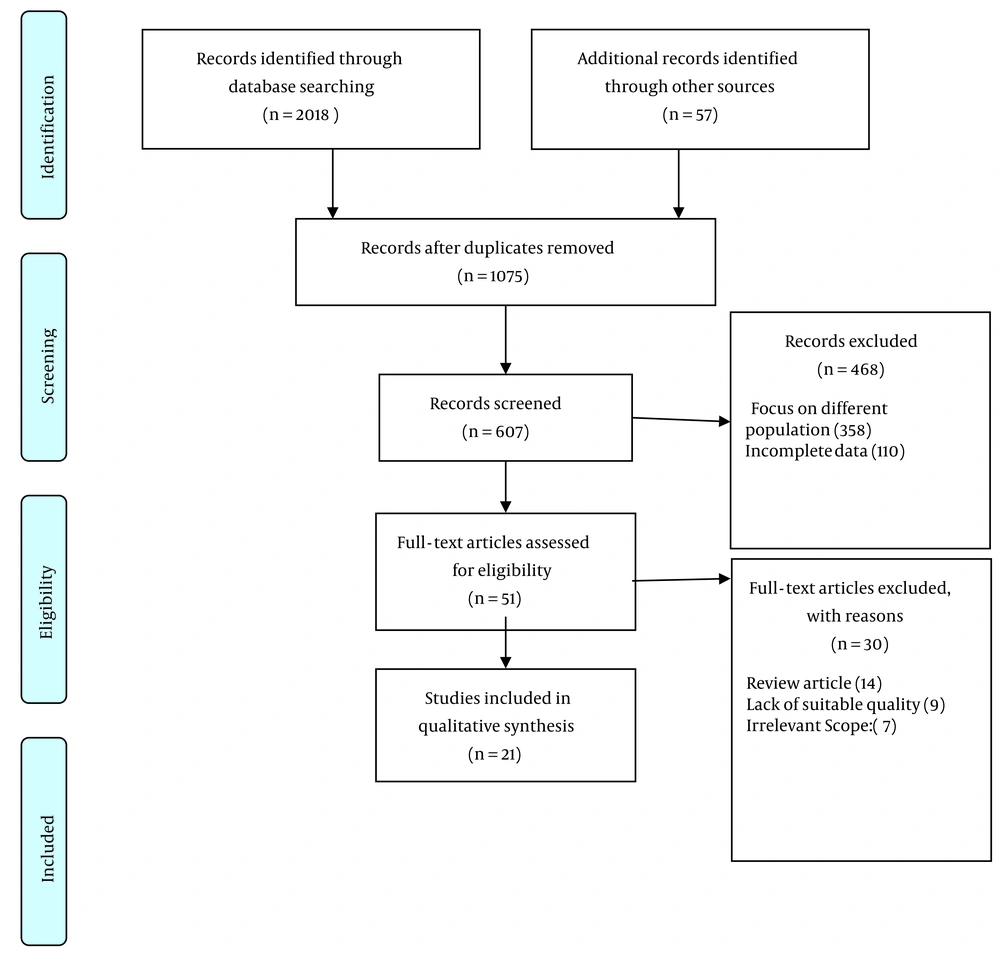
Figure 1.
Flowchart of the process of reviewing and selecting studies based on the systematic review method
2.2. Inclusion Criteria
Studies were included if they:
- Examined heat exhaustion or heat-related illnesses in mass gatherings.
- Provided empirical data or observational insights relevant to Arbaeen pilgrims.
- Were published in peer-reviewed journals, government reports, or reputable health organizations.
2.3. Exclusion Criteria
Excluded from the review were studies that did not meet the minimum required quality score following the quality assessment. Additionally, review studies, narratives, meta-analyses, and case reports were excluded.
2.4. Analytical Approach
Since narrative reviews aim to provide a qualitative synthesis rather than a systematic quantitative analysis, this review categorizes findings based on emerging themes rather than statistical evaluation. Sources were classified into two main domains:
- Environmental factors: Including temperature, humidity, hydration levels, and sun exposure.
- Social factors: Encompassing crowd density, cultural behaviors, clothing practices, and access to medical resources.
Relevant studies were critically examined for common patterns, contradictions, and knowledge gaps, forming the foundation for discussion and interpretation.
2.5. Contextual and Comparative Analysis
The findings were compared with studies on heat exhaustion in other mass gatherings (e.g., Hajj, marathon events, and other religious pilgrimages) to provide broader contextualization. This comparative approach helps identify shared challenges and unique stressors specific to Arbaeen, aiding in formulating targeted recommendations.
2.6. Ethical Considerations
Ethical approval was not required as this review relies solely on secondary sources and does not involve direct data collection from human subjects. However, all cited literature and reports were credited correctly to ensure academic integrity.
2.7. Presentation of Findings
The insights gained from this review were synthesized into narrative discussions that outline risk factors, preventive strategies, and policy implications. Recommendations were formulated based on empirical research, observed trends, and expert opinions to provide actionable solutions for minimizing heat exhaustion risks among Arbaeen pilgrims.
By employing this narrative review methodology, this article contributes to a deeper understanding of the health risks associated with the pilgrimage. It highlights avenues for future research and intervention strategies.
3. Results
This narrative review identifies multiple environmental and social factors influencing heat exhaustion among Arbaeen pilgrims. Findings are categorized into two main domains: Environmental factors and social dynamics. The interplay between these elements highlights the unique challenges of the pilgrimage and informs targeted intervention strategies.
3.1. Environmental Factors
- Temperature extremes: Pilgrims frequently experience temperatures exceeding 40°C, significantly increasing the risk of heat-related illnesses (10). Prolonged exposure to direct sunlight exacerbates dehydration and disrupts thermoregulation, leading to symptoms such as dizziness, fatigue, nausea, and heat cramps (20). Studies indicate that extended exposure to extreme heat can impair cellular function and lead to oxidative stress, worsening health outcomes for vulnerable populations such as the elderly and individuals with pre-existing medical conditions (21).
- Humidity levels: Elevated humidity reduces the body’s natural cooling mechanisms by inhibiting effective sweating, which is crucial for regulating body temperature (1, 3, 5, 22). In regions with high humidity, perspiration does not evaporate efficiently, preventing heat dissipation and accelerating the onset of heat exhaustion (14, 16, 18, 23). Pilgrims traveling from non-humid areas may be particularly vulnerable due to their lack of acclimatization, requiring additional hydration and cooling interventions (7, 8, 24).
- Inadequate hydration: Many pilgrims fail to consume adequate amounts of water, either due to limited access to hydration stations or underestimating fluid loss during prolonged walking under intense heat (25). Dehydration can lead to electrolyte imbalances, exacerbating fatigue and cognitive impairment, further increasing the risk of heat-related illnesses (11-19). Insufficient hydration also affects cardiovascular efficiency, making blood circulation less effective in cooling the body (26).
3.2. Social Factors
- Clothing choices: Pilgrims frequently wear heavy, layered, or non-breathable clothing due to cultural, religious, or personal preferences (27). These choices contribute to increased thermal stress, trapping heat close to the body and reducing airflow, leading to higher core temperatures. While modest attire remains a core aspect of the pilgrimage experience, its design and material composition must be reconsidered for better heat dissipation (28). Fabric technology incorporating breathable, moisture-wicking properties could be introduced as a culturally appropriate solution (29).
- Crowding and density: The high concentration of pilgrims in limited spaces restricts airflow, worsens heat exposure, and complicates efforts to provide timely medical assistance (3-9). Large gatherings naturally increase ambient temperature, and lack of shade exacerbates discomfort. As a result, heat exhaustion incidents rise, especially in locations with prolonged waiting times, such as checkpoints and entry areas near shrines (30). This issue necessitates better urban planning, including shaded rest zones and the strategic placement of ventilation systems (31) (Table 1).
Table 1.
Summary of Key Findings
| Factors | Impact on Heat Exhaustion | Proposed Mitigation Strategies |
|---|---|---|
| Temperature extremes | Exposure to temperatures exceeding 40°C increases dehydration and disrupts thermoregulation | Increased shaded areas, cooling stations, and awareness campaigns |
| Humidity levels | High humidity inhibits sweating, preventing effective heat dissipation | Hydration strategies, acclimatization programs, and cooling technologies |
| Inadequate hydration | Limited water intake leads to electrolyte imbalances, fatigue, and cognitive impairment | Improved access to hydration stations and education on fluid intake |
| Clothing choices | Heavy, layered clothing traps heat, increasing core temperature | Promotion of breathable, moisture-wicking fabrics |
| Crowding and density | Restricted airflow and prolonged exposure in congested areas worsen heat stress | Urban planning for shaded rest zones and ventilation systems |
4. Discussion
This review highlights the environmental and social factors contributing to heat exhaustion among Arbaeen pilgrims. While the findings provide valuable insights, it is essential to critically compare them with previous studies on mass gatherings, such as the Hajj pilgrimage, to contextualize the challenges and solutions.
4.1. Comparison with Previous Literature
Studies on Hajj have identified similar heat-related risks, including extreme temperatures, crowd density, and limited access to medical facilities (1). However, mitigation strategies implemented during Hajj — such as structured crowd management, hydration stations, and mobile medical units — have proven effective in reducing heat exhaustion cases (2). Unlike Hajj, Arbaeen lacks centralized health coordination, making community-driven interventions more critical.
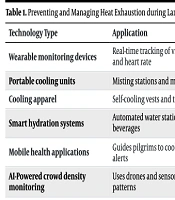
Additionally, research on marathon events and outdoor festivals suggests that real-time monitoring technologies, such as wearable hydration sensors, can significantly improve heat stress management (3). Integrating these innovations into Arbaeen pilgrimage planning could enhance early detection and intervention strategies.
4.2. Conclusions
Heat exhaustion among Arbaeen pilgrims is a significant public health concern, shaped by environmental stressors, cultural practices, and infrastructure limitations. The findings emphasize the urgent need for interdisciplinary strategies to mitigate risks and improve pilgrim safety.
4.3. Strengths and Limitations
Strengths are as follows:
- Comprehensive analysis of environmental and social factors influencing heat exhaustion.
- Inclusion of culturally sensitive mitigation strategies tailored to Arbaeen pilgrims.
- Comparative insights from other mass gatherings to inform best practices.
The limitations of the present study are:
- Lack of primary data collection, relying solely on secondary sources.
- Limited availability of longitudinal studies assessing the effectiveness of interventions over multiple pilgrimage seasons.
- Need for more granular demographic analysis to identify high-risk subgroups.
4.4. Key Recommendations
- Establish hydration stations with accessible and free drinking water points.
- Deploy mobile medical units at high-risk locations for rapid response treatment.
- Enhance public health messaging using multilingual formats, infographics, and mobile applications.
- Integrate culturally sensitive health education within religious guidance programs.
- Improve urban planning to optimize crowd flow, shaded areas, and ventilation systems.
By leveraging scientific research, technological advancements, and culturally tailored policies, stakeholders can significantly reduce heat exhaustion incidents. Future research should focus on data-driven monitoring systems, innovative cooling technologies, and long-term intervention assessments to ensure sustainable improvements in pilgrimage health management.