1. Background
Kickboxing is a high-intensity intermittent striking combat sport, which is characterized by complex skills and tactical key actions with short duration. Power for explosive attacks with integration of responses, intramuscular/intermuscular coordination and correct timing are necessary for effective application of techniques (1). Similar tests conducted to verify physical performance demands of kickboxing, such as countermovement jump (CMJ) and medicine ball throw (MBT), have strong relationship with effective technical/tactical abilities of athletes, which are used during championships and in training sessions (1, 2). For instance, from the physical conditioning perspective, the main goal of kickboxing training is to prepare the kickboxers to effectively manage both the technical/tactical, the physiological and psychological demands of combat.
Kickboxers have been studied for competitive performance improvements over the past three decades, contributing to increase in the knowledge of sports research methods; through the characterization of physical fitness (3, 4), technical-tactical and time-motion analysis (5). The few studies available on competitive kickboxing only investigated physiological responses (6, 7) and there has been some attention, albeit limited, to psychological factors which could affect the fight outcome (8, 9). Devonport (8) identifies a number of psychological variables, such as, high self-efficacy, high motivation, and mental toughness, that are linked with enhanced performance in kickboxing.
Several investigations have shown the positive relationships between self-confidence, mood state and performance (10, 11). Despite conceptual variations of mental factors, the greater part of sport studies involved analogous characteristics able to affect the outcomes (12, 13), which involves self-confidence, emotional control and persistent goals (13-15). Further, self-efficacy was a stronger predictor of performance when the measure was process oriented rather than win/loss (16). Nevertheless, the mental toughness (MT) study describes the personality of athletes whose drive motivates them relentlessly towards success and promotes thriving in tournaments or training environments (16-18). In martial arts, preceding reports have shown that goal profiles and mental toughness could influence outcomes of Wushu athletes (19). Chen and Cheesman (7) investigated whether mental toughness distinguishes levels of mixed martial arts (MMA) athletes, comparing professional to lower levels. The professional group had higher scores on the sport mental toughness questionnaire (SMTQ), than semi-professional and amateur groups with regard to confidence, positive cognition, and determination (7). Psychological factors were also able to increase the efficiency of different muscular movements in specific karate tests (20). However, associations between physical and psychological analysis are scarce in kickboxing, which is required to support the hypothesized issues underlying mental toughness, especially, concerning key elements that can help to develop physical capabilities and, at the same time, improve emotional conditions during the competitive challenges (16, 17).
The SMTQ consists of three mental toughness factors (control, constancy and confidence) (21), which can be combined into a global mental toughness score. Research into the relationship between mental toughness and performance has shown that better performances of both cognitive and motor skills are associated with higher levels of mental toughness (14, 15) and that elite athletes have higher mental toughness than lower level performers (22). Preceding reports showed significant relationships between mental toughness and endurance times (15) and rating of perceived exertion (RPE) (14). Furthermore, with methodological restrictions that have been highlighted and relatively small relationships found between mental toughness and performance (15), there is a need for further, more rigorous investigations (18, 23).
2. Objectives
In view of the above considerations, the present study a) verified whether mental toughness discriminates winner and loser in a kickboxing competition and b) examined the relationship between mental toughness and muscular power performance.
3. Materials and Methods
3.1. Participants
Thirty two high-level male kickboxers (22.4 ± 3.5 years, 1.72 ± 0.08 m, and 68.6 ± 12.6 kg) from all weight categories with more than seven years of experience participated in the present study. The subjects were assigned to a winner (n = 16) or loser (n = 16) group that participated in 16 bouts. Twenty kickboxers (winner = 10 and loser = 10: 21.2 ± 3.1 years, 1.73 ± 0.07 m, and 70.2 ± 9.4 kg) participated in muscular power tests one week before the commencement of the 2015 Tunisian national kickboxing championship. All subjects were first, second, or third dan black-belt holders. The elite kickboxers had been finalists and semi-finalists at their respective national championships in the last three seasons. The classification of kickboxers between winner and loser was according to the result of bouts in semi-final. The study conformed to the recommendations of the Declaration of Helsinki, and participants gave voluntary written informed consent to participate in the experiment, which was approved by the local institutional research ethics committee.
3.2. Procedure
On the first time, one week before the commencement of the 2015 national championship, following completion of the upper (MBT) and lower (CMJ) limbs muscular power tests, participants completed the sports mental toughness questionnaire (SMTQ) to obtain their self-ratings of mental toughness. The questionnaire was distributed by an investigator who explained the purpose of the study, which was to examine the mental abilitiy of the subject after each test. In addition, the subjects completed a consent form reflecting the confidential and voluntary nature of their involvement in the study. The investigator was present to answer questions pertaining to the wording or meaning of any of the items on the questionnaire. On the second time, 20 minutes prior to the commencement of the competition, each subject completed a questionnaire (SMTQ) in 10 minutes.
3.2.1. Sports Mental Toughness Questionnaire (SMTQ)
The SMTQ (21) was used to measure MT. The 14-item SMTQ provides a global measure of MT as well as the three subscales of confidence, constancy, and control. Participants respond to items using a 4-point Likert scale, ranging from (1) not at all true, to (4) very true. The SMTQ is based on a conceptualization of mental toughness from a positive psychology “mindset” perspective, focusing not only on an individual’s ability to overcome adversity, but also the attributes that allow them to thrive and grow under all circumstances, which include self-belief, commitment, perseverance, and emotion management. For the SMTQ, reliability and validity procedures were realized, with all subscales’ αs >.70 and significantly inter-correlated (21).
3.3. Testing Procedure
Participants were told to refrain from heavy training, alcohol, caffeine, and tobacco usage for the 2 days preceding testing sessions. To avoid any chronobiological bias on physical performances, all tests have been performed in the environmental condition (temperature: 15°C to 22°C) in the afternoon (between 5:30 - 7). During the week before the beginning of the experiment, athletes were familiarized with the test battery to avoid the learning effect during the testing period of the study. The testing of physical performance was preceded by a standard 15 minutes warm-up including jogging, dynamic stretching, and sprints.
Considering the lack of a specific kickboxing performance tests in the literature, we required athletes to perform a non-specific battery of physical performance tests. We based our choice on preceding studies evaluating combat sports athletes (2, 4, 20, 24). Validity and feasibility of the tests were also considered.
3.3.1. Countermovement Jump (CMJ)
During the CMJ, the athlete started from an upright position with hands on hips and with counter movement, and were instructed to flex their knees (approximately at 90°) as quickly as possible and then to perform a vertical jump as high as possible. For all jumps, kickboxers retained their hands on their hips to eliminate the influence of the arms swing impulse (25). The results of CMJ height are expressed in centimeters (cm). The CMJ test was performed using an infrared jump system (Optojump, Microgate, Bolzano, Italy) that was interfaced with a microcomputer.
3.3.2. Medicine Ball Throw (MBT)
The MBT is a common measure of upper-body (arms) explosive power (2). It is conducted using a standard 5 kg medicine ball. Participants were seated on the bench with their legs fully extended and back against the wall. The medicine ball was held with both hands against the centre of the chest and the forearms were positioned parallel to the ground. Participants were instructed to throw the medicine ball as far straight forward as they could while keeping their back maintained against the wall. The distance thrown is recorded in meters (m) and the best of the three trials is recorded.
3.3.3. Outcome of Competition
The outcome (win-loss) of each individual match was recorded after the end of combat. A typical kickboxing competition contains 3 rounds of 2 minutes each with a rest period of 1 minute in-between, and each kickboxer participates at their respective weight category.
3.4. Statistical Analysis
Descriptive statistics were obtained using SPSS 20.0 software (SPSS Inc., Chicago, IL, USA, version. 20.0). For the non-parametric data, Mann-Whitney test was conducted in order to compare outcome groups. Afterwards, the effect size measure for non-parametric analysis was calculated, defined as r = Z/√N, where r represents the effect size, Z is derived from the conversion of Mann-Whitney test and N is the total number of observations. This analysis considers r-values as: small effect size (r = 0.10), medium effect size (r = 0.30) or large effect size (r = 0.50). Multiple linear regressions were used to create models, which were able to show the relationship between mental toughness variables and response variables by fitting a linear equation to observed CMJ, BMT and outcome data. Pearson linear correlation analysis among variables was also conducted. For all, the significance level of P ≤ 0.05 was used.
4. Results
Comparison between mental toughness, and power tests by competitive success descriptive analyses of mental toughness variables and power tests by outcome are shown in Table 1.
Table 1.
Descriptive Statistics for Winners and Losers Kickboxers, Mental Toughness Subscales, and Muscular Power Tests
| Variable | Losers | Winners | Comparisons | ||||||
|---|---|---|---|---|---|---|---|---|---|
| 50th | 25th | 75th | 50th | 25th | 75th | U | Sig. | r | |
| Confidencea | 3.0 | 3.0 | 3.0 | 4.0 | 4.0 | 4.0 | 22 | < 0.001 | 0.79 |
| Controla | 2.0 | 2.0 | 3.0 | 4.0 | 4.0 | 4.0 | 10.5 | < 0.001 | 0.86 |
| Constancya | 2.0 | 2.0 | 2.0 | 3.0 | 3.0 | 3.0 | 37 | < 0.001 | 0.68 |
| Total MT | 7.0 | 7.0 | 8.0 | 11.0 | 10.2 | 11.0 | 4.0 | < 0.001 | 0.85 |
| CMJb | 33.0 | 31.8 | 34.8 | 35.5 | 33.0 | 36.5 | 27.5 | 0.086 | 0.30 |
| MBTb | 4.1 | 4.0 | 4.3 | 4.6 | 4.4 | 4.8 | 11 | 0.003 | 0.52 |
Abbreviations: MT, mental toughness; CMJ, Countermovement Jump; MBT, Medicine Ball Throw; Sign, significant; r, predictor value.
aN =16.
bN =10.
The present results showed significant differences between winner and loser in total MT (P < 0.001), and in confidence (P < 0.001), constancy (P < 0.001) and control (P < 0.001) subscales (Figure 1). In addittion, our results demonstrated also that the winners had a high upper-body muscular power for MBT (P = 0.003) than the losers.
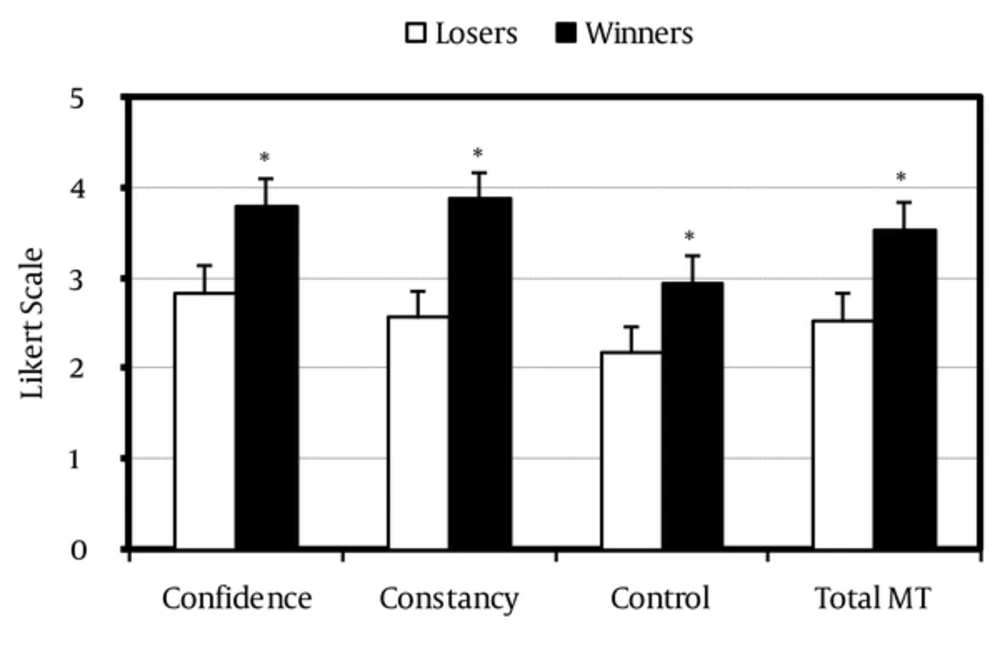
Figure 1.
* = Significant difference of winners compared to loser counterparts at P < 0.001.
4.1. Relationship between Mental Toughness and Performance Measures
Descriptive analyses and the multiple linear regressions of mental toughness subscales and power tests by outcome result are shown in Table 2.
Table 2.
Linear Regression Model to Observe Effects of Total Mental Toughness and Their Subscales in Countermovement Jump and Medicine Ball Throw Tests
| Variables | Unstandardized Coefficients | 95% CI for B | Sig. | |
|---|---|---|---|---|
| B | Lower Bound | Upper Bound | ||
| Outcome | ||||
| (Constant) | 3.486 | 2.924 | 4.049 | < 0.001 |
| Confidence | -0.190 | -0.435 | 0.055 | 0.123 |
| Control | -0.140 | -0.317 | 0.037 | 0.115 |
| Constancy | -0.310 | -0.492 | -0.129 | 0.002 |
| CMJ | ||||
| (Constant) | 25.904 | 20.963 | 30.846 | < 0.001 |
| Confidence | 1.058 | -1.249 | 3.364 | 0.346 |
| Control | 0.820 | -0.692 | 2.333 | 0.267 |
| Constancy | 0.868 | -1.008 | 2.743 | 0.341 |
| MBT | ||||
| (Constant) | 3.126 | 2.643 | 3.608 | < 0.001 |
| Confidence | 0.233 | 0.008 | 0.458 | 0.043 |
| Control | 0.058 | -0.090 | 0.205 | 0.418 |
| Constancy | 0.098 | -0.085 | 0.281 | 0.272 |
Abbreviations: CMJ, Countermovement jump; MBT, Medicine ball throw; B, regression coefficient; CI, confidence interval; Sign., significant.
The analysis demonstrated strong R values for outcome (r = 0.89, F (3,28) = 34.235, P < 0.001), MBT (r = 0.84, F (3,16) = 12.912, P < 0.001) and CMJ (r = 0.73, F (3,16) = 6.093, P < 0.001), with MT as a predictor. In addition, Pearson reinforce the associations between outcome, CMJ and MBT performance and total MT (large: r = 0.90, P < 0.001; r = 0.74, P < 0.001; r = 0.84, P < 0.001, respectively) and with the three subscales of confidence (large: r = 0.84, P < 0.001; r = 0.87, P < 0.001; r = 0.80, P < 0.001, respectively), constancy (large: r = 0.92; P < 0.001, r = 0.84, P < 0.001; r = 0.85, P < 0.001, respectively) and control (large: r = 0.77, P < 0.001; r = 0.67, P < 0.001; r = 0.76, P < 0.001, respectively) (Figures 2 and 3).
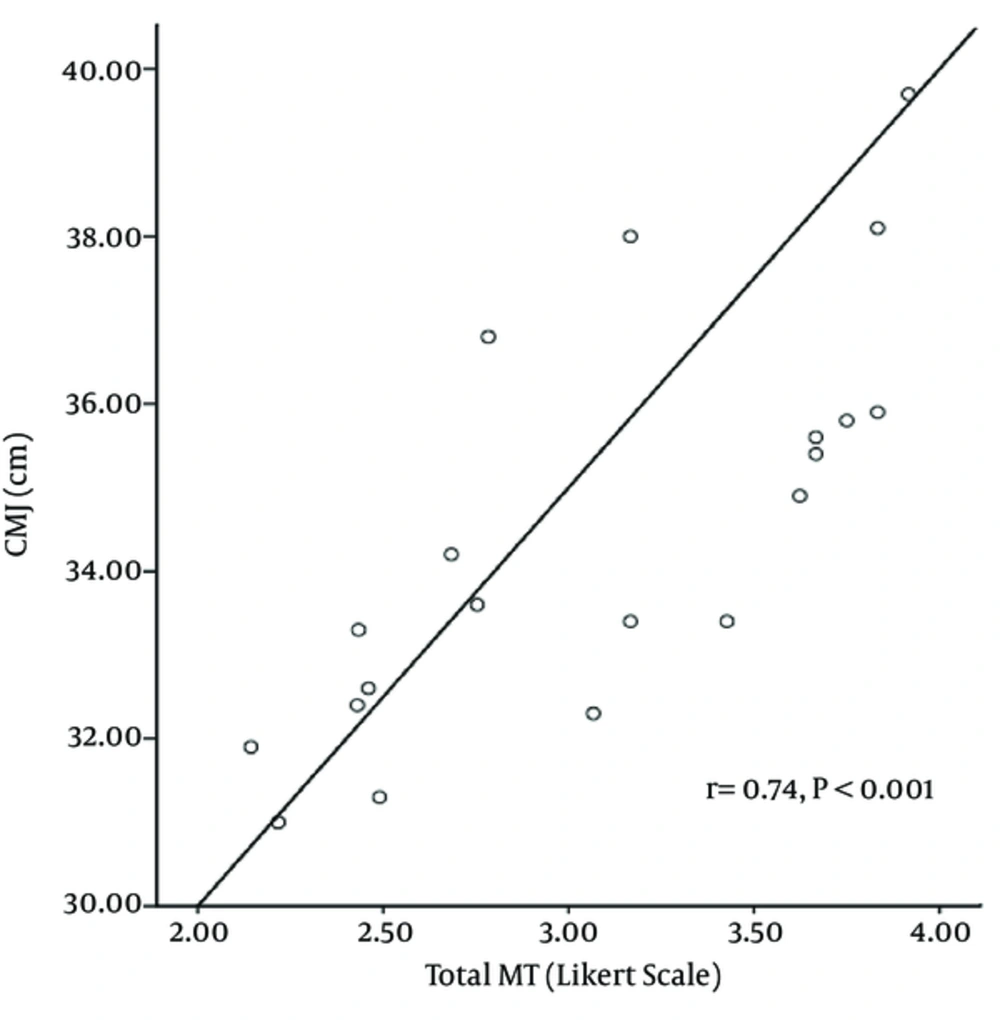
Figure 2.
Correlation Between Total Mental Toughness (MT) and Countermovement Jump (CMJ) Height
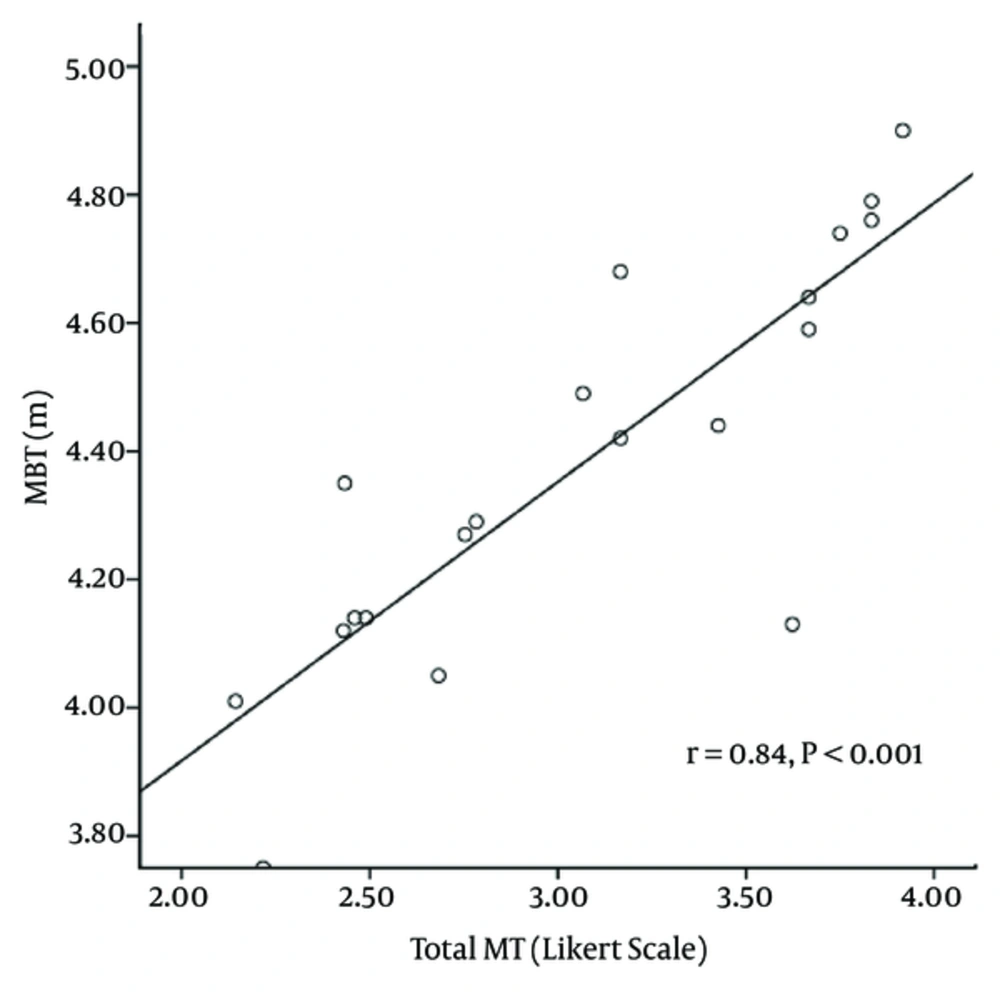
Figure 3.
Correlation Between Total Mental Toughness (MT) and Medicine Ball Throw (MBT) Performance
5. Discussion
The present study examined the relationship between mental toughness and muscular power performance and verified that mental toughness is able to discriminate between winner and loser of a kickboxing competition. The findings demonstrate a strong general correlation between mental toughness and muscular power performance. Further, mental toughness was a stronger predictor of performance when the measure was process oriented rather than win/loss. However, previous studies (26, 27) suggested that athletes in a competitive context have a self-confidence score with similar rank order of their performance. These findings agree with preceding studies (28), which showed that individuals who performed a persistent task within a competitive context were more motivated than individuals who performed the same task but within a non-competitive context. Also, the present data contribute to this knowledge when it demonstrated a positive relationship between tasks of muscular power and mental toughness and this least, considered the major factor or moderators that allow winners to reach victory in kickboxing competition (1).
A positive association between MBT and confidence hypothetically offered an adaptive mental confidence character and an accurate understanding of one’s abilities, which should contribute to the MBT success of the kickboxers by maximizing the power capability. This proposition is also consistent with preceding suggestions (13, 29), that mental toughness is associated with a rational self-concept. Thelwell et al. (27) indicated that mental toughness is encouraged during experiences with specific environmental conditions. According to Chen and Cheesman (17), the environmental conditions that seem to evoke conviction and drive include tough training in individual and group formats as well as various exercises requiring contact such as mixed martial arts (MMA) drills.
The present study showed the positive relationship between mental toughness and muscular power in elite kickboxers. In other words, the findings suggest that a heightened level of mental toughness is associated with optimal sport performance. For instance, muscular power must accompany strong brain activation relevant to the intended muscle action (30). Previous researches (31, 32) have shown a proportional relationship between magnitude of brain-to-muscle signal and voluntary muscle force by young human subjects, indicating that greater strength or power is a consequence of stronger brain activity. A stronger central command could recruit the motor units that were otherwise inactive in an untrained state and/or drive the active motor units to higher intensity (higher discharge rate), leading to greater muscle force and power (30). Recently, researchers and practitioners have stated that mental toughness is an important component in determining athletic performance (33, 34); mental toughness may also be an internal personal asset with a goal setting, emotional control, self-esteem, and hard work ethic, that can be facilitated or developed with sports practice (35). Emerging research suggests that mental toughness is multifaceted, and an important psychological construct that is related to successful sport performance (14, 15).
Regarding mental toughness differences by outcome, Scanlan and Lewthwaite (36) and Scanlan et al. (37) showed that pre-competition self-confidence best discriminated winners and losers. This occurred because confidence is a key component of MT (14), and winners have been reported as being more confident than losers. Also, Treasure et al. (16) described that athletes with higher self-efficacy perceived the competitive situation as less threatening than contestants with low levels of efficacy, and that the self-efficacy was a stronger predictor of performance when the measure was process oriented rather than win-loss.
Golby and Sheard (38) demonstrated that one particular construct that may be deemed important in differentiating athletes’ performance is mental toughness. The ability to regulate emotion and imagery effectively, display commitment and determination, possess an uncontrollable desire to succeed, and an unshakeable confidence, are all characteristic of mentally tough individuals (15). Further, attributions for success and failure have sometimes been shown to differ in stability as well as focus of control, with more stable attributions being made about success (39). In the sports literature, McAuley and Gross (40) have found winners to make attributions to more stable and more controllable causes than losers. Kuan and Roy (19) showed that benefits from having better control over unproductive negative energy in Wushu athletes, are likely to result in positive competition outcomes. Indeed, mental toughness is one of the most frequently cited psychological factors thought to affect the outcome or performance of a combat sports competition or other non-task-specific activity.
Differences between outcomes in kickboxing support previous authors, who observed significant relationships in mental toughness with medalist and non-medalists of Wushu championships, where the medalist displayed better self-confidence and better control than the non-medalist (19). A Similar study done by Kuan and Roy explored relationships between mental toughness and the social position of athletes in different team sports of Malaysia; and results suggested that the athletes with greater mental toughness were more likely to be selected into main team to play in crucial competition. Finally, the present findings suggest that winners had more upper-body muscular power than loser kickboxers who explained that the winner used more upper-limb techniques than lower-limb ones, knowing that the decisive actions in a kickboxing match, a punch, is dependent on muscle power (20, 24).
Mental toughness seems to be related to performance in kickboxing power tests and in championship outcomes. Athletes and coaches have consistently referred to mental toughness as one of the most important psychological characteristics related to outcomes and success. The present study showed a strong association among mental toughness, power tests and championship outcomes. Also, the findings demonstrated significant differences between winners and losers, of total mental toughness, confidence, constancy, control subscales and in the upper limbs muscular power. Further, applied sports psychologists also have interest in the effectiveness of psychological antecedents of sport performance e.g. mental toughness profile and going to be able to successfully intervene to enhance the mental toughness of their athletes. Future researchers might also consider assessing the relationship between mental toughness and other measures of physical fitness, such as strength performance, and to determinate the mechanisms to mediate these relationships. In all likelihood, both physiological and psychological factors are implicated.