1. Background
A crucial component of medical education is the assessment of students’ clinical and practical abilities to verify their capacity to apply classroom knowledge in real-world settings. In Iraq, medical schools are increasingly adopting structured practical examinations, including a specialized Integrated Practical Examination (IPE), to evaluate students’ skills fairly and objectively. The IPE, typically modeled after the Objective Structured Clinical Examination (OSCE), aims to assess a broad spectrum of competencies, including clinical reasoning, procedural skills, communication, and problem-solving (1). Some Iraqi institutions have implemented IPEs as early as the first and second stages of medical school. These IPEs integrate basic sciences with early clinical skills, unlike standard OSCEs, which are typically introduced later in the clinical years.
OSCEs are a reliable method for reducing examiner bias in medical college examinations (2, 3). However, due to limited faculty staffing, restricted training opportunities for staff and students, and inadequate infrastructure, organizing practical examinations is challenging, particularly in resource-constrained settings such as Iraq (4, 5). In addition, the application of basic science concepts in practical testing, a distinctive feature of Iraq’s IPE model, has not been extensively studied, making it difficult to assess its effectiveness compared with tests that focus on a specific subject. Despite these challenges, providing students with scheduled practical assessments early in training may help them prepare for clinical practice and reduce stress later (6). Some research indicates that formative, consistent evaluations improve information retention and facilitate skill acquisition over time. However, disagreement remains regarding how best to plan and design these assessments. In Iraq, where medical education is being restructured to meet international standards, it is essential to understand students’ perceptions of their experiences, the level of stress they encounter, and their performance during IPE sessions so that the curriculum can be tailored accordingly.
The OSCE format was successfully implemented by the Faculty of General Medicine at the University of Koya in 2020 for the clinical evaluation of sixth-year students enrolled in the Bachelor of Medicine and Surgery (MBChB) program (7). In contrast, there was no standardized practical examination for the preclinical stages.
2. Objectives
This study aimed to investigate first- and second-year medical students’ perceptions in Iraq of the efficacy, stress implications, and organizational quality of the IPE. We sought to assess the effectiveness of current practices and identify areas for improvement in Iraq’s practical examination format by comparing student feedback with the established literature on OSCEs and comparable assessments. The findings will contribute to the growing body of research on early clinical skills evaluation in resource-limited settings and provide evidence-based recommendations for improving IPEs in Iraqi medical schools.
3. Methods
3.1. Study Design and Setting
This mixed-methods, cross-sectional study was conducted at the Faculty of Medicine, Koya University, in the Kurdistan Region, Iraq, after completion of IPE sessions for first- and second-year medical students during the 2024 - 2025 academic year. The IPE program integrated foundational sciences and initial clinical skills within a multistation setup.
3.2. Participants and Sampling
All first- and second-year students in the Faculty of Medicine who participated in the IPE were eligible. Students who participated in the pilot survey (n = 12) or were absent on the day of the examination (n = 3) were excluded. Faculty members and external examiners involved in the examination were invited to provide informal feedback to enhance contextual understanding; however, only student data were used in the statistical analysis.
We used convenience sampling and invited all eligible students to participate.
3.3. Data Collection
The questionnaire was adapted from research assessing GOSCE in medical schools among Koya Medical College students, Malaysian pharmacology students, Basra Medical students, and Sulaymaniyah Medical students (7-10). It consisted of 3 sections and 29 questions. The first section collected respondents' demographic information, and the second section included 26 closed-ended questions using a Likert scale. The final section consisted of 1 open-ended question soliciting suggestions; identifying strengths and weaknesses; assessing time adequacy for task performance; and providing recommendations for improvement and better examination arrangements. The closed-ended questions used the following response terms: strongly agree, agree, neutral, disagree, strongly disagree, very bad, bad, neutral, good, very good, necessary, and unnecessary.
All students who took the IPE exam received the questionnaire; those who did not complete it or did not respond were excluded from the study.
Five medical education specialists evaluated the content quality and validity. The pilot group demonstrated acceptable internal consistency (Cronbach's α = 0.74), indicating that the instrument was reliable.
3.4. Procedure
Within 48 hours after the examination, the survey was distributed via Google Forms. Participation was voluntary.
3.5. Statistical and Qualitative Analysis
We used SPSS version 23 to analyze the quantitative data. Descriptive statistics (mean ± SD, frequencies, percentages) were used to summarize responses. Independent t-tests compared mean scores between students preparing to take foreign licensing examinations and those not preparing for the same examinations. Chi-square tests were used to compare categorical responses. A P value of less than 0.05 was considered significant.
Thematic analysis was used to analyze the qualitative data. Responses were read repeatedly, coded inductively, and organized into topics such as time limits, station clarity, and infrastructure problems.
3.6. Ethical Considerations
The study was reviewed by the Institutional Review Board (IRB) of the Faculty of General Medicine, Koya University. The IRB reviewed the survey on May 6, 2025, with the reference code 279/12 and determined that formal ethics approval or a reference number was not required. This decision was based on the minimal risk to participants and the exclusive focus on educational experiences, without any intervention or collection of sensitive personal data. All participants provided electronic informed consent. Data confidentiality and anonymity were maintained in accordance with the Declaration of Helsinki.
4. Results
One hundred forty-eight and 63 students from the first and second stages, respectively, of 156 and 69 eligible students, participated in the examination, excluding those who participated in the pilot study.
Among the 211 participants, 106 were male and 105 were female, yielding a male-to-female ratio of 49.8 to 50.2. Table 1 presents demographic differences.
Table 1.
Demographic Distribution
| Variables | No. (%) |
|---|---|
| Stage | |
| First | 148 (94) |
| Second | 63 (91.3) |
| Gender | |
| Male | 106 (49.8) |
| Female | 105 (50.2) |
| Residency | |
| Dormitory | 110 (52.1) |
| Traveling from other cities on the day of the examination | 79 (37.4) |
| Home in Koya | 22 (10.5) |
The Figure 1 shows stress levels before the examination, and the Figure 2 shows stress levels after the examination. All participants were asked about their stress levels before the examination, and their responses regarding stress levels after the examination were also recorded. Figures 1 and 2 show these variations.
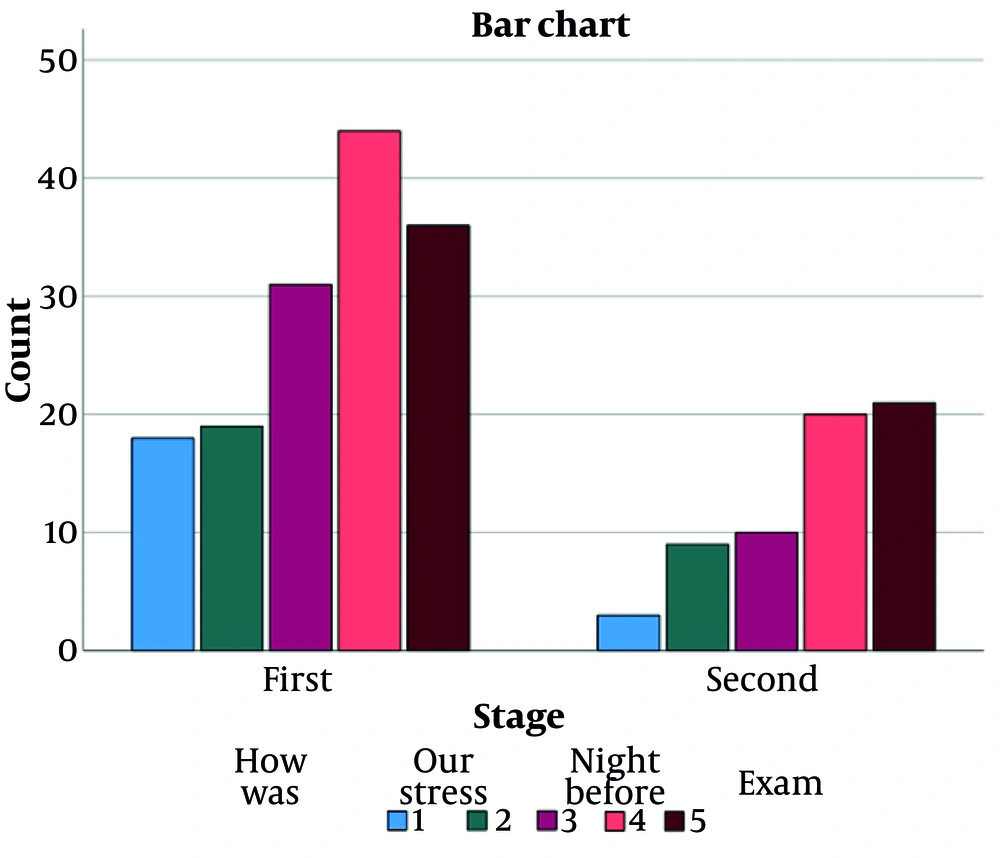
Figure 1.
Stress level before examination
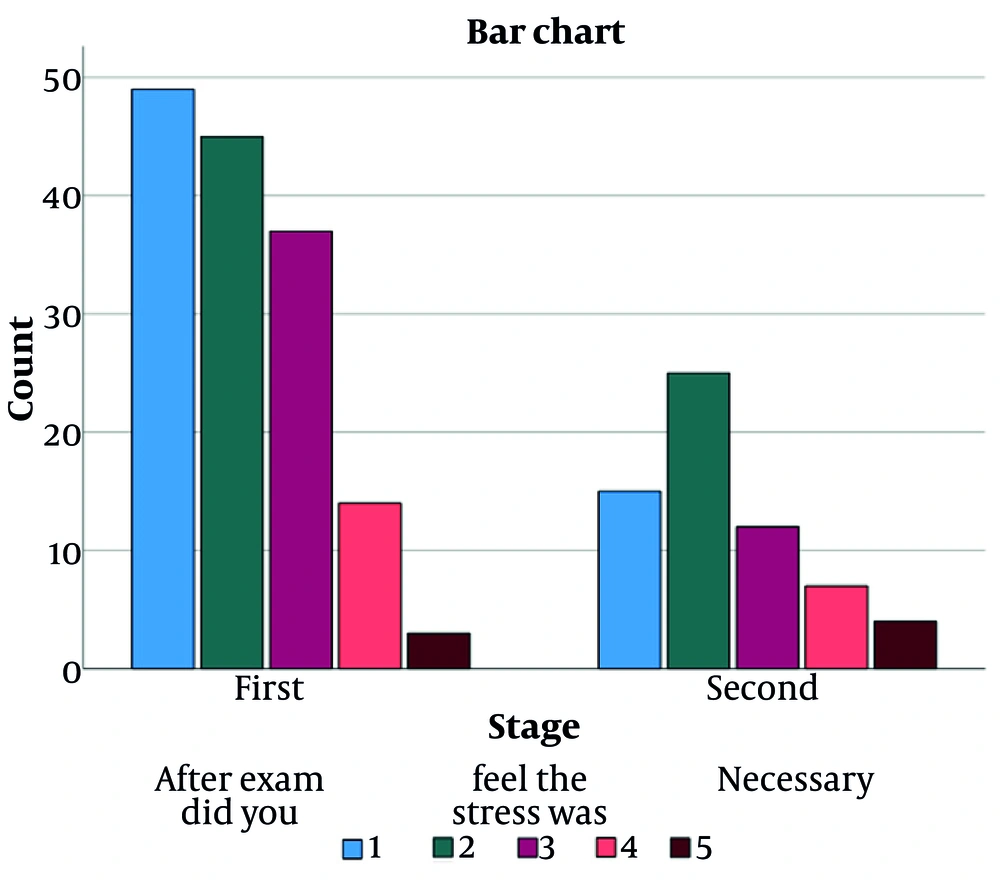
Figure 2.
Stress was necessary after the examination
Figure 2 indicates that stress was necessary.
Although the examination was conducted over 2 days, the numbers of students and stations differed.
The questionnaire included details about each step of the arrangement and the scientific content of the examination. Nearly three-quarters of first-stage students and 70% of second-stage students stated that the rest stations were adequate. Regarding staff helpfulness, mean satisfaction was 4.4 among first-stage students and 4.6 among second-stage students. We compared first- and second-stage responses across all examination details; Table 2 presents these results.
Table 2.
Responses of the First and Second Stages About Integrated Practical Examination Details
| Variables | The First Stage Means | The Second Stage Means | Total Mean | P-Value | Standard Deviation |
|---|---|---|---|---|---|
| Overall arrangement rating 1 - 5 | 4.1 | 4.3 | 4 | 0.07 | 0.886 |
| Rest station adequacy | Adequate 75% | Adequate 70% | 70 | 0.15 | 0.850 |
| Number of stations, adequate/too much/too little (%) | Adequate 80% | Adequate 75% | 78 | 0.8 | 0.9 |
| Fairness 1 - 5 | 3.7 | 3.9 | 3.65 | 0.09 | 1.0.19 |
| Coverage of practical skills 1 - 5 | 3.5 | 3.8 | 3.41 | 0.11 | 1.007 |
| Minimized chance of failing 1 - 5 | 3.4 | 3.6 | 4.11 | 0.14 | 1.081 |
| IPE is less stressful than other exams 1 - 5 | 3.2 | 3.4 | 3.18 | 0.032 ** | 1.011 |
| Minimized chance of cheating 1 - 5 | 4 | 4.2 | 4.11 | 0.08 | 1.081 |
| Clear instructions before the exam 1 - 5 | 4.2 | 4.4 | 3.91 | 0.021 ** | 1.024 |
| Enough time to demonstrate skills 1 - 5 | 3.6 | 3.8 | 3.42 | 0.13 | 1.072 |
| Room setup, lighting, and cooling 1 - 5 | 4.1 | 4.3 | 4.27 | 0.06 | 0.817 |
| Clarity of questions and curriculum alignment 1 - 5 | 3.9 | 4.1 | 3.47 | 0.17 | 1.025 |
| Direction of movement between stations 1 - 5 | 4.3 | 4.5 | 4.28 | 0.07 | 0.813 |
| Helpfulness of organizing staff 1 - 5 | 4.4 | 4.6 | 4.42 | 0.015 ** | 0.754 |
| Opportunities to learn 1 - 5 | 4 | 4.2 | 3.84 | 0.11 | 0.856 |
| Dean's support and arrangement 1 - 5 | 4.2 | 4.4 | 4.13 | 0.08 | 0.840 |
Table 3 presents statistically significant differences between students who planned to take international examinations and those who did not. There was a significant difference in stress levels before the examination.
Table 3.
Comparison of Parameters by Consideration of International Exams (PLAB, Etc.)
| Variables | Yes Maybe | No | Mean | P-Value | Standard Deviation |
|---|---|---|---|---|---|
| Stress level the night before the exam 1 - 5 | 3.4 | 3.1 | 3.51 | 0.0028 ** | 1.289 |
| Ate breakfast, yes/no | 68% Yes | 72% Yes | 70 | 0.32 | 0.85 |
| Felt the stress was necessary after the exam 1 - 5 | 2.3 | 2.0 | 2.23 | 0.041 ** | 1.089 |
| Sleep quality the night before the exam 1 - 5 | 2.7 | 2.9 | 2.28 | 0.15 | 1.262 |
| Overall arrangement rating 1 - 5 | 4.2 | 4.0 | 3.94 | 0.09 | 0.967 |
| Rest station adequacy, adequate/too much/too little | 73% Adequate | 77% Adequate | 70% | 0.24 | 0.850 |
| Number of stations, adequate/too much/too little | 78% Adequate | 82% Adequate | 78% | 0.19 | 0.9 |
| Fairness of IPE design 1 - 5 | 3.8 | 3.6 | 3.65 | 0.12 | 1.019 |
| Coverage of practical skills 1 - 5 | 3.7 | 3.4 | 3.41 | 0.047 ** | 1.007 |
| Minimized chance of failing 1 - 5 | 3.5 | 3.3 | 4.11 | 0.18 | 1.081 |
| IPE is less stressful than other exams 1 - 5 | 3.3 | 3.1 | 3.18 | 0.21 | 1.011 |
| Minimized chance of cheating 1 - 5 | 4.1 | 3.9 | 4.11 | 0.11 | 1.081 |
| The exam was very stressful 1 - 5 | 3.2 | 3.0 | - | 0.14 | - |
| Clear instructions before the exam 1 - 5 | 4.3 | 4.1 | 3.91 | 0.07 | 1.024 |
| Enough time to demonstrate skills 1 - 5 | 3.7 | 3.5 | 2.88 | 0.16 | 1.163 |
| IPE organization 1 - 5 | 4.1 | 3.9 | 4 | 0.08 | 0.886 |
| Room setup, lighting, and cooling 1 - 5 | 4.2 | 4.0 | 4.27 | 0.10 | 0817 |
| Clarity of questions and curriculum alignment 1 - 5 | 4.0 | 3.8 | 3.47 | 0.13 | 1.025 |
| Time for study after theory exam 1 - 5 | 3.6 | 3.4 | 3.29 | 0.20 | 1.229 |
| Direction of movement between stations 1 - 5 | 4.4 | 4.2 | 4.28 | 0.06 | 0.813 |
| Helpfulness of organizing staff 1 - 5 | 4.5 | 4.3 | 4.42 | 0.09 | 0.754 |
| Opportunities to learn 1 - 5 | 4.1 | 3.9 | 3.84 | 0.17 | 0.856 |
| Dean's support and arrangement 1 - 5 | 4.3 | 4.1 | 4.13 | 0.11 | 0.840 |
5. Discussion
This novel assessment method at Koya Medical Faculty comprised 2 separate days of the integrated practical test, including both a practical examination and a basic clinical examination, conducted at the end of the first and second semesters. All first-stage students attended 30 stations, whereas second-stage students attended 36 stations.
This study examined medical college students’ perceptions of an IPE. It compared responses from first-year and second-year students, including those considering examinations abroad, such as PLAB, and those who were not. The main findings indicated that first-stage students and those aspiring to take overseas examinations experienced higher stress. The structure and fairness of the examinations were evaluated favorably. As detailed below, these results both align with and diverge from global trends in OSCE/IPE evaluations.
Our group reported moderate stress before the test, which is substantially lower than the levels reported in Indian (11) and Middle Eastern medical schools (12). This difference may be attributable to institutional efforts to reduce anxiety by providing clearer instructions and staff psychological support. However, the finding that second-stage students and PLAB-aspiring students were more stressed is consistent with global reports on stress and high-stakes tests (3). Students considering international examinations also rated the IPE’s coverage of practical skills significantly higher, suggesting that they view these examinations as adequate preparation for meeting global competency standards. Because this test is new and shares the same time constraints as previous OSCEs, a moderate level of stress is acceptable.
Sleep quality the night before the examination was lower among travelers, which may be explained by the additional pressures faced by commuting students, such as early wake-up times and transit-related uncertainty. This is consistent with Dyrbye et al. (13), who found that medical students who commute frequently experience fatigue and perform worse academically. Compared with noncommuting students, commuting students did not report significantly poorer examination ratings, such as fairness and time adequacy, suggesting resilience or effective coping strategies despite lower sleep quality.
According to Alkhateeb et al. (14), pre-examination anxiety in OSCEs is exacerbated by transportation stress. Our IPE received high ratings for staff helpfulness, including assistance and clear instructions, which may have mitigated some of these challenges. As noted by Hawezy et al. (8), centralized testing locations helped Grand OSCE commuters feel less stressed. Similar advantages were likely provided by our IPE’s single-location design, with all stations on-site. However, a factor less relevant to our interdisciplinary IPE was noted by Abdulla (9), who reported that surgical OSCEs disadvantaged rural commuters because of unfamiliarity with the equipment.
An article demonstrated that breakfast improves working memory and sustained attention during high-stakes examinations, which is critical for IPE stations requiring rapid skill demonstration (15). Our data align with those of Ferguson et al. (16), who found that nutritional habits mediate examination anxiety in medical students.
Participants rated the IPE as fair and well organized, consistent with Khan et al.’s findings in Western schools (3). However, qualitative feedback highlighted time pressure for complex stations, such as biophysics calculations, a common critique in the OSCE literature (17). The 2-minute time per station was insufficient for complex activities. A duration of 5 to 7 minutes is recommended for clinical stations (18).
Unlike studies reporting inadequate rest stations (18), our students considered them sufficient, possibly because of structured breaks and staff support.
Students interested in the PLAB/USMLE reported higher stress levels but also expressed stronger approval of the coverage of practical skills. This aligns with previous observations that students prioritize rigorous assessment of training (12). Stress in this subgroup may stem from personal performance expectations or awareness of global competition. In contrast, students who do not aspire to a career in IPE tend to perceive the examination as less stressful and less significant, suggesting a need to align IPE goals with diverse career pathways.
The relatively lower stress levels in our cohort compared with studies from the Middle East and Asia (11, 12) may reflect cultural differences in stress expression or institutional support. Harden and Gleeson’s framework suggests that structured, transparent examinations reduce anxiety, which may represent a strength of our IPE model (1).
The study highlighted infrastructure limitations, such as station setup and logistical hurdles, that were not explored in depth and warrant further discussion. In resource-scarce regions such as Iraq, factors such as station configuration, available equipment, and weather conditions, including lighting and cooling, can substantially affect student performance and examiner efficiency. Comparable challenges have been noted in other low-resource environments, where inadequate infrastructure has hindered the effectiveness of OSCEs or IPEs (5, 14). For example, stations that are too crowded or lack sufficient materials may increase stress levels or make fair grading more difficult, even if the examination design itself is strong. Future iterations of the IPE should prioritize infrastructure audits and allocate resources to standardize station quality, ensuring that they meet international standards, such as Harden and Gleeson’s OSCE framework (1). This is particularly important for interdisciplinary examinations such as the IPE, where different arrangements may be required for basic science and clinical activities.
Residency status, including dormitory, commuter, or local status, was another aspect that this study did not adequately examine, despite its potential impact on stress and performance. Commuting students reported worse sleep quality, supporting findings from previous studies (12, 13) indicating that transportation challenges intensify examination-related anxiety among medical students worldwide. In contrast to research reporting diminished performance among commuters, such as Abdulla (9), our group showed no notable differences in examination ratings, suggesting resilience or strong institutional support, such as clear instructions and staff assistance. This finding prompts further exploration of whether Iraq’s IPE model alleviates travel-related pressures through centralized locations or cultural shifts. Comparative research in similar contexts may clarify whether these results reflect specific institutional policies or broader trends in student coping. Additionally, addressing residency-related issues, such as providing overnight stays or flexible schedules, could help reduce bias in high-stakes examinations.
5.1. Conclusions
The IPE for preclinical medical students at Koya University demonstrates that robust, multistation clinical assessments can be conducted in settings with limited resources. The results show that the IPE format causes moderate anticipatory stress, especially among first-year students experiencing a novelty effect and those preparing for highly competitive international medical examinations. However, most students believe that the test is fair, well organized, and very useful for improving their clinical skills. The IPE was highly successful in this case because the organizing faculty were dedicated, communicated clearly, and provided psychological support, which compensated for the lack of physical and infrastructural resources. To ensure that these programs in Iraq are sustainable over the long term and comparable with those in other countries, future efforts should focus on targeted investments in infrastructure, optimizing station time limits for complex tasks, and maintaining strong institutional support systems for commuting students. Addressing these logistical issues will maximize the teaching value of early clinical assessments while also keeping students safe.