Early diagnosis and determining the tumor boundary provide important insights to prognosis, tumor response to treatment, and quality of life (
19).
Proton MR spectroscopy (a metabolic technique) and diffusion weighted imaging (a functional technique) are two non-invasive and advanced imaging approaches that could be useful in this regard.
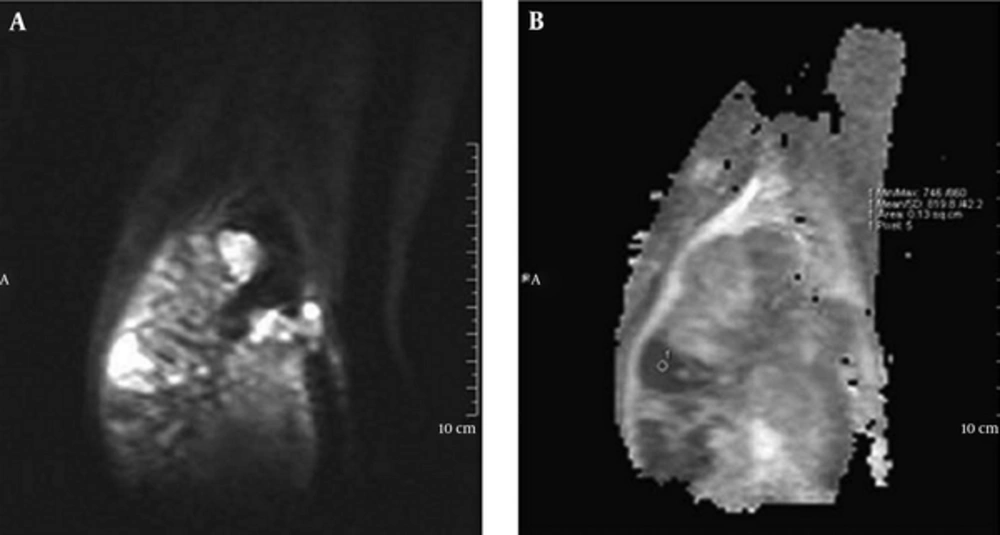
In this study, the minimum ADC value of osteosarcoma was 0.88 ± 0.28 × 10⁻³ mm2/s (mean ± SD) and 14 (82%) of the 17 patients had ADC values ≤ 1 × 10⁻³ mm2/s.
The ADC values are comparable with earlier studies on musculoskeletal DW imaging performed at 1.5T.
In a study conducted by Hayashida et al. (
20), the mean ADC value of pretreatment was 1.09 × 10
-3 mm
2/s in treatment responders and 1.35 × 10
-3 mm
2/s in non-responders.
The minimum ADC values of chondroblastic osteosarcoma and other types of osteosarcoma were reported by Yakushiji et al. as 1.24 ± 0.10 × 10⁻³ mm
2/s and 0.84 ± 0.15 × 10⁻³ mm
2/s, respectively (
21).
Proton MR spectroscopy has been broadly used for detection of malignant lesions in other organs, but there are limited published studies for characterizing musculoskeletal lesions (
8,
22,
23) all performed at 1.5 T. We performed 2D proton MR spectroscopy by employing multivoxel technique at 3T during which information is simultaneously obtained over a larger field of view (
7). At present, there is only one study in which musculoskeletal investigation was performed on three cases using multivoxel proton MR spectroscopy (
24).
In single voxel MR spectroscopic studies, peak of enhancement or solid tissue has been used for voxel placement. Many other tissues like granulation, neovascularized necrosis and inflammatory muscles can show enhancement (
25). So, we covered the whole suspicious areas and had to utilize multivoxel technique.
The relationship between the levels of metabolites and the degree of malignancies has been investigated in several studies (
23,
24). Metabolite quantification needs an external or internal standard reference, which is usually water. Water content has been affected in different musculoskeletal tissues, several pathological conditions and during treatment that influence the final results of the internal reference methods (
7,
26). We employed Cho/Cr ratio to have more reliable numerical results as well as cut point, practically. It has been proved that longer echo times (TEs) increase the Cho/Cr ratio differences between normal and tumoral tissues (
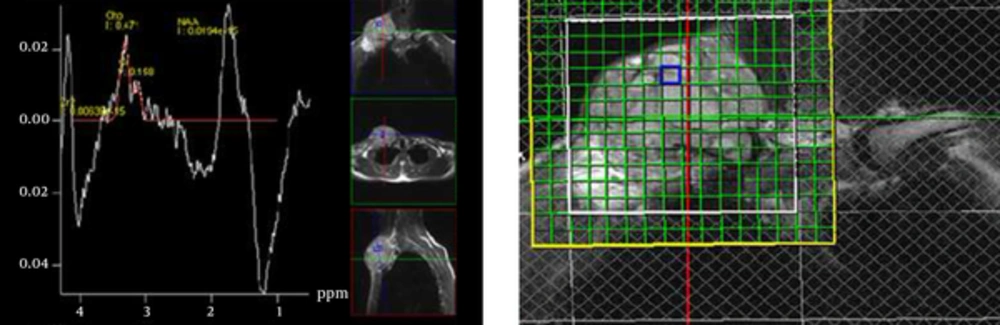
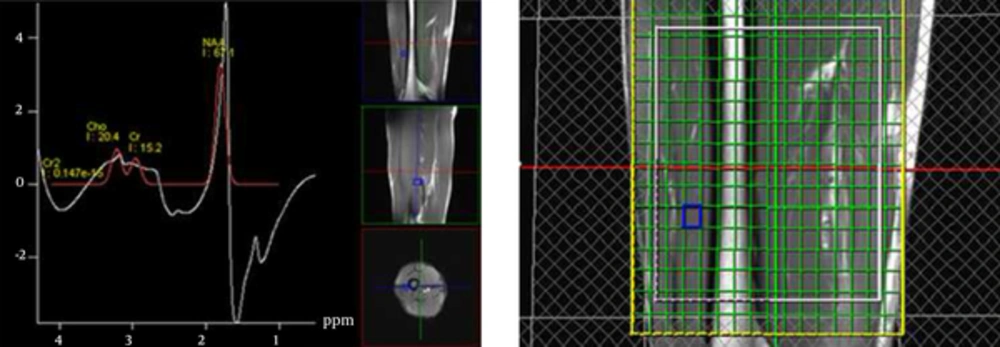
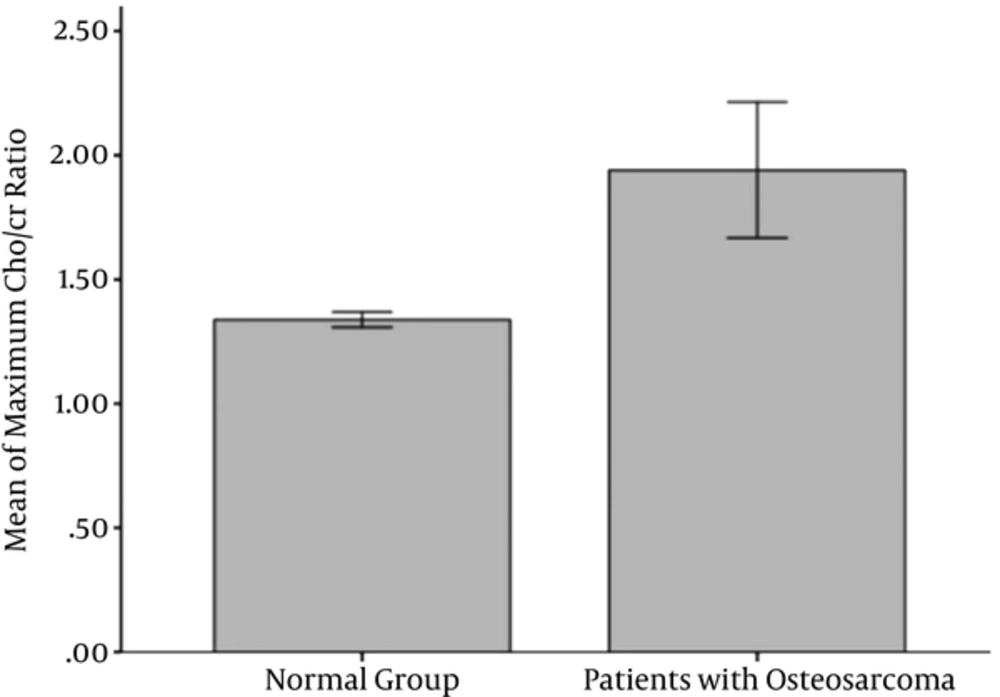
8). We used TE of 135 in this study. Herein, maximum Cho/Cr ratio of osteosarcoma (1.94 ± 1.12) was significantly higher than the normal muscle (1.34 ± 0.11). Because of data overlap, we performed ROC curve analysis and acquired 1.37 as the cut point between the normal muscle and osteosarcoma tumoral tissue, with sensitivity, specificity and accuracy of 58.8%, 83.3%, and 69%, respectively.
Doganay et al. (
19) reported a sensitivity of 72% and specificity of 83.3% for MR spectroscopy in detecting malignant soft tissue and bone tumors. Lee et al. (
12) noted a sensitivity of 68.4% and specificity of 87.5% for proton MR spectroscopy in detecting choline compounds. This sensitivity was lower in primary malignant tumors (53.8%). They had one case of grade 3 osteosarcoma, which did not show any choline compounds due to a relatively large amount of ossification. Although Wang et al. (
8) showed high sensitivity and specificity of proton MR spectroscopy in detecting malignant bone and soft tissue tumors in an initial study, in a parosteal osteosarcoma, no choline peak was detected. In a study performed by Qi et al. (
27), one patient with osteoblastic osteosarcoma did not show any choline peak either. Low choline concentration (false negative choline uptake) in some subtype of osteosarcoma can be attributed to lower proton amounts and susceptibility effects due to mineralization (
8).
Fayad et al. (
5) showed higher choline concentrations in malignant versus benign lesions in a quantitative study. Fayad et al. (
28) also showed significant choline concentration in the normal muscle. In a study carried out by Maheshwari et al. (
10), the average of Cho/Cr ratio in normal muscle at TEs of 136 and 272 were 1.16 and 1.31, respectively. This emphasizes the maximum Cho/Cr ratio of normal muscle in our study, which is expected to be higher than this average.
Our results appear to be in keeping with previous studies. Utilizing proton MR spectroscopy to evaluate osteosarcoma seems to be potentially successful in about 58.8% of patients.
We had two cases of small cell osteosarcoma, a rare subtype, which is composed of small blue cells, similar to round cell neoplasm as Ewing sarcoma. Both of them showed low ADC values and high Cho/Cr ratios. So, we expect Ewing sarcoma to have the same characteristics, which must be examined in future studies.
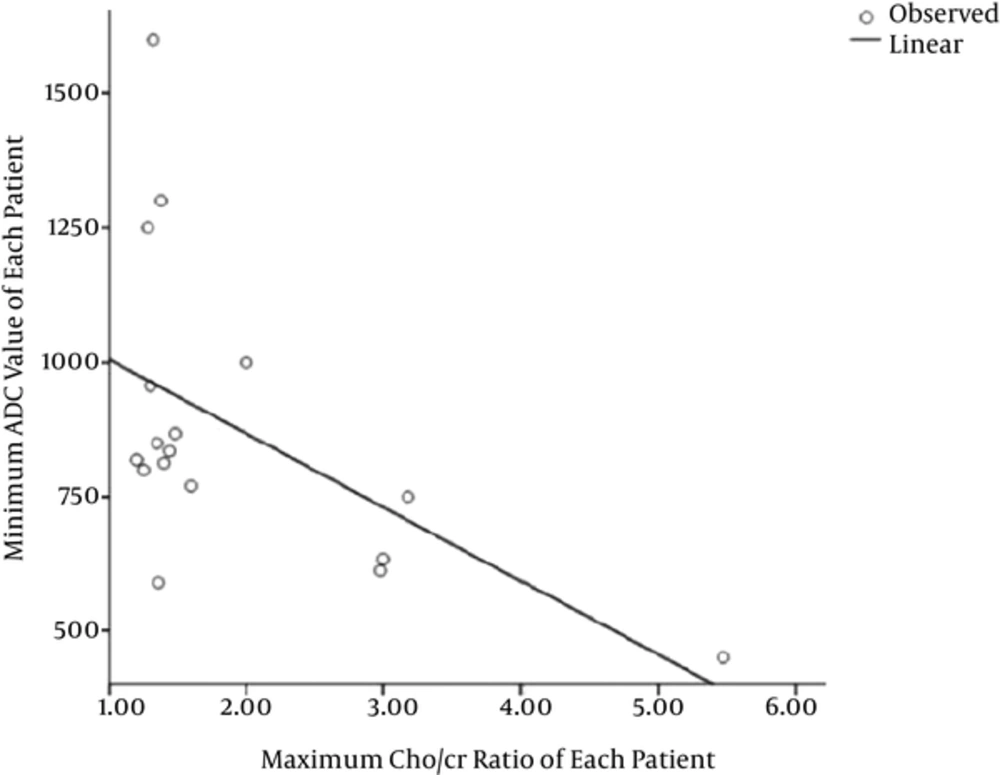
Performing DW imaging is technically easier and less time consuming than proton MR spectroscopy. DW imaging was helpful in at least 82% of the patients at a glance, but proton MR spectroscopy was helpful in about 58.8% of the patients. In our study, all patients with Cho/Cr ratios higher than the cut point had ADC values lower than or equal to 1 × 10⁻³ mm2/s and all patients with the minimum ADC values higher than 1 × 10⁻³ mm2/s had Cho/Cr ratios lower or nearly in the limit of the cut point. In contrast, some patients with ADC values lower than 1 × 10⁻³ mm2/s did not show Cho/Cr ratios higher than the cut point. These points reveal that DW imaging is much more effective and proton MR spectroscopy cannot be more helpful than DW imaging in any of the patients with osteosarcoma. However, these results needs to be more investigated.
The goal of this study was to search about differences of MR spectroscopy and DWI findingsbetween osteosarcoma and normal muscle. It is clear that in future studies, pathologic correlation of other tissues including necrotic tissues is necessary.
Although osteosarcoma is one of the most frequent primary bone tumors, the number of cases is limited due to its relatively low incidence rate (4 - 5 per year per million persons) (
29). So, more and if possible multicenter studies for better evaluation of this aggressive bone tumor should be conducted.
In conclusion, this study reports that performing MR spectroscopy and DW imaging at 3T is helpful in characterizing musculoskeletal lesions. Further evaluation should be performed for pre and post treatment patients. This information could be helpful in increasing diagnostic specificity of malignancy, definition of the neoadjuvant treatment response, and a preliminary study for determining lesion boundaries.