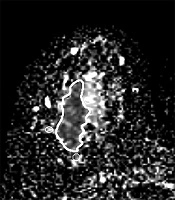
Usually, MRI is T2-weighted (transversal relaxation time) and/or T1-weighted (longitudinal relaxation time). Theoretically, the T2 relaxation time is dependent on tissue characteristics itself (
14), and is independent of the main magnetic field strength.
T2 relaxation time could be obtained using spin echo (SE) or gradient echo (GRE) sequences; this study used a spin echo sequence. Currently, multispin-echo (MSE) sequences are commonly employed (
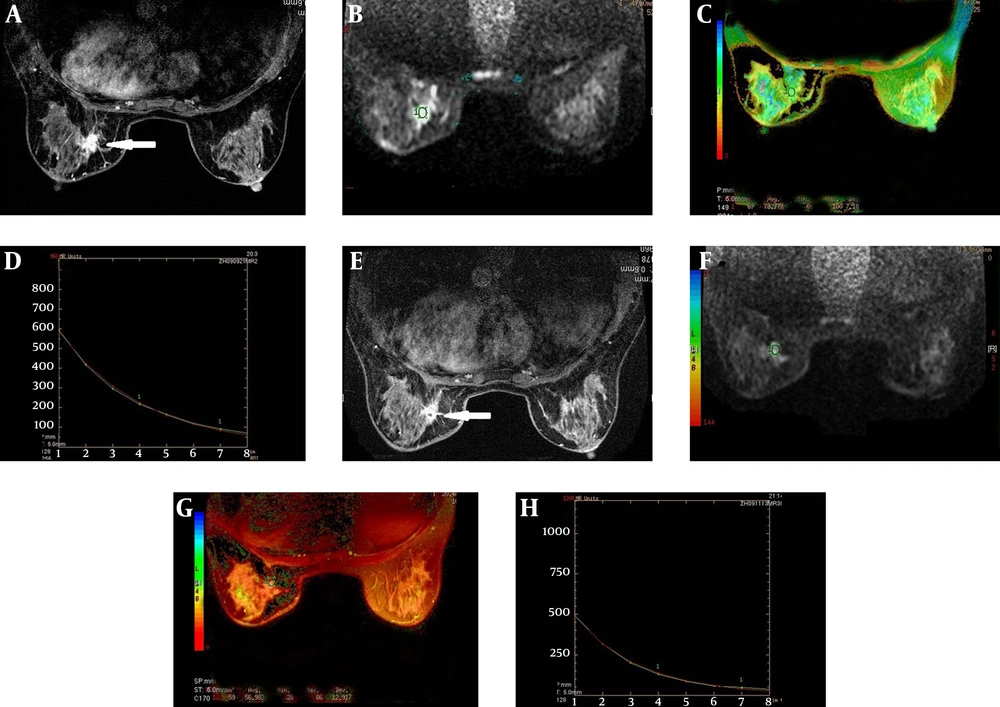
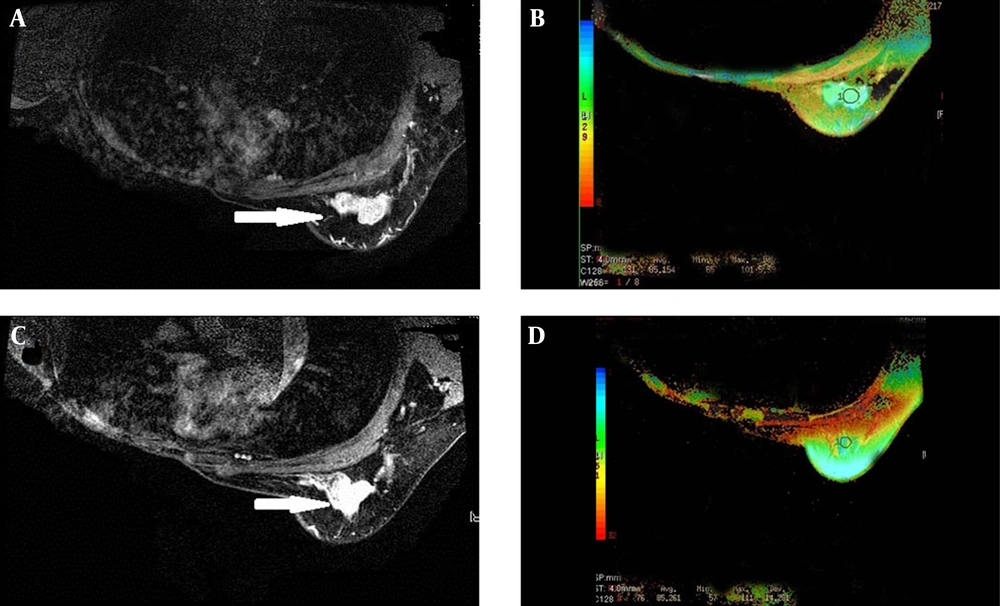
9). In this study, the data were collected using 8 different TEs. After the images were acquired, they could be generated directly in color T2 mapping by using Functool T2 mapping software to determine the level of the pixel values in T2 mapping, based on the tissue T2 relaxation time. When using a single spin echo acquisition for T2 weighted images, TE close to the tissue T2 relaxation time must be selected.
In addition to the effects of the main magnetic field strength, the T2 relaxation time was affected by the tissue water content, random movement of water molecules and macromolecules, tissue fat content, presence of paramagnetic particles and pH value (
15,
16). Among these factors, the tissue water content was the most important, T1 and T2 relaxation times of free water are longer than those of bound water (
16). Cytotoxic drugs used in neoadjuvant chemotherapy could alter the distribution of water in a tumor, and a possible explanation for this finding could be due to swelling, necrosis and apoptosis of tumor cells (
10). A study showed that in a regimen using cyclophosphamide in the treatment of breast cancer, the extracellular space is increased the day following treatment (
17). Tan et al. (
10) investigated the use of the relaxation times of malignant breast lesions in predicting the response after the first cycles of NAC, and 60% of the patients showed a lengthening of the lesion T2 relaxation times. According to Duvvuri et al. (
18), although a trend of increasing T2 relaxation times relative to the controls was noted in the viable regions of the tumor 36 hours after cyclophosphamide administration in the RIF-1 tumor model, the changes were not statistically significant, presumably because the free water content of the extracellular space was not significantly altered after one cycle. According to Tan et al. (
10), the difference in the groups was far more apparent after the second cycle because the majority of the responders (76%) had lesion T2 relaxation times shorter than their pretreatment value, whereas the proportion for nonresponders was only 44%. A possible explanation for this finding could be that as tumor cells undergo necrosis, various macromolecular compounds in the cells are released into the extracellular space, potentially binding to water molecules and reducing the proportion of free water.
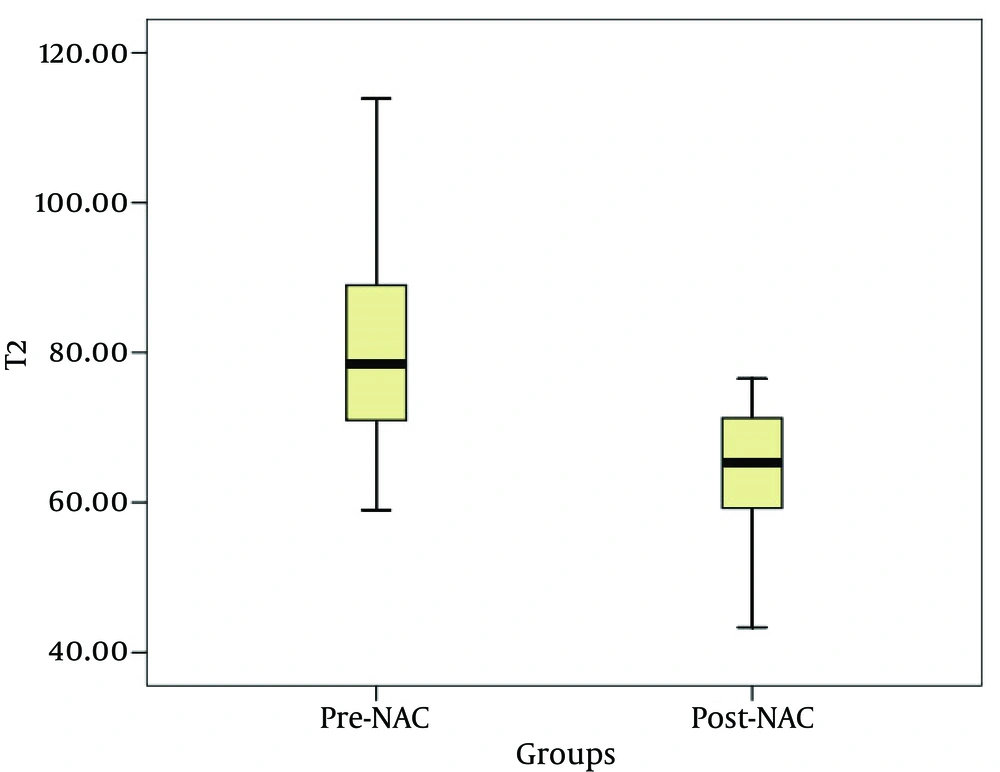
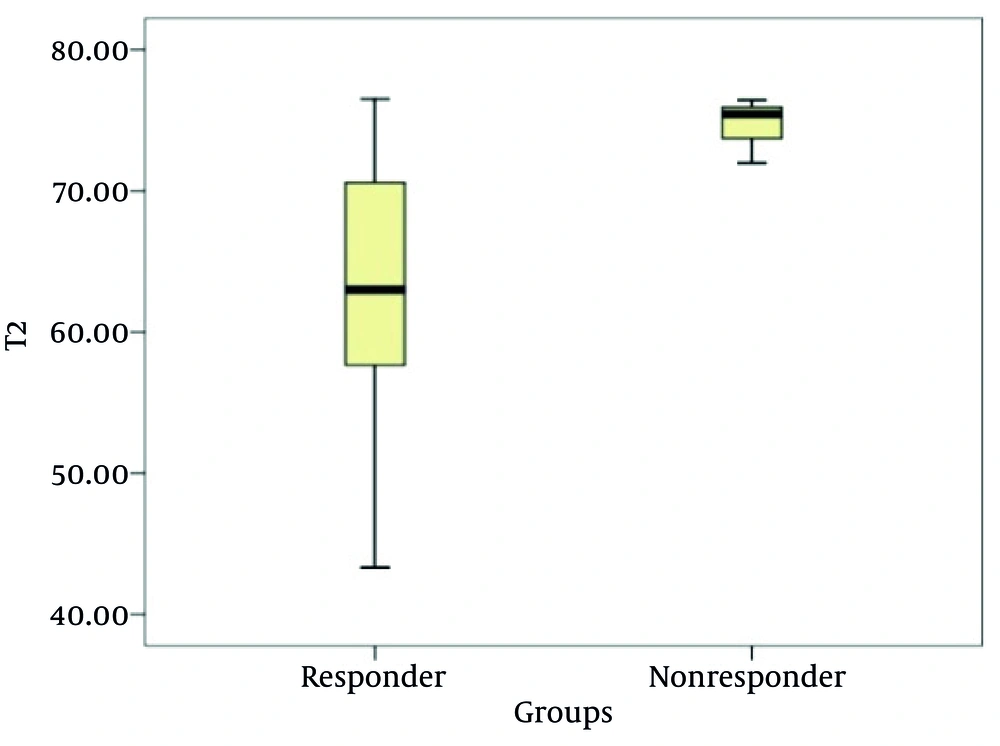
In our study, after NAC, the lesion T2 relaxation time was shorter than those before NAC. We hypothesize that the reason is probably apoptosis or cell death leading to release of intracellular macromolecules into the extracellular space; simultaneously, the extent of the lesion edema decreased and fibrosis increased significantly. These factors might lead to shortened T2 relaxation times after NAC, after which the lesion T2 relaxation times of the responders were shorter than those of the nonresponders. We hypothesize that a significant increase in fibrotic lesions of the responder group of patients significantly reduces the degree of the lesion edema in this group. In this study, the measurement of the lesion T2 relaxation times after NAC were correlated with the ultimate lesion response, which confirmed the findings of Tan (
10). T2 relaxation times can reflect biological state of lesions, may prove useful to assess the response to NAC.
In order to reduce measurement errors due to changes in the place of the patient before and after chemotherapy,T2 measurement was necessarily performed subsequent to DWI and STIR since it is often impossible to determine accurately the position and extent of lesions.
In this study, there were some limitations. First, the number of cases was small, and the majority of the cases were invasive ductal carcinoma with relatively fewer cases of invasive lobular carcinoma; because the T2 relaxation time was related to the composition of the lesions, this difference could have resulted in bias in the measurement of the T2 relaxation time. Second, neoadjuvant chemotherapy in patients have different chemotherapy cycles, including 12 cases of three cycles and 14 cases of four cycles, this inhomogeneity might affect the evaluation results.
After breast cancer NAC, the lesion T2 relaxation times were shorter than those before NAC, and the lesion T2 relaxation times of the responders were shorter than those of the nonresponders post-NAC. This finding is potentially useful to assess the response to NAC. We will further study the T2 relaxation time as early predictors of response in breast cancer patients undergoing NAC.