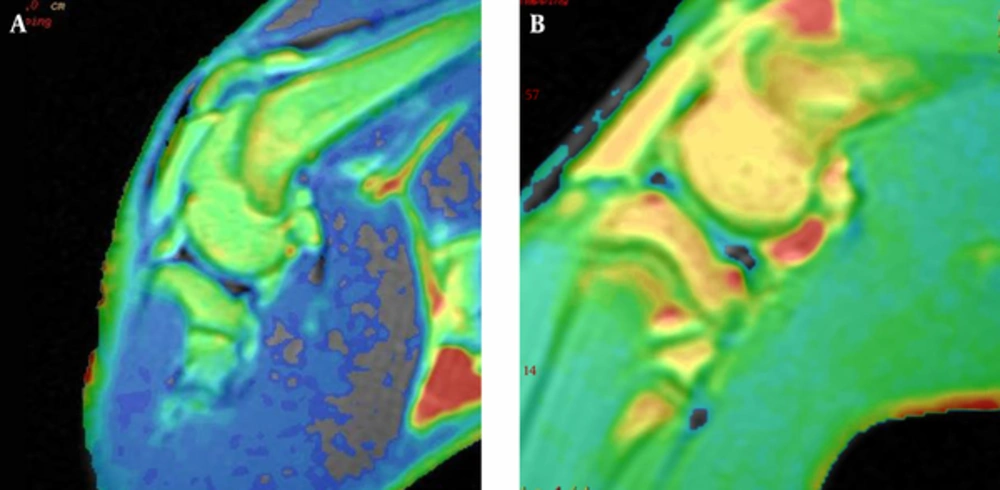
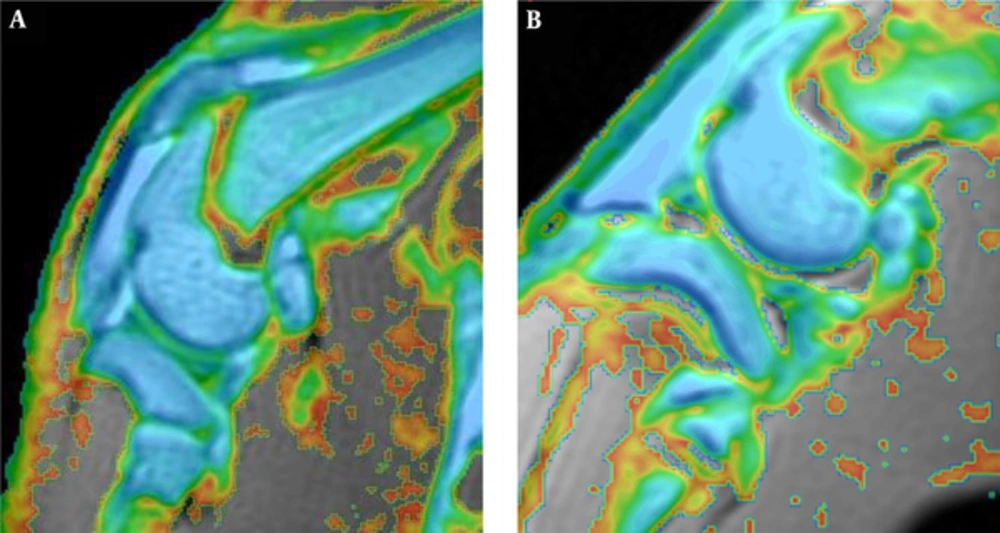
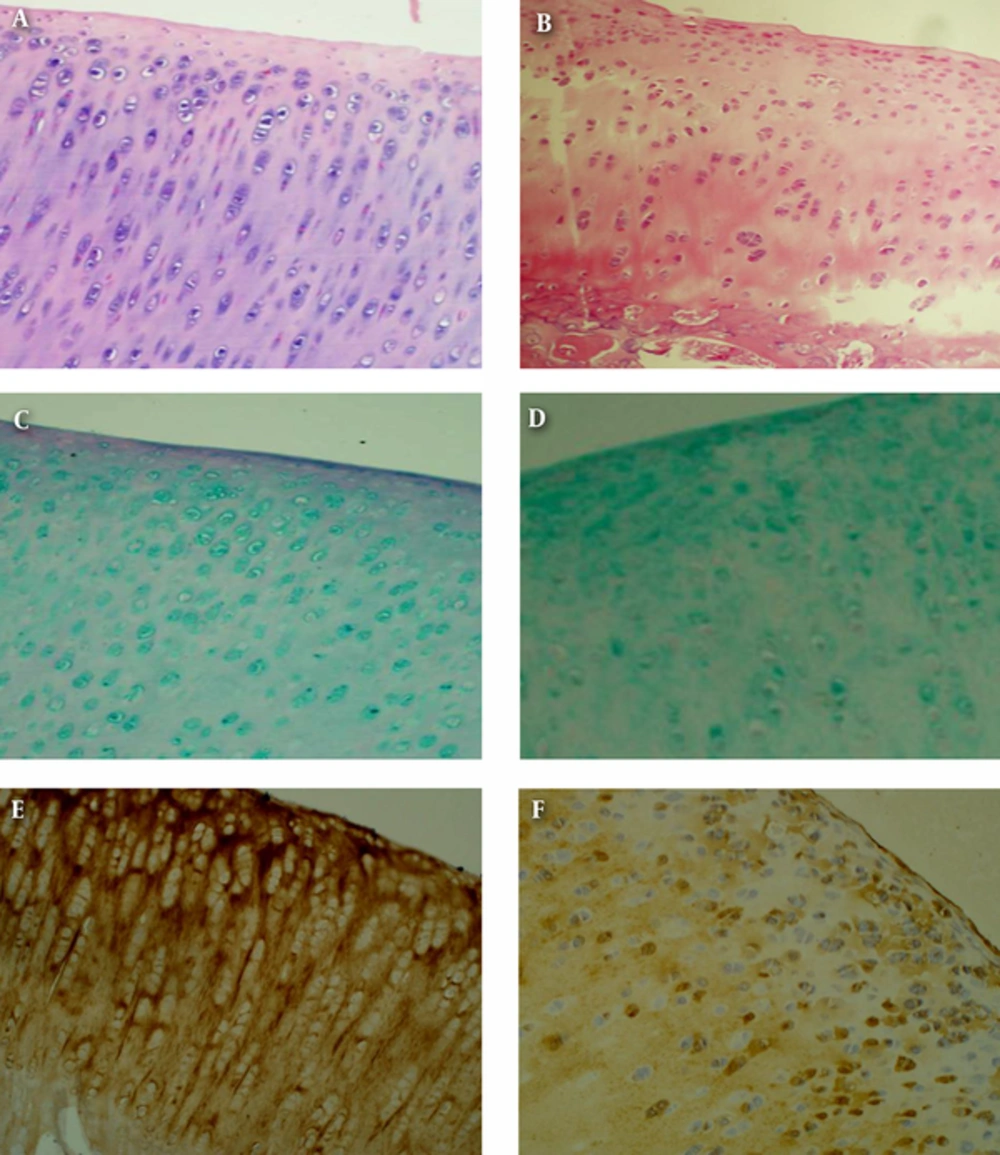
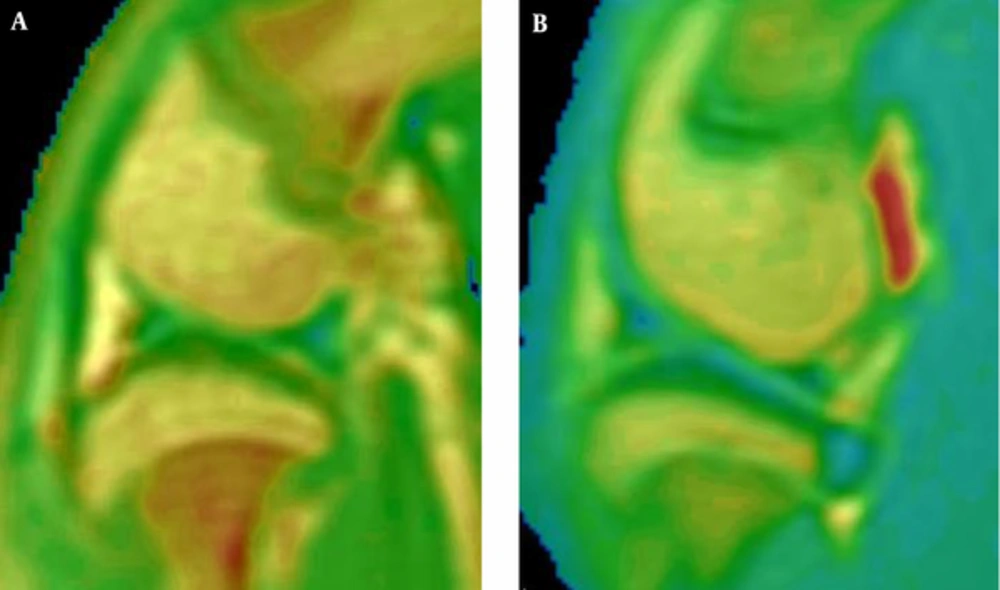
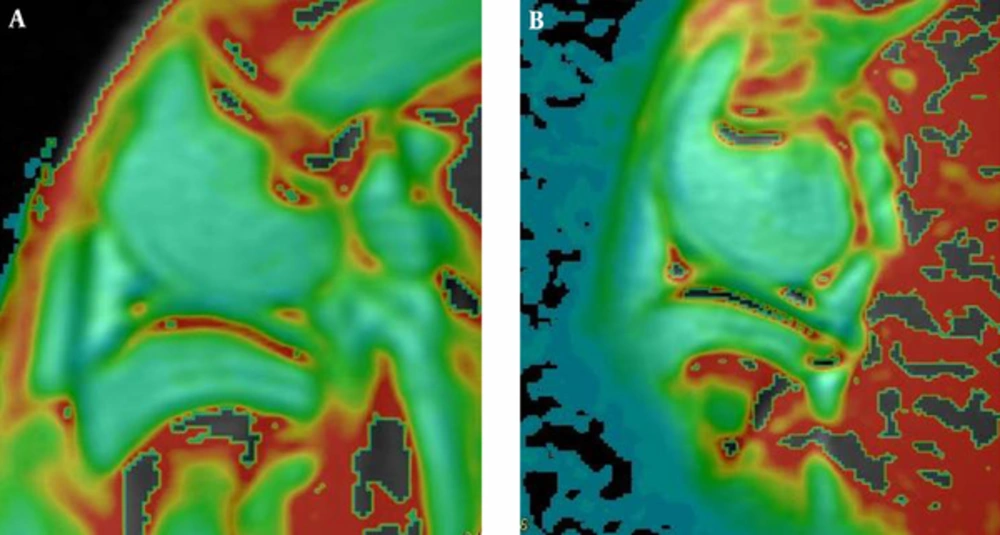
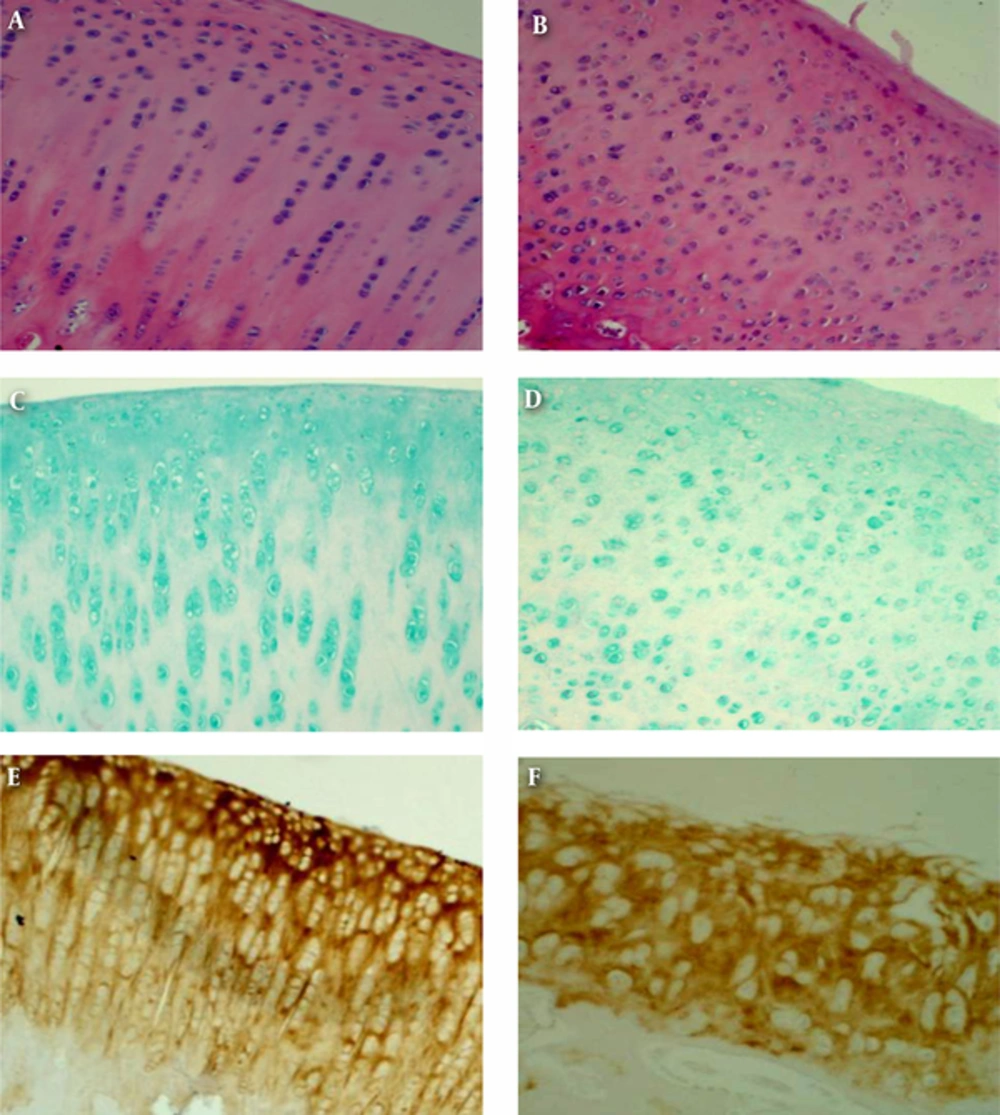
This study used New Zealand white rabbits to construct two animal models of early OA. The anatomic structure of the rabbit knee joint is the same as the human knee joint. In addition, humans and rabbits have similar extracellular matrix components. The composition ratio of the articular cartilage is also similar, as well as the arrangement and size of the chondrocytes (
2). In terms of model construction, some studies (
3,
4) showed that the injection of collagenase type II or papain into the rabbit knee joint can cause rapidly progressing OA. The onset of OA is rapid with good reproducibility, and the induced OA is similar to that reported in humans. The injection of 2 mg of collagenase type II into the rabbit knee joint with a second injection on day 4 can establish a model of early OA, with predominant collagen network structural damage 4 weeks after the last injection. A model of advanced OA can be established 6 weeks after the last injection. In this study, 8 mg of papain caused significant reduction in proteoglycan in the articular cartilage 6 weeks after the last injection, without apparent damage to the collagen network.
A large number of clinical and experimental studies have confirmed that the T
2 relaxation time of articular cartilage is associated with a variety of factors (
5-
8), including the anisotropy of the four layers of the cartilage tissue, content of collagen and water, and the direction of arrangement. Histologically, collagen fibers are arranged in parallel in the superficial layer, they are arranged randomly in the transitional layer, and vertically in the radial and calcified layers, forming a three-dimensional network of collagen fibers. Proteoglycans are scattered throughout the network. They are hydrophilic molecules that are less abundant in the superficial layer and more abundant in the radial layer (
9,
10). Some researchers believe that the T
2 relaxation time of articular cartilage is related to the proteoglycan content (
11). The direction of arrangement of water molecules in the cartilage is parallel to that of collagen fibers. The different arrangements of collagen fibers in different layers of cartilage result in anisotropy of the distribution of water molecules, forming a stable magnetization vector angle. This is referred to as the “magic angle” effect (
12), which affects the T
2 relaxation time of the cartilage.
In this study, collagenase type II was used to destroy the cartilage collagen fiber network in the rabbits included in group A, and the measured T2 values were significantly higher than those measured in the control group. Papain was used to hydrolyze cartilage proteoglycan in the treated knees of rabbits in group B, and the measured T2 values were not significantly different from those measured in the control group. The authors of this report believe that the T2 relaxation time primarily reflects changes in collagen in the cartilage matrix and is not closely associated with changes in proteoglycan. After destruction of the collagen network, T2 relaxation time increased. There are several possible reasons for this increase in T2 relaxation time. First, destruction of the collagen network in group A weakened the anisotropy of the distribution of water molecules, which reduced the “magic angle” effect. As such, T2 value of the cartilage increased. Second, after destruction of collagen fibers in the superficial and transitional layers in group A, the barrier to water molecules was weakened, and the content of free water molecules significantly increased in the cartilage. The content of the corresponding hydrogen protons also increased, resulting in an increased T2 value of the cartilage. Third, after destruction of the collagen network in group A, the interactions between the water molecules and large molecules (collagen) were reduced, and the T2 values of the cartilage increased. In group B, endochondral proteoglycan was reduced; however, proteoglycan is only a small portion of the extracellular matrix. Thus, the decreased proteoglycan content only resulted in slightly reduced interactions between water molecules and macromolecules (proteoglycan) resulting in slightly increased T2 values of the cartilage. Fourth, the destruction of the collagen network in group A exposed negatively charged proteoglycans that made the proteoglycans attract more water molecules. Therefore, the water content of the articular cartilage increased, and the content of hydrogen protons increased, resulting in increased T2 values of the cartilage. In contrast, the reduction in the proteoglycan content in the cartilage in group B resulted in a slightly decreased content of the water and hydrogen protons in the articular cartilage; therefore, the T2 values of the cartilage slightly decreased. The combined actions of the aforementioned points lead to elevated T2 values in group A and insignificant change of T2 values in group B.
Cartilage damage caused by trauma occurs prior to obvious morphologic changes. The early manifestations are destruction of the ultrastructure of the collagens in the cartilage matrix and loss of collagen fibers. Those steps are followed by a decrease in the proteoglycan content, increase in amount of water, and increased T2 values of the cartilage. Then, the T2 values gradually decreased with collagen hyperplasia and repair. Therefore, T2 mapping appears to be a good tool for monitoring of the early events following trauma-induced OA. Further, T2 mapping can indirectly reflect changes in collagens in the cartilage matrix. In the early stages of OA, proteoglycan synthesis declined due to chondrocyte dysfunction, which changes the proteoglycan content. Collagens in the superficial cartilage layer degenerate first, resulting in an increase in water permeability. Next, proteoglycans progressively decrease, followed by destruction and rupture of the network structure and an increased water content. If only a reduction in proteoglycan content occurs and damage, changes to the collagen structure are not obvious so the T2 values changes are not great. With the destruction of the collagen network structure, T2 values gradually increase. The pathologic processes of early OA can be simulated at both molecular and biochemical levels to provide help for clinical diagnosis and treatment planning, as well as for assessing efficacy (e.g., collagen repair).
Most studies show that delayed gadolinium-enhanced MRI of the cartilage is a good imaging sequence for cartilage that could reflect changes in the cartilage matrix proteoglycan content through T
1 mapping (T
1 values) (
13-
15). Because glycosaminoglycans have negative charges, the contrast agent gadolinium diethylene triamine pentaacetic acid (Gd-DTPA2) enters the cartilage and concentrates at places where the glycosaminoglycan content is low. In patients with OA, if the glycosaminoglycan content decreased, the concentration of Gd-DTPA2 increased, leading to decreased T
1 values of the cartilage. This method is slightly invasive and it is therefore, difficult to apply widely in clinical practice. In contrast, standard T
1 mapping could be adopted to help determine whether the T
1 value of cartilage is associated with changes in the biochemical composition of the cartilage.
This study shows that both OA models can lead to significantly higher cartilage T1 values than normal. The T1 values of cartilage on the control side in the collagen type II group were slightly higher than those in the papain group. That difference was not statistically significant, indicating that T1 values are more sensitive to cartilage matrix changes in early OA. Both reduction in proteoglycan and damage to the collagen network structure can cause significantly increased T1 values; however, it is still unclear what matrix change predominates. There are two possible reasons for this. First, destruction of the collagen fiber network structure and/or reduction in proteoglycan content may result in decreased interactions between large molecules in the matrix (collagen/ proteoglycans) and water molecules, resulting in enhanced free activity of water molecules and increased T1 values. Second, after destruction of the collagen fiber network structure, the content of free water molecules in the cartilage increase as well as the T1 values.
Prior to changes in cartilage morphology in early OA, changes in T1 value could be used to reflect changes in the cartilage matrix. T1 values are sensitive to changes in both proteoglycan and collagen. When T1 values elevated and T2 values remained unchanged, it is reasonable to suggest that proteoglycan content in the matrix decreased. When both T1 and T2 values elevated, it is possible to suggest that the collagen network structure is damaged. Those findings are of significant importance in achieving an early diagnosis of OA and they may play an important role in targeted drug therapy and efficacy monitoring in vivo.
However, our research indeed has some shortcomes. First, T1 mapping scan time is too long, which brings great inconvenience to clinical work. Second, the pathogenesis and clinical manifestations of animal model and human are still different, and further study on the relevant contents of human osteoarthritis is necessary.