Contrast-enhanced MRI is the standard for diagnosis and follow-up of brain metastases tumor. Compared with other imaging methods, MRI has obvious advantages of multidimensional imaging, high soft tissue resolution, and not using/providing ionizing radiations. However, the limitations of MRI are a need for more scanning sequences and a longer examination time (
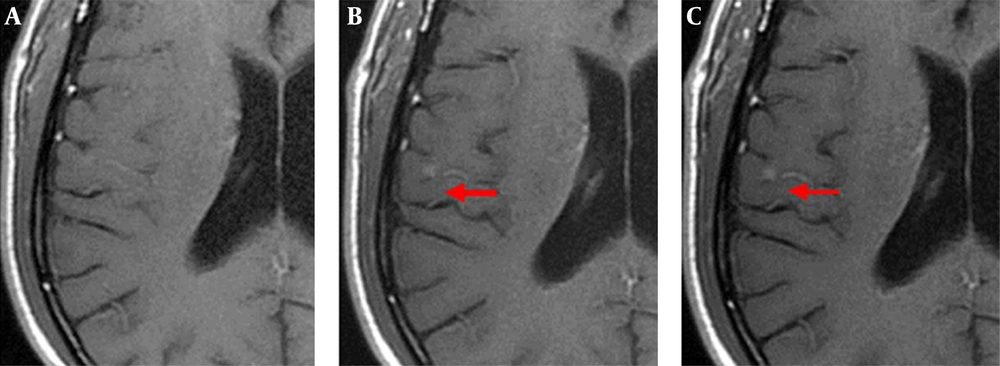
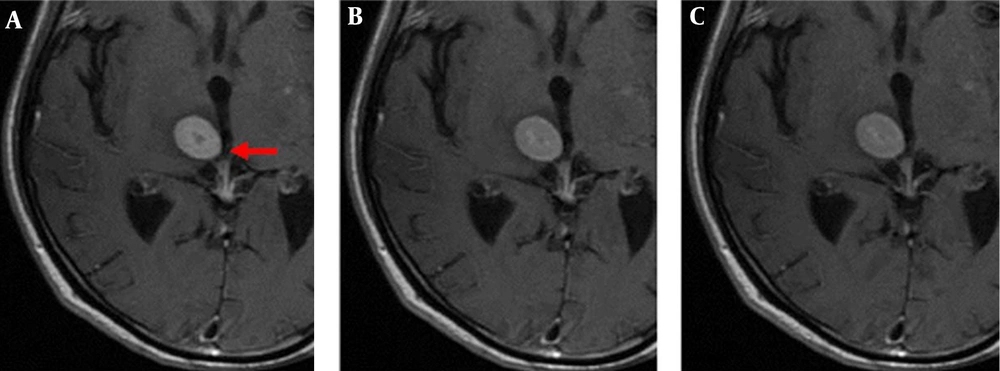
14). Delayed MRI scanning has shown improved detection of the brain metastases lesions than with immediate scanning. In developing countries like China, hospitals do not have adequate MRI equipment for medical examination and diagnosis of such large population. In addition, the examination time cannot be extended infinitely to improve diagnostic efficiency. Therefore, different delay times (3, 7, and 10 minutes) are compared in this study to find an optimal delay time to increase diagnostic efficacy within a reasonable time.
Previous studies have reported increased sensitivity and detection of more number of lesions with delayed CE-MRI than with an immediate scan. However, the optimal delay time is not yet clear (
5,
15,
18). Yuh et al. conducted a study on 45 patients with brain metastases. The patients received a cumulative standard dose of 0.1 mmol/kg gadoteridol (n = 16) and a cumulative triple dose of 0.3 mmol/kg gadoteridol (n = 29). There was an increase in the detection of brain lesions (< 0.5 mm in size) if the diagnosis was performed after 10- and 20-min delay compared with the initial immediate dose in both groups. No significant difference in detection was observed for lesions larger than 10 mm in size (
5). In another study, three MRI scans (5, 10, and 15 minutes) after administration of the contrast medium detected at least one new lesion in every subsequent scan. The volume of the lesions significantly increased from scan 1 to scan 2 and from scan 2 to scan 3 (
18). Increased mass of the tumor and edema were the reasons for easy diagnosis of large lesions. Newer and smaller lesions, however, were often located in the border area of the cortex and medulla without edema and therefore, were difficult to be detected by regular imagological examination methods. However, early detection of small lesions is very critical for clinical staging and treatment planning (
5,
19). A number of studies performed to study the effect of high-dose contrast agents have demonstrated enhanced lesion detection in patients with brain metastases compared to low-dose contrast agents (
12,
20).
To date, the available studies have used linear structured Gd-DTPA and there are no studies that have used circular structured gadobutrol. Consistent with the earlier studies that have reported detection of lesions less than 5 mm (
5,
18), this study also reports detection of an additional six lesions in the 7- and 10-min delay groups compared with the 3-min group. All the additionally detected lesions had diameters of less than 5 mm. This detection was of particular interest in one patient who was diagnosed with a single brain metastases lesion on MR examination of 3-min delay, but was diagnosed as having two lesions following MR examination after 7- and 10-min delay. In such cases, the patient’s clinical treatment plan may change. From a patient management viewpoint, changes from one to two lesions may have important clinical implications, especially in the absence of stereotactic radiosurgery when the available treatment option was aggressive local surgery (
1,
3).
In the present study, the average quality score of lesion edge, interior of lesion, and overall image qualities were measured on 4-, 3-, and 5-score scales, respectively. All the parameters were non-significantly higher in the 7-min and 10-min groups, indicating that the subjective evaluation of the 7- and 10-min delay groups was comparable with that of the 3-min delay group. Furthermore, objective evaluation showed that CNR and CBR were significantly higher in the 7- and 10-min groups than in the 3-min group. However, there was no significant difference in CNR and CBR between the 7- and 10-min groups. Detection of brain metastases requires reasonably high lesion contrast, which depends on the signal of a lesion in relation to the surrounding background (
5). The parameters of image quality (
21) reflect the strengthened differences between lesions and their surrounding white matter. Significantly higher CNR and CBR in the 7- and 10-min groups indicated better contrast between the lesion and the surrounding white matter compared with the 3-min group. The greater contrast allowed for greater visibility and distinguishability, resulting in the detection of six additional lesions.
SNR, CE, and CER of metastatic brain lesions did not differ significantly after enhancement delay of 3, 7, and 10 minutes indicating the persistent enhancement of lesions, which was different from glioma. For glioma, the enhancement peak was 1 - 3 minutes, and then the enhancement level would decline and assume to clean up the lesion profile for clear visibility (
16,
22). With delay in the imaging time, brain metastases lesions were filled up with the contrast agent in some patients (
23). This result provided a theoretical basis for the detection of more small lesions by delay scanning method. With increase in delay time, the gadolinium contrast agent might have leaked through the blood-brain barrier in larger quantities resulting in accumulation of the contrast agent and resulting in increased signal intensity (
4,
24).
There are some limitations associated with this study. First, the pathological evidence was only available for primary tumor for all patients and not for the intracranial lesions. The diagnosis was mainly based on typical imaging manifestations and clinical follow-up. Second, unlike other studies (
5,
18), the delay time was up to 10 minutes, and this was mainly because well-known Chinese hospitals do not allow for longer examination time due to excess clinical work. Finally, the small sample size of this study does not allow for generalization of the findings. Therefore, additional studies with larger sample size are required to validate the results of this study.
In conclusion, the higher scores for subjective assessment (lesion edge and internal details of the lesion), and significant improvement in the objective assessment (for CNR and CBR) demonstrated 7 minutes of Gadobutrol-enhanced MRI delay time as the optimal time for diagnosis of brain metastases in this study. However, larger studies are warranted to confirm these results.