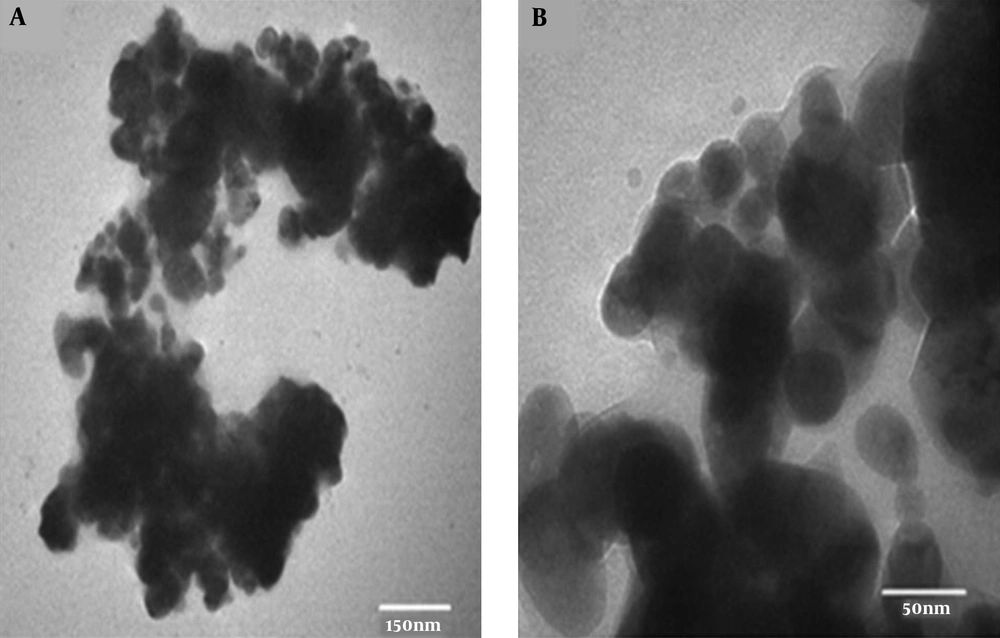
Figure 1 illustrates the TEM image of Bi
2O
3 nano-particle. The obtained Bi
2O
3 sample is the approximate spherical polycrystalline particles (
Figure 1). The powder XRD analysis of the Bi
2O
3 nanoparticles has been shown in
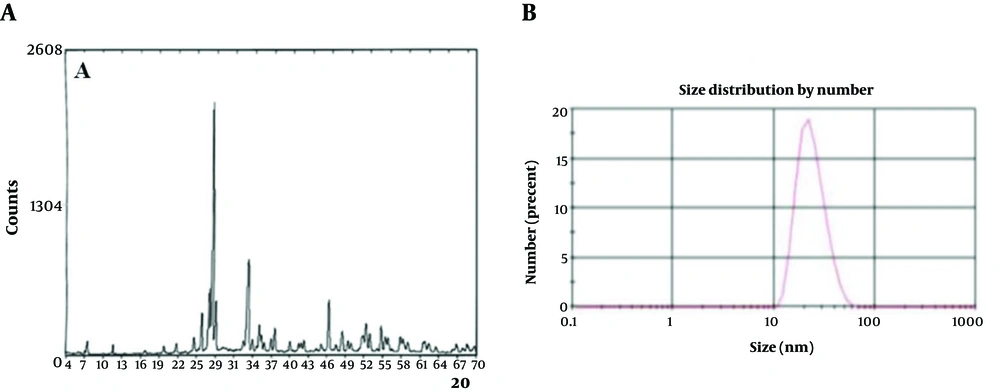
Figure 2A. The test was done in the diffraction angle (2θ) ranging from 4º to 70º. The place of the peaks revealed that the Bi
2O
3 nanoparticles were synthesized successfully and the card of joint committee on powder diffraction standards (JCPDS) by the number of 41-1449 is a standard card and it shows that the sample is exactly Bi
2O
3.
Transmission electron microscope (TEM) images of nano-bismuth oxide nanoparticles. A, With less magnification B, With more magnification
A, X-ray diffraction (XRD) analysis of the bismuth oxide (Bi2O3) nanoparticles. B, Dynamic light scattering (DLS) analysis of the Bi2O3 nanoparticles
Also the DLS was used for testing the size of nanoparticles. Based on the results, the nanoparticle size ranged from 20 to 60 nanometers and most of the particles had the size of 24 nanometers (
Figure 2B).
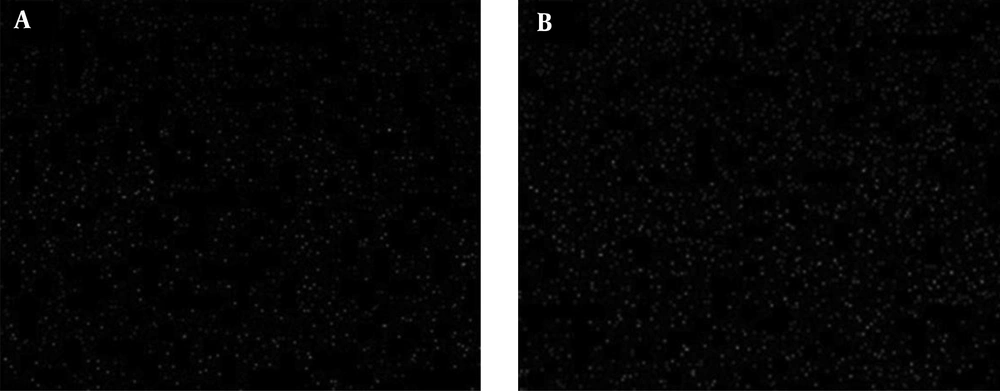
The distribution of nanoparticles in the matrix was calculated through SEM-MAP analysis as shown in
Figure 3. The SEM-MAP analysis of nano-Bi
2O
3 shields at 10% and 15% of ratios showed that the nanoparticles have a good distribution in the base silicone matrix.
Scanning electron microscope (SEM)-MAP of bismuth oxide (Bi2O3) nanoparticles in silicone matrix. A, 10% nano-Bi2O3 shield. B, 15% nano-Bi2O3 shield
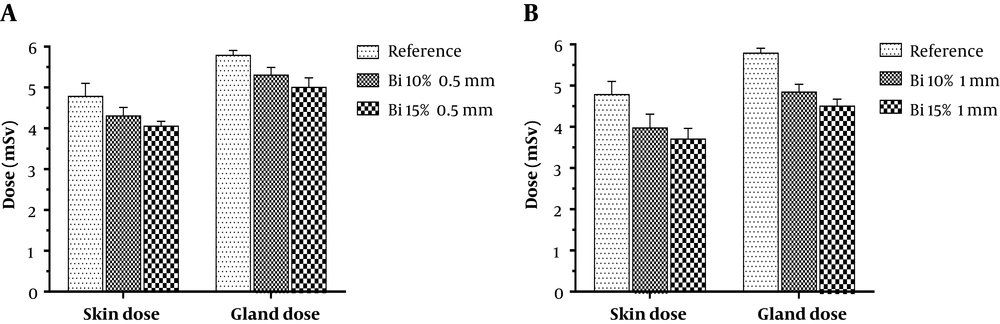
The amount of the received dose in the skin and glandular layers of the breast was equal to 4.84 and 5.26 mSv, respectively. When nano-Bi
2O
3 shield (1 mm) was used at 10% and 15%, the dose was reduced significantly in both skin and glandular layers, but dose reduction for the skin layer was higher (
Figure 4).
A, Evaluation of the dose of the skin layer and the fourth layer of normal breast with and without using nano-bismuth oxide (Bi2O3) shields with 0.5 thickness. B, Evaluation of the dose of the skin layer and the fourth layer of a large breast with and without using nano-Bi2O3 shields with 1 mm thickness.
The statistical analysis of data in
Figure 4A. showed that the reduction of the dose level by the use of 10% and 15% nano-Bi
2O
3 shields with 0.5 mm thickness was statistically significant compared to non-shield test mode (shield 10% P = 0.0460) and (shield 15% P = 0.0251). Comparison of dose reduction revealed that dose reduction in 10% and 15% shields was statistically significant (P = 0.0277) at the same 0.5 mm thickness.
In addition, statistical analysis of
Figure 4B showed that the reduction of the dose level by the use of 10% and 15% nano-Bi
2O
3 shields with 1 mm thickness was statistically significant compared to non-shield test mode (shield 10% P = 0.0305) and (shield 15% P = 0.0083). Dose reduction comparisons were also statistically significant in the cases of 10% and 15% (P = 0.0227) at the same 1 mm thickness. Moreover, statistical results showed that in the same percentage of fillers, with increasing thickness, dose reduction was not significant (shield 10%, P = 0.1038) and (shield 15%, P = 0.1112).
Using the 10% nano-Bi2O3 shield with a thickness of 0.5 mm, the breast dose was reduced to 9.8% in the skin layer and 4.8% in the fourth layer. The dose reduction for 10% nano-Bi2O3 shield with 1 mm thickness was equal to 18.3% and 16.3% in the surface and the fourth layer, respectively. Also, using a 15% nano-Bi2O3 shield with a thickness of 0.5 mm, the dose reduction of the breast was equal to 15% and 13.6% in the skin layer and the fourth layer, respectively. This decrease in breast doses using 15% nano-Bi2O3 shield with 1 mm thickness was equal to 24% and 21% at the surface and the fourth layer, respectively.
The results of the CT number and noise on the anterior, central and posterior region of the phantom are given in
Table 1. The average of CT number of ROI in the breast region was equal to -79 Hounsfield unit (HU) without the use of shield. Using the 10% and 15% bismuth shields with 0.5 mm thickness, they were equal to -80 and -83 HU, respectively. In addition, using 10% and 15% bismuth shields with 1 mm thickness, they were equal to -81 ± 3.6 and -85 ± 2.4 HU, respectively.
| Shields | Anterior region | Central region | Posterior region | Mean |
|---|
| CT number | Noise | CT number | Noise | CT number | Noise | CT number | Noise |
|---|
| Reference | -79.4 ± 5.5 | 24.2 ± 3.1 | -73.5 ± 2.3 | 23.4 ± 2.3 | -72.3 ± 4.6 | 22.4 ± 2.5 | -75.01 | 23.3 |
| 10% Bi 0.5 mm | -80 ± 3.2 | 26.1 ± 2.8 | -75.1 ± 4.3 | 24.2 ± 1.3 | -73.8 ± 5.1 | 22.7 ± 3.4 | -76.1 | 24.33 |
| 10% Bi 1 mm | -81.9 ± 3.6 | 27.1 ± 4.5 | -75.9 ± 4.6 | 24.9 ± 2.5 | -74.5 ± 4.7 | 23.1 ± 3.1 | -77.4 | 25.03 |
| 15% Bi 0.5 mm | -83.1 ± 4.3 | 28.4 ± 3.4 | -76.5 ± 4.1 | 25.4 ± 3.2 | -74.4 ± 5.3 | 234.4 ± 2.3 | -78 | 25.73 |
| 15% Bi 1 mm | -85.2 ± 4.2 | 29.7 ± 3.7 | -76.6 ± 5.2 | 26.2 ± 3.5 | -76.3 ± 3.8 | 76.3 ± 3.8 | -79.36 | 26.73 |
Abbreviation: Bi, bismuth
The result showed that the average noise in the breast region was equal to 24 ± 3.1% without the use of shield and were equal to 26 ± 8.2 HU and 28 ± 3.4 HU, respectively using 10% and 15% bismuth shields with 0.5 mm thickness. Also, using 10% and 15% bismuth shields with 1 mm thickness, the noises were equal to 27 ± 4.5 and 29 ± 7.3 HU, respectively. The statistical analysis showed that using 10% and 15% nano-bismuth shields with 0.5 mm thickness, the increase in the noise was not statistically significant. Furthermore, the increase in the noise was significant using 10% and 15% nano-bismuth shields with 1 mm thickness especially at the anterior section.
According to
Table 2, the highest increase in the noise was observed in the breast and under the shield area. The highest increase in the noise in this area was related to the use of 15% nano-bismuth shield with 1 mm thickness, which was equal to 18%. This increase in the noise in the heart region was less than the breast region. The slightest increase in the noise was associated with the posterior region of the phantom using the 10% nano-bismuth shield with 0.5 mm thickness.
| Increased noise % | Bi2O3 10% 0.5 mm | Bi2O3 10% 1 mm | Bi2O3 15% 0.5 mm | Bi2O3 15% 1 mm |
|---|
| Anterior | 7 % (0.045) | 10 % (0.031) | 14 % (0.034) | 18 % (0.026) |
| Central | 3 % (0.245) | 6 % (0.254) | 8 % (0.075) | 10 % (0.038) |
| Posterior | 2 % (0.309) | 3 % (0.555) | 4 % (0.333) | 8 % (0.089) |
Abbreviation: Bi2O3, bismuth oxide